

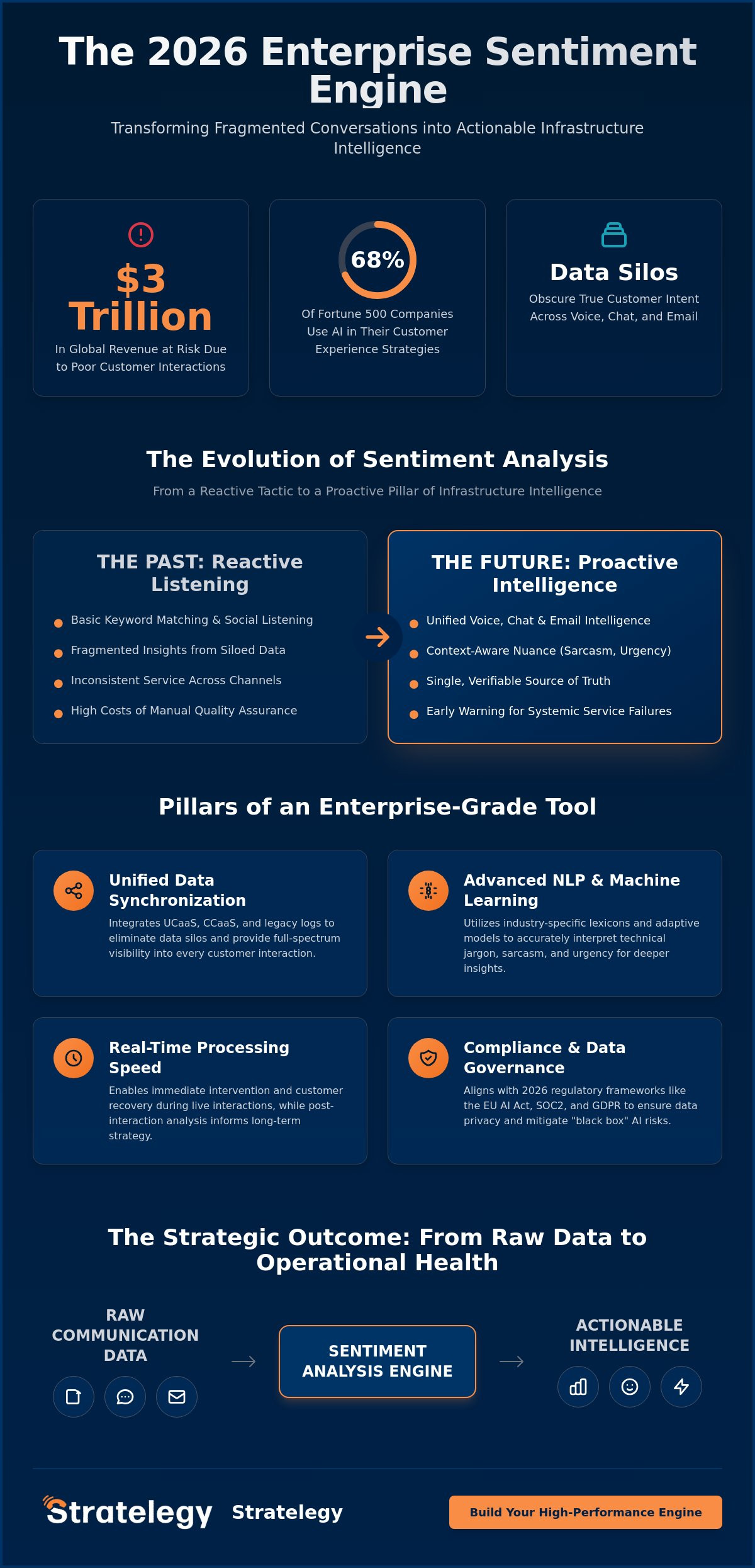
Over 68% of Fortune 500 companies have already integrated AI into their customer experience strategies, yet poor interactions still put an estimated $3 trillion in global revenue at risk. You likely recognize that raw data is plentiful, but selecting the right customer sentiment analysis tools to transform fragmented conversations into a cohesive strategy remains a significant hurdle. Data silos between voice, chat, and email often obscure the true health of your client relationships; this is particularly true in complex B2B environments where nuance is everything.
This guide will show you how to leverage these advanced systems to bridge operational gaps and turn raw communication data into actionable business intelligence. We’ll examine the shift toward multimodal analysis, navigate the new 2026 regulatory frameworks like the EU AI Act, and identify the specific infrastructure required to maintain a competitive, compliant edge. By the end of this guide, you’ll have a roadmap for building a predictable, high-performance sentiment engine that secures your operational longevity and eliminates the high cost of manual quality assurance.
Key Takeaways
- Modern sentiment analysis has evolved from reactive social listening into a proactive diagnostic engine for your entire enterprise communication infrastructure.
- Synchronizing data across UCaaS, CCaaS, and legacy hardware logs is essential for eliminating the data silos that obscure genuine customer intent.
- Select the most effective customer sentiment analysis tools by weighing the deep-dive research capabilities of standalone platforms against the real-time efficiency of integrated CCaaS modules.
- Move beyond surface-level metrics like Net Promoter Scores by defining specific KPIs that connect emotional data directly to long-term operational benefits.
- Maintain structural reliability and compliance by aligning your AI-driven sentiment strategies with the 2026 regulatory frameworks governing data privacy and automated decision-making.
Defining Customer Sentiment Analysis Tools in the 2026 Enterprise Landscape
Enterprise intelligence has moved past simple data collection. Modern customer sentiment analysis tools are sophisticated software packages that leverage Natural Language Processing (NLP) to identify, extract, and quantify emotional states from complex customer interactions. Sentiment analysis is the bridge between raw data and strategic customer experience management. In the 2026 enterprise environment, this technology has transitioned from a reactive social listening tactic to a proactive pillar of infrastructure intelligence.
The era of siloed data has ended. Previously, organizations viewed email, chat, and voice as separate buckets, leading to fragmented insights and inconsistent service. By 2026, unified communication streams have become the standard for high-performing firms. This unification ensures that emotional context isn’t lost when a client moves between channels. It provides a single, verifiable source of truth for the health of every customer relationship.
The Evolution from Text to Unified Voice Intelligence
Early iterations of Sentiment analysis focused on basic keyword matching. If a customer used a specific negative word, the system flagged the interaction. Today’s tools provide context-aware nuance, recognizing sarcasm, frustration, and urgency through vocal tonality and syntax patterns. Integrated cloud contact center platforms play a critical role in this shift. They capture real-time emotional cues during live interactions, allowing managers to intervene before a relationship deteriorates.
Why Sentiment Analysis is Critical for Infrastructure Stability
Reliability is the foundation of any enterprise. High-performance customer sentiment analysis tools act as an early warning system for systemic service failures. When sentiment trends dip across specific regions or service types, it often indicates an underlying technical issue rather than a simple customer service lapse. Using these trends to validate the reliability of enterprise-grade communication channels ensures your infrastructure remains resilient. It transforms emotional data into a diagnostic tool for long-term operational health.
Evaluating Key Features: What Makes a Sentiment Tool Enterprise-Grade?
Enterprise reliability requires more than superficial social monitoring. High-performance customer sentiment analysis tools must synchronize data across every communication pillar, including UCaaS and CCaaS platforms. This synchronization extends even to legacy infrastructure logs captured during pots line replacement projects. Without this full-spectrum visibility, your intelligence remains incomplete and prone to error.
Processing speed defines the utility of your data. Real-time analysis allows for immediate customer recovery during live interactions, whereas post-interaction processing is better suited for long-term lifecycle management. Modern tools move beyond binary “neutral” labels. They detect nuanced emotional states like sarcasm and urgency, providing a clear window into the customer’s intent. According to a Comparative Study with GooglePaLM, the architecture of these underlying models significantly impacts their ability to categorize complex interactions accurately. Integrating these insights directly into your CRM or BI framework ensures that every department acts on the same verified intelligence.
Natural Language Processing (NLP) and Machine Learning (ML) Capabilities
Generic algorithms often fail in specialized environments. Enterprise-grade tools utilize industry-specific lexicons to understand technical, financial, or regulatory jargon. Machine learning models then adapt to your specific customer base over time, refining their accuracy based on historical interaction patterns. This iterative improvement ensures your sentiment engine remains relevant as your business evolves.
Security, Governance, and Data Sovereignty
Security is non-negotiable. Managed sentiment solutions must comply with SOC2 and GDPR requirements to protect sensitive client data. Relying on third-party “black box” AI tools introduces systemic vulnerabilities and regulatory risks. A disciplined approach to data sovereignty keeps your information within controlled environments, providing the peace of mind necessary for long-term growth. If you are looking to harden your communication stack, consider auditing your CCaaS infrastructure for integrated security features.
Selecting the Right Solution: A Comparison Framework for 2026
Choosing the correct customer sentiment analysis tools requires a strategic assessment of your existing communication infrastructure. The enterprise market is currently divided into three primary categories. Standalone platforms provide deep-dive social analysis and specialized research capabilities. Integrated CCaaS modules prioritize operational efficiency and real-time agent coaching within the live interaction flow. Organizations with highly specialized data environments often opt for custom API solutions to maintain granular control over their proprietary datasets.
A rigorous cost-benefit analysis is essential for long-term stability. You must weigh the subscription price against the measurable reduction in customer churn. High-quality sentiment detection prevents revenue loss by identifying friction points before they trigger a service cancellation. This transition from a cost center to a value driver is the hallmark of a mature intelligence strategy.
Standalone vs. Integrated: The Strategic Trade-off
Data integrity remains the highest priority for the modern firm. Leading voip providers with native sentiment tools offer superior data accuracy because the analysis occurs directly at the point of capture. Bolting on external tools often creates hidden costs in the form of integration maintenance and increased latency. A unified approach within unified communications as a service ensures your emotional intelligence is a core feature of your stack rather than a secondary addition.
Scalability and Future-Proofing Your Choice
Your selected tool must handle the heavy volume of a global enterprise operation without degradation in accuracy. Evaluate vendor roadmaps carefully to ensure they align with the rapidly evolving AI landscape. Predictable performance and engineering excellence are the hallmarks of a mature solution. If you need assistance auditing your current stack for compatibility, consult with our technical engineers to ensure your infrastructure remains future-proof.
Implementing Sentiment Analysis: From Data Collection to Strategic Action
Successful implementation of customer sentiment analysis tools requires a disciplined, four-step methodology. Data integrity starts with a comprehensive audit of your current communication channels. If your underlying data is fragmented or low-quality, your analysis will be inherently flawed. Once the audit is complete, you must define KPIs that provide more depth than the standard Net Promoter Score. Focus on metrics such as “Sentiment Volatility” or “Resolution Sentiment” to measure how effectively your team shifts a negative interaction toward a positive outcome.
Training the model on your specific business context ensures relevance. Your customer personas have unique communication styles; the frustration expressed by a financial officer differs from that of a technical engineer. Finally, closing the loop is the most critical stage. You must establish automated workflows that turn these insights into immediate operational changes, ensuring the data drives real-world results.
Operationalizing Insights in the Contact Center
Real-time intervention is now a baseline requirement for the modern enterprise. Modern systems automate supervisor alerts for high-frustration calls, allowing for immediate de-escalation during the interaction. This data also serves as a diagnostic tool for workforce development. By analyzing sentiment trends, you can refine agent training programs and improve your understanding unified communications and collaboration efficiency across the entire organization.
The Stratelegy Approach: Foundational Engineering for Sentiment
We believe that reliable infrastructure is the prerequisite for accurate data collection. Projects like LTE-based POTS replacement are not just about connectivity; they are about ensuring the signal is clear enough for advanced AI processing. Stratelegy acts as your foundational partner. We ensure the pipes are clear so your customer sentiment analysis tools can function at peak performance. Engineering excellence is the only way to eliminate the fear of obsolescence and ensure long-term predictability. Modernize your enterprise communications with Stratelegy to secure your operational future.
Securing Your Enterprise Intelligence for the Decades Ahead
The diagnostic power of customer sentiment analysis tools is only as reliable as the infrastructure supporting them. By 2026, the distinction between simple software and foundational engineering has become the primary driver of enterprise success. You’ve seen how unified data streams and real-time processing transform raw interactions into actionable intelligence. However, these advanced systems require a stable, secure communication environment to deliver their full ROI.
Structural reliability is our specialty. We provide the technical expertise necessary to manage complex security, governance, and lifecycle requirements. From enterprise-grade UCaaS and CCaaS reliability to specialized LTE POTS replacement for your most critical systems, we ensure your data pipes remain clear and predictable. This methodical approach eliminates the fear of obsolescence and builds a foundation for sustained growth.
Design your future-proof communication stack with Stratelegy. Your journey toward a more intelligent, responsive enterprise starts with engineering excellence. We’re ready to help you navigate this transition with confidence.
Frequently Asked Questions
What are the best customer sentiment analysis tools for large enterprises in 2026?
Large enterprises in 2026 prioritize platforms like Medallia XM and Chattermill for their custom enterprise-grade scalability and deep analytics. Other high-performance options include Unwrap AI and Brandwatch; these tools offer robust integration capabilities for large-scale operations. Your choice should align with whether your organization requires standalone research power or integrated CCaaS modules for real-time agent coaching and operational efficiency.
How does sentiment analysis work in a cloud-based contact center?
Sentiment analysis in a cloud-based contact center functions by ingesting live audio and text streams through integrated CCaaS and UCaaS modules. The system uses Natural Language Processing (NLP) to convert speech to text while simultaneously analyzing vocal tonality and syntax patterns. This allows supervisors to receive immediate alerts for high-friction interactions, which enables proactive de-escalation before a customer relationship is compromised.
Can sentiment analysis tools accurately detect sarcasm and complex emotions?
Modern customer sentiment analysis tools accurately detect sarcasm and complex emotions by utilizing multimodal analysis. These advanced systems look beyond simple text to evaluate voice pitch, speed, and emphasis; these are critical markers for identifying irony or hidden frustration. Research published in 2026 indicates that fusing text and voice analysis improves detection accuracy by 23% to 37% over traditional text-only methods.
Is sentiment analysis data secure and compliant with industry regulations?
Enterprise-grade sentiment tools are designed to comply with rigorous frameworks like SOC2, GDPR, and the 2026 EU AI Act. Managed solutions prioritize data sovereignty by keeping processing within secure, controlled environments rather than relying on third-party algorithms. This disciplined approach ensures your customer data remains protected while meeting the transparency requirements mandated by state-level privacy laws in California, Colorado, and Texas.
What is the ROI of implementing sentiment analysis in a B2B environment?
The ROI of implementing customer sentiment analysis tools in a B2B environment is realized through reduced churn and improved lifecycle management. With $3 trillion in global revenue at risk due to poor customer experiences, identifying friction points early directly protects your bottom line. Organizations using these tools see operational savings by automating quality assurance and focusing training resources on specific, data-identified problem areas.