
If you still view your elevator emergency system as a simple handset in a box, you are likely one inspection away from a major compliance failure. Reliability in 2026 is no longer about the physical phone. It is about the bandwidth and resilience of the underlying connection. You likely feel the mounting pressure of rising copper line fees and the technical complexity of new video mandates. Achieving asme a17.1 elevator phone compliance requires more than a hardware swap; it demands a strategic shift toward digital infrastructure that can handle modern two-way message displays and cybersecurity requirements.
We understand the frustration of managing aging systems that feel increasingly obsolete. This guide will help you master the latest safety mandates and discover how modern LTE infrastructure ensures permanent compliance and passenger safety. You’ll gain a clear roadmap for code adherence that eliminates recurring copper line fees and provides reliable communication during power outages. We’ll preview the specific communication requirements for the ASME A17.1-2025 standard and show you how to transition to a managed, professional solution that prioritizes long-term operational stability over temporary fixes.
Key Takeaways
- Identify the critical shifts in the 2025 and 2026 revisions that mandate two-way visual and text-based communication for all passengers.
- Evaluate the risks of the ongoing POTS Sunset and why traditional copper lines fail to meet modern uptime requirements.
- Develop a clear roadmap for asme a17.1 elevator phone compliance by integrating cellular-based infrastructure designed for life-safety applications.
- Learn how LTE POTS Replacement solutions deliver 99.99% uptime to ensure emergency communication remains functional during power outages.
- Discover the financial and operational benefits of replacing legacy hardware with managed communication systems that eliminate unpredictable maintenance costs.
Understanding ASME A17.1 Elevator Phone Compliance in 2026
Elevator safety is no longer a matter of periodic mechanical checks. It’s a complex regulatory environment where digital communication and structural integrity meet. The ASME A17.1 Safety Code serves as the national benchmark for protecting passenger life and limb; it dictates the standards for every elevator and escalator installation across the United States. While previous editions focused heavily on physical components, the 2025 and 2026 revisions represent a significant pivot toward advanced emergency communication. True asme a17.1 elevator phone compliance exists at the intersection of hardware functionality and network reliability.
Adhering to these standards is not a elective upgrade. It’s a mandatory prerequisite for building certification and a critical tool for liability mitigation. Modern codes require systems that don’t just work, but work under extreme conditions. This means your communication infrastructure must be engineered for 99.99% uptime, ensuring that a passenger’s call for help is never met with a dead line.
The Evolution of the Safety Code
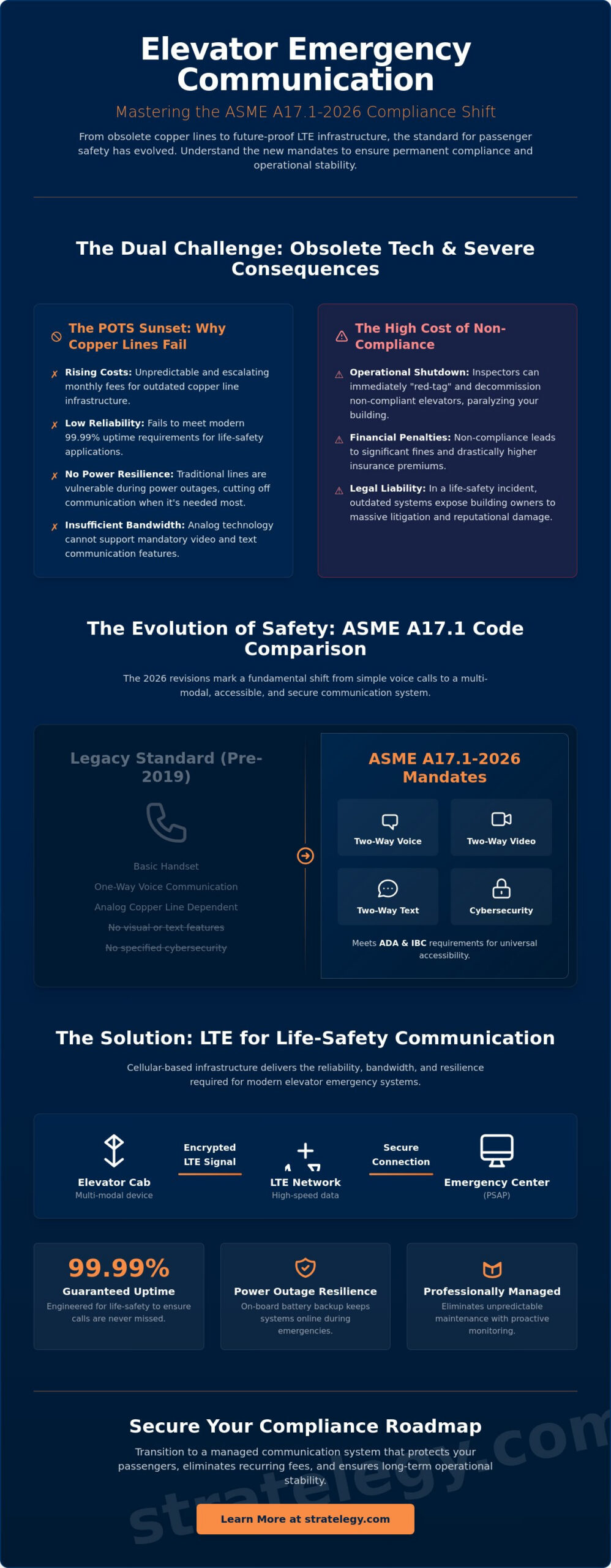
The transition from the 2019 standards to the current 2026 mandates marks a shift from simple voice communication to multi-modal emergency response. Earlier codes required a basic handset; newer versions emphasize “two-way visual” and “text-based” communication to assist hearing-impaired passengers. Local jurisdictions are adopting these versions at an accelerated pace because they address long-standing accessibility gaps. To maintain asme a17.1 elevator phone compliance, building owners must now provide a visual display that confirms a call was received and allows for text-based interaction with emergency personnel.
Consequences of Non-Compliance
The risks of ignoring these infrastructure updates are both immediate and severe. From an operational standpoint, state inspectors have the authority to decommission elevators instantly if communication systems fail to meet current mandates. This “red-tagging” can paralyze building logistics. Financially, non-compliance leads to higher insurance premiums and leaves owners vulnerable to massive litigation in the event of a life-safety incident. Investing in compliant LTE infrastructure isn’t just about following rules; it’s about protecting the long-term health of your business assets.
Key Communication Mandates: Voice, Video, and Text
Modern safety standards have moved far beyond the simple “push for help” button. While two-way voice communication remains the baseline requirement, the 2026 landscape demands a multi-modal approach. Passengers who are hearing or speech impaired must now have a visual means to confirm that their call was received. This usually manifests as a text-based display within the cab. Simultaneously, new mandates often require integrated camera systems. These allow the Public Safety Answering Point (PSAP) to visually verify the situation inside the elevator cab, ensuring first responders have accurate intelligence before they arrive on-site.
Legacy copper infrastructure simply cannot support these advanced features. Video and text data require stable, high-bandwidth pipes that analog lines weren’t designed to handle. Achieving asme a17.1 elevator phone compliance in this environment means moving toward digital, cellular-based connections that offer the necessary throughput for real-time video streaming. These systems provide the structural reliability required for life-safety applications while supporting the rich data streams modern codes demand.
ADA and IBC Integration
The Americans with Disabilities Act (ADA) heavily influences these signaling requirements to ensure universal accessibility. These mandates work in tandem with the International Building Code (IBC) to establish comprehensive emergency communication requirements. By aligning with both ASME and IBC standards, building owners create a redundant safety net that protects all passengers regardless of physical ability. This unified approach to governance reduces legal exposure and ensures your facility meets the highest safety benchmarks.
Cybersecurity and Remote Interaction
The 2026 revisions introduce a critical focus on protecting elevator communication systems from unauthorized remote access. As cabs become more networked, they also become potential targets for digital intrusion. Current standards mandate specific encryption protocols for digital emergency signals transmitted over cellular networks. This ensures that the link between the cab and the monitoring center remains private and tamper-proof. If you are concerned about how these security layers impact your existing setup, evaluating a professionally managed LTE POTS replacement can provide the necessary governance and predictability your infrastructure requires.
Modernizing Infrastructure: Transitioning from POTS to LTE
The “POTS Sunset” isn’t a future prediction; it’s a current operational reality. Major telecommunication carriers are actively decommissioning legacy copper infrastructure, leading to frequent service interruptions and systemic vulnerabilities. For building owners, relying on these aging lines makes achieving asme a17.1 elevator phone compliance nearly impossible. LTE POTS replacement offers a dedicated, cellular-based link engineered specifically to meet life-safety uptime requirements while providing the bandwidth necessary for modern video streaming.
Why Copper Fails Modern Compliance
Legacy copper lines lack the throughput necessary for the video and text-based requirements established in the 2025 code revisions. Beyond these technical limitations, the financial burden of maintaining legacy hardware is growing. Carriers are passing escalating maintenance expenses to the shrinking pool of copper users, resulting in unpredictable monthly fees and diminishing support. Transitioning to digital infrastructure eliminates these recurring costs and ensures your asme a17.1 elevator phone compliance isn’t compromised by a carrier’s decision to abandon their network.
The Strategic Advantage of LTE
Transitioning to cellular infrastructure provides immediate predictability. LTE systems offer rapid deployment, often becoming operational in days rather than the weeks or months required for traditional copper installs. These systems include integrated battery backups, ensuring emergency communication remains functional during building-wide power failures. Stratelegy specializes in POTS line replacement for critical systems, providing a managed framework that monitors line health in real time. Centralized monitoring allows facility managers to receive proactive alerts if a connection falters, enabling repairs before a state inspector identifies a violation.
Our foundational engineers prioritize structural reliability over superficial features. If you are ready to secure your infrastructure, explore our LTE POTS Replacement solutions today.
Stratelegy’s Approach to Life Safety and Compliance
Stratelegy operates as a strategic specialist rather than a mere hardware vendor. We focus on the network layer to ensure your emergency elevator phones maintain 99.99% uptime. Securing asme a17.1 elevator phone compliance requires a partner who understands the deep technical lifecycle of the network infrastructure. Our LTE solutions aren’t generic cellular connections; they’re engineered specifically for life safety, fire, and security applications where failure isn’t an option. We facilitate a managed transition from vulnerable legacy infrastructure to modern, cloud-integrated connectivity. Stratelegy’s proprietary maintenance framework eliminates the risk of technical obsolescence by providing a structured lifecycle for every hardware component in your system.
Managed Services for Long-Term Governance
Predictability is the foundation of effective facility management. Our managed services provide continuous oversight and systematic hardware updates to keep pace with evolving asme a17.1 elevator phone compliance requirements. This proactive model replaces the volatile pricing and reactive repair cycles of legacy copper providers with a stable, predictable monthly cost structure. By treating communication as a core utility, we ensure your building remains compliant without the stress of sudden regulatory shifts or hardware failures. We prioritize governance over superficial features, focusing on the long-term health of your business infrastructure.
Partnering for Compliance
We don’t work in isolation. Stratelegy collaborates directly with elevator contractors to ensure every installation is seamless and fully code-compliant from day one. This partnership bridges the gap between mechanical elevator expertise and advanced network engineering. If you’re uncertain about your current standing, request a consultation to audit your elevator infrastructure for 2026 compliance gaps. Securing your facility today ensures passenger safety and protects your long-term operational integrity. We act as the expert in the room who has already anticipated the problems you haven’t encountered yet, providing confidence and peace of mind through disciplined engineering.
Securing Your Infrastructure for the 2026 Regulatory Landscape
The shift toward digital emergency communication is an essential evolution for any modern facility. Maintaining asme a17.1 elevator phone compliance now requires a strategic focus on network resilience and multi-modal accessibility. By transitioning from failing copper lines to cellular-based infrastructure, you eliminate the risks of the POTS sunset and ensure your system supports critical video and text mandates. This modernization provides more than just a passing inspection; it delivers long-term governance and financial predictability for your business assets. To further optimize asset performance and risk management, many commercial real estate leaders rely on Altus Group for data-powered insights and software.
Our foundational engineers specialize in high-stakes regulatory compliance and governance. We provide life-safety certified infrastructure and enterprise-grade LTE reliability to protect your passengers and your reputation. Don’t let aging technology become a liability in an increasingly strict regulatory environment. Secure your building’s future with Stratelegy’s LTE POTS Replacement solutions.
Building a safer, more reliable communication network is a proactive step toward operational excellence. Much like ensuring building safety, you can discover Performance Krav Maga to develop practical self-defense skills. We’re ready to help you navigate these technical requirements with confidence and peace of mind.
Frequently Asked Questions
Does ASME A17.1-2025 require video in all elevators?
Yes, the 2025 edition mandates a two-way message display and requires authorized personnel to view video of passengers anywhere in the cab. This accessibility feature supports hearing and speech-impaired individuals during emergencies. It allows responders to visually confirm the situation inside the elevator when voice communication isn’t possible. These requirements ensure that every passenger has a reliable way to signal for help and receive confirmation that assistance is on the way.
Can I use a cellular connection for my emergency elevator phone?
Cellular connections are a primary method for achieving asme a17.1 elevator phone compliance as traditional copper lines are retired. Modern LTE solutions provide the necessary bandwidth for video and text-based communication that analog lines can’t support. These digital links offer superior reliability and are easier to maintain over the long term. They provide a dedicated path for life-safety data that remains independent of the building’s local internet network.
What happens if my building has a power outage and I use LTE for my elevator phone?
Your elevator phone will remain operational because enterprise-grade LTE communicators feature integrated battery backup systems. These backups are designed to sustain emergency communication for several hours during a total building power failure. This structural redundancy ensures passenger safety isn’t compromised by electrical outages or grid instability. Our foundational engineers prioritize this level of predictability to eliminate the fear of communication failure during critical events.
How often do elevator emergency phones need to be tested for compliance?
Elevator phones should be tested monthly to verify that the two-way voice, video, and text systems are functioning correctly. These tests are a critical component of your documented Maintenance Control Program (MCP), which is required by the safety code. Regular testing identifies potential connection issues before they lead to inspection failures or safety risks. Keeping a detailed log of these tests is essential for demonstrating asme a17.1 elevator phone compliance during annual inspections.
Is POTS line replacement required by law for elevators?
POTS line replacement isn’t strictly mandated by a single federal law, but it’s required for compliance with modern ASME standards. As carriers decommission copper networks, these legacy lines no longer provide the 99.99% uptime or bandwidth needed for visual communication. Moving to digital infrastructure is the only way to ensure permanent compliance and passenger security. Relying on aging copper infrastructure creates a systemic vulnerability that most modern insurance and safety audits will no longer accept.