

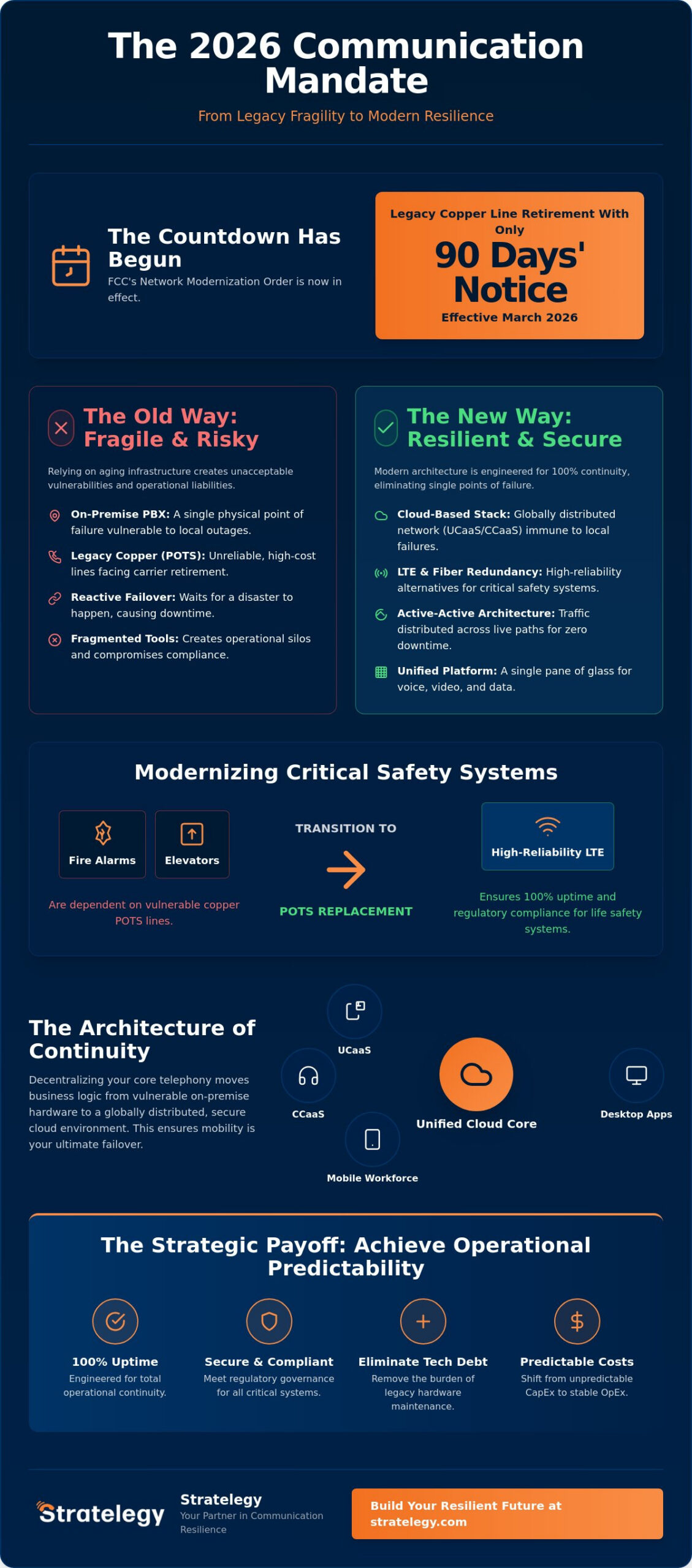
Would your business survive a 90-day countdown to a total communication blackout? With the FCC’s March 2026 Network and Services Modernization Order now in full effect, carriers can retire legacy copper lines with minimal notice, leaving organizations vulnerable to sudden service terminations. Building a resilient communication infrastructure is no longer a luxury for the future; it is a fundamental requirement for operational survival in 2026. We understand the pressure of managing rising costs and the unreliability of aging POTS lines, especially when fragmented tools create silos that compromise your fire and life safety compliance.
It’s time to shift from reactive patching to foundational engineering. This article provides a strategic framework to eliminate single points of failure and modernize your enterprise stack for 100% operational continuity. You’ll learn how to transition to a unified, cloud-based environment that secures your critical safety systems and removes the burden of legacy hardware maintenance. We will break down the path toward a predictable, high-performance communication ecosystem that prioritizes security, regulatory governance, and long-term stability.
Key Takeaways
- Eliminate single points of failure by transitioning from traditional failover models to modern, active-active architectures.
- Decentralize the enterprise PBX. Learn how building a resilient communication infrastructure requires the strategic integration of UCaaS and CCaaS.
- Secure critical safety systems. Protect fire alarms and elevators by replacing vulnerable copper lines with high-reliability LTE alternatives.
- Prevent tech debt accumulation by establishing a disciplined framework for continuous infrastructure auditing and hardware lifecycle management.
- Achieve operational predictability through a unified, cloud-based communication stack designed for 100% uptime and regulatory compliance.
What is Resilient Communication Infrastructure in 2026?
Resilient infrastructure isn’t a backup plan. It’s an engineering standard where zero single points of failure (SPOF) exist within the system. In 2026, building a resilient communication infrastructure requires moving beyond traditional failover models. While failover waits for a crash to trigger a secondary line, modern active-active architectures distribute traffic across multiple live paths simultaneously. This ensures that if one node fails, the system continues without a millisecond of downtime. It’s the difference between recovering from a disaster and preventing one entirely.
The industry has shifted decisively from hardware-dependent legacy systems toward software-defined cloud environments. This transition moves the intelligence of your network away from vulnerable on-premise hardware and into distributed data centers. As a vital component of our critical infrastructure, these communication stacks must rely on three core pillars to ensure 100% operational continuity: cloud connectivity for global accessibility, cellular redundancy for physical path diversity, and unified governance for continuous oversight. This methodical approach transforms communication from a utility into a strategic asset.
The Cost of Communication Fragility
Fragility carries a heavy price tag that extends far beyond lost sales. Downtime now triggers severe regulatory fines, especially for fire and life safety systems that fail to meet modern compliance standards. The “Copper Sunset” is no longer a theoretical threat. Following the FCC’s March 2026 Network and Services Modernization Order, carriers are accelerating the retirement of traditional lines with as little as 90 days’ notice. Relying on these aging circuits isn’t just inefficient; it’s a liability that threatens your long-term business health.
Resilience vs. Redundancy: Understanding the Difference
Redundancy means having extra parts, while resilience represents the systemic health and adaptability of the entire architecture. Adding more of the same legacy technology doesn’t increase actual resilience. It simply multiplies the number of components that can fail. True resilience comes from diverse paths and intelligent routing that anticipates disruptions before they impact the end user. Building a resilient communication infrastructure means engineering a system that remains stable regardless of individual component failures.
The Architecture of Continuity: UCaaS and CCaaS Integration
Physical hardware is a liability in a crisis. When you rely on an on-premise PBX, a single power surge or localized flood can sever your connection to the outside world. Building a resilient communication infrastructure requires the total decentralization of your core telephony. By migrating to unified communications as a service, you transition from a single point of failure to a globally distributed network. This architecture ensures that your business logic remains active even if your physical office is unreachable.
Mobility is the ultimate failover. Device-agnostic platforms allow your workforce to move seamlessly between mobile, desktop, and desk phones without losing connectivity. If a local ISP fails, employees simply switch to cellular data on their mobile apps. This level of flexibility is anchored by centralized cloud encryption; it provides a higher security posture than aging, unpatched on-premise hardware ever could. Transitioning to these software-defined environments removes the maintenance burden while improving your overall defensive layer.
Eliminating Silos with Unified Platforms
Fragmented tools create blind spots. When voice, video, and messaging operate in separate environments, critical data often disappears during a transition. Utilizing unified communications and collaboration tools ensures that your team stays connected through a single, resilient pane of glass. This integration isn’t just about convenience. It’s a strategic move to prevent data loss and ensure seamless internal coordination during operational shifts.
Cloud Contact Centers as a Failover Strategy
Customer engagement cannot pause for a disaster. A cloud contact center enables instant agent relocation, allowing your team to work from any location with an internet connection. This supports a ‘follow-the-sun’ operational model where global uptime is guaranteed by shifting workloads across time zones. If you’re ready to secure your customer experience, our team at Stratelegy can help you engineer a stack that never sleeps.
Modernizing Critical Systems: The LTE POTS Replacement Strategy
Legacy copper is your weakest link. While enterprise telephony has moved to the cloud, many critical systems like fire alarms, elevators, and security panels still cling to aging analog lines. Building a resilient communication infrastructure requires addressing these silent vulnerabilities before the carrier cuts the cord. Transitioning to an LTE-based pots line replacement solution provides the stability that crumbling copper can’t match. It’s a proactive shift from a liability-prone legacy to a modern, software-defined standard.
Engineering for life safety demands more than a single cellular connection. We utilize a dual-SIM cellular approach to ensure carrier-grade redundancy at the edge. If one carrier’s tower experiences an outage or congestion, the system instantly routes traffic through a secondary provider. This architecture maintains strict adherence to NFPA 72 and UL compliance standards for digital emergency communications. It ensures your facility remains protected, compliant, and ready for inspection at any time. This methodical approach to hardware ensures that your most vital systems never go dark. To learn how Energy Control Systems protects critical infrastructure from electrical damage, click here.
Why Copper is No Longer the Gold Standard
Major carriers have effectively ceased maintenance on the Public Switched Telephone Network (PSTN). They’ve redirected capital toward fiber and 5G, leaving copper lines to corrode in neglected telco closets. This neglect makes landlines the most frequent point of failure during regional weather events. We solve this through ‘POTS in a box’ technology. These managed gateways bridge your existing legacy hardware to modern networks, providing a digital handoff that preserves your current equipment investment while eliminating the analog risk.
Life Safety and Regulatory Compliance
Modern LTE communicators are now the preferred standard for fire marshals and insurance providers alike. Unlike passive copper lines that only reveal a failure when someone picks up the phone, these cellular gateways offer ongoing oversight. They provide real-time monitoring and automated heartbeat signals to verify connection integrity every few minutes. If you’re ready to modernize your critical infrastructure, explore our LTE replacement solutions to eliminate your dependency on the PSTN and secure your facility’s future.
Engineering for the Long Term: Governance and Lifecycle Management
Resilience is a moving target. Building a resilient communication infrastructure requires a shift from static installations to dynamic lifecycle management. Many organizations fall into the trap of accumulating ‘tech debt’ by allowing hardware to age out of support, which creates vulnerabilities that are only discovered during a crisis. A systematic hardware update policy ensures that every node in your network remains modern, secure, and fully compatible with evolving cloud standards. This disciplined approach prevents obsolescence and maintains the integrity of your operational continuity.
The transition from CapEx-heavy hardware to OpEx-predictable cloud services is a strategic financial move. Instead of facing massive capital reinvestments every few years, you benefit from a managed service model where updates are incremental and continuous. This shift allows for better financial predictability and ensures your infrastructure remains cutting-edge without the traditional spikes in expenditure. By treating communication as a managed foundation rather than a series of isolated purchases, you secure the long-term health of your business ecosystem.
To better understand how this managed approach scales with your organization, you can explore Managed IT Services that prioritize proactive maintenance and cybersecurity as core components of business stability.
The Proactive Maintenance Framework
A ‘set and forget’ mentality is the enemy of enterprise resilience. We recommend a disciplined, four-step quarterly audit to maintain peak communication health:
- Connectivity Mapping: Verify all primary and redundant paths to ensure no new single points of failure have emerged.
- Stress Testing: Conduct simulated failovers to confirm that active-active architectures respond exactly as engineered.
- Security Hardening: Apply firmware updates and review centralized encryption protocols across all cloud and edge devices.
- Compliance Validation: Confirm that all critical systems, including fire and life safety, meet current regulatory requirements.
Choosing a Strategic Specialist Partner
There’s a fundamental difference between a vendor and a foundational engineer. A vendor sells a product, but a foundational engineer manages the structural reliability of your entire business. This partnership prioritizes security, governance, and predictability over superficial features. We act as the technical experts who anticipate problems before they impact your operations. If you’re ready to move beyond temporary fixes and secure your enterprise stack, partner with Stratelegy to engineer your resilient future.
Securing Your Operational Future
The transition from legacy copper to software-defined environments is no longer optional. As carriers accelerate the retirement of traditional PSTN services, the window to modernize critical life safety systems is closing. Building a resilient communication infrastructure requires a shift from reactive repairs to foundational engineering. By integrating enterprise-grade UCaaS and CCaaS platforms, you decentralize your core business logic and ensure your workforce remains mobile and connected regardless of localized outages.
Success in 2026 depends on more than just new software. It requires a disciplined approach to hardware lifecycle management and a commitment to 100% uptime. We specialize in LTE POTS replacement for fire and life safety, utilizing proprietary maintenance frameworks to eliminate single points of failure. This methodical oversight provides the predictability your business needs to thrive in an increasingly complex regulatory environment.
It’s time to eliminate the fear of obsolescence. Secure your enterprise infrastructure with Stratelegy’s foundational engineering and gain the peace of mind that comes from a truly stable communication stack. We’re ready to partner with you to build a future that is secure, compliant, and engineered for the long term.
Frequently Asked Questions
What are the key components of a resilient communication infrastructure?
Building a resilient communication infrastructure relies on three core pillars: path diversity, decentralized logic, and proactive governance. This involves utilizing LTE POTS replacement for critical edge devices and migrating telephony to cloud-based UCaaS platforms. By distributing services across multiple data centers and diverse cellular carriers, organizations eliminate single points of failure. This structural approach ensures that your communication stack remains operational regardless of localized hardware or carrier failures.
Is LTE POTS replacement safe for fire alarm systems?
LTE POTS replacement is significantly safer and more reliable than traditional copper lines for fire alarm systems. Modern LTE gateways meet strict NFPA 72 and UL compliance requirements, providing dual-SIM redundancy that copper cannot offer. Unlike passive analog lines, these digital systems utilize automated heartbeat signals to monitor connection integrity in real-time. This proactive oversight ensures that emergency calls are transmitted even during widespread PSTN outages or physical line damage.
How does UCaaS improve business continuity during a disaster?
UCaaS improves business continuity by decoupling your communication logic from physical office hardware. When your PBX is hosted in the cloud, employees can access voice, video, and messaging from any location using mobile apps or desktop clients. If a primary facility becomes inaccessible, your team simply relocates and continues operations without reconfiguring complex onsite equipment. This workforce mobility is essential for maintaining 100% operational continuity during geographic disruptions or utility failures.
What is the difference between network redundancy and resilience?
Redundancy refers to having duplicate components, while resilience is the system’s ability to maintain performance through intelligent adaptation. Simply adding a second legacy line provides redundancy but doesn’t solve the underlying fragility of the PSTN. Resilience involves building a resilient communication infrastructure that utilizes active-active routing and diverse transmission technologies. True resilience ensures that the system as a whole survives even if individual components or specific carrier networks fail.
How often should an enterprise audit its communication infrastructure?
Enterprises should perform a comprehensive infrastructure audit at least once per quarter. These evaluations must include stress testing failover protocols and verifying the firmware status of all edge devices. Regular auditing prevents the accumulation of tech debt and ensures that your hardware update policies remain aligned with current security standards. This disciplined frequency allows foundational engineers to identify and mitigate potential vulnerabilities before they can escalate into systemic failures.