
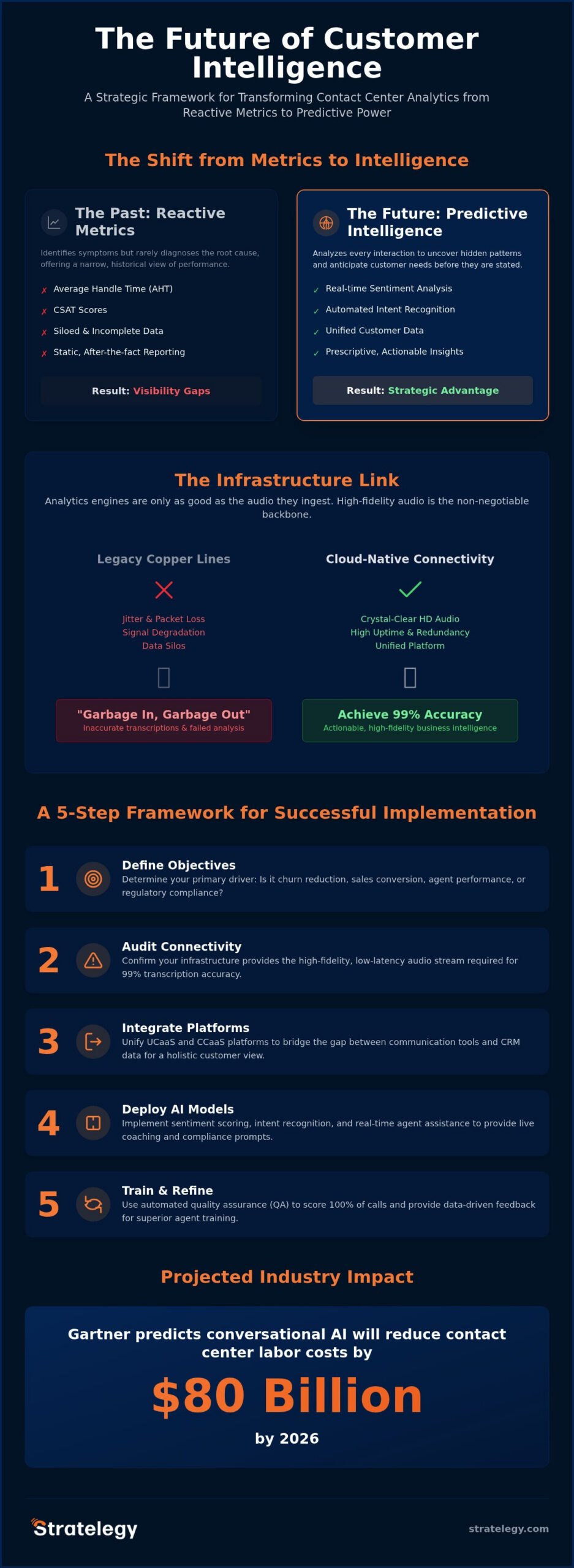
Gartner predicts that conversational AI will reduce contact center labor costs by $80 billion in 2026. This shift represents a turning point for leaders who understand that effective call analytics for contact centers are no longer optional. You likely recognize that your current metrics don’t tell the full story, especially when data silos and poor audio quality from legacy lines create visibility gaps. It’s frustrating to manage a mountain of information without a clear path toward strategic improvement.
You can master the transition from surface-level metrics to deep predictive intelligence by aligning your analytics with a robust cloud infrastructure. This article provides a strategic framework to eliminate technical friction and future-proof your communications. You’ll learn how to leverage sentiment analysis to reduce churn and implement automated quality assurance for superior agent training. We will preview the architectural shifts necessary to transform your operation into a predictable engine of high-fidelity customer intelligence.
Key Takeaways
- Shift from descriptive to prescriptive intelligence to move beyond tracking what happened and start predicting what your customers will do next.
- Recognize why legacy copper infrastructure sabotages your data quality and how cloud-native connectivity provides the audio fidelity required for 99% transcription accuracy.
- Implement a strategic framework for call analytics for contact centers that prioritizes your business objectives and audits your current connectivity layer.
- Bridge the gap between communication tools and CRM data by unifying your UCaaS and CCaaS platforms for a more predictable and secure business environment.
Defining Call Analytics for the 2026 Contact Center
Modern call analytics for contact centers is no longer a luxury for high-volume environments. It’s the systematic computational analysis of every voice and digital interaction to uncover hidden operational patterns. This technology has evolved rapidly from descriptive analytics, which merely report what happened, to prescriptive analytics that dictate what your team should do next. In 2026, static reporting is considered a liability rather than an asset for enterprise-grade customer engagement.
The Shift from Metrics to Intelligence
Traditional KPIs like Average Handle Time (AHT) and CSAT offer a narrow view of performance. They identify symptoms but rarely diagnose the cause. Deep call analytics for contact centers leverage advanced AI models to interpret unstructured data from voice recordings. These models analyze tone, silence, and specific linguistic markers to turn raw audio into structured business intelligence. This transition from simple measurement to deep intelligence allows leaders to anticipate customer needs before they’re explicitly stated.
Core Analytics Capabilities
The prerequisite for any meaningful insight is high-fidelity transcription. Speech analytics depends on the clarity of the underlying audio stream to achieve the 99% accuracy required for modern standards. Once this foundation is secure, organizations can deploy real-time intent recognition and automated sentiment scoring. These tools provide live agent assistance, offering on-screen coaching and compliance prompts during the interaction. This proactive oversight ensures every call aligns with your strategic goals, reducing the need for reactive training sessions later. By integrating Natural Language Processing (NLP) into the communication flow, businesses achieve a level of predictability that legacy systems simply can’t match.
The Infrastructure Link: Why Reliability Dictates Analytics Quality
Analytics engines are only as good as the audio they ingest. If your operation still relies on legacy copper lines, you’re likely feeding your AI degraded signals. This creates a “Garbage In, Garbage Out” scenario where even the most advanced algorithms fail. High-fidelity audio is the non-negotiable backbone of effective call analytics for contact centers. Cloud-native platforms provide the crystal-clear sound quality required to reach 99% transcription accuracy, ensuring your data is actionable rather than an approximation.
Hosting voice and analytics on a single, secure cloud backbone eliminates the data silos that plague fragmented systems. By integrating unified communications and collaboration with your analytics engine, you gain a holistic view of the customer journey. This unified approach ensures that every interaction is captured securely and predictably, providing a stable foundation for long-term operational growth.
Overcoming Legacy Limitations
Jitter and latency are more than just technical nuisances; they’re data killers. Sentiment analysis algorithms rely on subtle tonal shifts and timing that get lost in packet loss or analog signal degradation. This is why POTS line replacement isn’t just a basic IT upgrade. It’s a strategic prerequisite for modern intelligence. Enterprises using Call Analytics For Growth recognize that structural reliability is the first step toward meaningful ROI.
Ensuring Data Integrity
Consistency is vital for effective AI training and lifecycle management. Standardizing audio formats across the enterprise prevents the fragmented insights that result from disparate hardware. We also prioritize uptime through LTE and cellular backup systems to maintain data continuity. These redundant paths ensure your analytics engine never misses an interaction, even during primary network outages. If you’re ready to eliminate technical friction, modernizing your infrastructure with a specialized partner is the most disciplined path forward.
Strategic Implementation: A 5-Step Framework for Success
Deploying call analytics for contact centers requires a disciplined, structural approach. You can’t simply layer software over a fragmented network and expect actionable results. Success depends on a methodical five-step framework:
- Define Objectives: Determine if your primary driver is churn reduction, sales conversion, or regulatory compliance.
- Audit Connectivity: Confirm your cloud contact center infrastructure can support high-bandwidth, real-time data streams.
- Select CCaaS: Choose a platform designed for deep integration rather than superficial features.
- Unify Data: Connect your voice streams with CRM and Workforce Engagement Management (WEM) tools to create a 360-degree customer view.
- Refine Models: Establish a continuous maintenance loop to update AI models as customer language and market trends evolve.
Setting Relevant KPIs
Move beyond legacy metrics like Average Handle Time. Focus on ‘Sentiment Shift’ to measure how effectively agents resolve emotional friction. High-performing teams also prioritize First Contact Resolution (FCR) and use predictive analytics to forecast staffing needs. This foresight is critical for the future of contact centers, where data correlation across domains becomes the standard for excellence.
Governance and Compliance
Security is the foundation of any analytics deployment. Managing voice data within SOC2, HIPAA, or GDPR environments requires rigorous oversight. We utilize proprietary maintenance frameworks to ensure your analytics software remains secure against evolving threats. This disciplined approach ensures that your call analytics for contact centers remain compliant with evolving privacy laws. If you’re ready to secure your infrastructure, contact our engineering team to begin your strategic audit.
Modernizing Engagement: The Stratelegy CCaaS Advantage
At Stratelegy, we believe software is only as effective as the infrastructure supporting it. We focus on building the structural reliability required for advanced call analytics for contact centers. While others focus solely on the application layer, we prioritize the connectivity that makes deep intelligence possible. This includes the seamless integration of unified communications as a service with your analytics engine. Our partnership model emphasizes engineering excellence over superficial features, moving your operation from legacy LTE POTS replacement to a global CCaaS deployment.
Engineering Predictability
We provide peace of mind by anticipating operational challenges before they disrupt your customer experience. Our expertise spans both the cellular infrastructure layer and the cloud software environment. This dual-competency ensures that your data streams remain consistent, secure, and governed by strict regulatory standards. We implement proactive lifecycle management to keep your hardware and software ahead of the obsolescence curve. This systematic approach ensures your investment remains relevant as the industry evolves.
The Future of Enterprise Communication
Legacy voice systems face total obsolescence by 2027 as analog deregulation continues to drive costs upward. Waiting to modernize creates systemic vulnerabilities that can’t be fixed with simple software patches. Transitioning to a managed, analytics-driven environment is the only way to maintain a competitive advantage in a crowded market. We guide you through this migration with a disciplined framework that prioritizes security and predictability. By choosing a partner who acts as a strategic specialist, you eliminate the fear of technical debt and focus on long-term growth.
Future-Proof Your Customer Intelligence
Transitioning to advanced call analytics for contact centers requires more than just a software license. It demands a foundational shift toward structural reliability and high-fidelity audio streams. By eliminating the technical friction of legacy copper lines and unifying your communication silos, you’ll unlock the ability to move from basic reporting to deep, predictive intelligence. This evolution ensures your operation remains proactive as customer expectations continue to rise across the enterprise.
Stratelegy acts as your strategic partner in this transition. We’re specialists in complex legacy-to-cloud migrations and provide enterprise-grade security with full SOC2 compliance. Our proactive maintenance frameworks and hardware update policies protect your business from obsolescence and technical debt. Don’t let outdated infrastructure limit your long-term growth. Schedule a Strategic Infrastructure Audit with Stratelegy today. Your path to a modern, predictable contact center is within reach.
Frequently Asked Questions
What is the difference between call center metrics and call center analytics?
Metrics are raw data points like Average Handle Time or Abandonment Rate. Analytics is the computational processing of that data to find patterns. While metrics tell you what happened, call analytics for contact centers explain why it happened. This intelligence allows leaders to move from reactive reporting to prescriptive strategy. It uses sentiment and intent to guide future operations and improve structural reliability.
How does speech analytics improve agent performance in real-time?
Real-time speech analytics provides live on-screen coaching by identifying specific keywords or emotional shifts during a conversation. It’s like having a supervisor monitor every call simultaneously. These tools can trigger compliance prompts or suggest technical solutions to resolve issues faster. This immediate feedback loop reduces training time and ensures agents adhere to brand standards without waiting for a post-call review session to address errors.
Can call analytics help with regulatory compliance and quality assurance?
Yes, call analytics automates the quality assurance process by scanning 100% of interactions for compliance breaches or mandatory disclosures. This is far more effective than the traditional method of manually auditing a random 2% of calls. By identifying systemic vulnerabilities in real-time, organizations can maintain SOC2 or HIPAA standards more predictably. It’s a disciplined approach to governance that eliminates the risk of human oversight in regulated environments.
Do I need to replace my existing phone lines to use modern call analytics?
Most modern call analytics for contact centers require high-fidelity digital audio to reach peak transcription accuracy. Legacy copper POTS lines often introduce jitter and noise that degrade the data quality. While some software can work with analog inputs, we recommend an LTE POTS replacement or a full CCaaS migration. This structural upgrade ensures your AI models receive the clean signals necessary for reliable sentiment and intent analysis.
How long does it take to see ROI from a contact center analytics implementation?
Enterprises typically observe operational improvements within the first 90 days as automated quality assurance reduces manual labor costs. Long-term ROI often manifests through a measurable reduction in customer churn and improved sales conversion rates. By identifying the root causes of friction early, businesses can implement structural changes that prevent future losses. The timeline depends on how quickly you integrate these insights into your existing CRM and workforce management tools.