
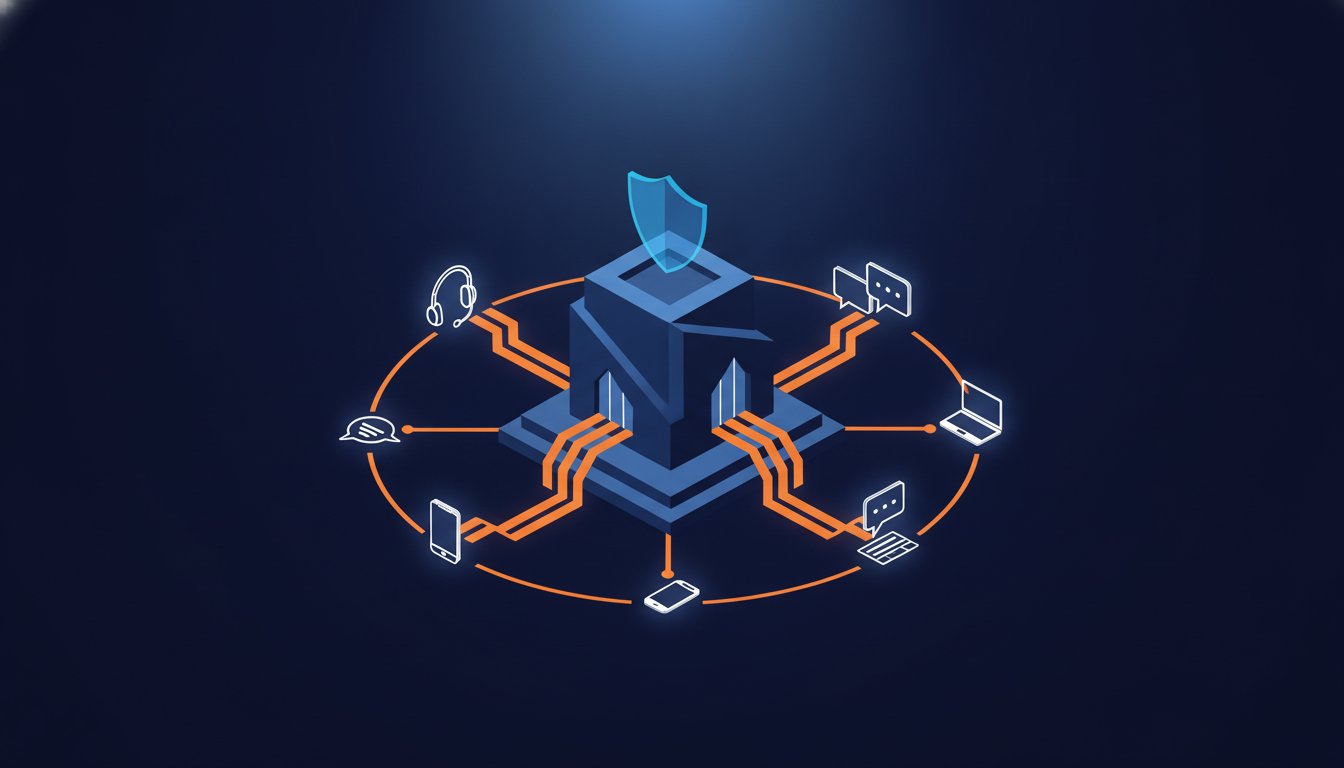
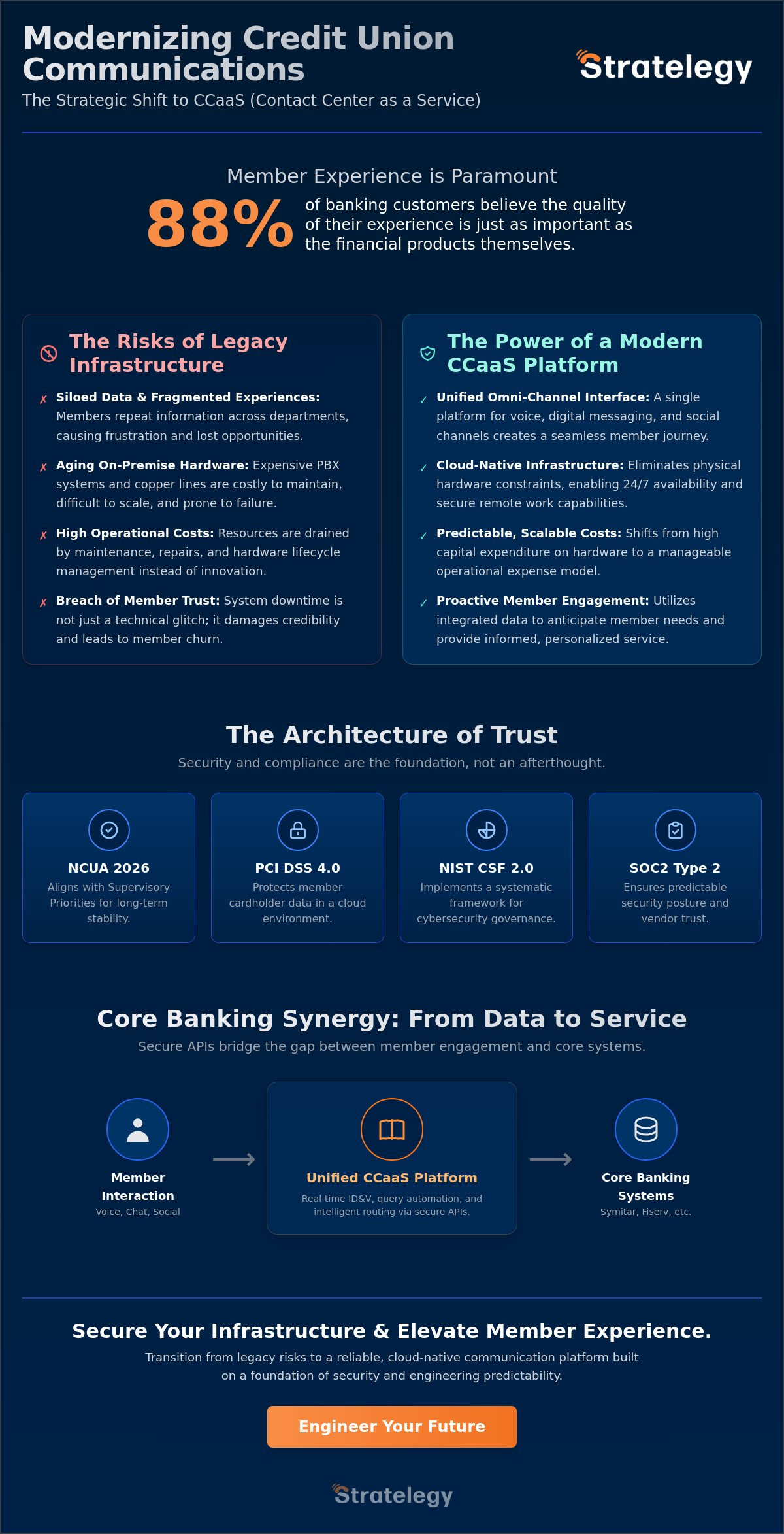
88% of banking customers now believe that the quality of their experience is just as important as the financial products themselves. For credit unions, this shift creates a difficult tension. You likely feel the pressure of maintaining member-centric service while your team battles siloed data and the rising costs of aging, on-premise hardware. Implementing ccaas for credit unions isn’t just a software upgrade; it’s a strategic move to secure your infrastructure against the threat of obsolescence. We understand that your priority is balancing cutting-edge accessibility with the rigorous security standards required by the NCUA 2026 Supervisory Priorities.
This article provides a framework for modernizing your contact center without compromising your operational stability. You’ll learn how to transition from legacy systems to a unified, omni-channel environment that supports 24/7 availability and remote work. We’ll examine how aligning with NIST CSF 2.0 and PCI DSS 4.0 standards ensures your member data remains protected. By focusing on foundational engineering rather than superficial features, you can achieve predictable costs and a seamless member experience that lasts well beyond the current fiscal year.
Key Takeaways
- Identify the operational risks of legacy copper lines and the strategic necessity of a unified, cloud-native communication interface.
- Explore how modern platforms utilize secure APIs to bridge the gap between member engagement and core systems like Symitar or Fiserv.
- Determine the most effective migration path for your institution to ensure voice quality and network stability during the transition.
- Understand the long-term benefits of implementing ccaas for credit unions as a managed infrastructure play rather than a simple software layer.
- Learn how systematic maintenance frameworks provide the security and governance required to meet 2026 regulatory standards.
Beyond the Dial Tone: Why CCaaS is Essential for Modern Credit Unions
Traditional telephony is no longer a viable foundation for financial services. Maintaining legacy copper lines is becoming a significant fiscal liability. CCaaS, or Contact Center as a Service, provides a cloud-native platform that unifies voice, digital messaging, and social channels into a single, member-centric interface. By moving to a cloud-based infrastructure, credit unions eliminate the physical constraints of on-premise hardware. This shift serves as the prerequisite for a modern unified communications and collaboration strategy that connects back-office experts with front-line member advocates.
The current market demands a move from reactive support to proactive engagement. Members don’t just want their problems solved; they expect their credit union to anticipate their needs during peak loan seasons or market shifts. Adopting ccaas for credit unions ensures your team has the data visibility required to meet these expectations. It replaces the siloed dial tone with a dynamic environment where every interaction is informed by the member’s history. This transition isn’t just about software. It’s about structural reliability.
The Cost of Inaction: Legacy Risks in a Digital World
Aging PBX systems are expensive to repair and difficult to scale. When on-premise hardware fails, the resulting downtime is more than a technical glitch. It’s a breach of member trust that often leads to churn. Fragmented member experiences also result in lost cross-selling opportunities. If a member has to repeat their account details three times across different departments, they’ll likely seek a more digitally mature institution. High maintenance costs for legacy systems drain resources that should be used for security and governance. Investing in ccaas for credit unions eliminates these vulnerabilities by shifting the burden of hardware lifecycle management to the provider.
The Architecture of Trust: Security, Compliance, and Core Integrations
Trust is the primary currency of any financial institution. When deploying ccaas for credit unions, security cannot be an afterthought or a secondary layer. It must be the foundation. This requires a shift from superficial software evaluations to a rigorous assessment of infrastructure governance. Achieving full compliance with PCI DSS version 4.0 and SOC2 Type 2 standards is non-negotiable for protecting member cardholder data in a cloud environment. These frameworks provide the predictable security posture necessary to eliminate the fear of systemic vulnerabilities.
Building a cloud contact center requires a security-first engineering mindset. This includes end-to-end encryption and strict data sovereignty protocols, especially as more credit unions embrace a distributed workforce model. Ensuring that member privacy remains intact across remote endpoints is a technical challenge that demands proactive oversight. For institutions looking to stabilize their digital footprint, partnering with infrastructure specialists ensures these regulatory requirements are met without friction.
Core Banking Synergy: Turning Data into Personalized Service
Real-time member identification and verification (ID&V) is the first line of defense against fraud. When your contact center is integrated with your core, agents can verify identities instantly, reducing friction for the member and shortening average handle times. Automation also plays a vital role in operational efficiency. By automating routine queries like balance checks or payment dates, you free up your human specialists to provide complex financial advice, such as helping commercial members visit Legacy Funding Advisors for flexible business funding. This balance of automated precision and human expertise is what defines a modern, member-centric strategy.
Strategic Implementation: Transitioning Without Operational Friction
Implementation is the point where strategic planning meets operational reality. For credit unions, the transition to cloud-based communication must be executed with surgical precision. Choosing the right deployment path is the first critical decision. While some vendors push for a “rip and replace” model, we generally recommend a phased migration. This approach allows your team to maintain service continuity while validating complex core banking integrations. It mitigates risk and ensures that your member service representatives aren’t overwhelmed by sudden systemic changes.
Successful ccaas for credit unions depends entirely on the strength of your underlying network. You must conduct a robust network assessment before going live. This audit identifies bandwidth bottlenecks and latency issues that could degrade VoLTE and cloud voice quality. Without this foundational engineering, even the most advanced software will fail to deliver a clear, reliable member experience. Your contact center shouldn’t exist in a vacuum. It must be integrated with your existing unified communications as a service framework to ensure seamless collaboration between back-office staff and front-line agents. To begin your infrastructure audit, contact our engineering team for a strategic consultation.
The Roadmap to Cloud Maturity
A disciplined transition follows a logical sequence. It moves from discovery to validation before reaching full-scale deployment. This methodical approach builds the predictability your institution requires. We focus on structural reliability throughout every phase of the project lifecycle.
- Step 1: Audit existing silos. Identify fragmented data sources and evaluate your current pots line replacement needs to eliminate legacy hardware vulnerabilities.
- Step 2: Define success criteria. Establish clear member experience (MX) metrics, such as average handle time and first-contact resolution, to measure the impact of ccaas for credit unions.
- Step 3: Launch a pilot program. Implement the solution with a small group of agents. Use this phase to validate real-time data sync with your core banking system before a wider rollout.
Engineering Predictability: The Stratelegy Approach to Credit Union CCaaS
Software is a commodity. Structural reliability is an engineering outcome. At Stratelegy, we don’t view ccaas for credit unions as a simple application layer. We treat it as foundational infrastructure. This shift in perspective allows us to prioritize long-term stability and security over superficial features. By addressing the technical debt that often accumulates in financial institutions, we help you transition from legacy vulnerabilities to a proactive, modern posture. Our focus remains on the health of your business infrastructure, ensuring that every member interaction is supported by a resilient technical backbone.
Our proprietary maintenance frameworks provide the ongoing oversight necessary for financial-grade uptime. We implement systematic hardware update policies that eliminate the fear of technology obsolescence. These frameworks aren’t just about fixing what’s broken; they’re about lifecycle management and anticipating failures before they occur. This disciplined approach ensures your communication lines stay current and secure. We act as the technical experts in the room who have already planned for the challenges you haven’t encountered yet. This level of predictability is essential for maintaining member trust in a volatile digital environment.
The Stratelegy partnership moves beyond the traditional vendor-client model. We serve as your strategic technical specialists, providing the governance and engineering excellence required for long-term growth. When you implement ccaas for credit unions through our framework, you gain a partner dedicated to your institutional longevity. We manage the underlying complexity so your team can focus on delivering high-value financial advice and member service. Our commitment to excellence is rooted in engineering, not just sales.
Foundational Reliability for Financial Institutions
Continuous availability is a requirement, not a goal. Our LTE-based solutions provide essential failover security for critical communication paths. This redundant architecture ensures that your contact center remains operational even if your primary network connection fails. By integrating these LTE paths into your broader strategy, we provide a level of structural reliability that software-only providers cannot match. Shifting to a strategic technical partnership allows your credit union to leverage our expertise in security and regulatory compliance, providing peace of mind for your leadership and seamless service for your members.
Securing Institutional Longevity Through Structural Reliability
The transition to ccaas for credit unions represents a fundamental shift from fragile legacy hardware to resilient, cloud-native infrastructure. We’ve explored how unifying member data across all channels eliminates operational silos and bridges the gap between traditional reliability and modern digital expectations. By integrating these platforms with your core banking systems, you transform simple interactions into personalized, high-value member experiences. This journey requires more than just a software license; it demands a commitment to foundational engineering and rigorous security standards.
Stratelegy provides the technical authority needed to navigate this complex landscape. We specialize in technical niches like financial compliance and utilize proprietary maintenance frameworks to ensure long-term reliability. Our expertise in LTE-based infrastructure stability offers a level of failover security that software-only vendors simply cannot match. We’re here to serve as your strategic partner, eliminating the fear of obsolescence through proactive oversight and disciplined lifecycle management. Your institution deserves a communication foundation built on engineering excellence rather than superficial features.
Secure your credit union’s communication future with Stratelegy. Let’s build a predictable, member-centric environment together.
Frequently Asked Questions
What is CCaaS for credit unions and how does it differ from traditional call center software?
CCaaS is a cloud-native platform that unifies voice, digital, and social channels into a single interface. Traditional software relies on on-premise hardware and siloed databases that are difficult to update. CCaaS eliminates physical infrastructure constraints and allows for rapid scaling. It provides a foundational layer for omni-channel engagement. This shift ensures institutional longevity by replacing aging PBX systems with a managed, engineered solution that evolves with member needs.
How does CCaaS integrate with my credit union’s core banking system?
Integration occurs through robust APIs that connect the communication platform directly to core systems like Symitar or Fiserv. This creates a bi-directional data flow, allowing for real-time member identification and verification. Agents can view account histories without toggling between screens. These integrations reduce friction and improve first-contact resolution. By automating routine data retrieval, your team can focus on providing strategic financial advice rather than navigating disconnected legacy databases.
Is CCaaS secure enough for sensitive member financial data and compliance?
Modern platforms are engineered to meet the most stringent financial regulations, including PCI DSS 4.0 and SOC2 Type 2. Unlike legacy systems that require manual patching, cloud-native solutions benefit from systematic maintenance frameworks and automated security updates. Implementing ccaas for credit unions prioritizes data sovereignty and end-to-end encryption. This approach aligns with the NCUA 2026 Supervisory Priorities, ensuring that member privacy is protected across every communication endpoint.
What are the primary ROI drivers for a credit union moving to a cloud contact center?
The primary drivers include predictable operational costs and the elimination of high maintenance fees for aging hardware. Moving to ccaas for credit unions shifts capital expenditure to a scalable operational model. You gain efficiency through automated routine queries and reduced average handle times. Additionally, the ability to scale support during peak loan seasons without adding permanent headcount provides significant long-term value. These results contribute to a healthier bottom line and improved member retention.
Can CCaaS help my credit union support a remote or hybrid workforce?
CCaaS is specifically designed to support a distributed workforce by providing secure, browser-based access to communication tools. MSRs can handle member inquiries from any location without compromising data security or voice quality. This flexibility helps you attract and retain top talent while maintaining institutional availability. Because the infrastructure is managed in the cloud, your IT team no longer needs to manage complex VPNs or local hardware for remote employees.