
A single minute of infrastructure failure during a peak shopping event is no longer just a lost sale; it’s a systemic collapse of your brand’s structural integrity. With the global CCaaS market projected to reach $9.4 billion in 2026, the transition from reactive service to engineered resilience is now a requirement for survival. You’ve likely experienced the anxiety of legacy systems buckling under Black Friday surges or the friction of agents toggling between fragmented data silos. It’s a common pain point that threatens both customer loyalty and operational predictability.
This guide demonstrates how a modern architecture for ccaas for retail e-commerce provides the foundational reliability and omnichannel scale necessary for high-volume operations. You’ll discover how to achieve zero-downtime scalability while maintaining compliance with 2026 data privacy updates in states like Kentucky and Rhode Island. We’ll examine the technical frameworks that unify customer data across every channel, ensuring your infrastructure is built for longevity rather than just the next quarter.
Key Takeaways
- Transition from reactive support to proactive engagement by positioning your contact center as a strategic cloud-based hub.
- Leverage elastic cloud architecture and API-first design to manage massive traffic spikes during peak seasons without experiencing latency.
- Avoid operational bloat by prioritizing foundational engineering and structural reliability over superficial AI widgets.
- Implement a systematic migration roadmap to transition your legacy retail communications to a modern ccaas for retail e-commerce environment.
- Build long-term predictability into your infrastructure by focusing on security, governance, and lifecycle management.
What is CCaaS for Retail E-commerce?
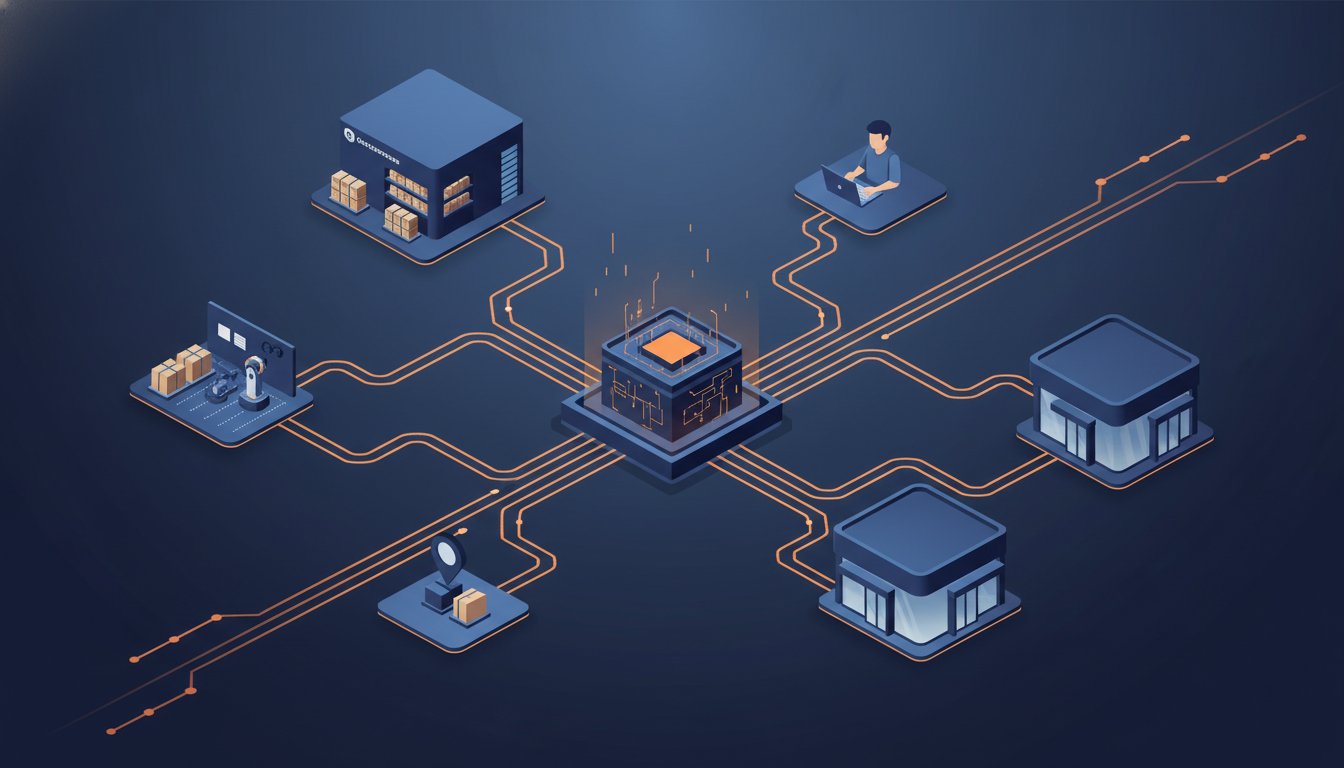
Contact Center as a Service (CCaaS) for retail e-commerce is the architectural foundation that enables high-volume brands to manage complex customer interactions through a single, cloud-native interface. While the traditional Call Centre focused on reactive voice responses, modern CCaaS environments operate as proactive engagement hubs. In 2026, retail infrastructure must support a unified communication layer that bridges digital storefronts and physical logistics seamlessly. This technology isn’t just a service tool; it’s a critical component of your brand’s structural resilience.
The shopper lifecycle is no longer linear. It spans discovery, purchase, and post-purchase support across multiple devices and platforms. CCaaS provides the structural visibility required to track these touchpoints without data fragmentation. It ensures that a customer’s journey isn’t interrupted by system transitions or departmental silos. By engineering a unified view of the customer, retailers can anticipate needs before they become service tickets, shifting the operation from a cost center to a value driver.
The Core Components of a Retail-First CCaaS
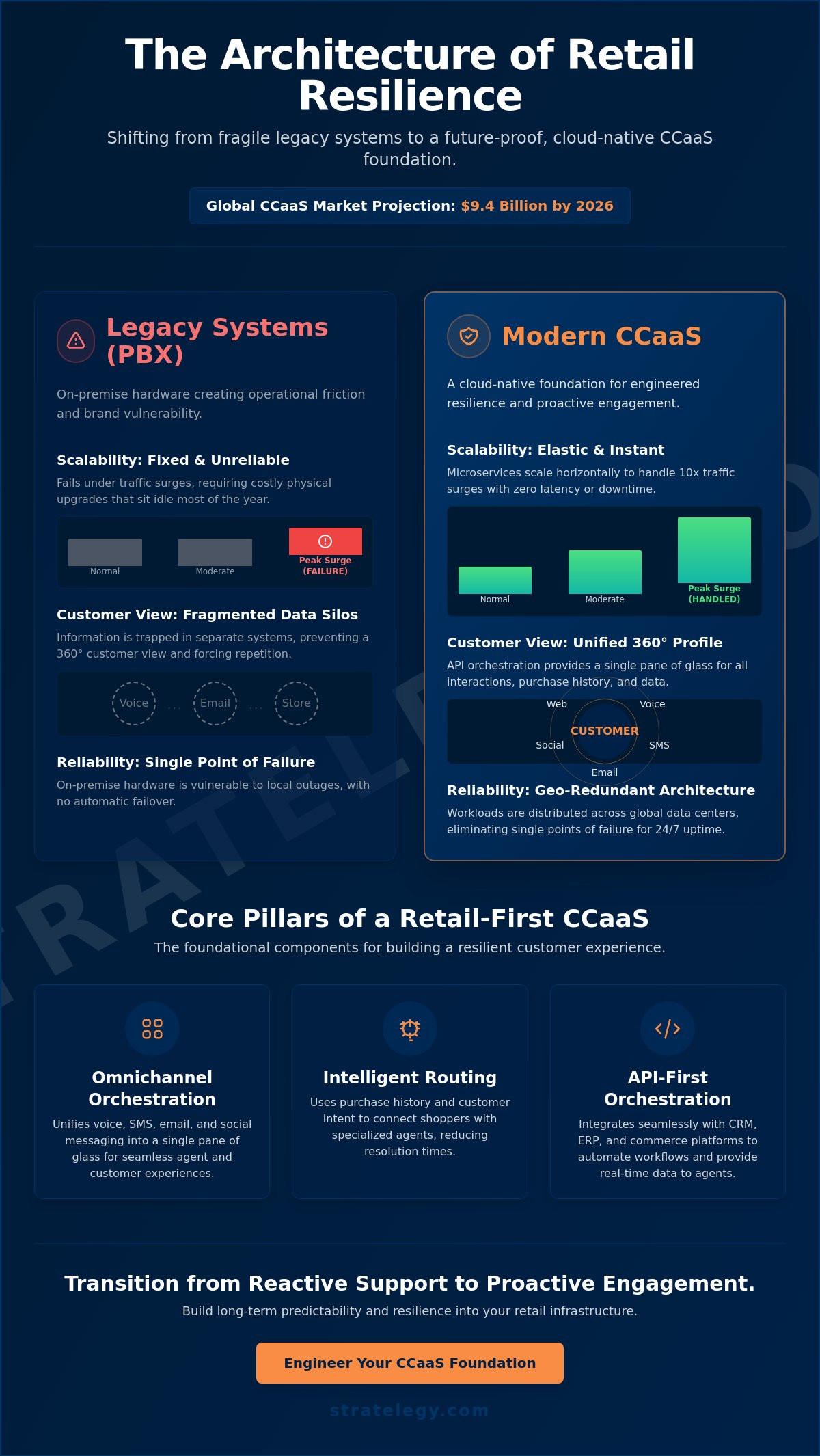
A robust CCaaS deployment for retail isn’t defined by features alone. It’s defined by its ability to orchestrate complex workflows that prioritize structural reliability. Key pillars of this architecture include:
- Omnichannel orchestration: This unifies voice, SMS, email, and social messaging into a single pane of glass for agents, ensuring no interaction is lost in the shuffle.
- Intelligent routing: Systems use purchase history and customer intent to connect shoppers with specialized agents. This reduces resolution time and improves the quality of the engagement.
- Self-service automation: Modern platforms handle routine inquiries like order tracking or return processing. This lightens the load on human staff during peak volume surges.
Why Traditional PBX Fails Modern E-commerce
Legacy Private Branch Exchange (PBX) systems were built for static, office-bound environments. They can’t handle the dynamic requirements of 2026 e-commerce. High-volume retailers often face a scalability crisis during peak seasons like Black Friday. On-premise hardware doesn’t scale instantly. It requires physical intervention and costly over-provisioning that sits idle for most of the year. The maintenance burden of legacy hardware is unsustainable in a decentralized work environment. These systems create data silos and prevent brands from gaining a 360-degree view of the customer. Without a cloud-native foundation, your retail operation remains vulnerable to outages and operational friction that can damage your brand’s reputation.
Core Architectures: How CCaaS Solves the Retail Scalability Crisis
Scaling a high-volume retail operation requires more than just additional headcount. It demands an infrastructure that can breathe with the market. Elasticity as a service is the hallmark of modern architecture. During peak seasons like Cyber Monday, traffic can surge 10x within minutes. Legacy systems fail because they rely on fixed hardware capacities. In contrast, cloud-native ccaas for retail e-commerce utilizes microservices that scale horizontally. This ensures zero latency and consistent voice quality regardless of concurrent session volume. Business leaders often consult Gartner CCaaS Reviews to verify which platforms provide this level of structural resilience under pressure.
Strategic reliability is also maintained through geo-redundancy. By distributing workloads across multiple global data centers, retailers eliminate single points of failure. If one region experiences an outage, traffic fails over to an active node instantly. This geographical distribution ensures that global retail operations remain online 24/7. When evaluating these complex architectures, it’s beneficial to partner with experts who understand the nuances of enterprise-grade CCaaS deployment and foundational engineering.
The Role of API Orchestration in E-commerce
API orchestration in retail is the synchronized coordination of data exchanges between the contact center and external commerce systems to ensure a continuous, real-time information flow. This design allows agents to see shopping cart data and inventory levels directly within their console. It eliminates the need for customers to repeat their order numbers. Furthermore, CCaaS triggers can automate order status updates via SMS or WhatsApp, reducing the volume of routine inquiries. This connectivity transforms the contact center from a silo into an integrated part of the ERP and CRM ecosystem.
Data Governance and Compliance
Handling sensitive payment information in a cloud environment requires rigorous security protocols. PCI-DSS compliance must be baked into every digital touchpoint to protect customer financial data. As of January 1, 2026, new data privacy laws in Indiana, Kentucky, and Rhode Island have introduced stricter obligations for handling personal data. Modern CCaaS platforms address these through automated redaction and secure payment IVR systems. The Stratelegy approach focuses on this secure, enterprise-grade data management. We prioritize infrastructure health and regulatory adherence, ensuring your retail brand meets national standards across all jurisdictions without compromising operational speed.
Beyond Omnichannel: Strategic Infrastructure vs. Superficial Features
Retailers often fall into the trap of feature-chasing. They prioritize “shiny” AI widgets while ignoring the underlying stability of their communication paths. This leads to operational bloat. A system packed with bells and whistles is useless if the voice quality drops during a high-stakes customer resolution. True excellence in ccaas for retail e-commerce is found in the invisible layers of the stack. It’s about prioritizing 99.999% uptime and low-latency audio over superficial novelties. When you treat your communication layer as a strategic asset rather than a monthly software expense, you build for longevity. This shifts the focus from short-term “fixes” to long-term lifecycle management.
Feature fragmentation is a significant risk for large-scale retail organizations. When different departments pull in disparate tools for chat, social, and voice, the result is a disjointed customer experience. Agents suffer from high turnover when they’re forced to navigate a cluttered interface that lacks deep tool integration. An engineered approach ensures that every new capability serves the core mission of reliability. It eliminates the technical debt that accumulates when businesses prioritize novelty over foundational health. By focusing on structural integrity, you ensure your brand remains resilient against the shifting trends of the market.
The Myth of the “All-in-One” Solution
Many vendors promise a single platform that does everything. In reality, these “all-in-one” solutions often provide mediocre versions of specialized tools. A high-volume retail environment demands deep integration with best-in-class CRM and ERP systems rather than a suite of average built-in features. You should evaluate vendors based on their uptime SLAs and the depth of their infrastructure redundancy. A common objection is whether cloud communication can match the perceived reliability of legacy copper. Modern cloud architectures provide superior failover capabilities that physical lines simply cannot replicate. They offer a level of predictability that legacy hardware can’t sustain in 2026.
Structural Reliability: The Stratelegy Perspective
We approach every project as foundational engineers rather than mere service providers. Our focus is the long-term health of your business infrastructure. This philosophy extends from our pots line replacement frameworks to our complex CCaaS deployments. We ensure that critical communication paths remain open even if your primary network fails. By engineering resilience into the core, we eliminate the fear of obsolescence. This methodical approach builds trust by providing the predictability your retail brand requires to scale. We prioritize the security and governance necessary to protect your data across every digital touchpoint.
Implementation Roadmap: Transitioning Your Retail Brand to the Cloud
A successful migration to ccaas for retail e-commerce requires a methodical engineering approach. It isn’t merely a software swap; it’s a structural overhaul of your brand’s communication foundation. Transitioning from legacy environments to the cloud must be executed in phases to ensure that customer experience remains uninterrupted. A disciplined roadmap begins with a deep audit and moves through a controlled pilot before reaching full enterprise scale. This systematic progression allows for the identification of systemic vulnerabilities before they impact your entire operation.
Testing CCaaS workflows on a single brand or specific geographical region serves as a critical proof of concept. This pilot phase validates the architectural stability of the new system under real-world conditions. Once the infrastructure is proven resilient, the transition to the full enterprise can proceed with confidence. After the rollout is complete, the focus shifts to optimization. Utilizing advanced contact center reporting software allows leadership to refine agent performance and identify bottlenecks in the shopper lifecycle. This data-driven oversight ensures that the platform evolves alongside your business requirements.
Step 1: The Infrastructure Audit
The first stage of any transition is a comprehensive audit of current legacy touchpoints. Aging copper lines and legacy PBX hardware represent a significant systemic risk to modern retail operations. These outdated components lack the redundancy needed for 2026 e-commerce demands and often lead to unexpected outages. We evaluate your current bandwidth and network stability to ensure cloud-voice readiness. Mapping the data flow between your existing support tools and the proposed CCaaS environment is essential for maintaining a unified view of the customer. This audit phase uncovers the hidden friction points that could derail a cloud migration if left unaddressed.
Step 2: Training and Cultural Adoption
Technology is only as effective as the people who operate it. Equipping your agents with the skills to manage a unified, omnichannel interface is a prerequisite for success. This transition requires establishing new KPIs that reflect modern engagement metrics, such as first-contact resolution across multiple digital channels. Agents must move away from siloed communication habits toward a more integrated approach to customer support. Investing in comprehensive agent training directly correlates with reduced handle times and a significant decrease in operational friction. This cultural shift ensures that your team is prepared to deliver the high-level service that modern retail consumers expect.
Ready to secure your communication foundation? Consult with our foundational engineers to begin your strategic transition to a resilient cloud infrastructure.
The Stratelegy Advantage: Engineering Resilience into Retail CCaaS
Resilience is an engineered outcome, not a software setting. Stratelegy bridges the gap between high-performance ccaas for retail e-commerce and the foundational stability required for enterprise survival. We are foundational engineers first. Our methodology prioritizes infrastructure health and proactive oversight over the rapid adoption of unproven features. This approach eliminates the fear of obsolescence by ensuring your communication stack is built for longevity and regulatory compliance. We provide the technical authority needed to transform a standard service into a strategic asset.
Total enterprise solutions require a unified front. By integrating unified communications as a service with your contact center architecture, we align your internal collaboration with your external customer engagement. This synchronization ensures that data flows securely across every department without friction. Our commitment to lifecycle management means your systems stay current as technologies evolve through 2026 and beyond. We don’t just deploy software; we manage the ongoing health of your business infrastructure.
LTE-Backed Redundancy for Retail Operations
A resilient communication stack must account for local infrastructure failures. We protect your contact center from local ISP outages by implementing LTE-backed redundancy. This cellular failover ensures that your customer engagement hub remains online even when primary wired networks fail. This level of redundancy is critical for maintaining life safety and security lines alongside your standard business communications. It provides the peace of mind that comes from knowing your brand is reachable during localized technical crises. We prioritize this structural reliability to ensure your retail operations never face a total blackout.
Your Strategic Partner in Retail Growth
We move beyond the traditional vendor-client relationship to become a deep technical partner. Our proprietary maintenance frameworks are designed to keep your systems at peak performance without the need for constant manual intervention. We anticipate the problems your brand hasn’t encountered yet, providing a disciplined approach to infrastructure scaling. This partnership ensures that your retail CCaaS roadmap is grounded in predictability and security. Our focus on excellence through engineering allows you to focus on growth while we maintain the foundation. You can trust our experts to provide the ongoing oversight necessary for a high-volume e-commerce environment.
Speak with a Stratelegy engineer about your retail CCaaS roadmap to ensure your brand’s infrastructure is ready for the demands of 2026.
Securing Your Operational Future
Engineering a resilient communication stack is the difference between operational excellence and systemic failure during peak retail cycles. We’ve explored how transitioning to ccaas for retail e-commerce provides the elastic architecture needed to handle massive traffic spikes without compromising voice quality. By prioritizing structural reliability over superficial features, your brand secures a unified view of the customer while maintaining strict compliance with evolving data privacy standards.
Stratelegy bridges the gap between cutting-edge technology and infrastructure stability. Our proprietary maintenance frameworks are designed to target 100% uptime; additionally, our specialized expertise in LTE-backed infrastructure resilience protects your contact center from localized ISP outages. We prioritize enterprise-grade security and governance to eliminate the fear of technical obsolescence. This methodical approach ensures that your communication layer remains a long-term strategic asset rather than a recurring software burden.
Consult with our foundational engineers to build your retail CCaaS strategy and ensure your business remains disciplined, modern, and ready for the challenges of 2026. Your long-term operational health is our primary objective.
Frequently Asked Questions
What is the difference between CCaaS and traditional call center software for retail?
CCaaS is a cloud-native architecture that provides instant scalability and API-first integration, whereas traditional software relies on on-premise hardware and fixed capacities. Traditional setups often create data silos and require manual hardware maintenance. Modern ccaas for retail e-commerce unifies digital and voice channels into a single engagement hub, allowing for proactive lifecycle management rather than just reactive answering.
How does CCaaS help retail brands handle seasonal spikes in customer inquiries?
CCaaS handles spikes through elastic cloud computing, where resources scale horizontally to meet 10x traffic increases without latency. This architecture eliminates the risk of system outages during high-volume events like Black Friday or Cyber Monday. By utilizing microservices, the platform ensures that voice quality and response times remain consistent regardless of the concurrent session volume hitting your servers.
Can CCaaS integrate with my existing Shopify or e-commerce platform?
Yes, modern CCaaS platforms use an API-first design to integrate seamlessly with Shopify, Magento, and other major e-commerce platforms. This connectivity allows agents to view real-time shopping cart data and order history directly within their console. It streamlines the resolution process by providing a unified view of the customer without forcing agents to toggle between disparate applications.
Is CCaaS secure enough to handle PCI-compliant retail transactions?
CCaaS platforms are engineered with enterprise-grade security to handle PCI-DSS compliant transactions through automated redaction and secure IVR payment processing. These systems ensure that sensitive financial data is never stored in the clear or heard by agents. This structural governance helps brands meet the 2026 data privacy requirements established in states like Indiana, Kentucky, and Rhode Island.
What happens to my retail contact center if the primary internet connection goes down?
A resilient contact center utilizes LTE-backed redundancy to ensure continuity when primary wired connections fail. Cellular failover automatically routes traffic through secondary paths, keeping critical communication lines active. This ensures that your retail operations remain reachable even during localized ISP outages, providing the peace of mind that comes from a hardened, multi-path communication stack.
How does CCaaS improve the agent experience in a high-volume retail environment?
The agent experience improves through a unified, omnichannel interface that reduces the cognitive load of switching between fragmented tools. Agents gain access to intelligent routing and real-time customer data, which reduces frustration and helps lower turnover rates. By automating routine tasks like order tracking, the system allows agents to focus on high-value interactions that require human expertise.
Can I use CCaaS to manage multiple retail brands from a single dashboard?
Multi-brand management is a core capability of CCaaS, allowing retailers to oversee disparate brands through a single, centralized dashboard. You can configure brand-specific routing rules, greetings, and reporting while maintaining a unified workforce. This centralized oversight provides a consistent level of service across your entire portfolio while simplifying the complex management of multiple digital storefronts.
What is the typical ROI for a retail brand transitioning to CCaaS?
ROI is realized through reduced infrastructure maintenance costs and improved agent productivity. By eliminating the need for on-premise hardware and legacy copper lines, businesses achieve predictable operational expenses and lower total cost of ownership. Additionally, higher first-contact resolution rates and lower customer churn contribute to the long-term financial health and structural stability of the enterprise.