
A successful migration to the cloud is a foundational engineering project, not just a software swap. If you treat your ccaas implementation project plan like a simple application installation, you risk the service disruptions and integration failures that compromise enterprise reliability. You’re likely managing the rapid obsolescence of legacy copper infrastructure while trying to bridge complex CRM systems into a unified environment. It’s a high-stakes technical challenge where predictability is the only acceptable outcome for your business operations.
We understand that you need a strategic framework that prioritizes governance and structural stability. This 2026 guide provides a disciplined, phase-based roadmap designed to deliver a zero-downtime migration and long-term infrastructure health. We’ll explore the essential milestones for integrating conversational AI, which is forecasted to reduce contact center labor costs by $80 billion this year. We’ll also detail how to ensure your system meets the stringent security requirements of the updated HIPAA Security Rule, protecting your organization from modern vulnerabilities.
Key Takeaways
- Conduct a comprehensive infrastructure audit to inventory carrier contracts and mitigate the operational risks associated with legacy copper infrastructure.
- Architect a unified communication environment that integrates CRM and ERP layers with AI-driven analytics to drive measurable agent productivity.
- Execute a disciplined ccaas implementation project plan using a phased pilot approach to ensure zero-downtime during the enterprise transition.
- Implement rigorous User Acceptance Testing (UAT) across all call paths to validate technical configurations before full-scale deployment.
- Establish long-term operational health through systematic hardware update policies and continuous performance monitoring frameworks.
Phase 1: Foundation Audit and Infrastructure Discovery
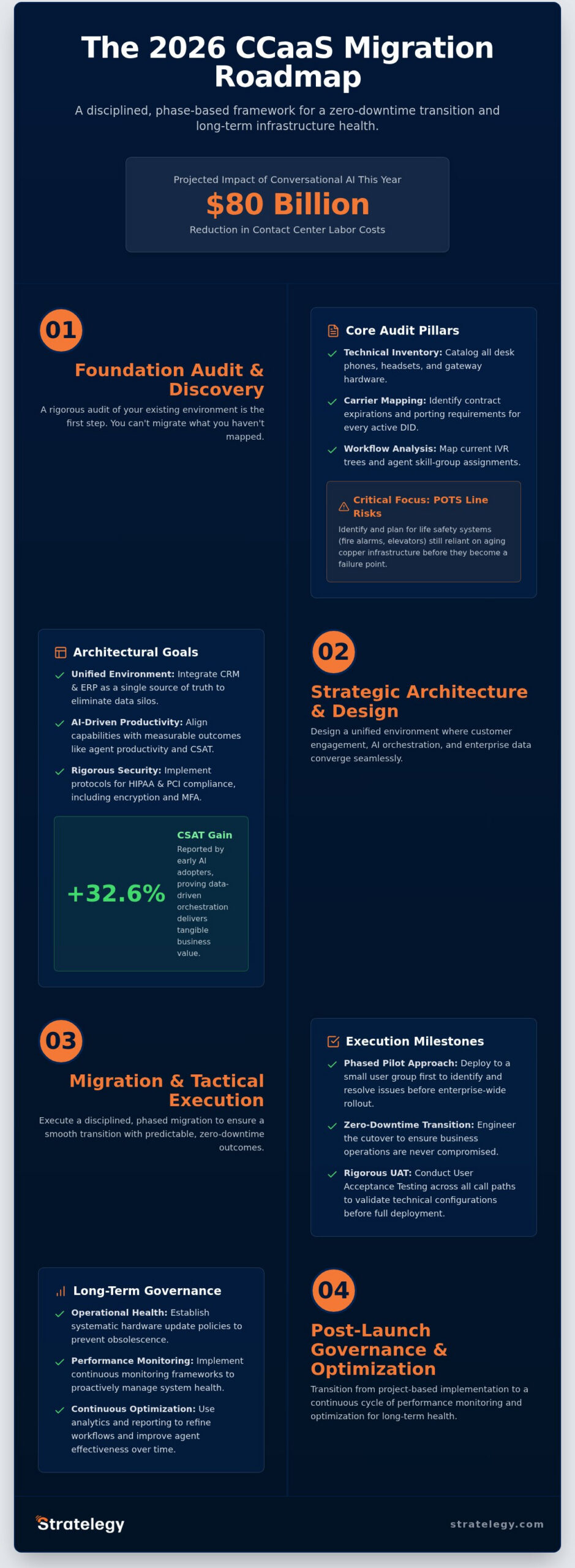
Operational stability begins at the physical layer. A disciplined ccaas implementation project plan starts with a rigorous audit of your existing environment. You can’t migrate what you haven’t mapped. This phase requires a granular inventory of all current hardware, carrier contracts, and toll-free service mappings. We look beyond the surface to assess network bandwidth and Quality of Service (QoS) capabilities. Transitioning to a cloud-based service model demands a network that can prioritize real-time voice and video traffic without jitter or latency.
Documentation is your insurance against service disruption. We analyze every customer journey touchpoint and agent workflow to identify potential friction points. This isn’t just about software features; it’s about engineering a predictable operational flow. By documenting these processes now, you ensure the future state architecture supports existing business logic while leveraging new cloud efficiencies. A successful audit focuses on these core pillars:
- Technical Inventory: Cataloging all desk phones, headsets, and gateway hardware.
- Carrier Mapping: Identifying contract expiration dates and porting requirements for every active DID.
- Workflow Analysis: Mapping current IVR trees and agent skill-group assignments.
Evaluating Legacy Infrastructure and POTS Risks
Many enterprises overlook the critical systems still tied to aging copper infrastructure. As carriers phase out traditional lines, your ccaas implementation project plan must account for life safety systems. This includes fire alarms, elevator phones, and security panels that require specialized pots line replacement solutions. We verify cellular signal strength at every site to ensure LTE backup is viable for these mission-critical paths. Mapping these dependencies prevents the “black box” syndrome where legacy telephony failures unexpectedly cripple modern cloud requirements. Our engineering-first approach ensures these foundational elements are secured before the first agent logs into the new platform.
Phase 2: Strategic Solution Architecture and Design
Design defines the success of your technical transition. A high-performing ccaas implementation project plan architects a unified environment where customer engagement, AI orchestration, and enterprise data converge. By 2026 standards, an omnichannel strategy must do more than just offer Voice, SMS, and Email. It requires a shared foundation where back-office staff and field experts can collaborate on the customer journey in real-time. This structural unity eliminates the data silos that traditionally plague legacy systems.
We architect the integration layer to ensure your CRM and ERP systems act as a single source of truth. This isn’t just about data syncing; it’s about creating a responsive infrastructure that anticipates customer needs through deep data integration. As you design your call flow logic and IVR hierarchies, prioritize reducing cognitive load for your agents. Security remains a board-level priority in this phase. We establish rigorous protocols that align with the latest HIPAA and PCI mandates, including mandatory encryption of ePHI and multi-factor authentication. If you’re concerned about how these technical requirements fit your specific industry, you can consult with our engineering team to review your current network readiness.
Predictability is the goal of every architectural decision. We focus on the long-term health of your communications stack by selecting interoperable components that resist obsolescence. This methodical approach ensures that your ccaas implementation project plan delivers a platform that is both modern and deeply grounded in infrastructure stability. We don’t just build for today’s features; we engineer for tomorrow’s governance requirements.
Aligning CCaaS Features with Business Outcomes
Features should never be selected for their novelty. We align every capability with agent productivity and customer satisfaction (CSAT) goals. By implementing a modern cloud contact center, you gain access to real-time visibility through advanced reporting tools. This allows for AI-assisted coaching and automated sentiment analysis, which are critical for addressing high turnover rates. Early AI adopters report a 32.6% gain in CSAT scores, proving that data-driven orchestration leads to tangible business value rather than just superficial improvements.
Phase 3: The Migration Roadmap and Tactical Execution
Execution is the ultimate test of infrastructure engineering. A disciplined ccaas implementation project plan mandates a phased rollout, starting with a low-risk pilot group to validate routing logic before full-scale deployment. This methodical approach allows us to identify and resolve configuration anomalies without impacting your entire operation. We conduct comprehensive User Acceptance Testing (UAT) for every call path, ensuring that complex IVR hierarchies function exactly as designed. Don’t settle for a “big bang” migration that risks service gaps; engineering excellence requires a controlled transition.
Data migration requires precision and oversight. We transfer historical records and customer profiles using secure protocols that maintain data integrity and regulatory compliance. For large enterprise operations, this migration process often requires 6 to 12 months to complete correctly, reflecting the complexity of modern integrations. We finalize the “Go-Live” cutover with a 24/7 technical support team on standby to ensure a zero-downtime transition. If you’re ready to secure your communication infrastructure, partner with our engineering experts to manage your migration.
Pilot Programs and Technical Validation
Testing API integrations under peak load conditions is vital for long-term stability. As customer interactions move toward higher automation levels in 2026, your infrastructure must handle increased data throughput without latency. We validate failover mechanisms and disaster recovery protocols to guarantee uptime during unforeseen network events. Establishing a feedback loop for agents during this early phase ensures that the tools we’ve built actually improve their daily productivity. This real-world validation prevents the common pitfalls that cause many cloud projects to fail due to poor user adoption or technical bottlenecks.
Phase 4: Post-Launch Governance and Optimization
Launch day is the beginning of your platform’s operational lifecycle, not the conclusion. A robust ccaas implementation project plan must include a dedicated phase for post-launch governance to ensure the system doesn’t degrade over time. We implement continuous performance monitoring using advanced analytics to track interaction quality and system health. This proactive oversight allows us to identify and remediate technical drift before it impacts agent productivity or customer experience. Predictability in the cloud requires constant vigilance and data-driven adjustments.
Stability requires a systematic hardware and software update policy. We don’t wait for failures to occur. Instead, we establish a maintenance cadence that keeps your infrastructure modern and secure against evolving cyber threats. We conduct monthly ROI audits against your initial project benchmarks to verify that the transition is delivering the expected financial and operational value. Ongoing training ensures your team remains proficient with new features and AI tool updates as the platform evolves. This commitment to lifecycle management prevents the technical debt that often accumulates after a major migration.
Governance in 2026 also demands a rigorous focus on AI-driven security. As automated interactions increase, maintaining the integrity of your data orchestration layer is vital. We monitor these automated paths to ensure they comply with the latest regulatory standards and don’t create new vulnerabilities. By treating your ccaas implementation project plan as a living framework, you protect your investment and ensure your communications infrastructure remains a competitive advantage rather than a legacy burden.
Predictive Maintenance and Long-Term Reliability
We utilize proprietary maintenance frameworks to prevent system drift and ensure long-term structural reliability. It’s essential that all unified communications as a service components stay synchronized with your contact center environment. We schedule quarterly strategic reviews to align your technology stack with business growth and emerging 2026 compliance standards. This methodical oversight transforms your communications from a static expense into a dynamic, managed asset that scales with your enterprise needs.
Securing Your Communications Infrastructure for the Next Decade
Modernizing your contact center is a high-stakes engineering project that requires more than just a software license. It demands a disciplined approach that bridges the gap between cutting-edge cloud capabilities and the physical reliability of your existing network. By following a phase-based ccaas implementation project plan, you eliminate the risks of service disruption and ensure that your legacy life safety systems are fully accounted for during the transition. Success is found in the precision of the initial audit and the persistence of post-launch governance.
We are enterprise-grade infrastructure engineers who prioritize structural stability and predictability. As specialists in critical life safety communications, we provide the modern cloud-based scalability your business needs while maintaining legacy reliability. You don’t have to navigate these technical complexities alone. Partner with Stratelegy for a disciplined CCaaS implementation to secure a predictable and high-performing future for your customer engagement operations. Your infrastructure is the foundation of your business; let’s build it to last.
Frequently Asked Questions
How long does a typical CCaaS implementation take for an enterprise?
Large enterprise migrations typically require between 6 and 12 months for a full transition. Medium operations usually complete the process in 3 to 6 months, while smaller centers may finish in 6 to 12 weeks. These timelines reflect the necessity of a disciplined ccaas implementation project plan that prioritizes rigorous integration testing and data migration over a rushed deployment.
What are the biggest risks during a CCaaS migration project?
Service disruption and integration failures are the primary risks when transitioning from on-premises systems. A “lift and shift” approach often fails because it doesn’t account for the re-evaluation of workflows required for cloud efficiency. Additionally, security vulnerabilities can emerge if the new infrastructure isn’t hardened against the expanded attack surface created by conversational AI and complex third-party CRM integrations.
Can we keep our existing phone numbers when moving to CCaaS?
Yes, you can retain your existing phone numbers through a formal porting process with your new provider. This requires a precise inventory of all active DIDs and toll-free service mappings during the initial discovery phase. We coordinate the tactical cutover to ensure that your business identity remains consistent while migrating your operations to a more stable cloud environment.
How does CCaaS implementation affect our legacy fire and safety alarms?
CCaaS platforms do not natively support analog signaling for life safety systems like fire alarms or elevator phones. A comprehensive ccaas implementation project plan must include a strategy for LTE POTS replacement to maintain these critical connections. We verify cellular signal strength and deploy dedicated hardware to ensure these lines remain active and compliant with safety regulations during the decommissioning of legacy copper lines.
What is the role of AI in a 2026 CCaaS project plan?
In 2026, AI serves as the foundational layer for interaction orchestration rather than just an optional add-on. It’s expected to automate 20% of customer interactions this year while providing real-time assistance to human agents through automated call summaries and sentiment analysis. Integrating these capabilities into your infrastructure reduces cognitive load for agents and is forecasted to reduce global contact center labor costs by $80 billion.