
While the global CCaaS market is projected to hit $8.33 billion in 2026, 66% of companies remain anchored to legacy infrastructure that stifles growth. This technical debt often manifests as fragmented customer context and high latency in CTI screen pops, forcing agents to navigate a maze of disconnected tools. Achieving a seamless ccaas integration with zendesk is no longer a luxury for the modern enterprise; it’s a foundational requirement for maintaining operational excellence and infrastructure predictability.
You understand that technical fragility in your communication stack leads to lost revenue and frustrated teams. We’re here to help you move past the complexity of managing disparate vendor APIs and move toward a unified environment. This article provides a strategic framework to architect a high-performance contact center by merging advanced CCaaS capabilities with Zendesk’s resolution platform. You’ll learn how to establish a single pane of glass for your agents, automate data synchronization, and ensure your infrastructure remains resilient against the rapid pace of technological change. We’ll break down the engineering requirements for a stable, future-proof ecosystem that prioritizes security and governance.
Key Takeaways
- Understand why legacy middleware is obsolete and how a direct technical bridge ensures your voice infrastructure and CRM data remain synchronized.
- Discover how to transform voice data into actionable tickets using WebRTC for high-fidelity audio directly within the agent’s browser.
- Identify the specific API maturity and latency benchmarks required to execute a high-performance ccaas integration with zendesk.
- Shift your strategy from a one-time setup to a continuous lifecycle management approach that prioritizes long-term infrastructure health.
- Establish a predictable operational environment where automated data flows eliminate manual entry and reduce systemic vulnerabilities.
The Evolution of CCaaS Integration with Zendesk
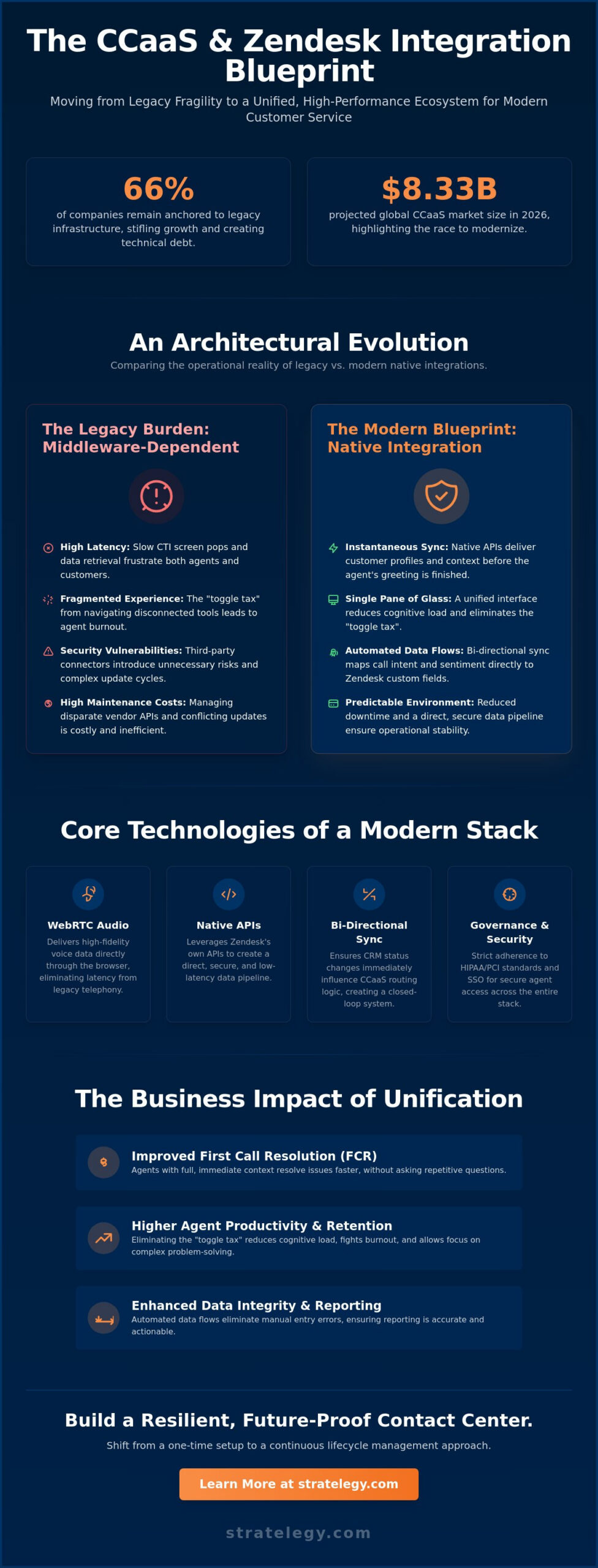
Integration isn’t just a feature; it’s an engineered bridge. Effective ccaas integration with zendesk creates a resilient data flow between your contact center telephony infrastructure and your CRM records. In 2026, the reliance on “middleware-heavy” connectors has become a significant operational liability. These legacy systems often introduce unnecessary latency and security vulnerabilities that modern enterprises simply won’t tolerate. We’ve moved beyond simple screen pops that merely display a caller’s name. Today’s standard is deep, two-way data synchronization where every voice interaction immediately updates the customer’s resolution history and sentiment profile. Modern CTI is defined as a series of cloud-native API requests that programmatically link voice events to specific Zendesk ticket actions without any manual intervention from the agent.
Why Native Integration Outperforms Middleware
Native integrations leverage Zendesk’s own APIs to minimize data travel time. A high-quality ccaas integration with zendesk ensures that data delivery is nearly instantaneous. This ensures the agent sees the customer profile before they even finish their greeting. Eliminating third-party middleware also slashes long-term maintenance costs and reduces the risk of system downtime during vendor updates. You aren’t managing multiple, conflicting update cycles; you’re maintaining a direct, secure pipeline. It’s an investment in structural reliability rather than just superficial connectivity.
The Business Impact of a Unified Engagement Layer
A seamless engagement layer directly improves First Call Resolution (FCR) metrics by providing immediate access to historical data. When agents have full context, they don’t waste time asking repetitive questions that the customer has already answered in other channels. This also addresses the “toggle tax” that frequently leads to agent burnout. By providing a single pane of glass, you reduce the cognitive load on your team. They can focus on resolving the complex issues that require a human touch rather than fighting with fragmented software interfaces. This level of predictability in the agent experience translates to higher retention and better customer outcomes.
Architecting for Resolution: How Modern Integrations Function
Architecture defines the modern service experience. A successful ccaas integration with zendesk converts a standard CRM into a high-performance resolution platform. This shift is a core component of Zendesk’s strategic framework, which emphasizes a unified environment over fragmented tools. By utilizing WebRTC, voice data is delivered with high fidelity directly through the browser. This eliminates the latency common in legacy setups and relies on a stable cloud contact center backbone to ensure every interaction is captured as a permanent record.
Intelligence is only as good as the data it can access. Modern integrations allow AI agents and human staff to share a continuous context loop. When an automated agent handles the initial intent, the integration layer passes the full metadata and sentiment analysis to the human agent who takes over. This level of engineering prevents the repetition that typically frustrates customers and bogs down operations. It ensures that every handoff is seamless and every agent is equipped with the data they need to resolve issues on the first attempt.
Real-Time Data Mapping and Synchronization
Precision matters in data management. Advanced integrations map CCaaS metadata, including call intent and customer sentiment, directly into Zendesk custom fields. This bi-directional synchronization ensures that CRM status changes immediately influence CCaaS routing logic. It’s a closed-loop system that eliminates manual data entry and maintains record integrity across your entire organization. This level of automation reduces human error and ensures your reporting remains accurate and actionable.
Security and Governance in the Integration Layer
Security is the foundation of trust. Transmitting sensitive data between platforms requires strict adherence to HIPAA and PCI compliance standards. We implement robust identity management using Single Sign-On (SSO) to secure agent access across the integrated stack. This disciplined focus on governance protects your business from regulatory vulnerabilities and systemic risks. You can consult with our engineers to verify your current security architecture meets these modern benchmarks and provides long-term peace of mind.
A Technical Framework for Evaluating Zendesk-Compatible CCaaS
Selecting a partner for your ccaas integration with zendesk requires a rigorous, engineering-first approach. You aren’t just buying a software subscription; you’re selecting a critical component for your foundational business infrastructure. To ensure long-term stability and predictable performance, your evaluation must move beyond superficial features and focus on structural reliability. This integration often sits within a broader unified communications as a service ecosystem where internal collaboration and external customer resolution must remain perfectly synchronized.
A high-performance integration relies on three technical pillars:
- API Maturity: The vendor must offer a robust, well-documented REST API. This is the only way to achieve the deep, two-way data synchronization required for modern workflows.
- Latency Benchmarks: You must measure the speed of data delivery to the agent desktop. In 2026, sub-second delivery is the standard for ensuring that customer context arrives before the agent begins the interaction.
- Scalability: Your infrastructure must handle burst traffic during peak seasonal demand without degradation. The integration layer should scale programmatically to maintain performance during high-volume events.
The “Built for Resolution” Checklist
Start by assessing the vendor’s commitment to the Zendesk ecosystem. With over 1,900 apps currently in the Zendesk Marketplace, a vendor’s presence and update frequency signal their dedication to maintaining compatibility. You should also review their documented history of uptime. A partner that prioritizes infrastructure stability will provide transparent service-level agreements (SLAs) that guarantee the availability of the integration layer, not just the core voice service.
Avoiding the “Bolted-On” Trap
Many vendors claim “seamless integration” but only provide a simple iframe that sits inside the Zendesk interface. These “bolted-on” solutions lack the ability to interact with Zendesk ticket fields or trigger automated workflows. A red flag is any requirement for extensive custom coding to perform basic tasks like call logging or contact matching. True ccaas integration with zendesk is native and deep, ensuring that voice data is immediately actionable within the CRM environment. If you need an objective audit of your current stack, contact our technical specialists to ensure your infrastructure is built for longevity and excellence.
Beyond the API: Ensuring Long-Term Stability and Maintenance
Integration isn’t a destination. It’s an ongoing state of operational readiness. A successful ccaas integration with zendesk requires a commitment to lifecycle management that extends far beyond the initial deployment phase. We view this technical bridge as a living infrastructure. It demands constant oversight to ensure peak performance and data integrity. Treating integration as a “one-and-done” project is a primary cause of technical debt and eventual system failure.
As Foundational Engineers, we don’t just deliver software. We manage the complex interplay between your voice infrastructure and CRM data. Our proprietary maintenance frameworks provide a disciplined approach to ongoing oversight. This ensures your communication stack remains resilient as both platforms evolve. We prioritize structural reliability over superficial features. This focus eliminates the fear of obsolescence and provides the predictability your business requires to thrive.
Predictive Maintenance for Communication Stacks
Infrastructure changes are inevitable. Zendesk frequently updates its environment, and CCaaS providers regularly release new API versions. Without proactive monitoring, these updates can cause critical integration breaks. Our systematic software and hardware update policies are designed to anticipate these shifts before they impact your operations. A managed service partner provides the necessary oversight to maintain a high-performance ccaas integration with zendesk. This proactive stance ensures that your data synchronization remains seamless and your agent workflows stay uninterrupted.
Transitioning from Legacy to Cloud-Native Stability
Moving away from technical debt requires a clear roadmap. Migrating from a legacy on-premises PBX to a modern, voip based CCaaS is the first step toward long-term stability. This transition replaces rigid hardware with a scalable, cloud-native architecture that integrates deeply with Zendesk. By shifting to a unified engagement layer, you establish a foundation for future growth and innovation. Contact Stratelegy to engineer your integrated contact center solution and ensure your infrastructure is built for excellence through rigorous engineering.
Engineering a Resilient Resolution Ecosystem
Your communication infrastructure is the backbone of your customer experience. Transitioning to a high-performance ccaas integration with zendesk requires moving beyond basic software plugins toward a disciplined engineering strategy. By prioritizing API maturity, sub-second latency, and bi-directional data synchronization, you eliminate the technical fragility that leads to agent burnout and customer frustration. We’ve established that long-term stability isn’t a byproduct of luck; it’s the result of rigorous lifecycle management and systematic update policies.
As technical experts specializing in enterprise-grade CCaaS and UCaaS, we prioritize security and governance in every deployment. We utilize proprietary maintenance frameworks to ensure your stack remains predictable and secure against the rapid pace of digital change. You don’t have to navigate these complexities alone. Partner with Stratelegy to engineer your integrated contact center foundation. Our foundational engineers are ready to help you build a system that achieves excellence through precision and reliability. Your path to a future-proofed engagement layer starts with a single strategic decision.
Frequently Asked Questions
How does CCaaS integration with Zendesk improve agent productivity?
Consolidation of voice and CRM data into a single interface eliminates the “toggle tax” and reduces manual data entry. Automated synchronization of call logs and customer metadata allows your team to focus on high-value resolution tasks rather than administrative overhead. This streamlined workflow directly impacts First Call Resolution (FCR) by ensuring agents have full context before the interaction even begins.
Can I use my existing phone system with Zendesk Contact Center?
Integration with existing infrastructure is possible through SIP trunking or specific connectors, though a native cloud-native provider offers the most stability. While you can often bridge legacy systems, a full ccaas integration with zendesk is most effective when utilizing a modern stack that supports WebRTC and cloud-native APIs. This ensures high-fidelity voice and seamless data flow without the latency of older hardware.
What are the security requirements for integrating CCaaS with a CRM?
Security requirements include strict adherence to SOC 2, HIPAA, and PCI DSS standards to ensure data integrity during transmission. We implement Single Sign-On (SSO) and advanced encryption protocols to secure the interplay between your CCaaS and CRM platforms. This disciplined focus on governance protects your organization from regulatory risks and ensures that customer data remains isolated and protected within a managed environment.
How long does it typically take to deploy a CCaaS integration with Zendesk?
Deployment of a comprehensive integration typically spans four to twelve weeks based on the complexity of your current infrastructure. This timeline covers the initial technical audit, API configuration, and extensive testing to guarantee system predictability. We follow a methodical engineering process to ensure that every data mapping is validated and that your team experiences zero operational downtime during the transition.
What happens to the integration if Zendesk or the CCaaS provider updates their API?
Managed ccaas integration with zendesk utilizes proactive monitoring and maintenance frameworks to anticipate and address API updates before they cause system downtime. We test all platform updates in isolated sandbox environments to verify compatibility and maintain infrastructure stability. This ongoing oversight prevents the technical debt and service interruptions that often plague unmanaged, “bolted-on” software plugins.