

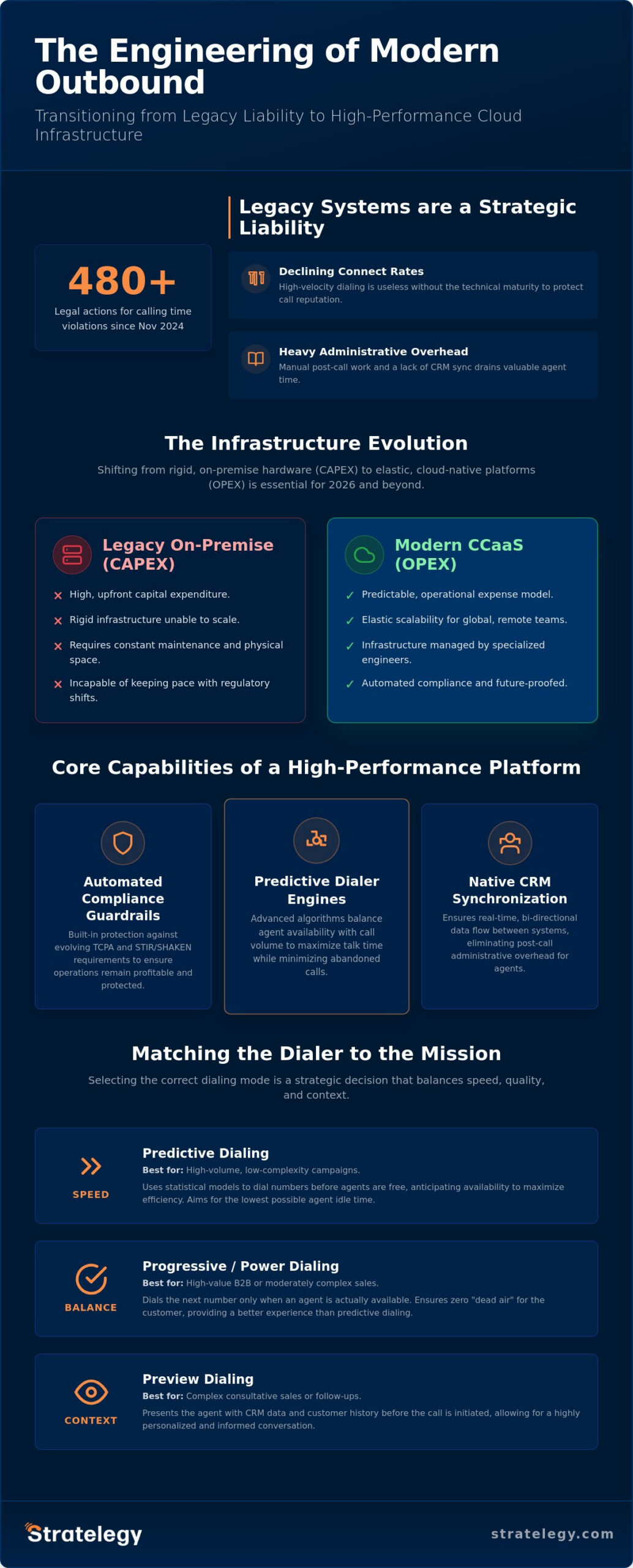
Your outbound strategy is no longer just a sales challenge; it’s a complex engineering problem where a single compliance oversight can trigger a federal lawsuit. Since November 2024, over 480 legal actions have targeted businesses for calling time violations. This shift proves that high-velocity dialing is useless if your infrastructure lacks the technical maturity to protect your reputation. You likely feel the pressure of declining connect rates and the administrative weight of manual post-call work. It’s clear that legacy systems can’t sustain the pace of modern regulatory demands or the precision required for intelligent pacing.
Selecting the right ccaas platform for outbound campaigns is the only way to bridge the gap between legacy reliability and cloud-scale execution. This guide provides a strategic roadmap for transitioning to a high-performance infrastructure that prioritizes engineering integrity and regulatory compliance. You’ll discover how to achieve automated, high-velocity dialing while maintaining predictable uptime and seamless CRM data synchronization. We’ll break down the technical requirements for 2026, from SIP 603+ mandates to AI-driven campaign optimization, ensuring your operations remain both profitable and protected.
Key Takeaways
- Transition from CAPEX-heavy legacy dialers to scalable cloud models that prioritize long-term infrastructure stability and reduced administrative overhead.
- Optimize the performance of your ccaas platform for outbound campaigns by balancing advanced dialing algorithms with strict adherence to call abandonment thresholds.
- Secure your call reputation through technical mastery of STIR/SHAKEN attestation levels and evolving TCPA regulatory frameworks.
- Bridge the gap between legacy data systems and modern execution by integrating high-velocity dialing with seamless CRM data synchronization.
What is a CCaaS Platform for Outbound Campaigns?
A ccaas platform for outbound campaigns is a cloud-native engine designed for proactive, high-velocity engagement. It represents a fundamental shift in how businesses approach communication infrastructure. In the past, companies were forced into CAPEX-heavy investments in on-premise hardware that required constant maintenance and dedicated physical space. Modern organizations now favor an OPEX-based model that offers elastic scalability. The core objective isn’t just making calls. It’s about using data-driven intelligence to pair the right agent with the right customer at the optimal time. This precision ensures that resources are never wasted on low-probability interactions.
The Evolution of Outbound Infrastructure
Legacy hardware is a growing strategic liability. In 2026, the rigidity of on-premise systems makes them incapable of keeping pace with rapid regulatory shifts and global workforce trends. Transitioning to cloud contact center solutions allows for a unified engagement strategy across multiple time zones. This evolution moves the conversation away from hardware troubleshooting and toward strategic execution. It provides the structural reliability needed to support remote and hybrid teams without sacrificing security or performance. By offloading infrastructure management to specialized engineers, you eliminate the fear of technical obsolescence.
For organizations expanding their strategic execution into global markets, STRATEX Corporate Services provides the expertise required to establish a secure and compliant corporate foundation in the UAE.
Core Capabilities of Modern Platforms
Enterprise-grade platforms are distinct from basic auto-dialers because they prioritize structural integrity over superficial features. A sophisticated Contact Center infrastructure relies on a blend of high-level engineering and real-time data processing. Key components include:
- Predictive Dialer Engines: These algorithms balance agent availability with call volume to maximize talk time while minimizing abandoned calls.
- Native CRM Synchronization: This ensures data flows bi-directionally in real-time, reducing post-call administrative overhead.
- Automated Compliance Guardrails: These systems provide built-in protection against evolving legal requirements like the TCPA and STIR/SHAKEN.
A high-performance ccaas platform for outbound campaigns delivers predictable uptime and consistent call quality. It’s an engineered environment where technical authority ensures operational peace of mind. Unlike simple dialers that focus only on volume, these platforms focus on the long-term health of your business infrastructure.
For organizations that require specialized communication tools for political campaigns or high-volume business outreach, you can visit Calls-Are-Us to discover their suite of professional services.
Engineering Efficiency: Dialer Types and Campaign Mechanics
The fundamental engine of any modern ccaas platform for outbound campaigns is its dialing algorithm. This isn’t just a matter of volume. It’s a precise calculation that balances agent talk time against abandoned call rates. In 2026, Answering Machine Detection (AMD) accuracy is a non-negotiable metric. If your AMD is imprecise, you waste agent time on recordings or, worse, disconnect live customers. High-performance platforms utilize Call Blending to maintain productivity. This allows agents to switch between inbound queues and outbound campaigns based on real-time traffic fluctuations, ensuring that your workforce is never idle.
Choosing the Right Dialer for Your Campaign
Selecting the correct dialing mode is a strategic decision that depends on your specific campaign objectives. No single dialer fits every scenario. Consider these engineering frameworks:
- Predictive Dialing: This is best for high-volume, low-complexity sales where speed is paramount. It uses statistical models to dial numbers before agents are free, anticipating when the next person will be available.
- Progressive/Power Dialing: This is ideal for high-value B2B accounts. It dials only when an agent is actually available, ensuring there’s no “dead air” when the customer answers.
- Preview Dialing: This is the standard for complex consultative sales. Agents review CRM data before the system initiates the call, allowing for a personalized approach.
Using the wrong dialer type can lead to poor reputation and wasted resources. For instance, aggressive predictive dialing without proper pacing can lead to violations of outbound campaign regulations. If you need to audit your current dialing mechanics for maximum ROI, our experts at Stratelegy can help you refine your approach.
Data-Driven Campaign Management
Modern infrastructure relies on unified communications and collaboration to synchronize real-time data. This integration ensures that list management and the automated recycling of non-answers happen without manual intervention. It’s about engineering a workflow where data informs every dial. This synchronization reduces the administrative weight on your team, allowing them to focus on conversion rather than data entry.
Strategic Compliance and Integration Requirements
Compliance is the primary barrier to outbound success in 2026. A robust ccaas platform for outbound campaigns must do more than dial; it must act as a regulatory shield. STIR/SHAKEN attestation levels are now the gatekeepers of call reputation. Achieving “Level A” attestation is critical to ensure your calls aren’t blocked or flagged before they reach the consumer. New FCC rules that took effect in September 2025 regarding third-party signing mean that your platform’s carrier relationships are just as important as its software features. You need an infrastructure that guarantees your identity is verified at every hop.
Data integrity is the second pillar of a resilient infrastructure. Deep CRM integration is non-negotiable for maintaining “Do Not Call” (DNC) lists and honoring opt-out requests within the mandatory 10-day window. When your platform and CRM exist in silos, you risk duplicate contacts and legal exposure. Following Contact center best practices involves creating a unified data environment where every interaction is logged instantly. This level of governance is what separates professional operations from high-risk ventures.
Protecting Your Organization’s Reputation
Modern platforms utilize branded caller ID and verified identity protocols to combat “Scam Likely” labels. This technical requirement is essential for maintaining connect rates in an era of heightened carrier filtering. By engineering your outbound identity, you provide customers with the confidence to answer. It’s about moving from anonymous dialing to a verified, branded presence that protects your long-term brand equity.
The CRM Integration Framework
Two-way data sync is the bedrock of outbound personalization. It ensures that agent notes, call outcomes, and consent status are mirrored across all systems in real-time. This eliminates integration gaps that lead to duplicate contacts and customer friction. Companies that integrate their ccaas platform for outbound campaigns with their CRM report a 27% higher first-call resolution rate. To ensure your stack is fully compliant and optimized, consult with our technical advisors to audit your current integration framework.
The Stratelegy Approach: Building Resilient Outbound Infrastructure
Success in outbound calling is built on the foundation of your network, not just the software interface. At Stratelegy, we position ourselves as foundational engineers rather than simple software vendors. Our approach to a ccaas platform for outbound campaigns treats your communication stack as a critical piece of enterprise infrastructure that requires ongoing oversight and lifecycle management. We don’t just hand over a digital key. We architect an environment where technical authority ensures long-term operational health and eliminates the risk of systemic failure.
From Legacy to Cloud: A Managed Transition
Migrating away from aging hardware often creates a fear of obsolescence and systemic downtime. We eliminate this anxiety by leveraging our deep expertise in POTS line replacement to bridge the gap between legacy reliability and cloud scalability. This managed transition ensures that your move to a ccaas platform for outbound campaigns is grounded in structural stability. You gain a partner who understands the intricacies of physical infrastructure and the necessity of maintaining predictable uptime during high-velocity campaigns.
Predictability Through Engineering
Our focus remains on governance, security, and the disciplined maintenance of your communication systems. We believe that excellence is achieved through engineering rather than just sales. By integrating your outbound efforts with unified communications as a service, we create a single, synchronized growth engine for your entire enterprise. This holistic framework provides the predictability you need to scale without technical friction. Our proprietary maintenance frameworks include:
- Systematic Hardware Updates: We ensure your underlying connectivity never becomes a bottleneck for your digital applications.
- Proactive Infrastructure Audits: We anticipate technical hurdles before they impact your connect rates or agent productivity.
- Lifecycle Governance: We manage the ongoing health of your communications to prevent the accumulation of technical debt.
It’s time to move beyond the simple dial tone. We invite you to embrace a managed, strategic engagement platform that prioritizes structural reliability over superficial features. Let’s build an outbound infrastructure that delivers peace of mind through superior engineering and proactive oversight.
Architecting a Future-Proof Outbound Strategy
Successful outbound operations in 2026 require more than just software. They demand a resilient foundation that bridges the gap between legacy data reliability and modern cloud execution. By prioritizing high-performance dialing algorithms and strict regulatory compliance, you protect your brand’s reputation while maximizing agent productivity. The transition to a ccaas platform for outbound campaigns is a strategic commitment to infrastructure stability and long-term growth.
Stratelegy provides the technical authority needed to navigate this transition with confidence. We deliver enterprise-grade infrastructure stability and specialized expertise in legacy-to-cloud migrations. Our focus on proactive maintenance and lifecycle management ensures your systems remain ahead of regulatory shifts and technical obsolescence. You don’t have to manage these engineering complexities alone. Partner with Stratelegy to engineer your outbound success. We’re ready to help you build a communication engine that delivers predictable results for years to come.
Frequently Asked Questions
What is the difference between a predictive dialer and a power dialer in a CCaaS platform?
A predictive dialer uses statistical algorithms to initiate calls before an agent is actually free, anticipating when the next conversation will end to minimize idle time. In contrast, a power dialer only initiates a call when an agent is available to talk, ensuring zero “dead air” for the recipient. Choosing the right mode within your ccaas platform for outbound campaigns depends on whether you prioritize high volume or a higher-touch customer experience.
How does a cloud-based outbound platform ensure TCPA compliance?
Cloud platforms enforce TCPA compliance through automated guardrails that restrict calling hours based on the recipient’s local time zone and scrub lists against national Do Not Call registries. These systems are engineered to honor opt-out requests within the mandatory 10 business day window required by the April 2025 updates. By centralizing these filters at the infrastructure level, you eliminate manual errors and protect your organization from systemic litigation risks.
Can I integrate my existing Salesforce or HubSpot CRM with an outbound CCaaS solution?
Yes, enterprise-grade outbound solutions offer native integrations with Salesforce, HubSpot, and other leading CRMs to facilitate a seamless two-way data sync. This integration ensures that every call outcome and consent update is mirrored across your tech stack in real time. It eliminates data silos and reduces post-call administrative overhead, allowing your agents to focus entirely on engagement rather than manual data entry or redundant record keeping.
How does STIR/SHAKEN affect my outbound campaign connect rates in 2026?
In 2026, STIR/SHAKEN attestation levels directly dictate your connect rates by determining if calls are flagged as “Scam Likely” by carriers. Achieving “Level A” attestation proves that the caller has a verified right to use the phone number. Without this verified identity, your connect rates will suffer as carriers increasingly block or label unauthenticated traffic to protect consumers from the surge of illegal robocalls and spoofing attempts.
What is call blending, and how does it improve agent productivity?
Call blending is a technical feature that allows agents to dynamically switch between handling inbound inquiries and making outbound calls based on real-time queue volume. When inbound traffic is low, the ccaas platform for outbound campaigns automatically assigns agents to proactive outreach tasks. This strategy maximizes agent utilization rates and ensures that your workforce remains productive during periods of fluctuating demand, maintaining a steady flow of engagement.