

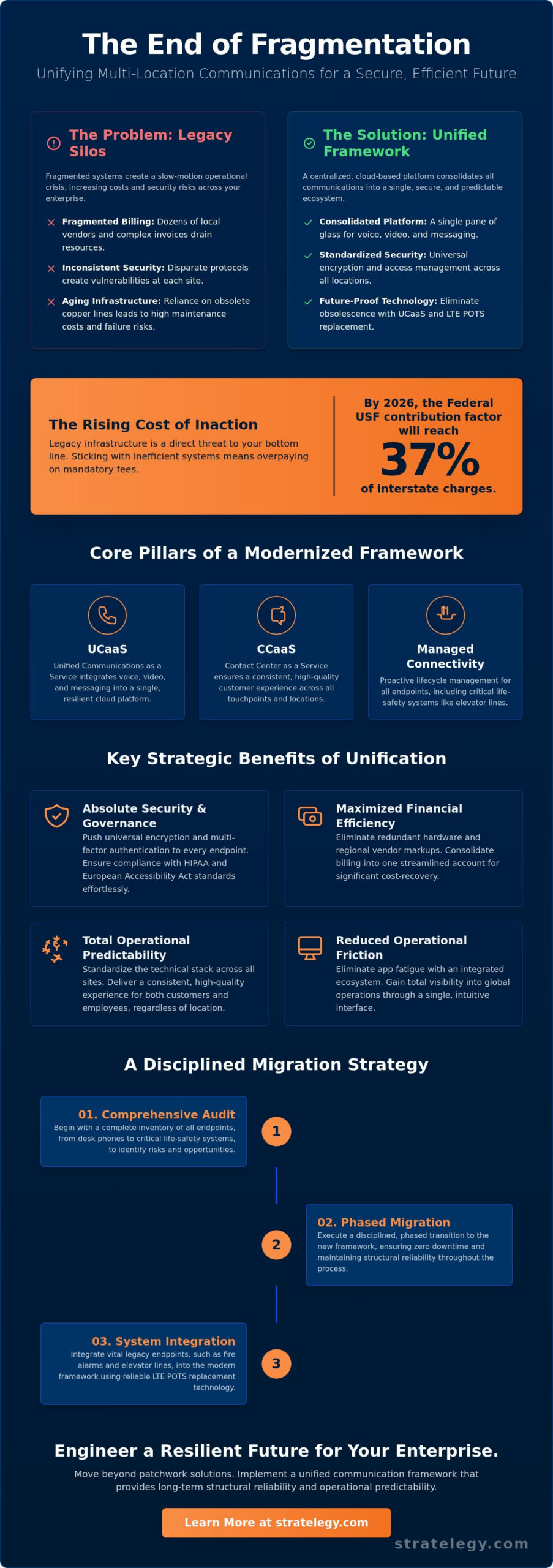
Why are you still paying for the technical debt of dozens of local vendors just to keep your satellite offices connected? If you’re managing fragmented billing and inconsistent security protocols across several sites, you’re likely facing a slow-motion operational crisis. Implementing centralized communication for multiple locations isn’t just about software. It’s about structural reliability. In 2026, with the Federal Universal Service Fund contribution factor reaching 37 percent, the cost of sticking with inefficient legacy infrastructure has become a direct threat to your bottom line.
We understand the frustration of limited visibility into site-wide communications and the rising maintenance costs of aging copper lines. This strategic guide will teach you how to unify these disparate silos into a single, secure enterprise framework that ensures operational predictability across every location. We’ll examine how transitioning to UCaaS and LTE POTS replacement eliminates the fear of obsolescence while ensuring your business meets the latest HIPAA and European Accessibility Act standards. It’s time to move beyond superficial features and focus on the long-term health of your business infrastructure through disciplined engineering and proactive lifecycle management.
Key Takeaways
- Transition from fragmented, site-specific silos to a unified national architecture that consolidates voice, video, and messaging into a single, cloud-based platform.
- Learn how implementing centralized communication for multiple locations standardizes security protocols and encryption to ensure consistent governance across every site.
- Identify the operational risks of leaving critical life-safety systems on legacy copper infrastructure and how to integrate these vital endpoints into your modern framework.
- Follow a disciplined, phased migration strategy that begins with a comprehensive audit of all endpoints to eliminate downtime and ensure structural reliability.
What Is Centralized Communication for Multiple Locations?
Centralized communication for multiple locations is a strategic framework that consolidates voice, video, messaging, and critical infrastructure into a single, cloud-based platform. For decades, enterprises operated within site-specific silos. Each branch managed its own local PBX and disparate carriers, creating a fragmented network that was difficult to secure and expensive to maintain. By 2026, this model has become a liability. The complete sunset of legacy copper networks has forced a transition toward a unified national architecture. This shift ensures that every endpoint, from an office desk phone to an emergency elevator line, operates within a controlled and predictable ecosystem.
This modernized approach relies on three core components: UCaaS, CCaaS, and managed connectivity. These pillars replace the fragility of local hardware with the resilience of the cloud. By integrating these services, businesses eliminate the risks associated with aging infrastructure. They gain total visibility into their global operations through a single pane of glass. It’s no longer about managing individual parts; it’s about engineering a foundational system that supports long-term growth.
The Evolution of the Multi-Site Communication Model
The transition from decentralized local vendors to a single point of strategic oversight represents a fundamental shift in business engineering. Historically, geographic boundaries dictated technical limitations. Today, the role of unified communications as a service is to dissolve these boundaries. It allows for a seamless flow of data and voice across thousands of miles. This evolution isn’t just about software updates. It’s about moving toward a model where hardware lifecycle management and systematic updates are handled at the enterprise level rather than site by site.
Core Pillars of a Centralized Framework
A robust Unified Communication Framework provides two primary advantages for national operations. First, it enables consolidated billing and vendor management. Instead of processing dozens of invoices from regional carriers, your finance team manages one streamlined account. Second, it establishes unified security protocols. Centralization allows for universal encryption standards and strict access management. This ensures every location adheres to current regulatory requirements, such as the 2026 HIPAA revisions and the European Accessibility Act, without requiring manual intervention at each individual site.
The Strategic Benefits of a Unified Communication Framework
Security and governance are where the centralized model truly excels. Modern regulatory landscapes, such as the 2026 HIPAA Privacy Rule revisions regarding substance use disorder records, require precise control over data disclosure. A centralized framework allows your technical team to push universal encryption standards and multi-factor authentication protocols to every endpoint simultaneously. This proactive stance on compliance mitigates the risk of localized security breaches that often plague decentralized networks. It’s about moving from a reactive “patchwork” mentality to a disciplined, engineered defense.
Financial efficiency is a direct result of consolidation. Maintaining dozens of local service contracts is administratively heavy and technically inefficient. By 2026, the Federal USF contribution factor has climbed to 37 percent of interstate charges. Businesses that fail to optimize their traffic through a single enterprise provider are often overpaying on these pass-through fees. Evaluating your current infrastructure can reveal significant cost-recovery opportunities by eliminating redundant legacy hardware and regional vendor markups.
Reducing Operational Friction and App Fatigue
Fragmented software ecosystems lead to cognitive overload. Implementing a unified communications and collaboration platform solves this by replacing multiple disparate apps with one cohesive interface. This streamlines coordination between regional hubs and headquarters. It ensures that internal data doesn’t get trapped in site-specific silos. It’s about engineering a workflow that prioritizes clarity over complexity.
Data Centralization and Business Intelligence
Bridging the Gap: Integrating Legacy Systems and Critical Infrastructure
The “elephant in the room” for many enterprise migrations is the survival of decentralized life-safety systems. While office phones move to the cloud, critical lines for fire alarms and elevators often remain tethered to aging copper infrastructure. This creates a systemic vulnerability. Implementing centralized communication for multiple locations requires a comprehensive strategy that accounts for every physical endpoint. Relying on legacy copper in 2026 is a gamble against infrastructure decay and rising maintenance costs. You need a solution that brings these mission-critical systems into your unified management framework.
Achieving 100 percent uptime for emergency lines requires a shift to cellular-based alternatives. These systems provide a redundant, secure bridge that allows for centralized monitoring of safety protocols across every site in your portfolio. By removing the dependency on local exchange carriers, you gain total oversight of your facility’s safety status from a single dashboard. This is foundational engineering. It’s about ensuring your most vital communication channels are as modern and reliable as your executive suite’s video conferencing tools.
Modernizing Critical Infrastructure with POTS Replacement
A successful pots line replacement strategy is a prerequisite for total facility centralization. You can’t claim to have a unified network if your fire panels and fax machines still run on 20th-century technology. Transitioning to cellular-based “POTS in a Box” solutions provides the stability your business needs. These units act as a direct replacement for traditional lines. They offer the same dial-tone functionality with significantly higher reliability and lower long-term costs. If you’re ready to eliminate legacy hardware risks, contact our team for a comprehensive infrastructure audit.
Unifying the Customer Experience with CCaaS
Centralization also extends to how you interact with your clients. Using a cloud contact center allows you to manage customer engagement across all locations from a central hub. This eliminates the need for site-specific staff to handle every localized inquiry. Implementing universal queueing and intelligent routing ensures calls reach the best available agent, regardless of their physical location. This strategy ensures a consistent brand voice and faster resolution times across your entire national footprint.
Executing the Transition: A Managed Approach to Global Connectivity
Transitioning to centralized communication for multiple locations requires a disciplined execution roadmap. You can’t rely on luck when migrating enterprise infrastructure. The process begins with a comprehensive audit of every communication endpoint across your entire footprint. This includes not just office handsets, but also legacy fax machines, fire panels, and elevator alarms. Identifying these dependencies early prevents the “dark site” scenarios that often plague unmanaged migrations.
Once the audit is complete, a phased migration plan ensures operational continuity. We recommend moving non-critical office voice services to UCaaS first, followed by a systematic integration of life-safety lines. This methodical approach avoids the downtime associated with a “big bang” switchover. After the migration, your team must implement centralized governance and universal security protocols. Finally, establishing a recurring maintenance framework ensures your infrastructure remains healthy and predictable for years to come.
The Stratelegy Difference: Engineering for Reliability
We don’t view ourselves as simple service providers. We are foundational engineers dedicated to enterprise stability. While many vendors focus on software features, we prioritize the underlying structural reliability. Our proprietary maintenance frameworks are designed to deliver 99.999% uptime. This level of precision equates to less than six minutes of downtime per year. It’s the difference between a system that merely works and one that provides total peace of mind for business owners.
Future-Proofing Your Enterprise Infrastructure
True centralization involves anticipating regulatory and technological shifts. In 2026, compliance with the European Accessibility Act (EAA) and updated HIPAA privacy rules is mandatory. A centralized framework allows you to push these compliance updates across every location from a single point of control. We also implement a predictable hardware update policy. This systematic approach eliminates the fear of obsolescence and ensures your business is always operating on cutting-edge, secure technology.
Secure Your Enterprise Infrastructure for 2026 and Beyond
Unifying your national footprint isn’t just a technical upgrade. It’s a strategic necessity for long-term operational health. You’ve seen how consolidating disparate billing cycles and security protocols eliminates the chaos of decentralized management. By replacing aging copper lines with resilient, cellular alternatives, you ensure that even your most critical life-safety systems remain functional and compliant. Transitioning to centralized communication for multiple locations allows your leadership to focus on growth rather than managing the technical debt of legacy silos.
Success in this transition requires a partner who prioritizes foundational engineering over superficial features. We provide enterprise-grade UCaaS and CCaaS reliability, ensuring your voice and data systems operate with 99.999% uptime. Our specialized LTE POTS replacement services bridge the gap for critical infrastructure, offering national scale with localized support and global coverage. We’re here to help you build a predictable, secure framework that stands the test of time.
Don’t let your business infrastructure become a collection of obsolete components. Take the first step toward a more disciplined and financially efficient future today.
Consult with a Stratelegy Expert on Your Multi-Location Strategy
Frequently Asked Questions
What is the difference between decentralized and centralized communication?
Decentralized models rely on site-specific hardware and fragmented regional carrier contracts, which creates operational silos. Centralized communication for multiple locations unifies these disparate systems into a single, cloud-native architecture managed from a headquarters level. This shift eliminates the need for localized maintenance and provides a consistent technical stack across the entire enterprise. It moves the focus from managing individual parts to overseeing a foundational, national network.
How does centralized communication improve security for multiple locations?
Centralization improves security by allowing for the universal enforcement of encryption standards and multi-factor authentication across all endpoints. Instead of managing security protocols site by site, your technical team can push updates and compliance patches simultaneously to every branch. This approach mitigates the risk of localized vulnerabilities and ensures that every location adheres to strict regulatory requirements like the 2026 HIPAA revisions and European Accessibility Act standards.
Can I keep my existing hardware when moving to a centralized cloud system?
Many modern IP-based handsets can be repurposed through firmware updates or specialized provisioning. However, legacy analog hardware often requires Analog Telephone Adapters or should be phased out as part of a systematic hardware update policy. We prioritize structural reliability, so we often recommend a phased replacement of aging equipment to ensure full compatibility with modern UCaaS features while eliminating the fear of sudden obsolescence.
How do I handle fire alarms and elevator phones in a centralized communication plan?
Critical life-safety lines like fire alarms and elevator phones are integrated using LTE POTS replacement technology. These cellular-based solutions provide a secure bridge that maintains dial-tone functionality without relying on legacy copper infrastructure. This allows you to monitor and manage these emergency endpoints through your central framework. It’s a proactive way to ensure 100 percent uptime and compliance with local fire codes across every site in your portfolio.
What is the ROI of centralizing communications for a multi-site business?
The return on investment stems from the elimination of redundant regional carrier contracts and the reduction of administrative overhead. By consolidating traffic, businesses can also optimize their Federal USF pass-through costs, which have reached 37 percent as of 2026. Additionally, the shift to a managed service model reduces the total cost of ownership by preventing expensive emergency repairs on legacy hardware and improving employee productivity through a unified, high-performance ecosystem.