
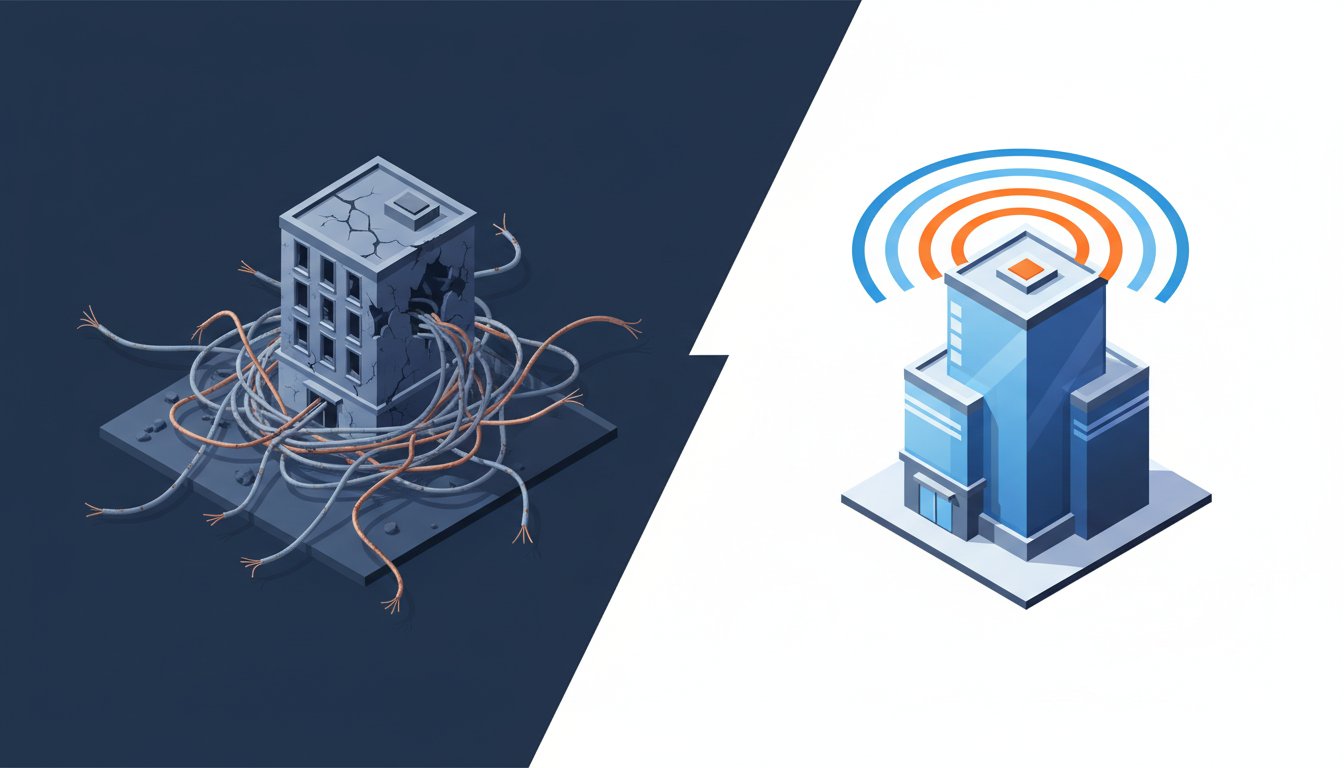
Maintaining a single legacy phone line can now cost your organization upwards of $2,700 per month. As major carriers like AT&T and Verizon aggressively decommission their networks through 2029, the physical copper wire degradation impact on business has shifted from a minor maintenance nuisance to a critical systemic liability. You’ve likely noticed the symptoms already: unexplained outages in your fire alarms, crackling elevator lines, and monthly invoices that increase by 200% or more without warning. It’s frustrating to pay premium prices for infrastructure that providers have essentially abandoned.
We understand that your priority is operational stability and regulatory compliance, not managing the decline of a century-old technology. This guide provides the technical clarity you need to understand the decay of your current systems and the strategic steps required to secure your operations. We’ll analyze the recent FCC regulatory shifts and provide a clear framework for migrating your critical life safety systems to reliable LTE POTS Replacement. This methodical approach ensures your business remains protected, compliant, and fiscally predictable without the risks associated with legacy hardware.
Key Takeaways
- Understand the physical copper wire degradation impact on business as a permanent state of oxidation and signal attenuation that traditional carriers have ceased to maintain.
- Identify the escalating financial risks associated with legacy POTS lines, including skyrocketing monthly recurring costs and the hidden expense of repeat technician visits.
- Recognize why life safety systems like fire alarms and elevator phones are at highest risk for silent failure on decaying copper infrastructure.
- Learn how to perform a comprehensive infrastructure audit to eliminate billing for “dark” lines and prioritize critical systems for migration.
- Discover how to transition to a reliable, engineering-first foundation using LTE POTS Replacement and modern UCaaS solutions.
The Physical Reality of Copper Wire Degradation in 2026
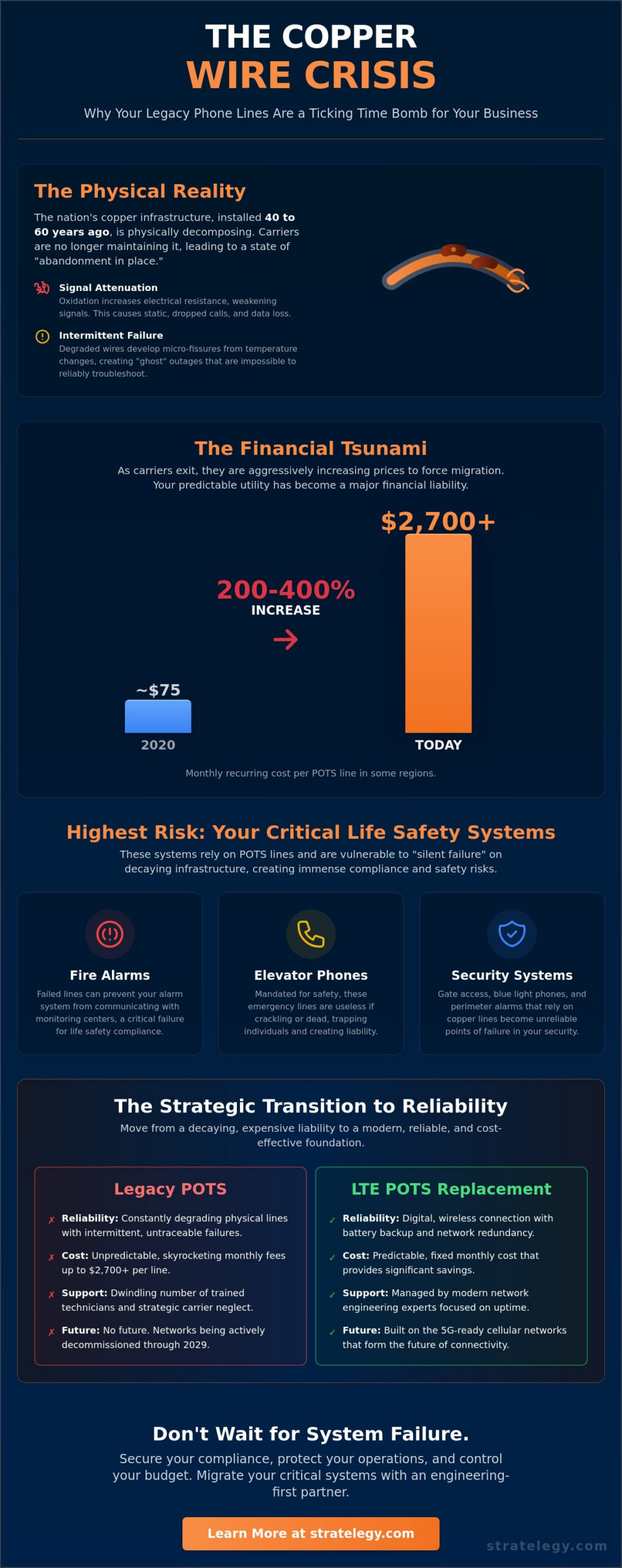
The year 2026 represents a critical tipping point for the nation’s telecommunications infrastructure. Most of the copper lines currently in the ground were installed between 40 and 60 years ago, far exceeding their intended operational lifespan. These cables were engineered for a different era of communication. Today, they face a slow but inevitable physical breakdown. The copper wire degradation impact on business isn’t just a theoretical concern; it’s the literal oxidation of your company’s connectivity. When moisture and soil acidity penetrate aging insulation, they trigger chemical reactions that compromise the metal’s integrity.
Carriers have largely adopted a strategy known as “abandonment in place.” Instead of investing in costly repairs for failing lines, they’re letting the infrastructure rot while focusing capital on fiber and 5G. This lack of maintenance accelerates the decay. As the physical properties of copper wire change due to environmental exposure, the infrastructure becomes incapable of supporting the voltage and clarity required for modern business systems. You aren’t just dealing with old tech; you’re dealing with a decomposing medium.
The Mechanism of Signal Decay
Signal decay begins when oxidation increases the electrical resistance within the wire. This process causes signal attenuation, where the strength of the transmission weakens as it travels. For voice calls, this manifests as static or “ghost” voices. For data-dependent systems, it results in packet loss and frequent disconnects. Several technical factors complicate this reality:
- Oxidation Resistance: Corroded copper requires more power to transmit data, often exceeding what legacy hardware can provide.
- Bridge Taps: Old, unused branches of the wire act as antennas, picking up electromagnetic interference that further drowns out the primary signal.
- Intermittent Failure: Thermal expansion and contraction cause micro-fissures in degraded wire. This creates outages that appear and disappear with the weather, making traditional troubleshooting nearly impossible.
Why Carriers Have Stopped Maintaining Copper
The “POTS Sunset” is no longer a future event; it’s a current operational policy. Major carriers have redirected their engineering teams away from legacy copper splicing. Finding a technician who’s trained in the specialized art of maintaining lead-sheathed copper is becoming increasingly difficult. This labor scarcity is intentional. Deregulation has removed the legal requirements for carriers to maintain these lines at a specific quality of service, allowing them to prioritize high-margin digital networks. The copper wire degradation impact on business is exacerbated by this strategic neglect. When a line fails today, the provider is more likely to offer a high-priced temporary fix or suggest you find a different solution entirely, rather than performing a permanent repair.
Operational and Financial Consequences for the Enterprise
The fiscal reality of maintaining analog infrastructure has reached an unsustainable peak. As carriers accelerate their exit from legacy systems, the copper wire degradation impact on business manifests as a direct assault on the bottom line. It’s no longer just about a failing wire; it’s about the systemic financial burden of supporting a platform that the industry is actively pricing into extinction. This persistent decay leads to service interruptions that compromise your daily operations and long-term profitability.
The Skyrocketing Cost of Legacy POTS
In 2020, a standard POTS line was a predictable utility expense. By May 2026, the landscape has shifted violently. Industry reports now show monthly recurring costs exceeding $2,700 per line in certain regions, representing a 200% to 400% increase in just six years. This isn’t accidental. Major providers are using price signaling to force enterprises toward modernizing communications networks. They’ve recognized that maintaining a $6 billion annual infrastructure is a liability. Consequently, they pass those costs to the remaining user base. Many businesses find themselves paying for redundant “just in case” lines that offer no actual reliability, creating a massive drain on capital that could be better spent on innovation.
Productivity Loss and Systemic Downtime
Operational friction is the silent killer of enterprise efficiency. When your point-of-sale (POS) systems or critical fax machines rely on degraded copper, every transaction becomes a gamble. Unreliable voice systems don’t just frustrate employees; they erode customer trust and damage your brand reputation. If a client can’t reach you because of a “static” line, they’ll call a competitor. The loss of a single hour of communication can cost a typical enterprise thousands in lost sales and delayed service delivery.
The strain on internal IT departments is equally severe. Teams are forced to manage failing legacy hardware and coordinate with carriers for technician visits that rarely result in permanent fixes. These visits are often hidden costs that don’t appear in the monthly bill but consume hundreds of billable hours annually. Transitioning to unified communications as a service removes these physical failure points entirely. By shifting to a digital-first architecture, you eliminate the hardware vulnerabilities inherent in aging copper. If you’re ready to stabilize your budget and ensure predictability, auditing your legacy lines is the first step toward reclaiming operational control.
The Critical Vulnerability: Fire, Life Safety, and Security Systems
Legacy infrastructure poses the greatest threat where it remains most invisible: within your emergency systems. Fire alarm panels, elevator phones, and security monitoring are the highest-risk assets currently tethered to aging cables. While a crackling voice line is an inconvenience, a failed emergency transmission is a catastrophic liability. The copper wire degradation impact on business becomes life-critical when these systems fail to communicate with central monitoring stations during a crisis. These failures often occur without warning, leaving facilities vulnerable during the exact moments they require protection.
Many facility managers mistakenly believe that dial-tone presence equals system readiness. It doesn’t. Modern life safety systems require specific voltage and signal clarity that oxidized copper can no longer guarantee. This has led to a major regulatory shift. The National Fire Protection Association (NFPA) and various local jurisdictions increasingly favor cellular and LTE communicators. When skeptics ask if cellular is as reliable as the “old copper line,” the answer is rooted in modern engineering. LTE networks offer superior uptime and supervised connectivity that legacy wires, prone to physical decay and theft, simply cannot match.
Compliance Risks and Insurance Liabilities
Liability doesn’t end with a service contract. If an emergency call fails because of known infrastructure decay, facility managers face massive legal exposure. Insurance providers are increasingly scrutinizing legacy infrastructure as part of their risk assessment. They recognize that rotting copper is a systemic risk; some may even deny claims or increase premiums if building systems aren’t modernized. Implementing pots line replacement isn’t just a technical upgrade. It’s a fundamental requirement for maintaining building certifications and satisfying the stringent risk-mitigation standards of modern carriers and underwriters.
Silent Failures in Emergency Infrastructure
Voltage drop is the primary culprit in emergency system failure. As resistance increases in degraded lines, fire panels often lack the electrical “push” to successfully dial out. This creates a silent failure. The panel may appear normal, but it’s effectively isolated from the world. Elevator entrapment scenarios become significantly more dangerous when the emergency phone is connected to rotting copper. Periodic testing, once the gold standard, is no longer sufficient. Infrastructure in an advanced state of decay can fail between test cycles, making real-time supervised LTE solutions the only viable path for ensuring constant protection.
Strategic Transition: Moving Beyond Legacy Infrastructure
Legacy infrastructure requires a calculated exit strategy. Transitioning away from failing copper is no longer an optional upgrade; it’s a necessary maneuver to protect your operational continuity. The copper wire degradation impact on business has reached a level where reactive repairs are mathematically impossible to justify. Success depends on a structured, engineering-first approach that replaces systemic vulnerability with modern reliability. You must move from a state of constant troubleshooting to a state of managed predictability.
A phased migration plan minimizes disruption while addressing the most critical risks first. This process begins with a comprehensive technical assessment of your current environment. By categorizing every connection by its function and criticality, you can ensure that life safety systems are modernized without delay, while voice and data systems are migrated to more efficient platforms. Verification is the final, non-negotiable step. Every new installation must undergo rigorous signal strength testing and redundancy validation to ensure it meets the high standards your business requires.
Auditing Your Legacy Footprint
Identifying every active copper circuit in a multi-site enterprise is a complex undertaking. Many organizations are plagued by “billing ghosts”—lines that appear on monthly invoices but no longer serve a functional purpose. These are often remnants of previous fax machines, DSL connections, or discontinued security panels. Mapping legacy lines to specific business functions allows you to prune unnecessary costs and focus your migration resources on active infrastructure. A thorough audit often reveals significant immediate savings by simply disconnecting abandoned circuits that have survived through years of billing inertia.
Choosing the Right Replacement Technology
The solution must match the application. While fiber and VoIP are excellent for standard office connectivity, life safety systems require the specialized resilience of LTE POTS Replacement. These “POTS in a Box” solutions simulate the electrical characteristics of a copper line while transmitting data over secure cellular networks. For voice-heavy operations, implementing cloud contact center solutions provides the scalability and feature set that analog hardware simply cannot match. It’s critical to ensure that any LTE communicator used for fire or life safety includes integrated battery backups to maintain operation during power outages, satisfying NFPA requirements. If you’re ready to eliminate infrastructure risk, schedule an infrastructure audit with our strategic specialists to begin your transition.
Future-Proofing with Stratelegy: LTE POTS and UCaaS
Mitigating the copper wire degradation impact on business requires more than a simple patch; it demands a complete structural reimagining. Stratelegy approaches this transition through a lens of engineering discipline rather than simple sales. By replacing volatile analog circuits with a managed digital foundation, we provide the predictability that modern enterprises require for long-term growth. This move eliminates the fear of obsolescence and secures your critical communication channels against the physical decay of the public switched telephone network. We don’t just provide a service; we build a resilient infrastructure that stands as the backbone of your operations.
Our methodology focuses on achieving excellence through engineering. We recognize that your business relies on more than just “working” phones. You need a system that adheres to strict security, governance, and predictability standards. This proactive stance allows us to anticipate the infrastructure problems you haven’t encountered yet, ensuring that your transition to modern technology is both disciplined and secure. By moving away from the systemic vulnerabilities of rotting copper, you gain a partner dedicated to the long-term health of your business infrastructure.
The Stratelegy LTE Advantage
Our LTE POTS Replacement technology is built on the principle of redundant reliability. Unlike standard consumer-grade cellular bridges, our communicators feature dual-path redundancy and integrated battery backups. These technical specifications ensure uninterrupted service during power failures or localized network congestion, which is vital for fire and life safety compliance. We handle the technical heavy lifting of the transition, from the initial site audit to final regulatory verification. Our focus remains steadfast on regulatory compliance and security, providing a level of oversight that legacy carriers have long since abandoned. We’re committed to ensuring that every device we deploy meets the rigorous standards required for enterprise-grade protection.
Structural Reliability Over Superficial Features
We identify as foundational engineers rather than just service providers. While many tech companies focus solely on the novelty of superficial software features, we prioritize the structural reliability of your communications ecosystem. Integrating UCaaS and CCaaS into your workflow creates a seamless environment for modern business collaboration, but the true value lies in the managed maintenance we provide. Our proprietary maintenance frameworks and systematic hardware update policies ensure your infrastructure remains current and secure without requiring constant internal oversight.
This shift to a fully managed cloud ecosystem delivers a superior return on investment. It stabilizes your monthly telecommunications budget and eliminates the unpredictable costs associated with emergency legacy repairs. The result is a steady, logical, and highly organized communication flow that mirrors the predictability we promise in all our services. You can finally move forward with confidence, knowing your infrastructure is managed by strategic specialists who prioritize stability over all else. Protect your critical infrastructure with Stratelegy’s LTE POTS Replacement and secure the future of your enterprise communications today.
Securing a Resilient Foundation for Enterprise Connectivity
The physical decay of analog networks is an irreversible reality. The copper wire degradation impact on business extends far beyond static on a line; it threatens your regulatory standing and monthly operational budget. Staying on legacy hardware is a choice to accept systemic vulnerability. By auditing your current footprint and prioritizing life safety systems, you can eliminate the risks of silent failures and skyrocketing costs.
Stratelegy provides the engineering expertise required to navigate this transition with precision. Our enterprise-grade LTE POTS replacement solutions and proprietary managed maintenance frameworks ensure your infrastructure remains compliant and predictable. We specialize in fire and life safety compliance, providing the technical oversight necessary to protect your people and your assets. Audit your legacy infrastructure with a Stratelegy specialist today to reclaim control of your communications environment. You don’t have to manage the decline of legacy technology alone. Modernizing your infrastructure is the most effective way to ensure long-term stability and peace of mind.
Frequently Asked Questions
Why is my business phone line crackling or cutting out?
Physical oxidation of aging infrastructure is the primary cause of audio interference and dropped connections. When moisture and environmental acidity penetrate decades-old insulation, the copper wire begins to decompose. This chemical breakdown increases electrical resistance and creates the “static” you hear during calls. The copper wire degradation impact on business is often first noticed through these intermittent signal failures that traditional carriers can no longer permanently repair.
What does the “POTS Sunset” mean for my building’s fire alarm?
The POTS Sunset represents the formal decommissioning of the copper network by major telecommunications carriers. For your fire alarm, this means the traditional path to the central monitoring station is being eliminated. As carriers stop maintaining these lines, your system faces a higher risk of silent failure. Transitioning to an LTE POTS Replacement ensures your life safety systems remain compliant with NFPA standards and stay connected through modern wireless networks.
Is LTE more reliable than copper for emergency elevator phones?
LTE provides superior reliability because it bypasses the physical vulnerabilities of rotting underground cables. While legacy copper is prone to water damage, soil shifts, and even theft, cellular networks offer supervised connectivity that alerts you immediately if a connection is lost. Our enterprise-grade LTE solutions include dual-path redundancy and battery backups. These features ensure that emergency phones remain operational during power outages or localized infrastructure failures.
How much can I save by replacing my copper lines with LTE?
Replacing legacy infrastructure often leads to a significant reduction in monthly recurring costs. Carriers are aggressively raising rates on remaining copper lines to encourage migration, with some monthly bills exceeding $2,700 per line. By switching to LTE, you eliminate these artificial price hikes and the hidden costs of repeat technician visits for unfixable hardware. Most organizations see a stabilized telecommunications budget and a clear return on investment within the first year of the transition.
Does my fire insurance require me to upgrade from copper lines?
You should review your specific policy, but many insurance providers are now scrutinizing legacy infrastructure as a systemic risk. If a fire alarm fails to communicate during an emergency due to known copper wire degradation impact on business, your organization could face massive legal and financial liability. Upgrading to a supervised LTE communicator demonstrates proactive risk management. This move helps satisfy the stringent safety requirements of modern underwriters and building inspectors.
What happens if the cellular network goes down during an emergency?
Enterprise-grade LTE communicators use multi-carrier SIM cards and dual-path technology to prevent outages. If one carrier’s tower experiences an issue, the device automatically switches to the strongest available signal from a different provider. Combined with robust battery backups that meet life safety regulations, these systems provide a level of uptime that aging copper wires simply cannot match. This redundancy is a core pillar of our engineering-first approach to infrastructure stability.
Can I keep my existing phone numbers when moving to a digital system?
Yes, you can retain all your existing phone numbers through a process called Local Number Portability. Whether you are migrating to UCaaS for your office staff or LTE for your emergency lines, your numbers stay with your business. We coordinate the “porting” process with your current carrier to ensure a seamless transition. This preserves your brand identity and ensures that customers and emergency services can still reach you without any configuration changes.
How long does it take to transition an enterprise from copper to LTE?
The timeline for a strategic transition depends on the complexity of your infrastructure and the number of sites involved. A typical enterprise rollout begins with a comprehensive audit of existing lines, which usually takes one to two weeks. Once the audit is complete, a phased migration can often be executed over several weeks. This methodical approach ensures that critical life safety systems are prioritized and that there is zero downtime for your daily business operations.