
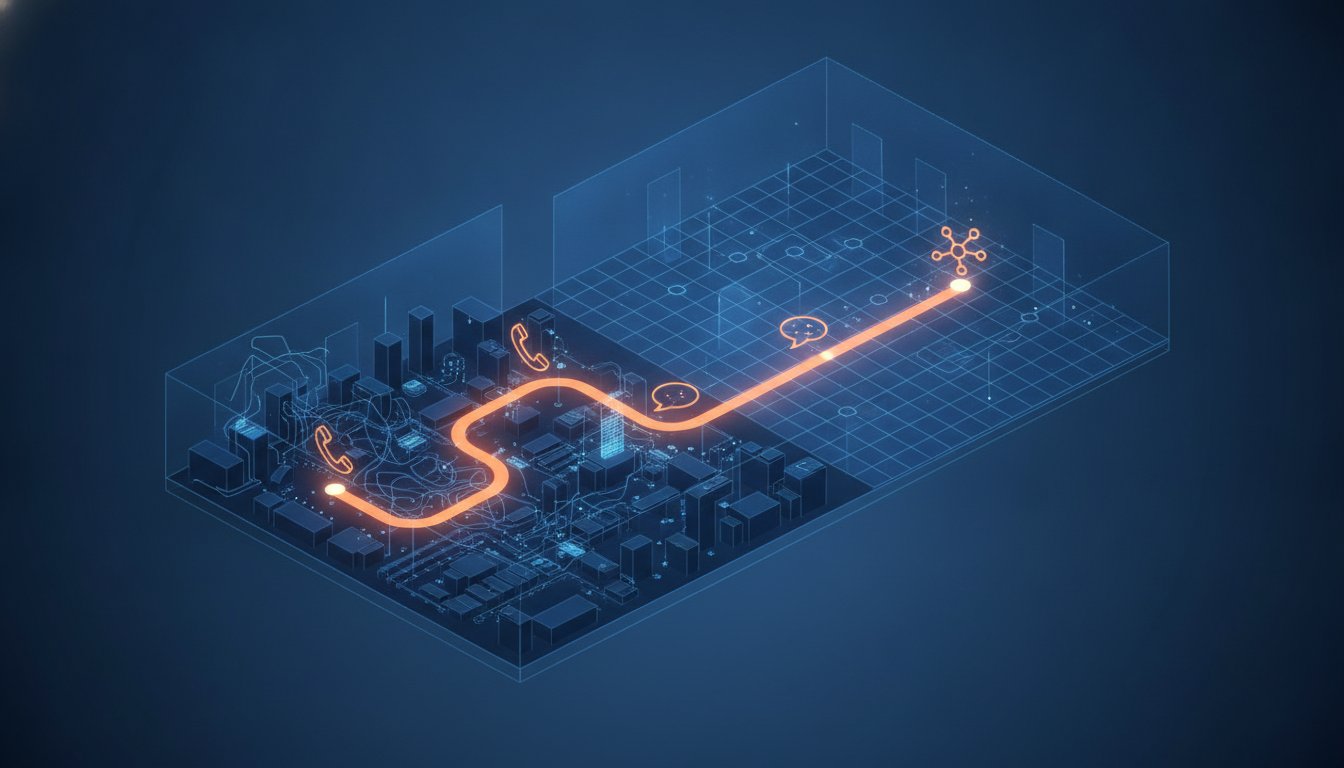
Most customer journey maps are nothing more than expensive wall art that fails to change a single operational outcome. They look impressive in a boardroom but offer zero guidance when an agent is forced to toggle between three different legacy screens to solve a simple billing issue. You’re likely dealing with fragmented customer data and inconsistent experiences across voice and digital channels. It’s frustrating to know your CX strategy is sound while your infrastructure remains stubborn. Scaling these efforts often feels impossible without a clear way to measure the ROI of your initiatives.
This guide moves beyond the whiteboard to help you master the technical and operational architecture required for customer journey mapping for contact centers. We’ll provide a clear roadmap for mapping every touchpoint and a technical framework for journey orchestration. You’ll learn how to bridge the gap between legacy silos and modern CCaaS capabilities to improve First Call Resolution (FCR) and ensure long-term infrastructure stability. By the end, you’ll have the engineering blueprint needed to turn static diagrams into a live, predictable engine for customer success. We prioritize structural reliability over superficial features to ensure your center is ready for the 2026 landscape.
Key Takeaways
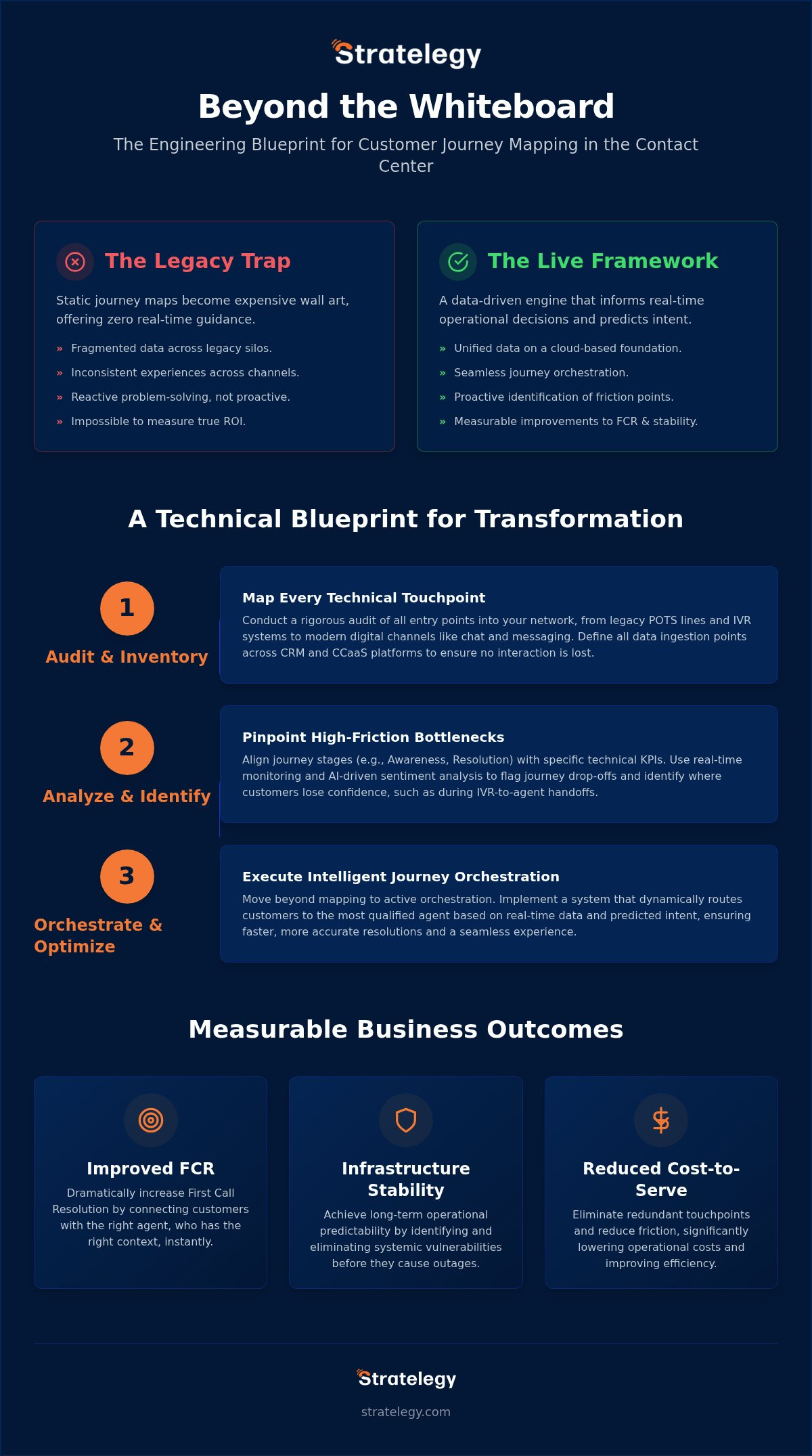
- Transition from static, visual diagrams to live, data-driven frameworks that inform real-time operational decisions across the enterprise.
- Master the technical architecture for customer journey mapping for contact centers by auditing every touchpoint from legacy POTS lines to modern digital channels.
- Eliminate the legacy trap by replacing fragmented analog infrastructure with a unified, cloud-based CCaaS foundation that enables seamless data ingestion.
- Implement journey orchestration to move beyond mapping, allowing your system to route calls to the most qualified agents based on real-time customer intent.
- Bridge the gap between technical governance and CX excellence to drive measurable improvements in First Call Resolution and operational predictability.
The Strategic Role of Customer Journey Mapping in 2026
Static diagrams belong in the archives. In a high-velocity enterprise environment, a visual representation of touchpoints is no longer sufficient for maintaining a competitive edge. Effective customer journey mapping for contact centers has evolved into a live, data-driven framework that operates in real time. It’s the difference between looking at a historical paper map and using a GPS with live traffic updates. You need a system that reflects the current state of your network, not a snapshot from a quarterly meeting.
Modern customer journey mapping must be grounded in actual data ingestion rather than anecdotal evidence or abstract persona workshops. We’ve shifted from merely tracking interactions to predicting intent. This proactive approach ensures infrastructure stability by identifying systemic vulnerabilities before they impact the bottom line. When you understand the technical path a customer takes, you can anticipate their needs and allocate resources with surgical precision. It’s about achieving excellence through engineering rather than reacting to failures.
Beyond CX: Why Journey Mapping is an Operational Necessity
Operational predictability is the primary beneficiary of a technical mapping framework. By identifying and eliminating redundant touchpoints, you significantly reduce the cost-to-serve. This isn’t just about the customer; it’s about the long-term health of your business infrastructure. When agents have a clear, data-backed view of the customer’s history, friction decreases. This improved context leads to higher agent retention rates. Your team spends less time fighting legacy data silos and more time resolving complex issues, which reinforces your reputation for reliability.
The 2026 Enterprise Context: Unified Engagement
The silos between internal and external communications are dissolving. The convergence of UCaaS and CCaaS creates a single source of truth for the entire organization. This structural reliability is essential for accurate customer journey mapping for contact centers. When your internal network and customer engagement platforms are integrated, data flows without friction. For a deeper look at the foundational technology involved, refer to our guide on Unified Communications as a Service (UCaaS): The 2026 Strategic Framework. This unified engagement model ensures every department is aligned with the actual path the customer takes, eliminating the fear of operational obsolescence.
A Technical Framework for Mapping Complex B2B Touchpoints
Precision engineering requires a complete inventory. You can’t optimize a journey if you haven’t identified every entry point into your network. Effective customer journey mapping for contact centers begins with a rigorous audit of all technical touchpoints. This includes everything from legacy POTS lines that still support critical infrastructure to modern cloud channels and international messaging platforms. Once you’ve mapped the hardware, you must define data ingestion points across your CRM and CCaaS platform. This ensures every interaction is captured and analyzed rather than lost in a silo.
Aligning journey stages like Awareness, Resolution, and Loyalty with specific technical KPIs transforms a map into a management tool. You need to implement real-time monitoring to identify journey drop-offs immediately. If a customer abandons a session during an IVR transition, your system should flag it as a technical failure rather than a lack of interest. Understanding the core elements of a customer journey map allows you to build a resilient architecture that supports business growth. If your current setup lacks this visibility, exploring enterprise-grade CCaaS solutions can provide the necessary data engine.
Identifying High-Friction Touchpoints
Bottlenecks often hide in the transitions. We use AI-driven sentiment analysis to flag these journey obstacles automatically. By analyzing the shift from self-service IVR to live agent assistance, you can pinpoint exactly where customers lose confidence. It’s not just about the outcome; it’s about the technical friction encountered along the way. Eliminating these hurdles ensures a predictable, professional experience that reflects your brand’s commitment to excellence and infrastructure stability.
Metrics that Fuel the Map
Traditional metrics are evolving. While CSAT remains useful, the Customer Effort Score (CES) has become the primary indicator of journey health in 2026. High effort usually signals a breakdown in technical orchestration or a failure in your data flow. First Call Resolution (FCR) acts as the ultimate validator of your journey’s accuracy. If your map is correct, your routing logic will ensure the customer reaches the right resource the first time, every time. This focus on efficiency drives long-term operational health and eliminates the fear of obsolescence.
Overcoming Data Silos: The Infrastructure Behind the Map
Data silos are structural failures that render even the most sophisticated strategies useless. When information is trapped within disconnected legacy systems, your view of the customer remains fragmented. Effective customer journey mapping for contact centers requires a unified data architecture that spans the entire enterprise. This isn’t a design challenge; it’s a foundational engineering requirement. You must replace the “Legacy Trap” of isolated hardware with an integrated CCaaS environment that prioritizes visibility and flow.
Modernizing your foundation involves moving toward an API-first architecture. This approach connects your contact center to the broader enterprise ecosystem, allowing for real-time data exchange between CRM, billing, and support platforms. As you integrate these systems, data governance and security must remain paramount. Ensuring compliance with regulatory standards like PCI DSS and GDPR is not optional. It’s a core component of a predictable, secure infrastructure that protects both the business and its customers.
The POTS Replacement Factor
Maintaining legacy copper lines is a significant operational risk that creates massive blind spots in your data collection. Analog infrastructure cannot transmit the rich metadata required for modern journey analytics. This technical debt prevents you from seeing the full picture of customer interactions. To understand how to eliminate these vulnerabilities, consult our guide on POTS Line Replacement: A Strategic Guide to Modernizing Enterprise Infrastructure in 2026. Upgrading to digital alternatives is the first step toward a transparent, data-driven network.
Integrating Voice and Digital Data
The wall between phone systems and digital support tickets must come down. A fragmented approach leads to inconsistent CX and frustrated agents who lack the necessary context to resolve issues quickly. Transitioning to integrated cloud contact center solutions provides the unified data lake required for accurate mapping. This centralized repository allows you to track a customer’s transition from a chat session to a live voice call without losing a single data point. If you’re ready to secure your infrastructure, partner with our technical experts to modernize your contact center today.
Executing Journey Orchestration with CCaaS
Mapping provides the blueprint. Journey orchestration is the active engine that drives operational results. It represents the critical transition from historical analysis to real-time intervention. By leveraging customer journey mapping for contact centers, modern CCaaS platforms route calls to the most qualified agent based on a customer’s current intent and past technical touchpoints. This ensures every interaction is handled with precision and professional authority. It shifts the focus from reactive service to proactive engagement.
Agents require immediate visibility to perform at peak efficiency. Modern agent context screens visualize the customer’s path across all channels in real-time. This eliminates the frustration of repetitive questioning and streamlines the resolution process. Stratelegy serves as the foundational engineer for these systems. We prioritize structural reliability and technical governance to ensure your contact center moves beyond simple dial tones toward a sophisticated engagement model. Our focus remains on the long-term health of your business infrastructure.
Predictive Routing and Journey Logic
Predictability is achieved through data. By using historical journey data, your CCaaS platform can anticipate why a customer is calling before the agent even answers. This proactive information delivery significantly reduces Average Handle Time (AHT). It allows your team to focus on high-value problem solving rather than manual data gathering. This result-oriented approach connects technical capabilities directly to long-term operational benefits and financial stability.
Continuous Optimization: The Lifecycle Approach
Excellence requires ongoing maintenance. Your journey map must be a living document that evolves alongside your CCaaS updates and shifting business requirements. Technical oversight and disciplined governance are non-negotiable for CX success in 2026. Stratelegy provides the expertise to manage this lifecycle, ensuring your systems remain modern, secure, and predictable. If you’re ready to build a more resilient future, partner with our technical experts to orchestrate your customer journeys.
Engineering a Resilient Future for Enterprise Engagement
Static diagrams are relics of the past. To maintain a competitive edge in 2026, your organization must embrace a live architecture that prioritizes data flow over visual aesthetics. Mastering customer journey mapping for contact centers requires a disciplined transition from legacy copper to modern cloud environments. This structural shift ensures that every touchpoint is captured, analyzed, and optimized for maximum operational impact. You’ve seen how legacy silos and analog infrastructure create vulnerabilities that no amount of superficial software can fix. Excellence is achieved through engineering rather than reaction.
Stratelegy acts as your strategic partner in this transformation. We provide the technical authority needed for seamless POTS replacement and enterprise-grade UCaaS/CCaaS integration. Our focus remains on infrastructure stability and security, ensuring your communication systems drive growth rather than introducing risk. It’s time to replace fragmented data with a unified engine for success. Modernize your contact center infrastructure with Stratelegy’s CCaaS solutions and build a foundation that won’t become obsolete. Your journey toward predictable, high-performance engagement begins with a stable technical framework.
Frequently Asked Questions
What is the difference between customer journey mapping and customer experience mapping?
Journey mapping focuses on the specific technical touchpoints and interaction paths a customer follows within your network. It’s a granular, data-driven look at the “how” and “where” of communication. Customer experience mapping is a broader, qualitative view of the customer’s emotional state and overall perception of the brand. For effective customer journey mapping for contact centers, you must prioritize the technical architecture that enables these specific interactions to occur without friction.
How often should an enterprise contact center update its journey map?
You should treat your journey map as a living technical document rather than a static annual project. Enterprise contact centers should review and update their maps at least quarterly or whenever a significant change occurs in their CCaaS platform. Continuous optimization ensures that your routing logic and data ingestion points remain aligned with current customer behaviors. Regular maintenance prevents the map from becoming obsolete as your infrastructure evolves and your business scales.
Can we map customer journeys if we still use legacy POTS lines?
You can attempt to map journeys with legacy POTS lines, but you’ll encounter significant data blind spots. Analog infrastructure lacks the metadata and signaling capabilities required for deep journey analytics. To achieve full visibility, you must replace legacy copper with digital alternatives like LTE POTS replacement or cloud-based engagement tools. Modernizing your foundation is the only way to ensure that every voice interaction is captured, tracked, and analyzed within your journey framework.
What technical tools are required for real-time journey mapping in 2026?
Real-time mapping in 2026 requires an integrated CCaaS platform with native AI orchestration and predictive routing capabilities. You need API-first architectures that connect your CRM directly to your communication channels to create a unified data lake. These tools allow for real-time intent detection and automated agent assistance. Without a modern cloud foundation, your mapping efforts will remain reactive rather than proactive, failing to provide the predictability required for enterprise-grade service.
How does customer journey mapping impact contact center ROI?
Customer journey mapping for contact centers directly impacts ROI by identifying and eliminating redundant operational costs and friction points. By improving First Call Resolution (FCR) and reducing Average Handle Time (AHT), you lower the cost-to-serve while increasing customer lifetime value. Predictable infrastructure also leads to higher agent retention and lower training costs. These efficiencies translate into measurable financial benefits and long-term business stability through engineered excellence.