
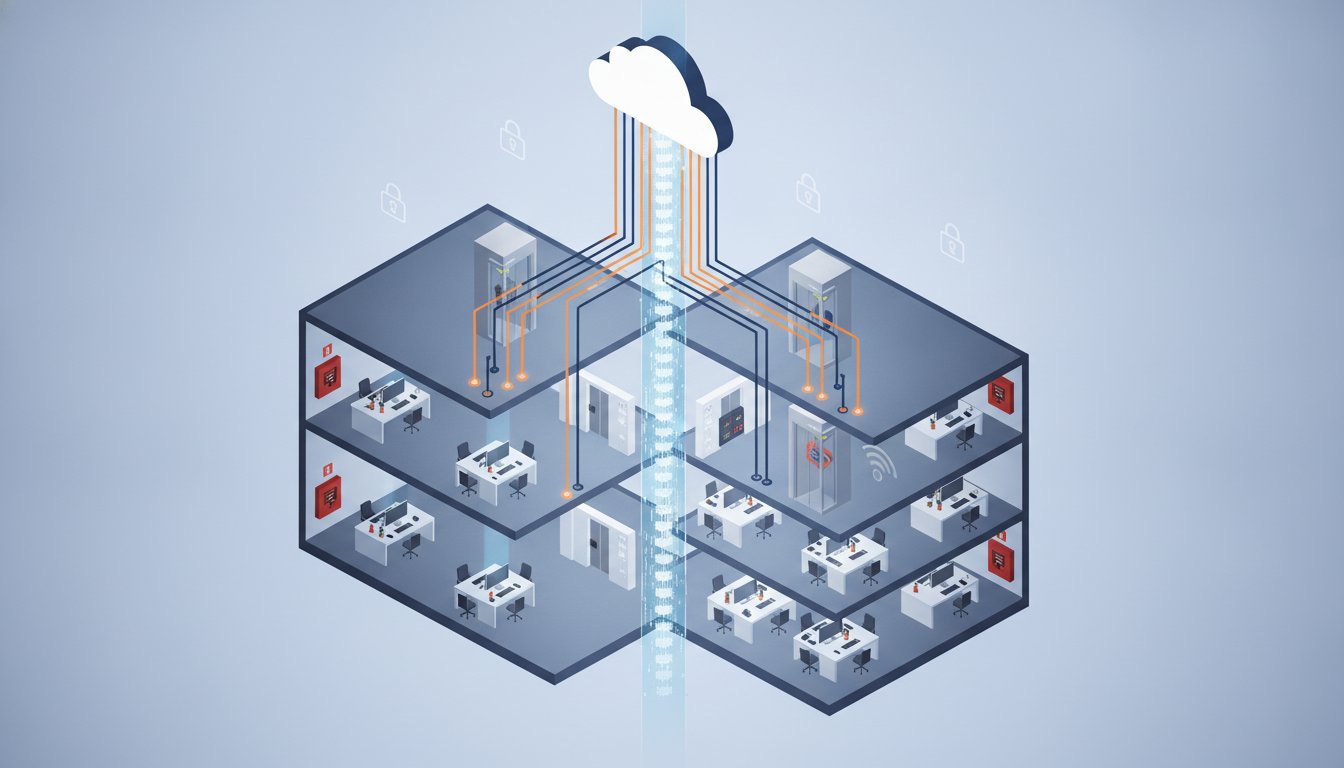
The most expensive mistake in 2026 isn’t choosing the wrong software features; it’s choosing a partner that treats your critical infrastructure as an afterthought. Most organizations have already moved to the cloud, yet many still struggle with fragmented apps and the looming fear of legacy system obsolescence. You need more than just a dial tone. You deserve a consolidated communication stack that actually works without sacrificing the reliability of your fire alarms, elevator phones, or life safety systems.
When evaluating unified communications vendors, the focus must shift from superficial bells and whistles to foundational engineering and long-term operational stability. It’s time to stop reacting to connectivity failures and start demanding predictable maintenance and rigorous security governance. This strategic framework will teach you how to audit vendors based on their ability to integrate with legacy hardware and their commitment to lifecycle management. We’ll break down the technical requirements for a resilient infrastructure that provides genuine peace of mind and eliminates the hidden costs of poor implementation. By the end of this guide, you’ll know how to move beyond sales demos to find a partner who prioritizes structural reliability over novelty.
Key Takeaways
- Learn why infrastructure stability and network backbone engineering are more critical for business continuity than a long list of software features.
- Discover a strategic framework for evaluating unified communications vendors that prioritizes end-to-end cybersecurity and proactive governance over basic encryption.
- Understand the necessity of integrating LTE POTS replacement into your communication stack to protect fire alarms, elevators, and other life safety systems.
- Shift from reactive patching to a long-term maintenance model that emphasizes hardware lifecycle management and predictable operational costs.
- Identify the specific markers of a foundational engineering partner who can bridge the gap between modern UCaaS platforms and critical legacy hardware.
The Shift in 2026: Moving Beyond the UCaaS Feature List
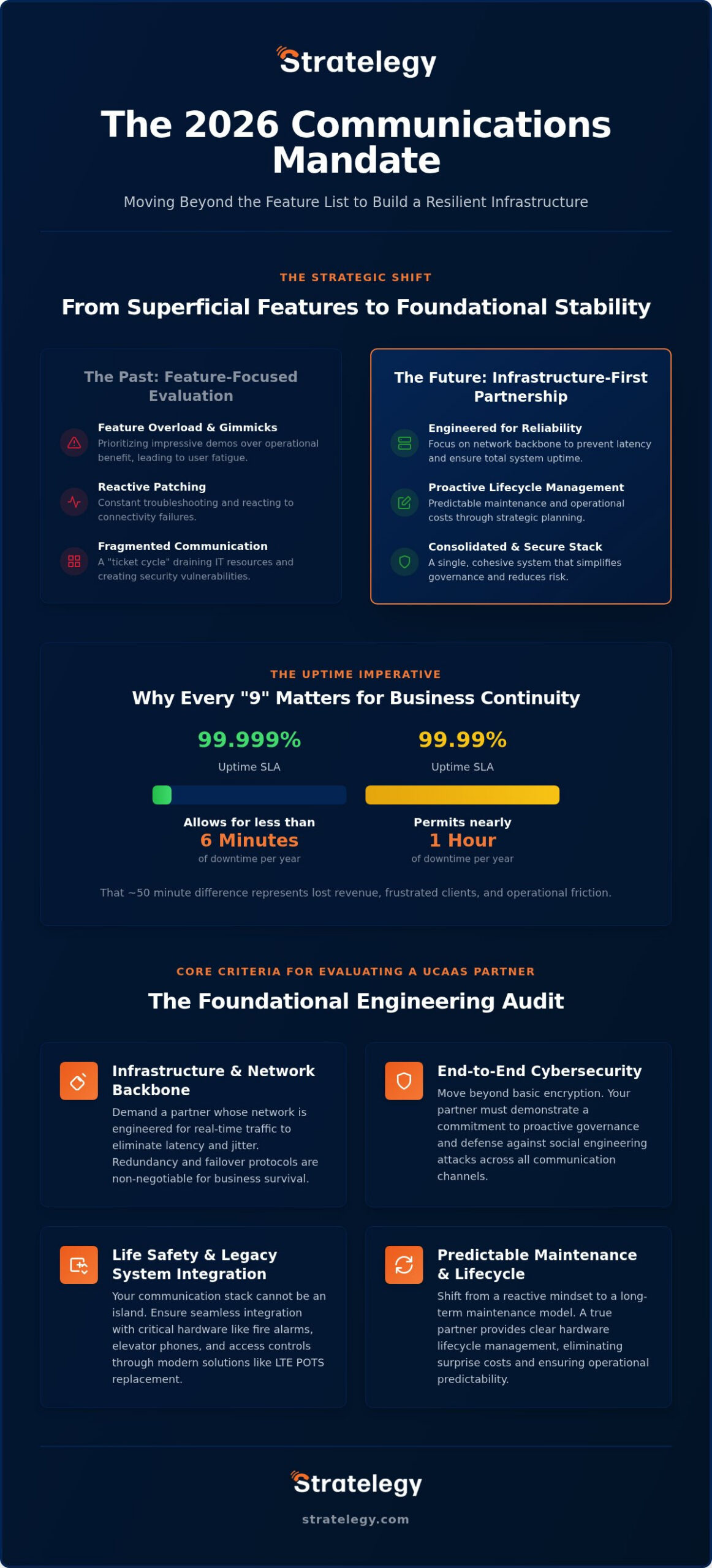
The market has matured. In 2026, Unified Communications (UC) is no longer a luxury or a novel experiment. With more than 90% of organizations now utilizing cloud-based communication, the baseline has shifted. Evaluating unified communications vendors today requires looking past the shiny interface to the underlying architecture. A simple dial tone is now a commodity; the real value lies in how voice, video, and data streams are synchronized to prevent latency and ensure total system reliability.
Feature overload has become a significant corporate liability. Many vendors prioritize AI-driven gimmicks that look impressive in a demo but offer little to no operational benefit. These “extra buttons” often lead to user fatigue rather than increased productivity. Instead of chasing the latest software trend, businesses must seek a strategic engineering partnership. Partners like IT Cloud Consulting help organizations adopt and optimize these technologies to ensure long-term stability. This shift moves the conversation from “what can the software do?” to “how will this infrastructure support my business for the next decade?” It’s the difference between buying a service and building a foundation.
Infrastructure vs. Interface: Where the Real Value Lies
Distinguishing between the visual “skin” of a platform and its technical “engine” is vital. While a sleek UI makes onboarding easier, it doesn’t guarantee that a call will stay connected during a network spike. When unified communications as a service is evaluated solely on aesthetics, the risk of downtime increases significantly. For instance, a 99.999% uptime SLA allows for less than six minutes of downtime per year. In contrast, a 99.99% SLA permits nearly an hour of annual failure. That difference represents lost revenue, frustrated clients, and operational friction.
The Cost of Fragmentation
Fragmented communication stacks create a “ticket cycle” that drains IT resources and slows down mid-sized organizations. Every time a user switches between a standalone video app and a separate messaging tool, context is lost and security vulnerabilities emerge. Consolidating into a single, engineered stack provides a measurable ROI through reduced context switching and simplified governance. Evaluating unified communications vendors based on their ability to unify these disparate channels into a cohesive system is the only way to achieve long-term predictability. A truly unified stack eliminates the need for constant troubleshooting, allowing your team to focus on growth rather than maintenance.
Core Criteria for Evaluating Enterprise UCaaS and CCaaS Vendors
Price is no longer the primary differentiator. When evaluating unified communications vendors, technical leaders must prioritize network architecture and engineering stability over introductory rates. A vendor’s backbone must be optimized for real-time traffic to eliminate the latency and jitter that disrupt professional communication. These technical metrics are the true indicators of a platform’s long-term viability and operational health.
Scalability is another non-negotiable factor. Your platform should handle global expansion and the sudden volume of an M&A transition without requiring a total infrastructure overhaul. This requires a solution that integrates deeply with existing workflows. For instance, an enterprise cloud contact center must communicate fluidly with your CRM and ERP to ensure data consistency across every touchpoint. Citing the Key Criteria for Evaluating UCaaS highlights that these integrations are now essential for maintaining competitive operational efficiency.
The Engineering Stability Audit
Redundancy isn’t just a checkbox; it’s a survival strategy. Ask potential partners about their specific failover protocols and how they maintain uptime during regional outages. A foundational engineer will understand your physical site needs, including how the cloud interacts with your local network hardware. Partnering with a strategic technical advisor can help you identify these infrastructure gaps before they become costly outages.
Cybersecurity as a Communication Foundation
Communication channels are the primary targets for social engineering attacks. Moving beyond basic encryption is mandatory. Your vendor must demonstrate a robust cybersecurity posture that includes end-to-end protection and strict governance. Verify that they meet industry-specific requirements like SOC2 and HIPAA to ensure your data remains secure and your organization stays compliant with evolving regulations. This disciplined approach to security eliminates the fear of obsolescence and builds a predictable environment for growth.
Critical Compliance: Life Safety and Legacy System Integration
A major oversight when evaluating unified communications vendors is ignoring the physical infrastructure that keeps a building safe. Most cloud-first providers focus on the desktop experience while neglecting the analog lines connected to your fire alarms and elevators. Legacy copper lines are no longer a reliable foundation; they are a liability. Carriers have largely abandoned the maintenance of these aging circuits, leading to skyrocketing costs and unpredictable failure rates that put your compliance at risk.
Integrating pots line replacement into your broader communication strategy is essential for 2026. This isn’t just about moving to the cloud. It’s about ensuring that critical life safety systems remain operational during a power outage or network breach. Modernizing this infrastructure doesn’t require ripping out expensive legacy hardware. Instead, it involves deploying specialized LTE solutions designed to mimic analog signals while providing the digital oversight and redundancy that modern regulations demand.
The Reality of Copper Obsolescence
The financial risk of relying on “maintenance-only” legacy line repair is unsustainable. As copper infrastructure degrades, the cost to keep these lines active increases without providing any improvement in service quality. LTE is the only viable path forward for fire and security connectivity because it bypasses the vulnerabilities of physical wire degradation and local exchange failures. Transitioning to a cellular-based backbone ensures your most critical signals always reach the monitoring station.
Bridging the Gap Between Analog and Cloud
Modern “POTS in a box” solutions serve as the bridge between your existing analog equipment and a high-speed digital network. These devices integrate seamlessly with modern UCaaS platforms, allowing for a consolidated management view of both your office phones and your life safety devices. This approach guarantees uptime during the transition from legacy to cellular by providing battery backups and dual-SIM redundancy. To ensure your infrastructure meets these rigorous standards, you should consult with a foundational engineering specialist who can audit your current connectivity.
The Strategic Partnership: Maintenance and Lifecycle Management
Implementation isn’t the finish line. Many organizations treat UCaaS as a simple utility, but this “set it and forget it” mindset leads to systemic decay and security vulnerabilities. When evaluating unified communications vendors, you must look for a partner who offers a rigorous lifecycle management framework. Reactive patching isn’t enough to protect a modern enterprise. You need proactive oversight that identifies potential failures before they impact your daily operations.
Hardware lifecycle management is often the weakest link in a communication strategy. Software moves fast; physical endpoints must keep pace. A vendor with a systematic hardware update policy ensures that your desk phones, conference room kits, and LTE gateways don’t become obsolete. This commitment to structural health prevents the security gaps that occur when aging hardware can no longer support modern encryption standards or regulatory requirements. A true technical specialist prioritizes the long-term health of your infrastructure over the short-term novelty of a sales demo.
Predictability Over Novelty
Systematic maintenance eliminates the shock of unbudgeted migrations and surprise downtime. By anticipating infrastructure problems, a partner provides the peace of mind that comes from a stable budget and a reliable network. You shouldn’t have to worry about emergency hardware replacements or sudden system failures. Predictability is the ultimate ROI in 2026. It allows your IT team to focus on strategic growth rather than constant firefighting.
Selecting Your Partner for 2026 and Beyond
The process of evaluating unified communications vendors should lead you to a foundational engineer, not just a service provider. Stratelegy prioritizes structural reliability and engineering excellence over superficial software features. We understand that your communication stack is only as strong as the network it runs on and the critical systems it supports. Our goal is to eliminate the fear of obsolescence through disciplined maintenance and proactive governance. The first step toward a resilient future is auditing your current stack for systemic vulnerabilities. Contact Stratelegy for a Strategic Infrastructure Audit to ensure your business is built on a stable foundation.
Building a Resilient Communication Foundation for 2026
Success in modern enterprise communication requires shifting your focus from superficial interface features to the structural integrity of your network. Evaluating unified communications vendors is a high-stakes decision that impacts your operational reliability and regulatory compliance. You must prioritize partners who understand the complex intersection of cloud software and physical infrastructure. This involves securing critical life safety systems through specialized LTE POTS replacement and implementing proprietary maintenance frameworks that prevent obsolescence.
Stratelegy takes an engineering-first approach to UCaaS and CCaaS, ensuring that your communication stack is built for longevity and security. We bridge the gap between cutting-edge collaboration tools and the foundational hardware that keeps your business running. Our expertise in critical infrastructure integration provides the peace of mind that comes from predictable oversight and disciplined governance. Don’t settle for a vendor-client relationship when you can have a strategic technical partnership focused on excellence.
Take the first step toward total infrastructure stability. Secure Your Critical Infrastructure with Stratelegy today and eliminate the risks of fragmented, aging systems. Your business deserves a foundation that is as ambitious as your future goals.
Frequently Asked Questions
What is the difference between a UCaaS provider and a UCaaS engineering partner?
A UCaaS engineering partner manages the foundational network architecture rather than just selling software licenses. While a standard provider delivers a cloud interface, a technical specialist ensures your physical environment and network backbone are optimized for real-time traffic. This methodology prioritizes long-term structural reliability and proprietary maintenance frameworks over simple subscription access. It’s the difference between buying a tool and building a resilient communication ecosystem.
Can I migrate my fire alarm and elevator phones to my new UCaaS platform?
You cannot directly connect fire alarms or elevator phones to a standard UCaaS platform because they require specialized analog-to-digital signaling. These critical systems need LTE POTS replacement solutions to maintain regulatory compliance and operational reliability. This hardware acts as a bridge, ensuring your life safety signals reach monitoring stations via cellular networks even during power or primary internet outages.
Why is POTS line replacement critical for my 2026 business communication strategy?
POTS line replacement is critical because legacy copper infrastructure has reached a point of total obsolescence. Carriers have largely stopped maintaining these circuits, which leads to unpredictable outages and inflated costs. Moving to LTE-based connectivity provides the digital redundancy required for fire and life safety compliance. It’s a necessary step when evaluating unified communications vendors to ensure your building systems don’t become a liability.
What security certifications should I look for when evaluating UC vendors?
You should prioritize vendors that hold SOC2 Type II, HIPAA, and industry-specific certifications like PCI DSS for payment security. These frameworks prove the vendor has undergone rigorous third-party audits of their security governance and data handling. When evaluating unified communications vendors, look for end-to-end encryption and a clear policy on regulatory compliance to protect your organization against social engineering and data breaches.
How does a unified communications platform reduce operational costs long-term?
A unified platform reduces costs by consolidating disparate service contracts and hardware into a single, predictable monthly expense. It eliminates the “ticket cycle” caused by fragmented apps and significantly reduces user context switching. Long-term savings also come from proactive lifecycle management and hardware update policies, which prevent expensive emergency migrations and minimize the financial impact of unbudgeted system downtime.