

Choosing the platform with the most impressive AI demo might be the fastest way to compromise your enterprise’s operational stability. Most leaders recognize that the race for AI-powered orchestration is essential, yet they rightly fear the hidden costs of modular licensing and the risk of system failure during a legacy transition. You need more than just a software vendor; you need an architecture that protects your existing life safety and security systems while you scale.
This technical guide provides a definitive evaluation of Genesys vs NICE for enterprise contact centers. It’s designed to help you choose a platform based on scalability, AI maturity, and long-term ROI. We will analyze the 2026 token and session-based pricing models, sovereign cloud options, and the critical role of LTE POTS replacement in maintaining connectivity. By the end, you’ll have a clear framework to modernize your contact center without sacrificing the foundational reliability that keeps your business running.
Key Takeaways
- Contrast the core architectural philosophies of Genesys and NICE to determine which platform better supports your enterprise orchestration goals.
- Review our technical breakdown of Genesys vs NICE for enterprise contact centers to understand the financial implications of 2026 consumption-based pricing.
- Identify the administrative overhead and hidden costs associated with modular CX suites versus all-in-one journey orchestration engines.
- Learn how to secure your critical fire and life safety systems during cloud migration through strategic LTE POTS replacement and network infrastructure hardening.
Navigating the CCaaS Giants: Genesys Cloud CX vs. NICE CXone
The enterprise contact centre market is no longer a fragmented field of experimental startups. In 2026, Genesys and NICE have solidified their status as the dominant CCaaS architects, holding a combined annual recurring revenue exceeding $5 billion. Migrating to a cloud contact center is now a strategic baseline for any organization prioritizing resilience over legacy constraints. These two leaders define the standard for what a modern engagement platform must achieve.
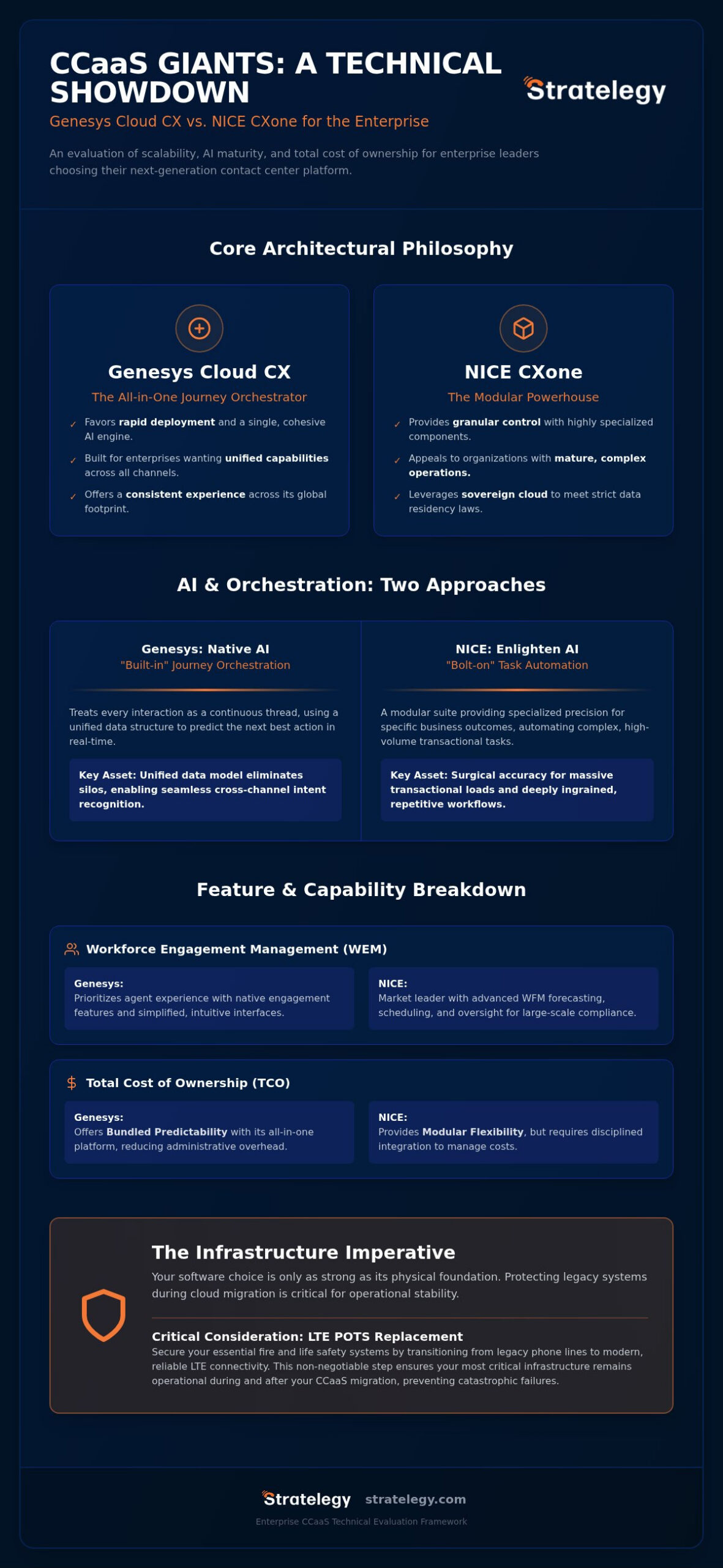
The fundamental choice between Genesys vs NICE for enterprise contact centers often hinges on a preference for architectural philosophy. Genesys Cloud CX operates as a unified, all-in-one journey orchestrator. It favors organizations that value rapid deployment and a single, cohesive AI engine. Conversely, NICE CXone functions as a modular powerhouse. It provides granular control for leaders who require highly specialized components for complex, high-volume operations.
Market Positioning and Enterprise Fit
Genesys focuses on speed and innovation. Its platform is built for enterprises that want to deploy unified AI capabilities across all channels without managing disparate modules. NICE appeals to organizations with mature operational requirements. They often choose NICE for its industry-leading workforce management (WFM) and deep interaction analytics. This modularity allows for precision, though it requires more sophisticated internal administration and vendor management to maintain peak efficiency.
Scalability and Global Reach
Both vendors offer extensive global infrastructure, but their execution differs. Genesys provides a consistent experience across its worldwide footprint, which simplifies management for multinational teams. NICE leverages its sovereign cloud solutions in regions like the EU and Australia to meet strict data residency laws. Integrating these platforms with unified communications as a service ensures that your back-office experts and front-line agents remain synchronized. This structural alignment is the only way to guarantee predictable performance at a global scale.
AI and Orchestration: Comparing Core Functional Philosophies
AI is the engine of the 2026 contact center, but its implementation defines the operational ceiling of your enterprise. When evaluating Genesys vs NICE for enterprise contact centers, the distinction lies in how AI interacts with your data. Genesys Cloud CX utilizes a native AI journey orchestration model. It treats every interaction as a continuous thread, using a unified data structure to predict the next best action in real-time. This “built-in” approach reduces the friction typically found when syncing disparate tools.
NICE CXone approaches AI through its Enlighten engine. This modular suite provides specialized precision for specific business outcomes. While Genesys focuses on the flow, NICE excels at automating complex, high-volume transactional tasks with surgical accuracy. This “bolt-on” modularity gives leaders granular control over which processes to automate, though it requires a more disciplined integration strategy to avoid operational silos.
Journey Orchestration vs. Task Automation
Genesys’s unified data model is its greatest asset for journey mapping. It eliminates data silos, allowing AI to recognize a customer’s intent across multiple touchpoints simultaneously. NICE, however, remains the leader in task-level automation. Its platform is engineered to handle massive transactional loads, making it ideal for enterprises with deeply ingrained, repetitive workflows that demand absolute consistency across thousands of monthly interactions.
The Role of Workforce Engagement Management (WEM)
Operational success depends on agent performance. NICE continues to dominate the market with its industry-leading WFM tools, offering advanced forecasting and scheduling for global teams. Genesys counters with native engagement features that prioritize agent experience and simplified interfaces. For remote and hybrid workforces, Genesys often provides a more intuitive environment, while NICE offers the oversight tools necessary for large-scale compliance. If you’re struggling to align these software capabilities with your physical network, our team provides enterprise-grade CCaaS integration expertise to bridge the gap.
Total Cost of Ownership: Bundled Predictability vs. Modular Flexibility
Enterprise leaders often focus on per-user licensing fees while ignoring the systemic costs of administration and legacy maintenance. Evaluating Genesys vs NICE for enterprise contact centers requires a deep dive into Total Cost of Ownership (TCO). In 2026, both vendors have pivoted toward consumption-based AI models, yet their financial philosophies remain distinct. Choosing between them involves balancing the simplicity of a bundled contract against the precision of a modular stack.
Genesys Pricing Logic: Tokens and Tiers
Genesys Cloud CX utilizes a tiered bundling strategy that prioritizes financial predictability. Their token-based AI model allows organizations to draw from a shared resource pool, which simplifies contract management across diverse departments. This structure eliminates the need for constant auditing of individual feature usage. It’s an ideal fit for enterprises seeking a single, manageable invoice that covers the majority of their orchestration needs without the risk of unexpected monthly spikes.
NICE Pricing Logic: Modular Precision
NICE CXone favors modular precision through its session-based pricing model. This a-la-carte approach allows departments like healthcare or finance to pay only for the advanced analytics or industry-specific bundles they actually use. However, this flexibility introduces administrative complexity. Forecasting spend becomes a challenge when session rates fluctuate based on volume commitments. Enterprises must account for the “hidden” labor costs of managing multiple modules and monitoring data portability fees for recording exports.
True operational savings extend beyond the software layer. Reducing long-term expenses requires addressing the physical infrastructure that supports your facility. Implementing POTS line replacement for fire, life safety, and security systems is a critical step. This modernization eliminates the high costs of maintaining obsolete copper lines while ensuring your facility remains compliant during your cloud transition. If you need assistance navigating these technical and financial hurdles, our experts can help you modernize your critical infrastructure with confidence.
The Infrastructure Factor: Why Software Choice Requires Hardware Stability
Infrastructure dictates performance. Software is only as resilient as the physical hardware that supports it. A cloud-native platform won’t compensate for a failing local network or obsolete copper lines. When comparing Genesys vs NICE for enterprise contact centers, leaders often overlook the physical facility. True operational excellence requires a synchronized approach where software innovation meets infrastructure stability.
Life Safety and Critical Connectivity
Maintaining legacy copper lines for fire and security systems during a CCaaS transition creates systemic risk. These aging circuits are increasingly unreliable and expensive to maintain. Cellular-based LTE POTS replacement provides the confidence and peace of mind required for 2026 enterprise uptime. It ensures that critical life safety systems remain operational even if the primary internet connection falters. This redundancy is not a luxury; it’s a regulatory necessity for modern facilities.
The Stratelegy Advantage: Engineering the Foundation
We position ourselves as foundational engineers rather than simple software vendors. Stratelegy manages the entire lifecycle of your connectivity, bridging the gap between high-level CCaaS software and specialized technical infrastructure. Our focus on regulatory compliance and security ensures that your migration is grounded in structural reliability. We prioritize the long-term health of your business infrastructure over superficial feature sets.
Before finalizing your choice between Genesys vs NICE for enterprise contact centers, ensure your facility is prepared with this infrastructure checklist:
- Audit Legacy Lines: Identify all copper circuits used for fire, life safety, and elevator alarms.
- Network Capacity: Verify IT network infrastructure can handle increased VoIP and AI data loads.
- Redundancy: Implement LTE POTS replacement to secure critical backup connectivity.
- Physical Layer: Assess structured cabling and fiber integrity to support high-density agent environments.
Building a Resilient Foundation for Your CX Evolution
Modernizing an enterprise contact center involves more than a software subscription. It requires a strategic alignment of AI-driven orchestration and physical network stability. Whether your organization prioritizes the unified journey mapping of Genesys or the modular precision of NICE, the success of your migration depends on the health of your underlying infrastructure. Choosing between Genesys vs NICE for enterprise contact centers is a strategic decision that impacts long-term ROI and operational security.
Stratelegy bridges the gap between high-level CCaaS software and foundational engineering. Our technical authority in CCaaS and UCaaS migrations ensures that your transition is predictable and secure. We specialize in LTE POTS replacement to protect your critical fire and life safety systems, providing the peace of mind that comes with a modernized, compliant facility. Don’t leave your infrastructure to chance. Design your enterprise-grade communication framework with Stratelegy and ensure the long-term health of your business today.
Frequently Asked Questions
Is Genesys or NICE better for global enterprise scalability in 2026?
Platform choice depends on your specific management structure. Genesys offers a unified global footprint that simplifies administration for multinational teams. NICE provides specialized sovereign cloud solutions in regions like the EU and Australia, which is essential for enterprises with strict data residency mandates. Both support massive seat counts, but NICE often excels in environments requiring deep, department-specific customization across diverse geographic locations.
What are the main differences between Genesys Cloud CX and NICE CXone pricing?
Predictability and flexibility are the primary differentiators. Genesys uses a tiered, token-based model that bundles features into a single contract, which simplifies long-term financial forecasting. NICE utilizes a session-based, modular approach where you pay specifically for the capabilities each department requires. When comparing Genesys vs NICE for enterprise contact centers, don’t ignore the administrative labor needed to audit NICE’s complex usage reports and billing spikes.
How do Genesys and NICE handle AI and journey orchestration?
Orchestration and automation define these two competing philosophies. Genesys prioritizes native journey orchestration through a unified data model, allowing AI to track customer intent across all touchpoints in real-time. NICE focuses on precision through its Enlighten AI engine, which excels at automating complex, high-volume transactional tasks. While Genesys provides a more cohesive flow for customer experience, NICE offers granular control for leaders who need to automate specific, data-heavy workflows.
Why is POTS replacement critical when moving to a cloud contact center?
Stable physical foundations are required for zero downtime. Legacy copper lines for fire alarms and security systems are increasingly unreliable and expensive. Implementing LTE POTS replacement provides cellular-based redundancy that secures your facility’s life safety infrastructure. This modernization eliminates the risk of communication failure during a cloud migration. It’s the most reliable way to ensure software innovation is supported by structural reliability.
Can I integrate my existing CRM with both Genesys and NICE?
Major CRM integrations are natively supported by both vendors. Genesys offers over 600 pre-built apps, while NICE maintains around 400. These integrations allow for seamless data synchronization between your contact center and customer records. When evaluating Genesys vs NICE for enterprise contact centers, review the specific API documentation so you don’t face excessive development costs. This ensures your proprietary systems maintain long-term connectivity.