
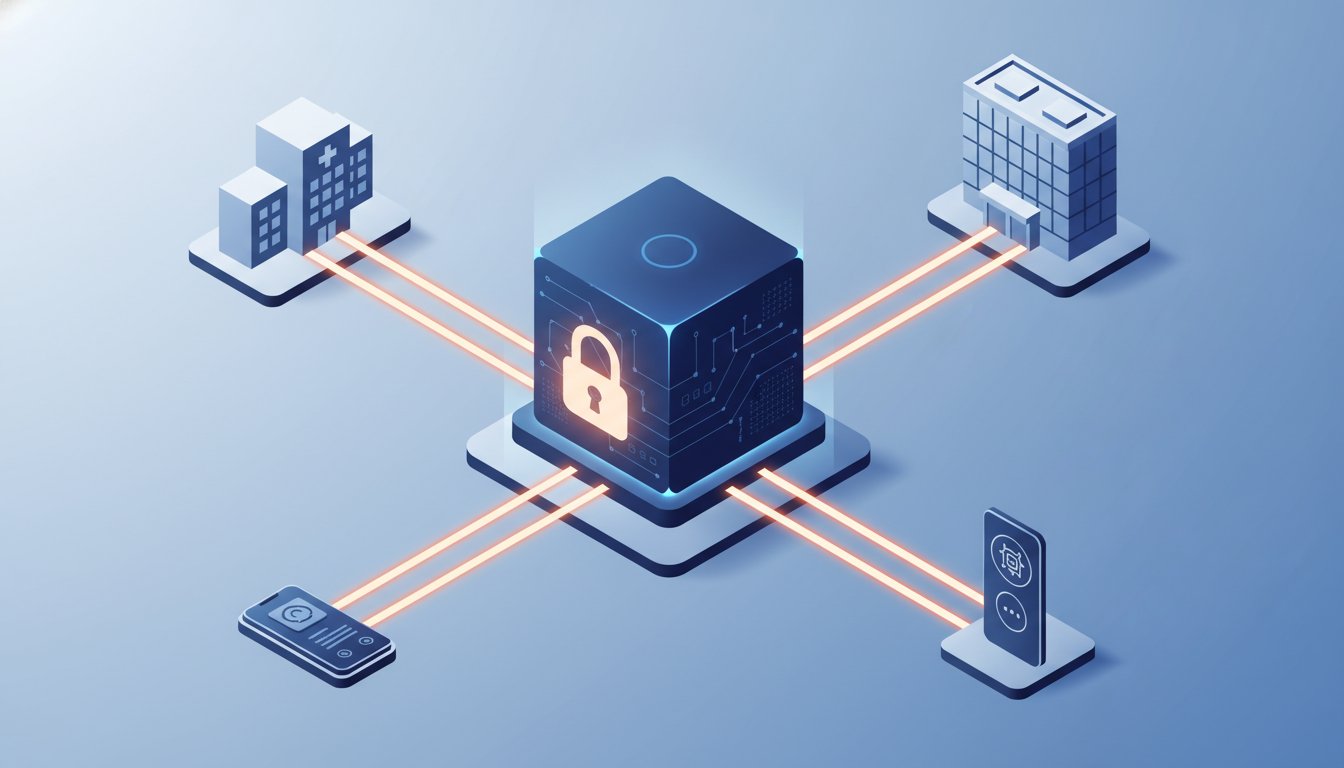
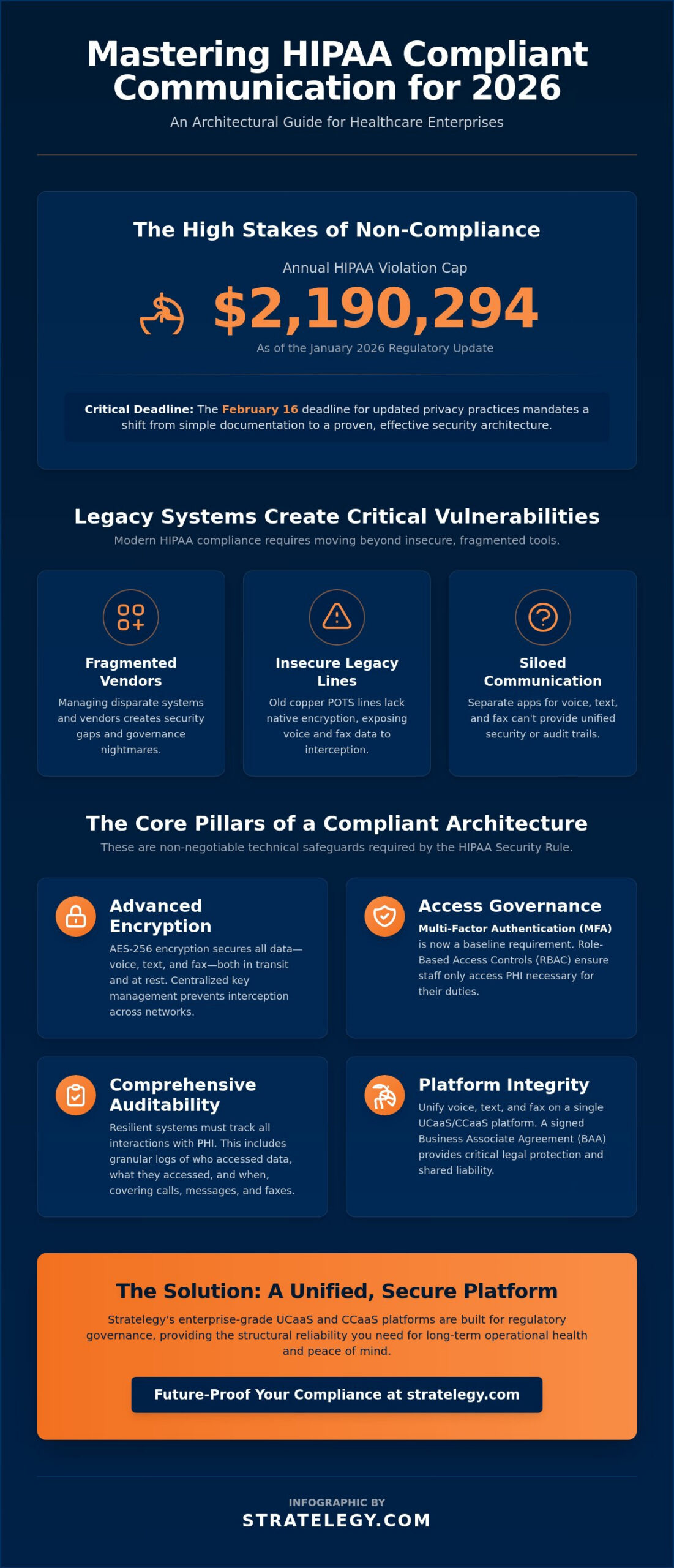
The annual cap for HIPAA violations has reached $2,190,294 as of the January 2026 regulatory update. This financial reality makes hipaa compliant business communication more than a checkbox; it’s a foundational requirement for your organizational stability. You’re likely feeling the pressure of managing fragmented vendors and insecure legacy hardware while facing the February 16 deadline for updated privacy practices. It’s exhausting to maintain security across disparate systems that weren’t built for modern governance.
We recognize that your priority is predictable, secure operations that protect your patients and your bottom line. This strategic guide will help you master the 2026 technical requirements, including mandatory multi-factor authentication and encryption protocols. We’ll explore how to consolidate your voice, text, and fax into a single platform through UCaaS and CCaaS. You’ll learn to future-proof your infrastructure with LTE POTS replacement while securing the legal protection of signed Business Associate Agreements. This methodical approach ensures your communication ecosystem remains resilient against both cyber threats and regulatory scrutiny.
Key Takeaways
- Understand why HIPAA compliance in 2026 requires an architectural standard for your entire ecosystem rather than a simple software feature.
- Learn to unify your security protocols across all channels to maintain hipaa compliant business communication for voice, video, and fax.
- Identify the operational risks of legacy copper lines and how LTE POTS replacement provides the encryption necessary for modern regulatory standards.
- Develop a strategic roadmap for decommissioning insecure hardware and conducting comprehensive audits of your communication touchpoints.
- Discover how enterprise-grade UCaaS and CCaaS platforms offer the structural reliability and governance needed for long-term operational health.
Defining HIPAA Compliant Business Communication for 2026
Infrastructure stability is the new compliance. In 2026, the Office for Civil Rights (OCR) prioritizes the effectiveness of your security program over simple documentation. This shift mandates a move away from legacy hardware that lacks native encryption. Achieving true hipaa compliant business communication requires moving beyond siloed messaging apps to a unified framework. It’s an architectural standard that ensures Protected Health Information (PHI) remains secure during every second of transmission. You can’t rely on reactive software patches anymore. You need a system where technical, physical, and administrative safeguards are active by default.
Modern Health Insurance Portability and Accountability Act (HIPAA) standards demand proactive governance across your entire stack. Compliance covers every channel your team uses: voice, video, fax, messaging, and even emergency lines. Most organizations make the mistake of focusing only on text messaging. A truly resilient architecture encompasses voice and data in a single, managed environment. This holistic approach is foundational for hipaa compliant business communication in the modern enterprise.
What Constitutes PHI in Digital Communication?
PHI is more than just a patient’s medical record or history. It includes names, dates, and any identifiers shared over any medium. Modern enforcement now scrutinizes metadata as well. Call logs, timestamps, and the duration of a communication are all protected data points. Standard consumer-grade apps fail the security test because they don’t offer the granular control needed to secure this metadata. They lack the enterprise-grade encryption required for both transmission and storage. If your system can’t account for who accessed a call log and when, it isn’t compliant.
The Role of the Business Associate Agreement (BAA)
A BAA is your legal foundation. It’s a contract that establishes a chain of trust between your organization and your technology partners. Without a signed BAA, a vendor isn’t compliant, regardless of their encryption levels. This agreement creates a shared liability model. When you partner with Stratelegy for UCaaS or CCaaS, the BAA ensures we’re technically and legally accountable for the security of your data. It transforms a simple vendor relationship into a strategic partnership focused on long-term governance and predictability. This legal protection is essential for any organization looking to eliminate the risk of massive fines.
The Core Pillars of a Compliant Communication Architecture
A resilient communication architecture isn’t built on software features alone. It’s built on structural reliability and rigorous technical safeguards. The 2026 enforcement environment requires every enterprise to move beyond basic compliance toward a robust, managed framework. To achieve true hipaa compliant business communication, your organization must anchor its strategy in four core pillars: encryption, access control, auditability, and data integrity. These aren’t suggestions; they’re the required technical safeguards dictated by the HIPAA Security Rule. When these pillars are engineered into the foundation of your unified communications, you eliminate the systemic vulnerabilities that lead to costly data breaches.
Advanced Encryption Standards (AES-256)
Encryption in transit and at rest is a non-negotiable standard for modern healthcare. We utilize AES-256 encryption to secure every data packet, whether it’s a voice call, a text message, or a digital fax. This end-to-end protection is necessary because information travels across diverse cloud and cellular networks before reaching its destination. Stratelegy secures these pathways by managing encryption keys with high-level discipline. In 2026, secure key management is just as important as the encryption algorithm itself. Without centralized key governance, your encrypted data remains vulnerable to sophisticated interception during its lifecycle.
User Authentication and Access Governance
Access controls ensure that only authorized personnel can interact with sensitive data. Multi-Factor Authentication (MFA) has moved from a recommendation to a baseline requirement for healthcare organizations. We implement Role-Based Access Control (RBAC) to ensure your staff only sees the information necessary for their specific duties. This discipline limits unnecessary exposure and reduces the risk associated with compromised credentials. Additionally, automatic log-offs on shared workstations prevent unauthorized access in high-traffic clinical environments. If you’re looking to upgrade your structural reliability, our enterprise UCaaS solutions integrate these governance features by design.
Audit controls provide a traceable, immutable history of all communication activities. If an incident occurs, your organization must be able to demonstrate exactly who accessed specific information and when. This transparency is vital for regulatory predictability and long-term legal protection. Finally, data integrity protocols ensure that patient information isn’t altered during transmission or storage. These four pillars work in tandem to create a secure environment that protects your patients and your operational health. By focusing on engineering excellence rather than just software novelty, you can build a communication system that stands up to the most rigorous audits.
Beyond Messaging: Securing Voice and Critical Infrastructure
Legacy systems are the silent failure points in your compliance strategy. While many organizations focus on securing chat and email, they often leave their voice and critical infrastructure exposed. Analog copper lines are increasingly difficult to maintain and nearly impossible to secure under modern standards. Achieving true hipaa compliant business communication requires a move toward digital, encrypted pathways for every signal that leaves your building. This includes not just your desk phones, but also your fire alarms, elevator lines, and security systems. You can’t claim compliance if your voice traffic is vulnerable to simple interception.
Aging copper infrastructure represents a systemic vulnerability. These legacy lines lack the native encryption needed to prevent eavesdropping during transmission. To align with the HIPAA Security Rule implementation guidance, organizations must ensure that all electronic protected health information (ePHI) is shielded, even when it’s transmitted via voice or fax. Transitioning to LTE-based infrastructure eliminates these physical security gaps and provides the structural reliability your facility requires. It’s a shift from fragile hardware to a managed, software-defined environment.
LTE POTS Replacement for Healthcare Facilities
Critical life safety lines shouldn’t be left to chance. Fire alarms, security panels, and elevator emergency phones require absolute uptime and modern connectivity. Our pots line replacement solutions use LTE technology to bypass the failing copper grid entirely. Cellular networks offer a more resilient and secure path for emergency signals. This transition doesn’t just improve reliability; it future-proofs your facility against the total obsolescence of analog infrastructure. We act as foundational engineers to ensure these critical lines remain active and compliant during every emergency.
VoIP and UCaaS: The Secure Alternative
Standard consumer voip services often lack the granular security controls necessary for medical environments. Enterprise-grade UCaaS platforms centralize your security management into a single, governed interface. This allows IT directors to monitor access logs and enforce encryption protocols across voice, video, and messaging from one dashboard. Virtual faxing is another critical component of this unified approach. By converting analog fax into encrypted digital transmissions, you ensure that sensitive documents are never left sitting on a communal tray. This level of technical oversight is what defines modern hipaa compliant business communication. It’s about engineering a system where security is the foundation, not an afterthought.
Building Your Compliance Roadmap: A 2026 Implementation Guide
Operational excellence requires a structured plan. Your roadmap for hipaa compliant business communication must be proactive and disciplined. It starts with a total inventory of your technical touchpoints. You cannot protect what you haven’t mapped. This guide provides the framework for transitioning from legacy vulnerabilities to a governed, modern architecture. By following a systematic implementation strategy, you eliminate the guesswork and ensure your organization meets the latest regulatory standards with confidence.
Auditing Your Communication Stack
Hidden risks often reside in the most mundane places. Unencrypted fax machines and standalone analog lines are frequent entry points for security breaches. Evaluating unified communications as a service vendors requires looking past superficial features to their core security architecture. You must verify their BAA readiness and technical certifications before integration. The “set it and forget it” mentality is a dangerous myth in 2026. Compliance requires ongoing oversight and periodic audits to ensure your technical safeguards remain effective against evolving threats. A truly secure stack is one that is constantly monitored and maintained.
Decommissioning legacy hardware is the next priority. If a device cannot support modern encryption or multi-factor authentication, it’s a liability that must be removed. Replacing these aging components with LTE-based solutions or secure VoIP ensures your infrastructure remains resilient. Continuous monitoring and regular risk assessments provide the predictability your business owners demand. To begin your infrastructure transformation, partner with our foundational engineers today.
Training for Human-Centric Compliance
Software is only one part of the equation. Human behavior remains a critical variable in your security posture. Staff must understand the distinction between secure internal channels and standard external communication. Best practices for mobile device management (MDM) are essential in clinical settings where personal devices might interact with patient data. Your goal is to build a culture of security where every employee understands their role in protecting PHI. This includes regular phishing awareness training and clear protocols for device loss or theft. Compliance is a collective responsibility rooted in discipline and education. When your team is trained to recognize risks, they become your strongest line of defense against cyber threats.
- Conduct comprehensive audits of all voice, fax, and messaging touchpoints.
- Identify hardware that lacks AES-256 or MFA capabilities for immediate replacement.
- Verify that every vendor in your communication chain has signed a current BAA.
- Establish a recurring schedule for security risk assessments and staff training.
Stratelegy: Enterprise-Grade UCaaS Built for Regulatory Governance
Stratelegy delivers more than software. We provide the structural reliability required to maintain hipaa compliant business communication at an enterprise scale. Our approach is rooted in the long-term health of your business infrastructure. We act as your strategic partner, ensuring that every component of your stack meets the rigorous technical standards of 2026. This isn’t about superficial features; it’s about engineering a predictable environment where security and governance are the baseline. We prioritize engineering over sales to ensure your organization remains resilient against both cyber threats and regulatory scrutiny.
Unified Communications for Modern Healthcare
Fragmented systems create security gaps that legacy vendors often ignore. By utilizing our cloud contact center, organizations can improve patient engagement without compromising data integrity. This framework integrates voice, video, and messaging into a single, compliant dashboard. It eliminates the need for multiple communication vendors, which simplifies your audit trail and centralizes governance. As your trusted technical advisor, we ensure that your CCaaS and UCaaS platforms are hardened against modern threats. This unified approach provides the visibility IT directors need to maintain high-level technical authority over their entire ecosystem. It’s a managed solution designed for the lifecycle of your business.
Secure Your Infrastructure Today
Consolidating your vendors under one compliant provider is a strategic move for operational stability. It reduces the complexity of managing multiple Business Associate Agreements and ensures a consistent security posture across your organization. Whether you’re implementing LTE POTS replacement for life safety lines or migrating to a unified cloud platform, Stratelegy provides the signed BAAs and proactive maintenance frameworks you need. We prioritize engineering excellence to eliminate the fear of obsolescence and regulatory fines. Our proprietary maintenance frameworks ensure your hardware and software remain in a state of constant readiness.
A secure infrastructure is the foundation of business predictability. When you eliminate systemic vulnerabilities, you gain the confidence to focus on patient care and operational growth. Our role is to anticipate the technical challenges you haven’t encountered yet, providing a managed solution that grows with your enterprise. We focus on specialized technical niches and specific regulatory certifications to mark our place as a deeply technical, compliance-oriented voice. Don’t let legacy hardware or fragmented apps compromise your mission. Modernize your HIPAA compliant infrastructure with Stratelegy and secure your organization’s future today.
Engineering a Resilient and Compliant Ecosystem
Compliance isn’t a static goal; it’s a continuous state of operational health. As you navigate the 2026 regulatory landscape, the shift from fragmented legacy systems to a unified, encrypted architecture is essential. Consolidating your voice, text, and fax into enterprise-grade UCaaS and CCaaS platforms eliminates the security gaps found in siloed applications. Simultaneously, implementing LTE POTS replacement ensures that your critical life safety lines remain active and secure during any emergency. This transition replaces fragile hardware with a managed, software-defined environment built for longevity.
Achieving hipaa compliant business communication requires a partner who understands the intersection of engineering and governance. Our expert technical advisors focus on the 2026 requirements, providing the signed BAAs and proactive maintenance your business owners demand. This methodical approach transforms compliance from a source of fear into a foundation for long-term predictability. It’s time to move beyond superficial software features and invest in the structural reliability of your enterprise. Modernize your HIPAA compliant infrastructure with Stratelegy and gain the peace of mind that comes with professional oversight. Your infrastructure is the backbone of your patient care; ensure it’s built to last.
Frequently Asked Questions
Is standard VoIP HIPAA compliant for business use?
Standard VoIP is not inherently compliant because it often lacks the end-to-end encryption and audit controls required by law. For a system to meet the criteria for hipaa compliant business communication, it must be configured with specific technical safeguards like AES-256 encryption and multi-factor authentication. Enterprise UCaaS platforms are designed to address these gaps through governed, secure infrastructure.
What is a Business Associate Agreement (BAA) and why do I need one?
A BAA is a legal contract that establishes a chain of trust between your organization and your technology provider. It’s mandatory because it ensures the vendor assumes liability for protecting any PHI they process or store. Without a signed BAA, any communication through that vendor is a regulatory violation, regardless of the software’s encryption levels.
Can I use consumer messaging apps like WhatsApp for patient communication?
You cannot use standard consumer messaging apps for patient communication because they don’t provide the necessary administrative controls or signed BAAs. These platforms often store metadata and messages in ways that don’t align with healthcare privacy standards. Using them puts your organization at risk for the maximum civil monetary penalties adjusted in early 2026.
How does LTE POTS replacement improve HIPAA compliance?
LTE POTS replacement modernizes critical life safety lines by replacing aging, unencrypted copper with secure cellular connectivity. Legacy analog lines are vulnerable to physical interception and lack the digital oversight required for modern governance. By moving to an LTE-based system, you ensure that even your emergency voice lines are part of a governed, encrypted ecosystem.
Do I need to encrypt internal communications between staff?
Yes, you must encrypt all internal communications that contain PHI. The HIPAA Security Rule doesn’t distinguish between internal and external data transmissions. Every internal message, voice call, or file transfer must be protected both at rest and in transit to maintain structural reliability across your organization’s entire communication stack.
What happens if a communication vendor refuses to sign a BAA?
You must immediately stop using that vendor for any activities involving protected health information. A refusal to sign a BAA is a clear signal that the provider won’t accept legal responsibility for data security. Continuing to use their services represents a significant compliance failure that can result in the highest tier of regulatory fines.
Is virtual faxing more secure than traditional analog faxing?
Virtual faxing is significantly more secure because it eliminates the physical risk of sensitive documents sitting on a communal paper tray. Digital faxing through a compliant UCaaS platform uses end-to-end encryption and creates an immutable audit log of every transmission. This level of technical oversight is impossible to achieve with traditional analog hardware.
How often should my organization conduct a HIPAA security risk assessment?
You should conduct a comprehensive security risk assessment at least once per year. While the law requires periodic reviews, the 2026 enforcement climate favors organizations that demonstrate proactive governance. Regular assessments are a foundational part of maintaining hipaa compliant business communication, especially whenever you implement significant infrastructure changes like migrating to a new CCaaS platform.