
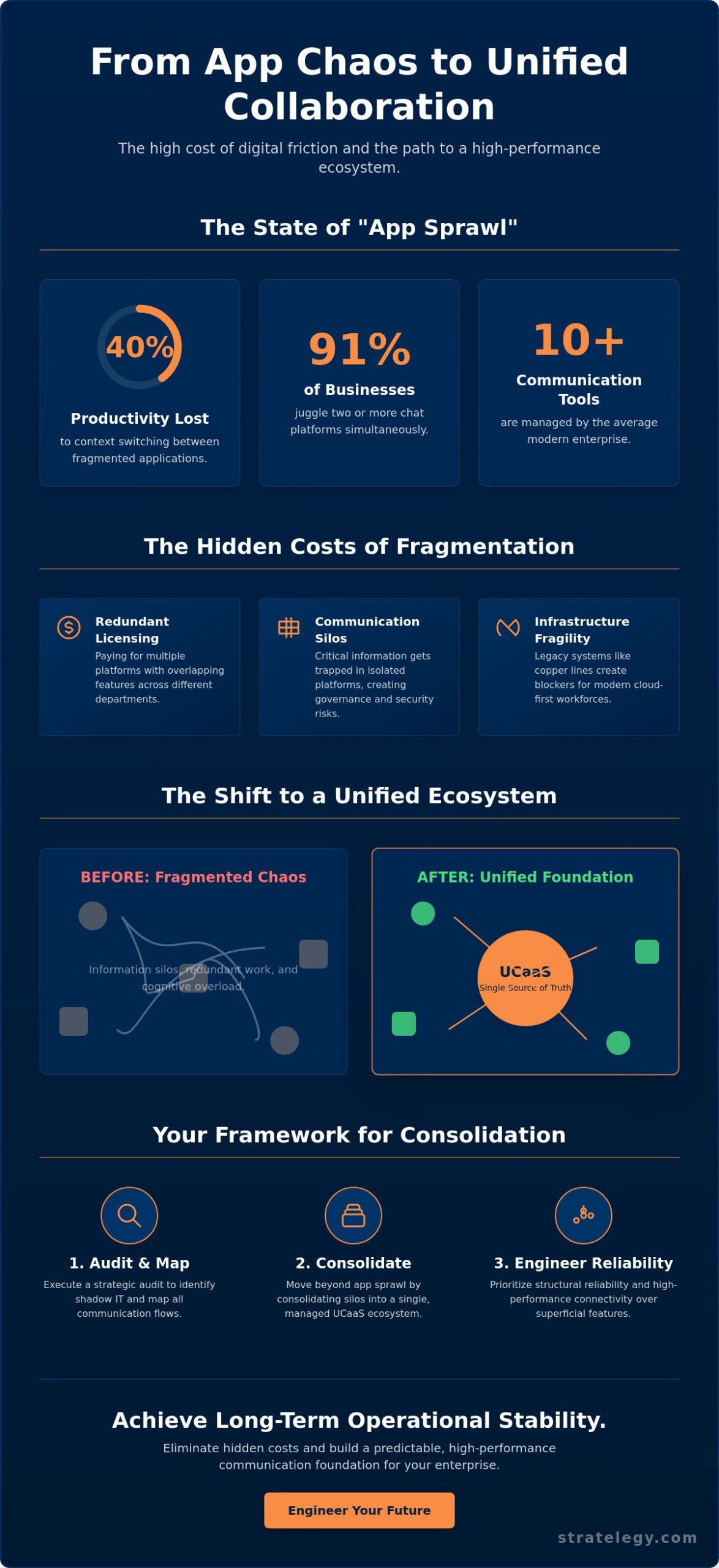
Did you know that context switching between fragmented applications can cost your organization up to 40% of its productive work time? Most enterprises today operate in a state of digital friction, with 91% of businesses juggling two or more chat platforms simultaneously. This fragmentation leads to more than just frustrated staff. It creates deep communication silos and hidden licensing costs that erode your bottom line. Improving employee collaboration tools in 2026 isn’t about adding another flashy app to the stack; it’s about engineering a stable, unified infrastructure that prioritizes governance and uptime.
You’ve likely felt the strain of app fatigue as your team toggles between a dozen different platforms just to complete a single task. You deserve an environment where connectivity is a constant rather than a variable. This guide will show you how to move beyond the chaos of redundant software and build an enterprise-grade ecosystem focused on performance. We’ll explore the technical frameworks necessary to consolidate your UCaaS and CCaaS foundations into a predictable, high-performance environment that ensures long-term operational health.
For small and mid-sized businesses that need a strategic partner to navigate these complex infrastructure changes, you can visit Mytech Partners for expert IT support and consulting.
Key Takeaways
- Move beyond the “app sprawl” crisis by consolidating fragmented communication silos into a single, managed UCaaS ecosystem.
- Execute a strategic audit to identify shadow IT and map communication flows, ensuring critical information no longer gets trapped in isolated platforms.
- Focus on improving employee collaboration tools by prioritizing structural reliability and high-performance connectivity over superficial software features.
- Secure your organization’s future by replacing legacy copper lines with LTE POTS solutions to maintain uptime for critical communication infrastructure.
- Achieve long-term operational stability through a foundational engineering approach that eliminates the hidden costs of redundant software licenses.
Beyond App Fatigue: The State of Employee Collaboration Tools in 2026
Enterprise connectivity has evolved past standalone applications. In 2026, we define modern collaboration as a high-performance ecosystem where voice, video, and messaging function as a single, governed utility. This shift is necessary because the average enterprise now manages over 10 different communication platforms. This state of “App Sprawl” creates a fragmented environment that compromises security and operational oversight. Improving employee collaboration tools is no longer a matter of adding features. It’s a matter of reclaiming structural control.
Many organizations still rely on a disparate collection of collaborative software that lacks a unified backbone. This fragmentation often stems from legacy systems that were never designed for the demands of a hybrid, cloud-first workforce. These aging frameworks act as the primary blocker for digital transformation, forcing teams to work around the technology rather than with it. True excellence in engineering requires moving away from these brittle, siloed setups toward a unified infrastructure.
The True Cost of Tool Fragmentation
The financial drain of tool fragmentation is often hidden within overlapping SaaS subscriptions and redundant licensing fees. Beyond the balance sheet, the “context switching” penalty remains a significant threat to focus. When employees must toggle between incompatible platforms, they lose the cognitive momentum required for deep work. This friction doesn’t just slow down individuals; it creates departmental silos that block the flow of critical data.
- Redundant Licensing: Paying for multiple platforms with identical feature sets across different departments.
- Communication Silos: Information becomes trapped in unsanctioned messaging apps, creating significant governance and security risks.
- Infrastructure Fragility: Maintaining legacy copper lines for critical voice traffic while simultaneously trying to support modern cloud applications.
A disciplined approach to improving employee collaboration tools starts with recognizing these systemic inefficiencies. By consolidating these services into a managed UCaaS or CCaaS framework, businesses can eliminate the noise of app fatigue and focus on long-term lifecycle management. It’s about building a foundation that ensures predictability and performance for years to come, and organizations looking for tailored assistance with this transition can check out Cornerstone Business Solutions for bespoke technology support.
The Strategic Shift from Siloed Apps to Unified Communications (UCaaS)
The “there is an app for that” mentality has reached its logical limit. While individual tools like Slack, Zoom, or Trello solve specific tasks, they often exist as isolated silos that fail to communicate with one another. Improving employee collaboration tools in 2026 requires a transition from these disparate applications to unified platforms. A Unified Communications as a Service (UCaaS) model replaces the clutter with a single pane of glass for voice, messaging, and video meetings. This consolidation isn’t just about convenience. It’s about engineering a predictable environment where data flows without friction.
By integrating these functions, organizations realize the strategic benefits of collaboration technology, such as reduced latency in decision making and lower operational overhead. This unified approach extends to customer engagement through Contact Center as a Service (CCaaS). When your internal collaboration tools bridge directly into your customer support channels, you eliminate the gap between back-office insights and front-line service. APIs further strengthen this ecosystem by connecting your communication stack to core business software like CRM and ERP systems.
Why UCaaS is the Growth Engine of 2026
Cloud-based unified services provide the elastic scalability that modern enterprises demand. This infrastructure ensures that as your team grows, your communication capacity expands without the need for manual hardware updates. A robust unified communications and collaboration strategy also creates parity for remote workers, ensuring they have the same high-fidelity experience as those in the office. Improving employee collaboration tools through this unified lens removes the technical barriers that often hinder distributed teams.
Centralization also provides management with a clear view of organizational health. Instead of chasing data across ten different portals, you gain access to centralized reporting and analytics. This oversight allows for proactive lifecycle management of your communication assets. If you’re ready to move beyond fragmented apps, it’s time to examine your technical infrastructure for potential consolidation opportunities. This methodical shift ensures your business remains resilient against technological obsolescence.
A Framework for Auditing and Improving Your Collaboration Stack
Systemic efficiency requires more than just high-speed internet. It demands a disciplined audit of every digital touchpoint within your organization. Improving employee collaboration tools begins with a rigorous inventory of your current technical landscape to identify where friction exists. This process ensures that your infrastructure supports your operational goals rather than hindering them through fragmentation.
- Step 1: Inventory Shadow IT. Identify every unsanctioned messaging app and file-sharing service currently in use. These “shadow” tools often emerge when enterprise systems are too cumbersome, but they represent significant security vulnerabilities.
- Step 2: Map Communication Flows. Document how information moves between departments. Identifying where data gets trapped or delayed allows you to engineer a more fluid path for critical business intelligence.
- Step 3: Evaluate Security and Compliance. Measure your existing toolset against modern standards. In 2026, tools must meet specific regulatory requirements to ensure long-term viability and risk mitigation.
- Step 4: Consolidate Infrastructure. Transition fragmented services into a managed unified communications as a service framework. This consolidation provides the predictability and centralized control necessary for enterprise-grade performance.
Prioritizing Governance and Security
Consumer-grade applications frequently fail enterprise security audits because they lack the robust oversight required for professional environments. Improving employee collaboration tools at scale means prioritizing end-to-end encryption and strict adherence to regulatory compliance standards like HIPAA or SOC2. These certifications aren’t just checkboxes; they are foundational requirements for protecting your intellectual property and client data.
Centralized user management is equally critical for maintaining operational integrity. Without a unified portal, offboarding employees becomes a systemic risk, as access to siloed apps may remain active long after a staff member departs. A disciplined approach to identity management prevents these data leaks and ensures that your technical experts maintain full oversight of the ecosystem. If you’re concerned about hidden vulnerabilities in your current setup, you can schedule a technical infrastructure review to identify and resolve these gaps before they impact your performance.
Foundational Engineering: Ensuring Predictability and Reliability
Software is secondary to structural integrity. Even the most advanced interface fails if the underlying connectivity is brittle. Improving employee collaboration tools requires a shift in focus from the application layer to the physical and network foundations. Organizations that ignore this reality often face unpredictable downtime and degraded call quality that no software update can fix. True operational excellence is built on a bedrock of reliable engineering.
Relying on legacy copper lines for critical communication is a systemic risk in 2026. These aging circuits are increasingly difficult to maintain and offer no built-in redundancy. A modern strategy utilizes LTE-based pots line replacement to safeguard uptime. This transition ensures that your voice and data traffic remain resilient against local outages. Beyond connectivity, managed hardware update policies prevent tool obsolescence. By treating hardware as a lifecycle asset rather than a one-time purchase, you maintain a baseline of high performance across the entire enterprise.
The Role of LTE Backup in Modern Collaboration
Cellular failover is a non-negotiable requirement for enterprise-grade UCaaS. When a primary fiber or cable connection fails, an automated switch to LTE ensures that your collaboration ecosystem remains online. This continuity is vital for maintaining productivity and meeting client expectations. Improving employee collaboration tools also means ensuring that life safety and emergency systems are fully integrated into your digital communication strategy, preventing silos in your most critical response protocols.
Stratelegy serves as the technical partner that manages this entire infrastructure lifecycle. We prioritize engineering excellence over superficial features to ensure your systems are secure, governed, and predictable. Our focus on foundational reliability eliminates the fear of technical debt and hardware failure. By partnering with experts who anticipate infrastructure challenges, you can focus on your core operations while we maintain the long-term health of your collaborative environment.
Securing Your Operational Foundation for 2026
True collaboration is built on structural reliability. As we’ve explored, the path to efficiency requires moving beyond the surface level of software to address the underlying infrastructure that supports your team. By consolidating fragmented applications into enterprise-grade UCaaS and CCaaS solutions, you eliminate the cognitive load and financial drain of app sprawl. Improving employee collaboration tools is a strategic investment in lifecycle management, ensuring your systems remain secure and compliant as the digital landscape shifts.
Stratelegy acts as your technical partner in this transformation. We provide the specialized technical niche expertise needed to build a resilient communication backbone. Our proprietary maintenance frameworks ensure your ecosystem remains predictable, allowing you to focus on growth rather than troubleshooting. You don’t have to manage these complex infrastructure transitions alone.
It’s time to replace fragmentation with engineering excellence. Schedule a consultation with Stratelegy’s foundational engineers today. Let’s build a communication ecosystem that provides the peace of mind your business deserves.
Frequently Asked Questions
How do I know if our company has too many collaboration tools?
High volumes of context switching and redundant feature sets across different departments are clear indicators of tool sprawl. If your staff must toggle between separate, disconnected apps for messaging, video conferencing, and file sharing, your stack is likely over-saturated. Improving employee collaboration tools through consolidation reduces these friction points and eliminates the hidden costs of overlapping software licenses.
What is the difference between a collaboration app and a UCaaS platform?
A collaboration app typically solves a single functional need, such as instant messaging or task management, whereas a UCaaS platform integrates all communication channels into one managed environment. UCaaS provides a unified backbone for voice, video, and messaging with centralized governance. This shift moves your business from a collection of software islands to a single, predictable infrastructure designed for enterprise-grade performance.
Can we improve collaboration without replacing all our current hardware?
Yes, many modern unified platforms integrate with existing hardware through cloud-based gateways and specialized adapters. While some legacy equipment might eventually require an update, the focus is often on optimizing your current network and implementing software-defined solutions. This approach allows for a phased modernization that respects your existing capital investments while significantly enhancing your team’s overall connectivity and output.
How does LTE POTS replacement relate to employee collaboration?
LTE POTS replacement ensures the underlying connectivity for your collaboration tools remains active during primary network failures. Most modern collaboration ecosystems rely on a stable internet connection; if your building’s primary fiber line goes down, LTE failover keeps your UCaaS and CCaaS platforms operational. This infrastructure safeguard prevents the communication blackouts that legacy copper lines are unable to mitigate.
What are the most common security risks in modern collaboration software?
Data leaks from unsanctioned shadow IT and a lack of centralized user offboarding are the most prevalent risks in the current landscape. When employees use consumer-grade messaging apps, your intellectual property exists outside of a governed environment. Improving employee collaboration tools requires implementing enterprise-grade security protocols, such as end-to-end encryption and multi-factor authentication, to protect sensitive business data from unauthorized access.