
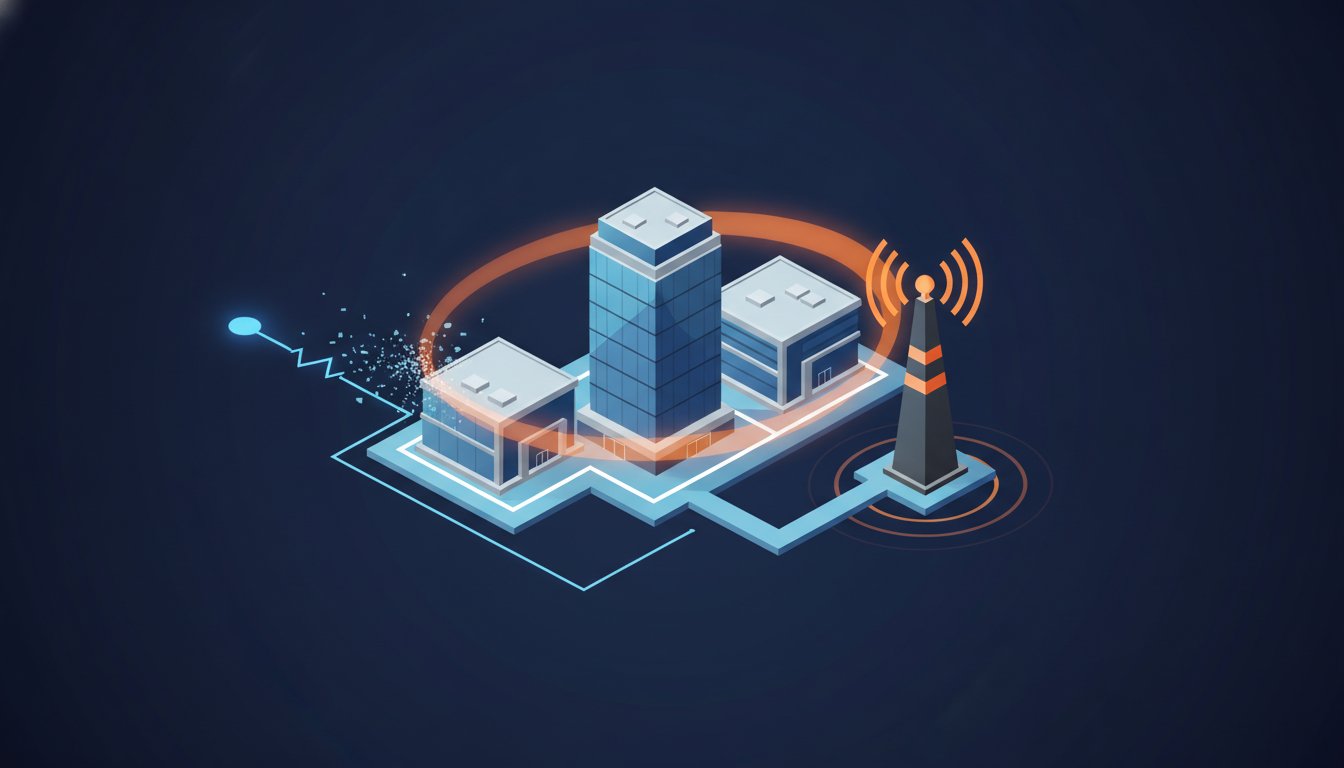
For the average mid-size enterprise, a single hour of internet downtime now costs over $300,000 in lost revenue and operational paralysis. It’s a staggering figure that highlights a simple truth: a primary fiber connection is no longer a complete connectivity strategy. You already recognize that staying online requires more than a single cable; it requires a sophisticated lte backup for business internet and voice solution that activates the moment your primary link falters.
This 2026 resilience guide shows you how to eliminate vulnerabilities by deploying enterprise-grade failover that prioritizes your most critical traffic. You’ll learn how to secure your infrastructure against obsolescence, ensuring that your data and voice services remain predictable even when the local grid fails. We will break down the transition from legacy copper to cellular life-safety systems and the technical frameworks required for true operational continuity through foundational engineering.
Key Takeaways
- Define the technical distinction between active-passive failover and active-active SD-WAN architectures to ensure seamless transitions for critical traffic.
- Solve the “SIP Timeout” problem to prevent dropped calls in your contact center during even the briefest internet disruptions.
- Deploy lte backup for business internet and voice as a strategic pillar to eliminate the “Downtime Tax” that costs enterprises hundreds of thousands per hour.
- Evaluate the limitations of standard ISP uptime guarantees and learn why they fail to provide a genuine financial or operational safety net.
- Execute a facility-wide audit to modernize your infrastructure, ensuring fire, life-safety, and security systems remain online through managed gateway deployment.
The Architecture of Resilience: Understanding LTE Failover for Business
Resilience isn’t an accident; it’s the result of deliberate infrastructure design. At its core, Wireless failover is an automated mechanism that reroutes traffic to cellular networks the moment a primary fiber or cable link is compromised. For many organizations, implementing lte backup for business internet and voice is the difference between a minor blip and a total operational shutdown.
Automatic Failover vs. Manual Intervention
Relying on manual intervention is a high-risk strategy that invites human error. In a fast-paced enterprise environment, the time it takes for an IT staffer to physically swap a cable can result in thousands of dollars in lost productivity. Proactive monitoring systems identify “brownouts,” which are periods of severe packet loss or latency, before the primary link goes completely dark. This allows the system to transition traffic to the backup link before users even notice a problem.
LTE vs. 5G for Business Continuity
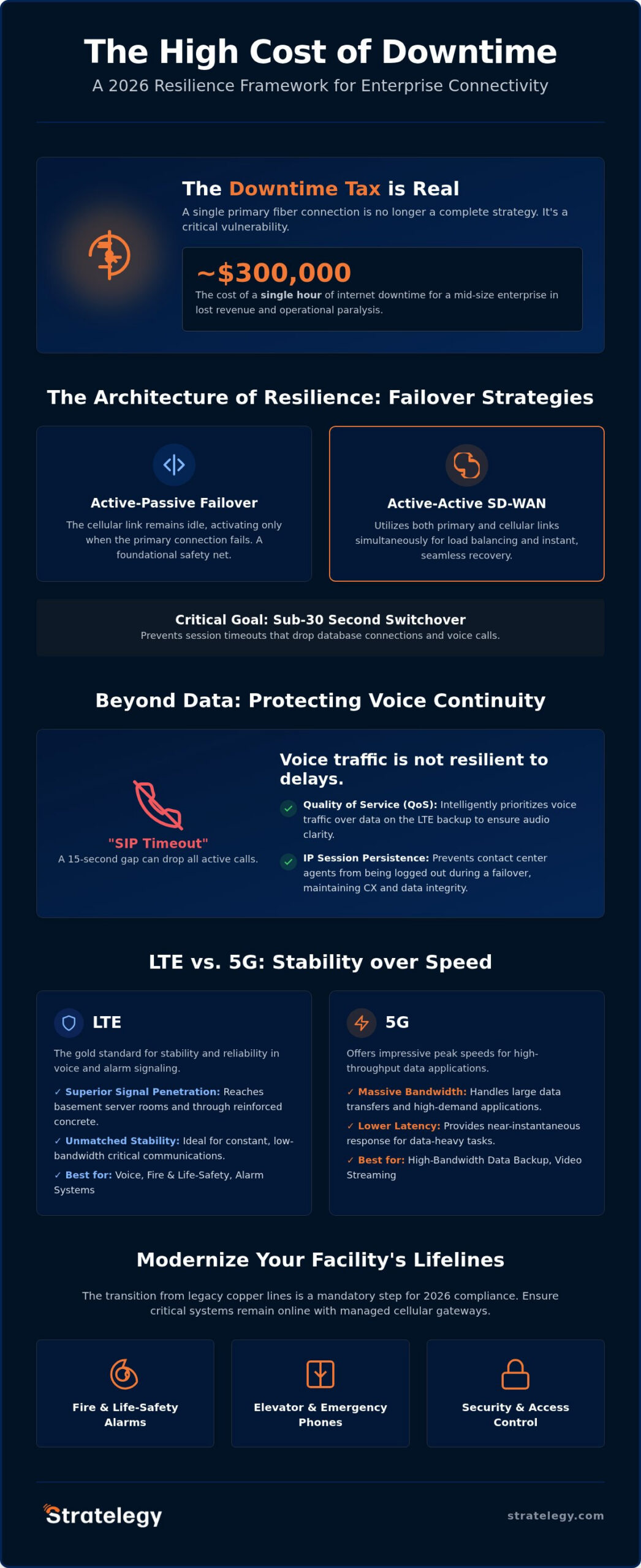
While 5G offers impressive peak speeds, LTE remains the gold standard for stability in voice and alarm signaling. Reliability often trumps raw throughput when maintaining critical lifelines. Coverage is another vital factor. LTE signals typically offer better penetration through reinforced concrete and into basement server rooms where primary network hardware is often housed. Choosing the right lte backup for business internet and voice solution requires balancing these coverage realities with your specific bandwidth needs.
Beyond Data: Why LTE Backup is Critical for UCaaS and Voice Continuity
Data packets for email or web browsing are resilient to small delays. Voice traffic is not. A gap as short as 15 seconds in your internet connection can trigger a “SIP Timeout,” effectively dropping every active call in your organization. When you rely on unified communications as a service, even a momentary ISP routing change can disrupt your entire communication flow. This is where lte backup for business internet and voice becomes a mandatory operational requirement rather than a luxury.
Protecting the customer experience (CX) requires more than just a secondary connection. It requires Quality of Service (QoS) rules that prioritize voice traffic over standard data when the system switches to cellular. Because LTE bandwidth is often narrower than fiber, your gateway must be engineered to ensure audio clarity remains the priority. This level of technical oversight is what maintains the integrity of your CCaaS operations during a crisis.
Preventing Dropped Calls in a Failover Event
Maintaining a cloud contact center requires sophisticated IP session persistence. Enterprise-grade gateways manage the technical handshake between primary and secondary links to ensure that an agent’s status doesn’t reset and reporting data remains accurate. Without this persistence, a failover event can force agents to log back into their systems, leading to minutes of unnecessary labor idleness and frustrated customers.
LTE for Critical Life-Safety Voice Lines
The transition from legacy copper to digital infrastructure includes your most critical lifelines. Modern building codes and the Network Outage Reporting System guidelines emphasize the need for reliable emergency communication. Replacing legacy elevator and emergency phones with cellular-based alternatives ensures VoLTE compliance and continuous connectivity. If you haven’t yet audited your emergency lines, it’s time to modernize your infrastructure to ensure your safety systems meet 2026 standards.
Evaluating the ROI: The Real Cost of Connectivity Gaps
Calculating the return on investment for network infrastructure requires a cold assessment of the “Downtime Tax.” For small businesses, this tax ranges between $137 and $427 per minute in lost productivity and missed opportunities. Mid-size enterprises often face even harsher realities. While a 99.9% uptime guarantee sounds impressive in a marketing brochure, it actually permits nearly nine hours of annual downtime. Most Service Level Agreements (SLAs) only offer bill credits as compensation, which fail to cover the actual fiscal damage or the 3.4% average stock price drop that publicly traded companies experience after a major outage.
Regulatory compliance provides another layer of ROI that many organizations overlook. Maintaining fire and life-safety monitoring through pots line replacement is no longer optional for modern facilities. Integrating lte backup for business internet and voice ensures you avoid heavy non-compliance fines while protecting your most critical human and physical assets. This strategic shift from legacy copper to managed cellular gateways secures your operational lifecycle against both technical failure and regulatory shifts.
Direct vs. Indirect Costs of a Voice Outage
The direct costs of an outage are easy to quantify: lost sales, missed service inquiries, and abandoned shopping carts. However, the indirect costs are often more corrosive to long-term health. When your voice services fail, employee morale plummets as staff struggle to perform basic tasks. This frustration often bleeds into the customer experience, leading to long-term churn and a tarnished brand reputation that takes years to rebuild.
The ‘Single Point of Failure’ Myth
Many businesses believe they are protected by purchasing lines from two different wired ISPs. In reality, these providers often share the same “last mile” conduit or utility pole. A single backhoe accident or fallen tree can sever both connections simultaneously. Wireless air-gapping through cellular redundancy provides a truly independent path for data. You can secure your perimeter and eliminate systemic vulnerabilities by partnering with our foundational engineers to design a diverse, resilient network architecture.
Implementing Enterprise-Grade LTE Failover with Stratelegy
Transitioning from a vulnerable network to a resilient architecture requires a methodical deployment strategy. Implementing lte backup for business internet and voice isn’t a “set it and forget it” task; it’s a structural upgrade that demands engineering precision. Our process moves beyond simple hardware installation to ensure your business remains operational through any primary link failure.
Execution follows a disciplined four-step framework:
- Step 1: Conduct a facility-wide audit to map every dependency, including data, voice, and critical life-safety systems.
- Step 2: Deploy managed LTE gateways equipped with external antenna arrays to ensure maximum signal integrity in challenging environments.
- Step 3: Integrate the failover link into your existing voip or UCaaS environment to maintain session persistence.
- Step 4: Establish continuous oversight and systematic hardware updates to prevent technical obsolescence and security vulnerabilities.
Modernizing Critical Infrastructure with LTE POTS Replacement
Many facilities still rely on expensive, fragile copper lines for fire alarms and security panels. These legacy systems are often the first to fail during an outage. By utilizing cellular-based POTS replacement solutions, you eliminate these vulnerabilities while ensuring strict compliance with 2026 NFPA 72 and UL standards. This modernization secures your life-safety monitoring and reduces the recurring costs associated with maintaining obsolete copper infrastructure.
The Stratelegy Advantage: Foundational Engineering
We define ourselves as foundational engineers rather than just service providers. This distinction matters because we prioritize the long-term health of your business infrastructure over superficial features. Our proactive partnership model includes customized maintenance frameworks that anticipate problems before they impact your operations. By choosing a managed lte backup for business internet and voice solution, you gain the predictability and security required to lead in a modern, digital-first economy. We don’t just provide a backup; we provide a guarantee of continuity through disciplined engineering.
Securing Your Operational Future with Managed Redundancy
True resilience is built on the foundation of engineering, not hope. You’ve seen how the “Downtime Tax” can erode your revenue and why standard ISP guarantees often fail to protect your bottom line. By air-gapping your connection through lte backup for business internet and voice, you eliminate the single point of failure that compromises so many modern enterprises. This strategy ensures that your UCaaS sessions remain persistent and your life-safety systems stay compliant with 2026 standards.
Operational excellence requires a partner who anticipates technical hurdles before they become systemic failures. We specialize in NFPA-compliant LTE POTS replacement and seamless UCaaS and CCaaS integration, engineering every solution for 99.999% reliability. Don’t leave your connectivity to chance or consumer-grade hardware. Secure your business continuity with Stratelegy’s LTE failover solutions.
The transition to a resilient infrastructure is a strategic investment in your brand’s longevity. We’re ready to help you build a network that is as dependable as your business goals.
Frequently Asked Questions
Does LTE backup work for both internet data and office phone systems?
Yes, enterprise-grade lte backup for business internet and voice is engineered to support both high-bandwidth data and latency-sensitive communication. By utilizing Quality of Service (QoS) protocols, our systems prioritize voice packets to prevent jitter or dropped calls. This dual-functionality ensures that your UCaaS platform remains operational even when the primary fiber connection is severed, maintaining seamless connectivity for your entire staff without manual reconfiguration.
How fast does an LTE failover switch occur during an outage?
Automated failover typically occurs in under 30 seconds. In many sophisticated SD-WAN configurations, the transition is nearly instantaneous. This rapid switch is essential for maintaining active IP sessions, such as those required for CCaaS agents or secure database connections. Without this speed, your systems would experience a timeout, forcing users to re-authenticate and causing significant operational friction during the disruption. It’s about maintaining session persistence through foundational engineering.
Is LTE fast enough to support a full office of employees?
LTE provides sufficient bandwidth for critical business operations when managed as a prioritized secondary link. While it doesn’t match the raw throughput of a primary 1 Gbps fiber line, it easily handles essential voice traffic, email, and cloud applications. For high-density environments, we implement traffic shaping policies. These restrict non-essential data to ensure that your core business functions remain fast and responsive during a failover event.
Can LTE backup replace my fire alarm’s legacy copper POTS lines?
Yes, specialized LTE POTS replacement solutions are engineered to modernize fire alarms, security panels, and elevator phones. These systems meet strict NFPA 72 and UL requirements for life-safety communications. Unlike standard internet backup, these devices provide the specific voltage and signaling required by legacy hardware. This allows you to decommission expensive copper lines while improving the reliability of your facility’s emergency monitoring systems through modern cellular technology.
What is the difference between a consumer LTE hotspot and enterprise LTE failover?
Consumer hotspots are reactive, manual devices intended for temporary personal use. Enterprise failover is a proactive, managed infrastructure component utilizing high-gain external antenna arrays and industrial-grade gateways. These systems offer automated switching, centralized monitoring, and robust security protocols. They are designed for long-term reliability and lifecycle management, ensuring that your business stays online without the need for manual intervention or frequent hardware resets.