
Your legacy copper lines aren’t just expensive. They’re being systematically decommissioned with as little as 90 days of notice. As of March 2026, the FCC’s Network and Services Modernization Order has accelerated this transition, forcing businesses to choose between skyrocketing maintenance fees or sudden service loss. It’s frustrating to manage aging infrastructure that fails more frequently every year while trying to maintain strict compliance. This guide explains why lte pots replacement for security systems has become the critical engineering standard for modern facility management.
We’ll show you how to achieve 100% uptime and meet all UL and NFPA 72 requirements by shifting to a managed LTE framework. You’ll discover the technical specifications for POTS in a Box solutions, the financial logic of retiring copper, and a strategic audit process to secure your life-safety systems for the long term. This systematic approach ensures that your security infrastructure remains stable, predictable, and fully compliant with evolving safety codes.
Key Takeaways
- Recognize the impact of the 2026 FCC modernization order and why legacy copper networks no longer provide the stability required for critical security monitoring.
- Discover how lte pots replacement for security systems converts analog signals into digital packets while maintaining dual-path redundancy for uninterrupted connectivity.
- Evaluate the technical advantages of LTE over VoIP, specifically regarding battery backup standards and signal compression requirements for NFPA 72 compliance.
- Master a strategic implementation framework to modernize your infrastructure without the need for expensive hardware replacements or extensive system downtime.
The Inevitable Obsolescence of Copper in Security Infrastructure
The “POTS Sunset” isn’t a future prediction. It’s an active decommissioning of the nation’s copper wire infrastructure. Major carriers have shifted their focus entirely to fiber and wireless, leaving traditional analog lines to decay. Security systems are disproportionately affected because they rely on the consistent voltage and specific frequencies of copper to transmit alarm signals. When these lines degrade, signal latency increases and communication failures become common. An lte pots replacement for security systems is a cellular-based interface that emulates an analog dial tone for legacy panels.
The Regulatory and Financial Drivers of the 2026 POTS Sunset
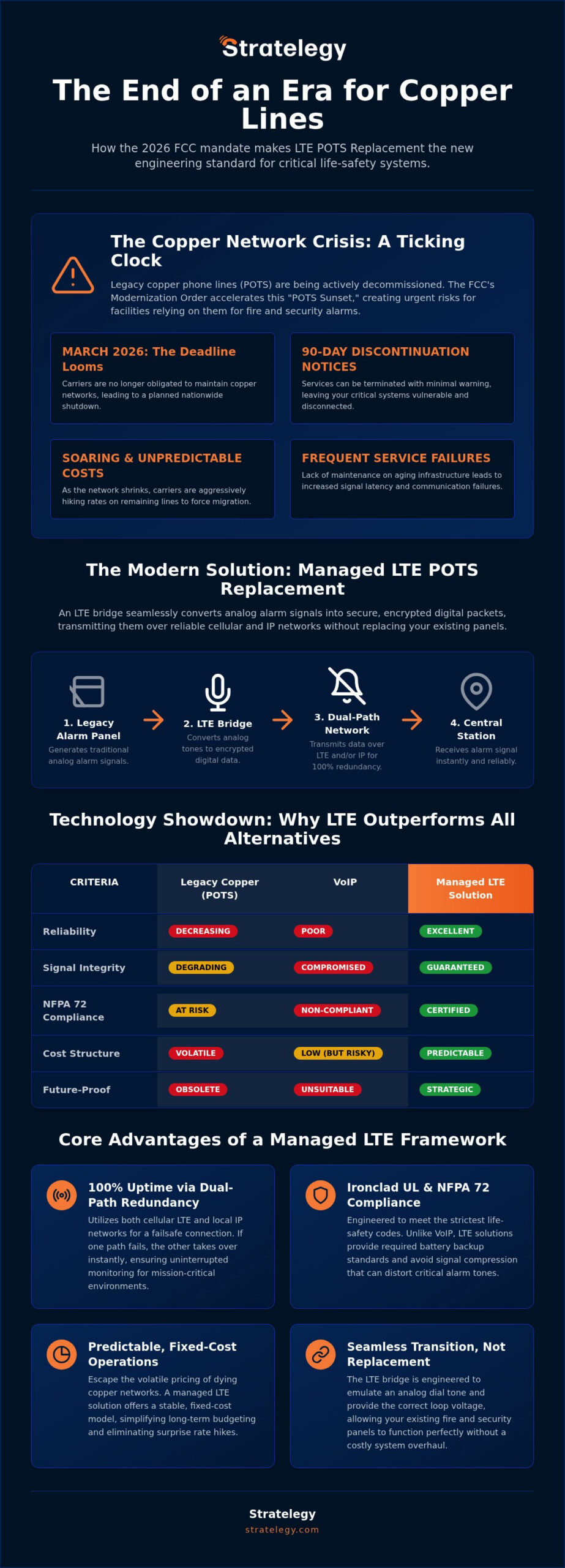
The legal framework for this transition began with FCC Order 19-72. This order effectively released carriers from the obligation to maintain legacy analog networks at regulated rates. More recently, the March 2026 Network and Services Modernization Order accelerated this timeline. It simplified the process for carriers to discontinue service entirely, often with as little as 90 days of notice. This regulatory shift has created a volatile financial environment for facility managers who must balance safety with mounting operational costs.
Carriers are aggressively raising rates on remaining copper lines to force migration. These cost increases don’t reflect improved service. Instead, they represent the extreme expense of maintaining a shrinking, fragile network. Adopting an lte pots replacement for security systems provides a predictable, fixed-cost alternative for long-term budgeting. By moving to a managed cellular framework, businesses eliminate the risks of:
- Sudden 90-day service discontinuation notices from regional carriers.
- Unpredictable monthly price hikes on aging copper infrastructure.
- Physical line failures caused by a total lack of ongoing maintenance.
This shift represents a move toward structural reliability. It positions your organization as proactive rather than reactive, securing your life safety systems before the copper network goes dark. It’s about engineering a foundation that remains stable regardless of carrier policy changes.
Technical Architecture: How LTE POTS Replacement Secures Critical Signals
The transition from copper to cellular requires more than a simple adapter. It demands a sophisticated bridge that understands the nuances of legacy signaling. When a security panel dials out, it produces specific analog frequencies. The bridge captures these signals and converts them into encrypted digital packets. Selecting a robust lte pots replacement for security systems ensures your hardware communicates seamlessly with modern monitoring centers without a full overhaul. Redundancy isn’t optional for life safety.
Reliability is built into the architecture through dual-path communication. By utilizing both cellular LTE and local IP networks, the system achieves maximum redundancy. If your primary internet connection fails, the cellular link remains active. This failsafe mechanism is vital for maintaining 100% uptime in mission-critical environments. Our foundational engineers focus on these structural details to ensure your lte pots replacement for security systems remains operational under any conditions.
Bridging the Gap: Analog Handshakes to Digital Cellular Pathways
Legacy fire panels require specific loop voltage to function. A professional LTE bridge maintains these electrical standards, providing the precise “handshake” the panel expects. Unlike standard VoIP lines, which often fail due to signal compression and latency, LTE provides a dedicated data pathway. This prevents the distortion of critical alarm tones that leads to communication errors in non-compliant systems. It’s about maintaining signal integrity through superior engineering.
Security is maintained through enterprise-grade encryption protocols. Data is protected from the moment it leaves the bridge until it reaches the central station. To maintain this protection, we implement systematic hardware update policies. These policies ensure your communicators receive the latest firmware and security patches. This proactive approach effectively eliminates the risk of technical obsolescence as network standards continue to evolve.
Reliability Frameworks: Why LTE Outperforms VoIP for Life Safety
VoIP is a communication tool, not a safety standard. Standard VoIP lines utilize compression algorithms that frequently distort the DTMF tones required by alarm panels. This results in failed handshakes and unreceived signals. An lte pots replacement for security systems avoids these vulnerabilities by using a transparent data pathway. It preserves signal integrity, ensuring emergency data reaches the central station without the packet loss or jitter inherent in residential-grade internet services.
Power is the silent failure point of modern infrastructure. While legacy copper once provided its own operating voltage, contemporary fiber networks often lose functionality during local power outages. Professional LTE bridges mitigate this risk with integrated battery backups that meet or exceed the 24-hour standby requirements mandated by fire codes. These systems also offer superior signal penetration. In the concrete cores of commercial facilities, LTE’s lower frequency bands outperform 5G, maintaining a stable link where other wireless technologies fail.
Proactive oversight transforms reactive maintenance into predictable uptime. Managed LTE systems include cloud-based monitoring that alerts facility managers to several critical events:
- Total loss of primary and secondary signal paths.
- Low battery or power supply interruptions.
- Hardware tampering or internal component failure.
To secure your facility against infrastructure decay, consult with our technical experts about a customized modernization plan.
Compliance and Uptime: Meeting NFPA and UL Standards
Regulatory adherence is non-negotiable for enterprise security. Standards like NFPA 72 and UL 864 require a “supervised” link that can report a communication failure within a strict timeframe. A managed lte pots replacement for security systems provides this pathway through frequent heartbeat polling. This ensures your system remains compliant with all local ordinances and insurance requirements. Implementing a pots line replacement strategy is the most efficient way to maintain these rigorous standards and protect your organization from liability.
Strategic Implementation: Transitioning to Managed LTE Connectivity
A successful transition begins with a rigorous POTS audit. You can’t modernize infrastructure that hasn’t been fully mapped across your portfolio. This assessment identifies every active analog line, its specific function, and its monthly cost. By uncovering redundant “ghost lines,” many organizations find that an lte pots replacement for security systems pays for itself through immediate operational savings. Our process focuses on identifying these vulnerabilities before the 90-day discontinuation notices arrive from local carriers.
Implementation is designed for speed and technical precision. Modern LTE bridges offer a “plug-and-play” architecture that mimics the traditional dial tone your legacy panels require. This allows for a seamless cutover with minimal system downtime, often completed in a single site visit. Beyond the hardware, this shift integrates your security pathways into a broader unified communications and collaboration environment. It transforms isolated analog signals into manageable, digital assets that support your organization’s long-term digital transformation goals.
Future-Proofing with Stratelegy’s Engineering-First Approach
Stratelegy operates as your foundational engineer rather than a simple service provider. We manage the entire hardware lifecycle, ensuring that every bridge in your network remains current and compliant. Our cloud-based management portal provides a single pane of glass for national security infrastructure. Facility managers can check signal strength, battery health, and connection status for every site in real-time. This level of visibility eliminates the guesswork often associated with aging copper networks.
We invite you to move from a state of reactive repairs to proactive, predictable infrastructure management. Our systematic hardware update policies and proprietary maintenance frameworks ensure your lte pots replacement for security systems stays ahead of technical obsolescence. By prioritizing engineering excellence and regulatory predictability, we provide the structural reliability your business requires to operate with total confidence in 2026 and beyond.
Securing Your Infrastructure for a Post-Copper Era
The decommissioning of copper infrastructure represents a permanent shift in how businesses must approach life safety. Relying on decaying analog lines or unmanaged VoIP adapters creates systemic vulnerabilities that no enterprise can afford. By implementing an lte pots replacement for security systems, you transition from a reactive maintenance cycle to a proactive, engineering-first framework. This modernization ensures that your fire alarms, elevators, and security panels remain fully operational regardless of carrier service changes or local power failures. It’s about building a foundation that doesn’t rely on obsolete technology.
We specialize in bridging the gap between legacy hardware and modern digital pathways. Our solutions provide enterprise-grade infrastructure stability and full compliance with NFPA and UL standards. With our national deployment and management capabilities, we ensure your entire portfolio is protected by a single, supervised link. Modernize your critical security infrastructure with Stratelegy’s LTE POTS replacement solutions. You deserve the peace of mind that comes from a predictable, future-proof foundation.
Frequently Asked Questions
Is LTE reliable enough for fire alarm monitoring and life safety?
Yes, LTE is specifically engineered to meet mission-critical uptime requirements for life safety. Unlike legacy copper lines that suffer from physical decay, LTE provides a stable, supervised connection that reports status in real-time. It’s the current industry standard because it offers superior penetration through building materials and remains operational during local power outages via dedicated internal battery backups.
Will I need to replace my existing security or fire panels to use LTE?
No, you don’t need to replace legacy hardware to modernize your connectivity. An lte pots replacement for security systems uses a specialized bridge that captures the analog signal from your existing panel and converts it into digital packets. This approach allows you to maintain your current infrastructure investment while benefiting from the reliability and cost-efficiency of a modern cellular network.
How does LTE POTS replacement compare to VoIP for alarm systems?
LTE is significantly more reliable than VoIP for alarm transmission because it avoids signal compression issues. VoIP often distorts the DTMF tones required for alarm “handshakes,” leading to communication failures. LTE provides a transparent, dedicated data pathway that preserves the integrity of the original signal. Professional LTE systems also include power redundancy that standard commercial VoIP setups typically lack.
What happens to my security system if the cellular network goes down?
Professional systems utilize dual-path communication to prevent total signal loss. If the primary LTE link experiences an interruption, the system automatically fails over to a secondary IP or alternative cellular carrier link. This redundancy is a core component of lte pots replacement for security systems, ensuring that your monitoring center receives critical alerts without delay, even during localized network events.
Are there specific NFPA or UL requirements for using cellular communicators?
Yes, cellular communicators must comply with NFPA 72 and UL 864 standards for fire and life safety. These codes require the system to have a “supervised” link, meaning it must perform regular “heartbeat” checks to verify connectivity. Managed LTE solutions are designed to meet these rigorous reporting intervals, ensuring your facility remains compliant with local fire marshal requirements and insurance mandates.