

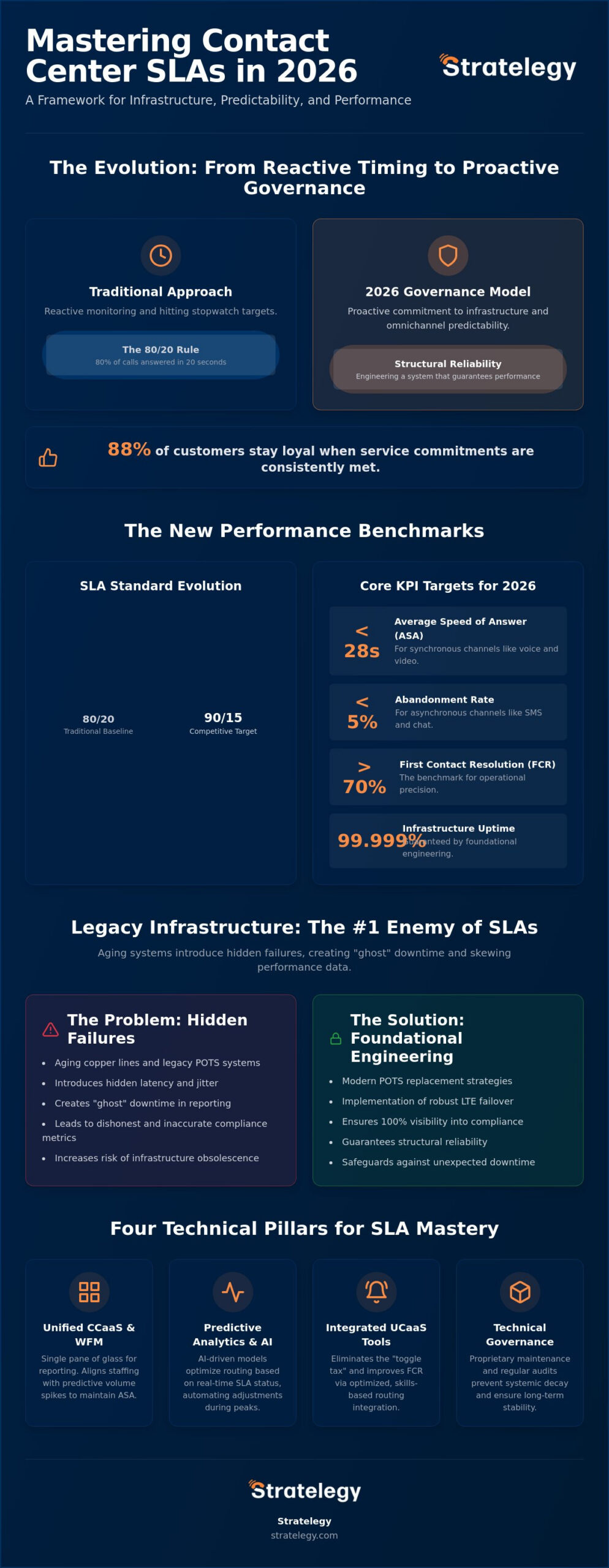
SLA management is no longer just a call-timing exercise; it’s a structural commitment to infrastructure reliability and omnichannel predictability. Managing service level agreements in contact centers in 2026 requires moving beyond the traditional 80/20 rule to ensure technical governance across every digital touchpoint. You’ve likely seen how 88% of customers stay loyal when service commitments are met, yet legacy systems and siloed data often cause unexpected downtime that makes these targets feel impossible to hit.
We recognize the difficulty of balancing agent occupancy with strict response goals in a complex environment. This article provides a strategic framework to master the technical and operational strategies required to maintain high-performance SLAs. We’ll examine how to align your CCaaS infrastructure with CX goals to build a predictable, scalable framework that reduces abandonment rates and secures the long-term health of your business infrastructure.
Key Takeaways
- Shift from reactive monitoring to a proactive governance model that prioritizes omnichannel predictability as a strategic asset.
- Master managing service level agreements in contact centers by unifying CCaaS reporting with predictive workforce management.
- Eliminate the “toggle tax” and improve resolution times by integrating UCaaS tools and optimized skills-based routing.
- Safeguard performance targets and ensure 99.999% uptime through foundational engineering like LTE failover and POTS replacement.
The Evolution of Service Level Agreements in 2026
A Service-level agreement in 2026 is a strategic governance document. It defines the technical health and operational pulse of the modern enterprise. Managing service level agreements in contact centers now requires a shift from reactive monitoring to proactive omnichannel predictability. We view this evolution as a move toward structural reliability rather than just hitting stopwatch targets. It’s about engineering a system that guarantees performance.
Why Legacy Infrastructure is the #1 Enemy of SLAs
Infrastructure stability dictates performance. Aging copper lines and legacy POTS systems introduce hidden latency and jitter. These technical failures create “ghost” downtime that skews aggregate reporting. If the foundation is weak, the performance data is dishonest. Replacing these systems is the only way to ensure 100% visibility into your compliance metrics and eliminate the fear of infrastructure obsolescence.
The 2026 Omnichannel SLA Matrix
Managing service level agreements in contact centers involves a complex matrix of synchronous and asynchronous channels. Each requires a distinct technical approach to remain compliant:
- Synchronous Channels: Voice and video require immediate routing to maintain an Average Speed of Answer (ASA) under 28 seconds.
- Asynchronous Channels: SMS and WebChat targets must align with current messaging standards to prevent abandonment rates from exceeding the 5% threshold.
Success depends on balancing speed with First Contact Resolution (FCR). A fast answer is a hollow victory if the FCR remains below the 70% industry benchmark. True excellence is found where infrastructure reliability meets operational precision. We prioritize this balance to ensure your contact center remains a high-performance asset.
Technical Pillars for Managing SLAs Effectively
Infrastructure is the bedrock of compliance. Managing service level agreements in contact centers requires more than just software; it demands a unified technical stack. A modern cloud contact center provides a single pane of glass for reporting. This visibility ensures that every interaction is captured with absolute data integrity. Without this “truth,” your SLA reporting is merely guesswork. We prioritize structural reliability to ensure your data reflects actual performance rather than system lag.
Managing service level agreements in contact centers also relies on the precision of your underlying platform. Integration between Workforce Management (WFM) and your CCaaS environment is essential. It allows you to align staffing levels with predictive volume spikes. When volumes exceed capacity, automated alert systems trigger ‘all-hands’ protocols. These triggers happen before thresholds are breached. It’s a proactive stance that maintains a global average speed of answer (ASA) within the 28-second benchmark. This level of coordination reduces customer abandon rates and keeps your operation within the 5% to 8% industry standard.
Predictive Analytics and AI-Driven Forecasting
Technical Governance and Oversight
Operational excellence is achieved through disciplined maintenance. We advocate for a proprietary maintenance framework for all communication hardware. Regular audits of unified communications as a service performance logs prevent systemic decay. This level of oversight ensures that your network infrastructure remains stable enough to support high-performance digital tools. Maintaining your structural reliability ensures that technical capabilities directly translate into long-term operational benefits. You might consider evaluating how a cloud contact center can consolidate your reporting and oversight for better results.
Practical Strategies to Improve Contact Center Service Levels
Operational excellence requires more than just infrastructure; it demands tactical execution. Managing service level agreements in contact centers is most effective when technical logic governs agent workflows. Implementing skills-based routing ensures that interactions reach the best-equipped agent immediately. This precision reduces internal transfers, which are the primary driver of missed resolution targets. We also recommend a tiered response strategy to prioritize high-value or urgent interactions within the SLA queue, protecting your most critical revenue streams.
Empowering agents with UCaaS tools is another vital step in maintaining performance. Integrating messaging and CRM data into a single interface eliminates the “toggle tax,” where agents lose productivity switching between disparate applications. Continuous improvement is then fueled by data-driven feedback loops. You should use call center monitoring logs to coach agents on specific behaviors that impact your service level metrics. Implement these advanced routing protocols today by upgrading to our enterprise CCaaS platform.
Reducing Abandonment Rates Through Queue Management
High abandonment rates signal a failure in queue management. Virtual hold and callback options preserve the customer experience by allowing callers to hang up without losing their place in line. This technology respects the customer’s time and prevents the 5% to 8% abandonment threshold from being breached. Using “In-Queue” messaging also helps set realistic expectations, which reduces perceived wait times and keeps callers engaged during peak volume periods.
Training for Omnichannel Proficiency
A modern workforce must be as agile as the technology they use. Cross-training agents to pivot between voice and digital channels based on real-time demand ensures that no single channel becomes a bottleneck. This flexibility is essential for maintaining a consistent Average Speed of Answer (ASA) across the entire enterprise. Concurrency is the ability for agents to handle multiple digital chats while maintaining quality. Mastering this balance allows your center to scale efficiently without compromising the rigorous standards defined in your governance framework.
Future-Proofing SLAs with Foundational Engineering
Software performance is only as stable as the physical network supporting it. Managing service level agreements in contact centers in 2026 requires a shift from software-only thinking to a focus on structural reliability. If your network fails, your SLA compliance disappears instantly regardless of how advanced your routing logic is. We view POTS line replacement as a critical prerequisite for ensuring 99.999% uptime in enterprise environments. This transition replaces unstable copper with resilient digital alternatives that eliminate the fear of infrastructure obsolescence.
Reliability also demands redundancy. LTE and cellular failover protocols act as a safeguard against local fiber cuts or unexpected network outages. These systems ensure that your contact center remains operational even when primary connections fail. Moving toward a managed infrastructure partnership allows you to focus on customer experience while we handle the foundational engineering. This approach is essential for meeting the specialized technical niches required for regulatory compliance and data security in modern digital communication.
Eliminating Infrastructure Obsolescence
Relying on legacy copper lines for back-office functions is a systemic vulnerability. These aging systems create bottlenecks that software cannot fix. Transitioning to cellular-based alternatives for fire, life safety, and secure voice ensures your facility remains compliant with current safety standards. It’s about protecting the long-term health of your business infrastructure through proactive hardware lifecycle management and ongoing oversight.
Choosing a Strategic Integration Partner
We prioritize technical governance over superficial features. Our focus as foundational engineers is to provide predictability through disciplined maintenance frameworks. Managing service level agreements in contact centers effectively requires end-to-end cybersecurity to protect sensitive customer data within the CCaaS environment. This partnership ensures that your technical capabilities are anchored in security and structural stability. We anticipate the infrastructure problems you hasn’t encountered yet so you can maintain excellence through engineering rather than just sales.
Securing Your Operational Future
The 2026 landscape demands a departure from reactive performance monitoring. Success in managing service level agreements in contact centers now rests on the strength of your foundational engineering. We’ve established that technical governance and infrastructure stability are the only ways to guarantee 99.999% uptime and meet modern omnichannel demands. By replacing unreliable legacy systems with resilient LTE and cloud-based platforms, you eliminate the risk of obsolescence and ensure every interaction is captured with absolute integrity.
Our identity as technical experts prioritizes predictability over superficial features. We provide the enterprise-grade reliability and national LTE POTS replacement expertise required to safeguard your service commitments. Partnering with a specialist who understands the intersection of network infrastructure and customer experience allows you to lead with confidence. Secure your contact center’s infrastructure with Stratelegy’s CCaaS solutions and experience the peace of mind that comes from expert technical governance. Your path to a scalable, high-performance future starts with a stable foundation.
Frequently Asked Questions
What is the standard service level for contact centers in 2026?
The common industry standard is to answer 80% of calls within 20 seconds. However, high-stakes sectors like healthcare and finance now aim for a stricter target of 90% of calls within 15 seconds. These targets ensure that customer expectations are met before abandonment occurs. Success depends on aligning your technical infrastructure with these specific response goals to maintain a competitive edge.
How do I calculate service level for an omnichannel contact center?
Omnichannel calculations require a weighted approach that accounts for varying response expectations across synchronous and asynchronous channels. Managing service level agreements in contact centers involves tracking voice calls in seconds while measuring digital messaging in minutes. You must integrate these disparate data points into a single reporting pane to gain a true view of your global performance and compliance.
Can I manage SLAs if my contact center uses legacy POTS lines?
Managing service level agreements in contact centers is nearly impossible with legacy POTS lines due to systemic instability. Copper infrastructure introduces latency and jitter that skews your data and causes unexpected downtime. We recommend transitioning to LTE POTS replacement to ensure the 99.999% uptime required for accurate reporting and consistent service delivery across all channels.
What is the difference between Service Level and Average Speed of Answer (ASA)?
Service Level measures the percentage of interactions handled within a specific timeframe, such as 80% in 20 seconds. Average Speed of Answer (ASA) is the mean time all callers wait before an agent picks up, which currently sits at a 28-second global average. While ASA provides a broad overview, Service Level offers a more precise look at how often you meet your specific brand promises.
How does agent occupancy affect my ability to meet SLAs?
Agent occupancy directly impacts your service level by determining how much time agents spend on active interactions versus waiting for new ones. The industry benchmark for occupancy is between 80% and 85%. Pushing beyond this limit often results in agent burnout, which leads to longer handle times and missed SLA targets during peak volume spikes. Maintaining this balance is essential for operational health.
What happens if my contact center misses its SLA targets?
Missing SLA targets leads to immediate brand erosion and a 15% increase in the time required to resolve customer disputes. Persistent failures often indicate underlying infrastructure weaknesses or staffing imbalances. Addressing these gaps through foundational engineering and better workforce management is the only way to restore predictability and protect your long-term customer retention rates.