
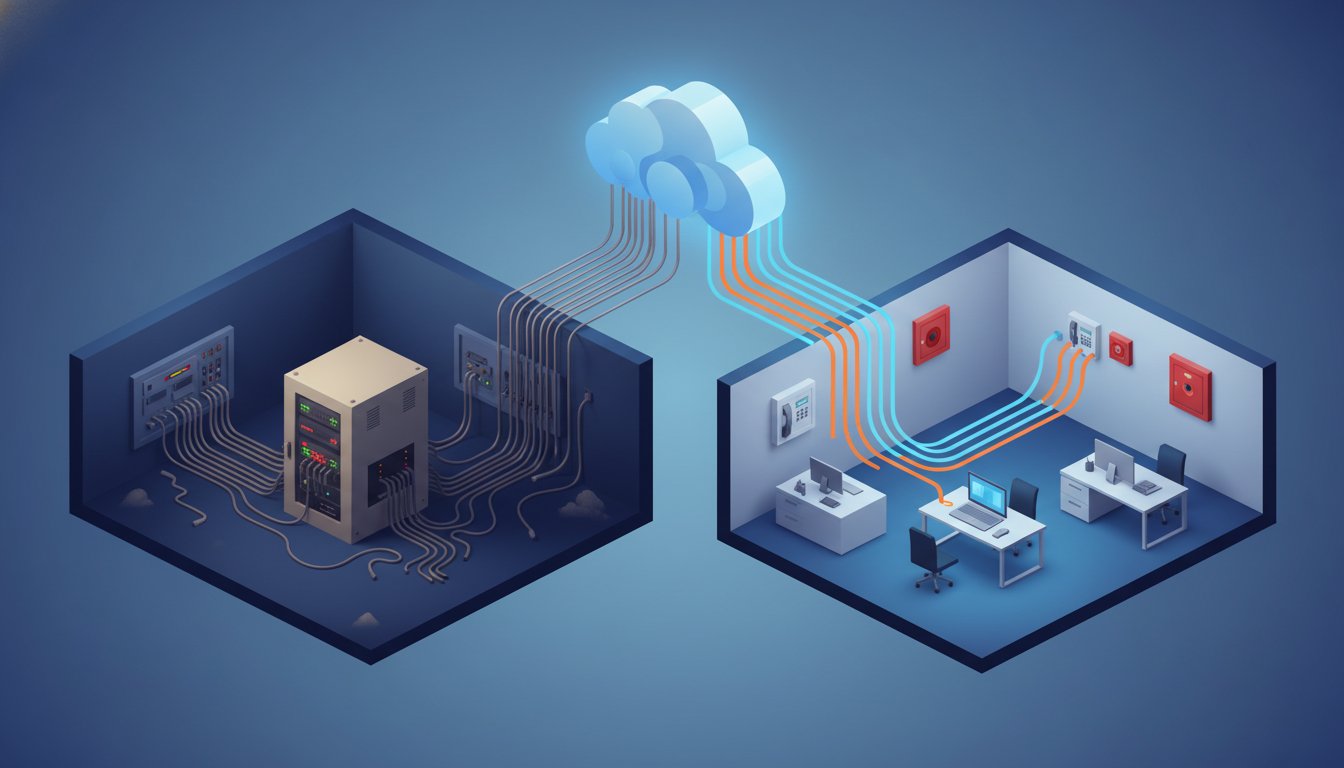
Did you know that as of March 26, 2026, the FCC only requires carriers to give you 90 days of notice before retiring your copper wire center? For many enterprises, migrating from on-premise pbx to cloud has shifted from a long-term goal to an immediate operational necessity. You’ve likely seen the maintenance contracts for your legacy hardware climb while the reliability of those aging systems begins to falter. It’s frustrating to pay 200% to 400% more for POTS lines that are scheduled for decommissioning as early as next month.
We understand the fear of downtime during a major cutover and the complexity of integrating legacy infrastructure with modern software. This guide provides the strategic framework you need to master the shift to cloud-native communications while securing your critical life-safety systems. You’ll learn how to achieve a predictable, scalable platform that eliminates legacy maintenance costs and future-proofs your business. We will break down the transition to UCaaS and CCaaS architectures and explain how LTE POTS replacement ensures your foundational engineering remains sound during the 2026 network modernization.
Key Takeaways
- Learn why the accelerating retirement of copper wire centers makes proactive LTE POTS replacement a requirement for maintaining life-safety systems.
- Discover a structured framework for migrating from on-premise pbx to cloud that avoids operational downtime and secures your long-term communication architecture.
- Understand how to transition from legacy circuit-switched hardware to cloud-native UCaaS and CCaaS platforms to consolidate voice, video, and messaging.
- Identify the critical analog endpoints, such as fire panels and elevator phones, that must be addressed to prevent infrastructure gaps during your digital transition.
- Explore why a successful migration requires an engineering-first partnership focused on structural reliability rather than just sourcing a software vendor.
The High Cost of Inertia: Why Migrating from On-Premise PBX to Cloud is Essential in 2026
On-premise PBX systems are hardware-dependent architectures that have become significant operational bottlenecks in 2026. These systems rely on physical servers and local wiring that lack the agility required for modern, distributed workforces. For many IT leaders, migrating from on-premise pbx to cloud is no longer a choice; it’s a defensive maneuver against infrastructure collapse. Relying on legacy hardware means accepting a ceiling on your operational efficiency while your competitors leverage the speed of software-defined communications.
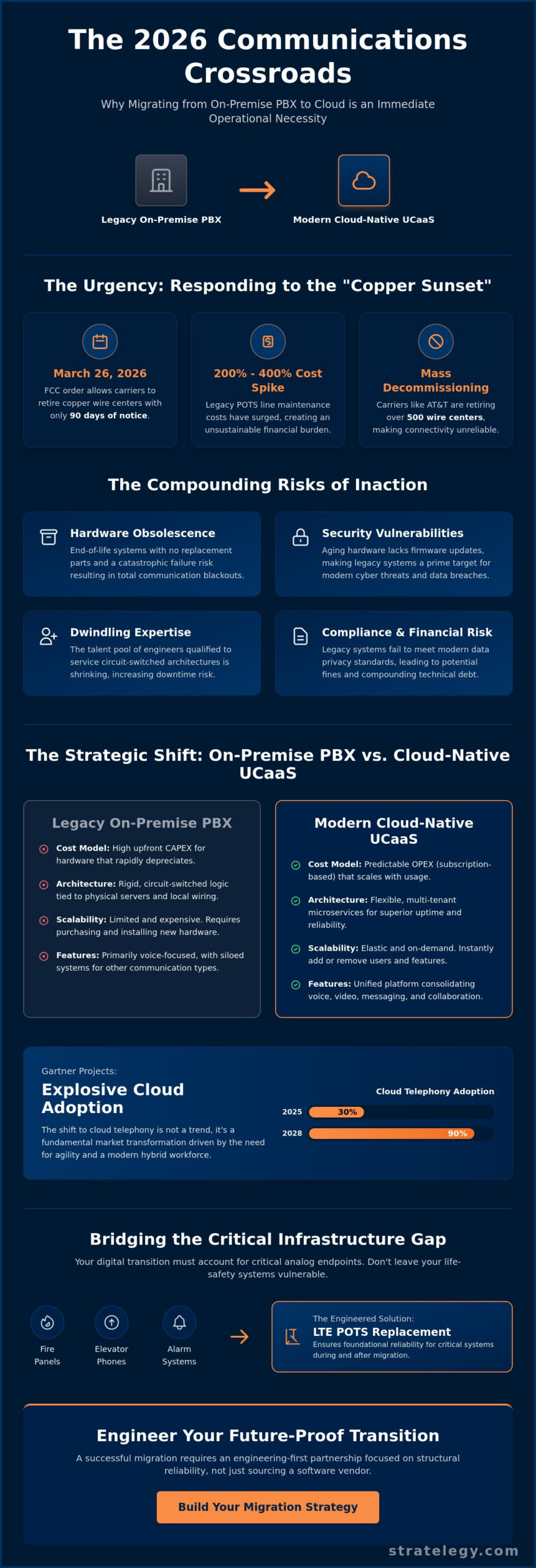
The “Copper Sunset” has accelerated this shift. On March 26, 2026, the FCC passed the Network and Services Modernization Order, allowing carriers to retire copper wire centers with just 90 days of notice. This regulatory shift means your traditional POTS connectivity is a liability. AT&T alone is set to decommission over 500 wire centers in June 2026. As these lines disappear, the cost of maintaining the remaining ones has spiked by 200% to 400%, creating a financial burden that legacy budgets can’t sustain.
Transitioning to cloud communications moves your organization from a CAPEX-heavy model to a predictable OPEX structure. Instead of massive upfront investments in hardware that begins depreciating the moment it’s installed, you pay for what you use. This shift also addresses critical security vulnerabilities. Aging hardware often lacks the firmware updates necessary to thwart 2026-era cyber threats, making legacy systems a prime target for exploitation. Engineering a secure environment requires a platform that receives real-time security patches and global threat intelligence updates.
The Obsolescence of Legacy Hardware
Sourcing replacement parts for end-of-life systems is increasingly difficult. Manufacturers have shifted their focus entirely to cloud-native development, leaving legacy users to scavenge for refurbished components. There’s also a growing talent gap; the number of engineers qualified to troubleshoot circuit-switched architectures is dwindling. Without these specialists, a catastrophic hardware failure leaves your business without a modern disaster recovery path, potentially resulting in days of total communication blackout.
Regulatory and Compliance Pressures in 2026
Modern data privacy standards require end-to-end encryption and rigorous access controls that legacy PBX systems weren’t designed to handle. When migrating from on-premise pbx to cloud, enterprises can finally align their communication stack with modern regulatory frameworks. The financial risk of staying on-premise is technical debt that compounds with every carrier price hike. As telcos aggressively decommission analog infrastructure, businesses that cling to legacy systems face increasing regulatory scrutiny and potential fines for failing to maintain reliable emergency communication standards.
Architecting the Shift: Transitioning to Cloud-Native UCaaS
Architecture defines performance. When migrating from on-premise pbx to cloud, you’re doing more than swapping hardware for software. You’re transitioning from the rigid, circuit-switched logic of the 20th century to a flexible, packet-switched, cloud-native environment. This shift allows for the consolidation of voice, video, and messaging into a single, unified platform. By 2028, Gartner projects that 90% of organizations will use cloud platforms for enterprise telephony, a massive jump from just 30% in 2025. This rapid adoption is driven by the need for a Unified Communications as a Service (UCaaS): The 2026 Strategic Framework that supports a modern, hybrid workforce.
True cloud-native platforms offer elasticity that hosted systems cannot match. While some businesses look for the best hosted PBX services, it’s vital to distinguish between ‘hosted’ and ‘cloud-native.’ Hosted often refers to a vendor managing a private instance of legacy software in their data center. In contrast, cloud-native UCaaS utilizes a multi-tenant, microservices architecture. This design ensures that if one service component fails, the rest of the system remains operational, providing the uptime and reliability required for enterprise-grade communication.
Scalability is no longer a multi-month procurement project. With cloud-native systems, adding seats or expanding to new global regions happens in minutes. The global UCaaS subscriber base already surpassed 120 million seats in mid-2025, according to Synergy Research Group. This growth reflects a fundamental change in how businesses view infrastructure. If you’re ready to modernize your stack, you can explore our engineering-first approach to UCaaS to see how we prioritize stability over superficial features.
UCaaS vs. Hosted PBX: Knowing the Difference
Elasticity is the core differentiator. A hosted PBX is often a static environment that requires manual intervention to scale or update. Cloud-native UCaaS is inherently elastic, automatically adjusting resources based on demand. It removes geographic barriers, allowing your team to maintain a consistent user experience regardless of their physical location. This structural flexibility is essential for organizations that have embraced hybrid work as a permanent operational model.
The Integration of CCaaS and Collaboration
Migrating the PBX creates a foundation for deeper integration with Contact Center as a Service (CCaaS). This convergence provides IT administrators with a ‘single pane of glass’ to manage every communication endpoint across the enterprise. However, software alone isn’t enough. Engineering for quality requires robust bandwidth management and SD-WAN implementation. These technologies prioritize voice packets over less critical data traffic, ensuring that your cloud-native transition delivers the crystal-clear audio quality your business demands.
The Critical Infrastructure Gap: Managing Fire, Life Safety, and POTS During Migration
A significant oversight often occurs when an enterprise begins migrating from on-premise pbx to cloud. While IT teams focus on handsets, softphones, and call routing logic, they frequently overlook the critical analog endpoints tethered to the legacy infrastructure. These “left behind” systems include fire alarm panels, elevator emergency phones, and gate entry systems. Moving to a cloud-native environment often severs the connection to these life-safety devices, creating a dangerous compliance gap and operational risk that legacy hardware used to handle through dedicated copper trunks.
Identifying these analog endpoints is a prerequisite for a successful cutover. Fire panels and security systems require constant, supervised connectivity that standard VoIP protocols cannot always guarantee. To solve this, engineering leaders are integrating POTS Line Replacement: A Strategic Guide to Modernizing Enterprise Infrastructure in 2026 as a parallel track to their UCaaS deployment. This approach ensures that while the business communications move to the cloud, the foundational safety infrastructure remains grounded in reliable, modern hardware.
LTE POTS Replacement: The Modern Life Safety Standard
Modern cellular-based communicators have replaced failing copper lines as the gold standard for emergency signaling. These devices bypass the aging PSTN entirely, utilizing LTE and 5G networks to transmit fire alarm signals and emergency voice data. This transition is essential for meeting NFPA 72 and UL compliance requirements. By utilizing professional-grade LTE POTS replacement hardware, organizations gain a supervised connection that provides real-time alerts if a path is disrupted, a level of oversight that traditional analog lines simply cannot provide.
Securing Elevator and Security Connections
Elevator emergency phones present a unique engineering challenge during a cloud migration. Standard VoIP adapters often fail in these scenarios because they lack the power reserves required to maintain operation during a building-wide power outage. We utilize “POTS in a Box” solutions that feature internal battery backups and ruggedized enclosures to ensure hardware-level reliability. These systems eliminate single points of failure by employing dual-SIM cellular backups. If one carrier network experiences a localized outage, the device automatically fails over to a secondary provider, ensuring your life-safety communications remain active and your facility stays compliant with local building codes.
The Enterprise Migration Framework: From Discovery to Managed Deployment
Engineering a successful transition requires a disciplined, multi-stage approach. Migrating from on-premise pbx to cloud is not a simple software installation; it is a comprehensive structural overhaul. A successful framework moves through five distinct stages to ensure your enterprise remains operational, secure, and fully optimized for the 2026 communications landscape.
- Step 1: Comprehensive Infrastructure Audit. We map every DID and analog endpoint to eliminate “ghost lines” that drain your budget without providing value.
- Step 2: Network Readiness Assessment. Our engineers evaluate your local network for latency, jitter, and PoE capacity to ensure your infrastructure can support high-definition voice traffic.
- Step 3: Phased Migration Strategy. We determine whether a “Big Bang” cutover or a phased hybrid approach best suits your operational risk profile.
- Step 4: Endpoint Modernization. We assess the balance between physical desk phones, softphones, and mobile applications to meet your team’s specific workflow needs.
- Step 5: Post-Migration Lifecycle Management. We implement systematic maintenance and ongoing oversight to maintain the long-term health of your communication stack.
Phase 1: The Discovery and Audit Process
Precision begins with data. The audit is the foundational layer where operational visibility meets financial optimization. During this phase, we identify legacy circuits and services that are no longer necessary, often uncovering significant cost-saving opportunities. We also map complex call flows and IVR structures. This ensures that the user experience remains seamless when you move your logic from local hardware to a cloud-native environment. If you’re ready to secure your infrastructure, you can contact our engineering team to schedule your initial infrastructure audit.
Phase 2: Execution and Cutover
Execution is where strategy meets reality. One of the most critical technical hurdles is number porting, a process that typically takes 2 to 4 weeks and requires meticulous coordination with legacy carriers. We manage this timeline to prevent day-one service outages. Beyond the technical cutover, we focus on user adoption. Shifting the culture from physical hardware to unified platforms is essential for maximizing your return on investment. To better understand the broader ecosystem of these platforms, consult our guide on Understanding Unified Communications and Collaboration: A Comprehensive Guide for 2026. This methodical approach ensures that your transition is predictable, disciplined, and focused on long-term structural reliability.
Engineering Your Transition: Why Strategic Partnership Trumps Software Sourcing
Enterprise leaders often mistake a communications shift for a simple software purchase. It’s not. While a vendor sells you a license and a login, an engineering partner solves the underlying infrastructure challenges that migrating from on-premise pbx to cloud inevitably uncovers. Many providers focus on the novelty of their interface, yet they lack the technical depth to manage the foundational engineering required for a seamless transition. A successful migration is an engineering project that demands a dual focus on modern UCaaS features and the critical life-safety infrastructure that keeps your buildings compliant.
Stratelegy operates as a strategic specialist rather than a mere service provider. We recognize that the shift to cloud communications isn’t just about voice and video; it’s about the long-term health and predictability of your business infrastructure. By focusing on specialized technical niches like fire and life safety, we bridge the gap between legacy reliability and cloud innovation. This approach ensures that your transition doesn’t leave your most critical emergency systems in the dark as copper networks continue to sunset across the country.
Predictability Over Novelty
We prioritize security, governance, and infrastructure stability over superficial features that don’t contribute to your bottom line. Our proprietary maintenance frameworks and systematic hardware update policies are designed to eliminate the fear of obsolescence. We utilize proactive monitoring to identify potential network bottlenecks before they impact your call quality. This disciplined oversight reduces the burden on your internal IT teams, allowing them to focus on high-level strategy while we manage the complex lifecycle of your UCaaS and CCaaS platforms. We don’t just deploy software; we engineer a predictable environment where your communications work exactly as intended, every time.
The Stratelegy Advantage in 2026
In the current landscape of rapid carrier decommissioning and evolving FCC regulations, you need more than a vendor. You need foundational engineers who have already anticipated the problems you haven’t encountered yet. Our commitment to excellence is rooted in engineering rather than sales. We provide the technical authority needed to navigate the complexities of LTE POTS replacement and cloud-native integration with total confidence. By aligning your communication stack with our rigorous maintenance standards, you secure a future-proofed infrastructure that is resilient, scalable, and fully compliant with 2026 standards.
Partner with Stratelegy for an engineered migration that secures your future.
Secure Your Communication Infrastructure for the Next Decade
The transition to cloud-native communications is no longer a matter of if, but when. As carrier decommissioning accelerates and the financial burden of legacy hardware grows, the risk of technical debt becomes unsustainable. You’ve seen how migrating from on-premise pbx to cloud requires a dual focus on modern software features and the critical life-safety endpoints that copper lines once supported. A successful shift isn’t just about choosing a provider; it’s about engineering a resilient, compliant foundation for your entire enterprise.
Stratelegy bridges the gap between legacy reliability and cloud innovation. We bring specialized LTE POTS replacement expertise and enterprise-grade UCaaS and CCaaS integration to every deployment. Our proprietary maintenance frameworks ensure your systems remain secure and predictable long after the initial cutover. You don’t have to navigate this technical complexity alone. Consult with a Stratelegy Engineer to architect your cloud migration and replace operational uncertainty with engineered excellence. Your future-proofed infrastructure is within reach.
Frequently Asked Questions
What is the primary difference between on-premise PBX and cloud PBX?
Architecture defines performance. On-premise PBX relies on physical hardware and local wiring managed at your facility. Cloud PBX is a software-defined service hosted in secure, multi-tenant data centers. This structural difference shifts your communication logic from rigid hardware to elastic microservices. This transition allows for global scalability and real-time updates, removing the operational bottlenecks and maintenance burdens associated with aging legacy systems that create significant friction in 2026.
Will our fire alarms and elevator phones still work after migrating to the cloud?
Standard VoIP cutovers often disrupt legacy emergency systems. To maintain compliance, you must integrate LTE POTS replacement for fire alarms and elevator phones. These cellular-based solutions provide the supervised connectivity required by UL and NFPA standards. By utilizing professional-grade hardware with dual-SIM backups, you ensure that your life-safety infrastructure remains operational even if your primary internet connection or the legacy copper network fails during a decommissioning event.
How long does a typical enterprise migration from PBX to cloud take?
A typical enterprise migration takes between 4 and 12 weeks. The timeline depends on the complexity of your infrastructure and the number of locations involved. When migrating from on-premise pbx to cloud, the most critical phase is number porting, which generally requires 2 to 4 weeks for carrier coordination. A disciplined framework ensures that network testing and user training occur in parallel to prevent service disruption during the final cutover.
Can we keep our existing phone numbers when we move to a cloud system?
You can keep every existing phone number through Local Number Portability (LNP). Our engineering team manages the administrative and technical coordination required to move your DIDs and toll-free numbers from legacy carriers to your new cloud platform. We schedule this transition with precision to ensure there is no loss of service during the final cutover. This process preserves your established business identity while modernizing your underlying communication infrastructure.
Is migrating from on-premise pbx to cloud secure for enterprise data?
Cloud-native communications are significantly more secure than aging legacy hardware. Migrating from on-premise pbx to cloud allows your organization to leverage real-time security patches and advanced encryption standards. Unlike on-premise systems that often lack the firmware updates needed for 2026-era threats, cloud platforms utilize global threat intelligence to proactively defend against systemic vulnerabilities. This transition shifts your security posture from reactive hardware maintenance to proactive digital governance.
What happens to our existing desk phones during a cloud migration?
SIP-compatible handsets can often be repurposed, but many enterprises choose to modernize their endpoints during the transition. You have the flexibility to utilize new IP desk phones, software-based clients on laptops, or mobile applications. Modernizing your endpoints supports a hybrid workforce by providing a consistent user experience across multiple devices. This approach ensures that your team remains connected regardless of their physical location, hardware preference, or the status of your local office wiring.
Do we need to upgrade our internet connection for a cloud phone system?
A network readiness assessment is required to determine if your current connection can support high-definition voice traffic. We evaluate your infrastructure for latency, jitter, and PoE capacity. While you may not need a complete bandwidth upgrade, implementing SD-WAN or quality-of-service (QoS) tagging is often necessary to prioritize voice packets. This engineering-first approach ensures crystal-clear audio quality and system reliability across your entire enterprise network without requiring unnecessary circuit expenses.
What is the ROI of migrating from on-premise PBX to UCaaS in 2026?
The ROI is primarily realized through the elimination of capital expenditures and the reduction of legacy maintenance fees. As carriers retire copper lines, the cost of maintaining POTS connectivity has increased by 200% to 400%. Transitioning to a UCaaS model replaces these volatile costs with a predictable monthly fee. This shift also enhances productivity by consolidating voice, video, and collaboration tools into a single, managed platform that supports long-term operational health.