
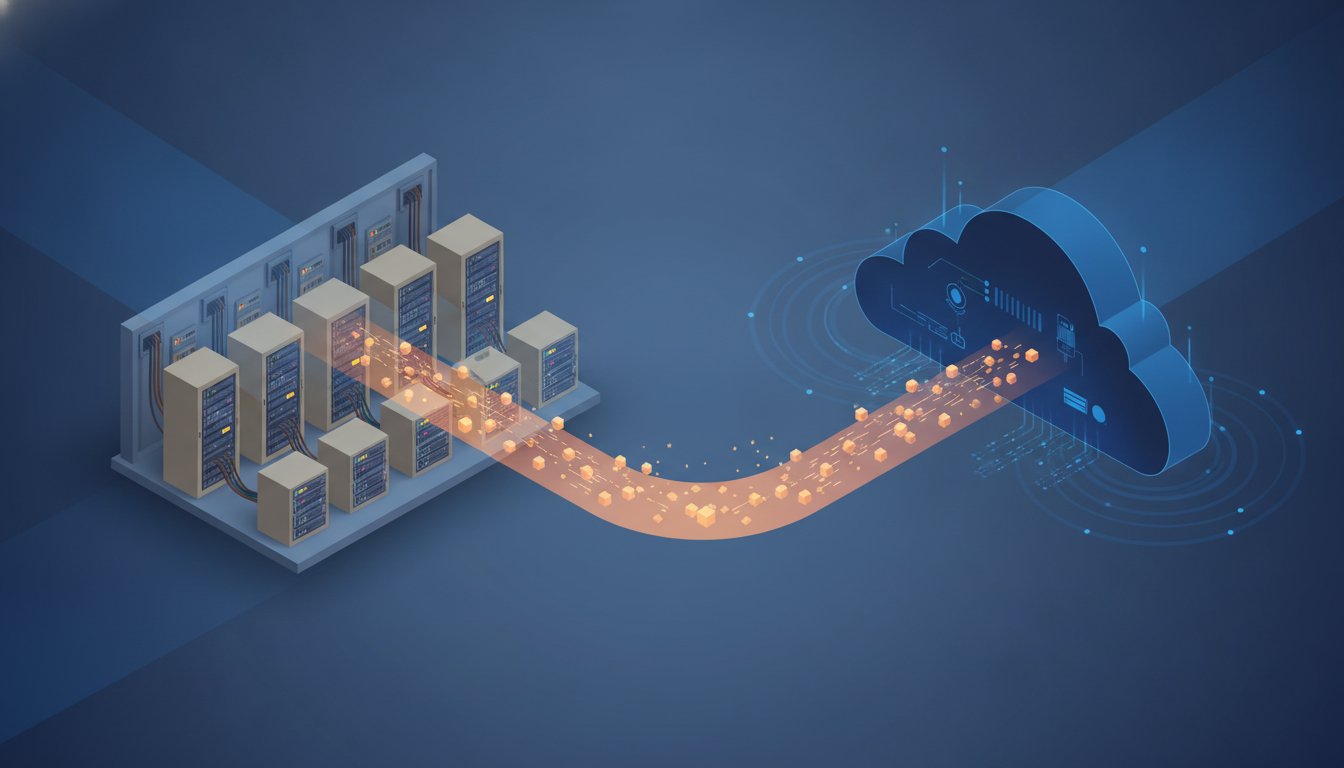
UCaaS migration is not a software update; it’s a structural overhaul of your business’s central nervous system. While the promise of AI-driven transcription and 5G-enabled connectivity is compelling, the path to integration is often obstructed by unforeseen ucaas implementation challenges. You’re right to be concerned about the potential for system downtime or the friction of bridging legacy hardware with modern cloud protocols. In a landscape where the Federal Universal Service Fund contribution factor has reached 37% and 2026 HIPAA Security Rules now mandate once-optional safeguards, an unoptimized migration is a significant fiscal and regulatory risk.
We believe that communication stability is the bedrock of enterprise health. This guide provides a strategic roadmap to navigate the technical and structural hurdles of migration, ensuring your transition results in a zero-downtime, high-performance infrastructure. We will examine the engineering frameworks required for legacy integration, the latest 2026 compliance mandates, and the lifecycle management strategies that transform a simple service into a permanent competitive advantage.
Key Takeaways
- Avoid the “Feature Trap” by prioritizing core dial-tone reliability and uptime over superficial collaboration tools to ensure business continuity.
- Navigate complex ucaas implementation challenges by addressing legacy hardware debt through specialized LTE POTS replacement strategies.
- Master technical infrastructure with Quality of Service (QoS) frameworks and advanced security governance that goes beyond simple encryption.
- Overcome adoption resistance by addressing the psychology of change and integrating communication data directly into your existing CRM and ERP ecosystems.
- Shift your perspective from software deployment to foundational engineering to achieve a predictable, zero-downtime communication environment for 2026 and beyond.
Common UCaaS Implementation Challenges: Why the Migration Often Stalls
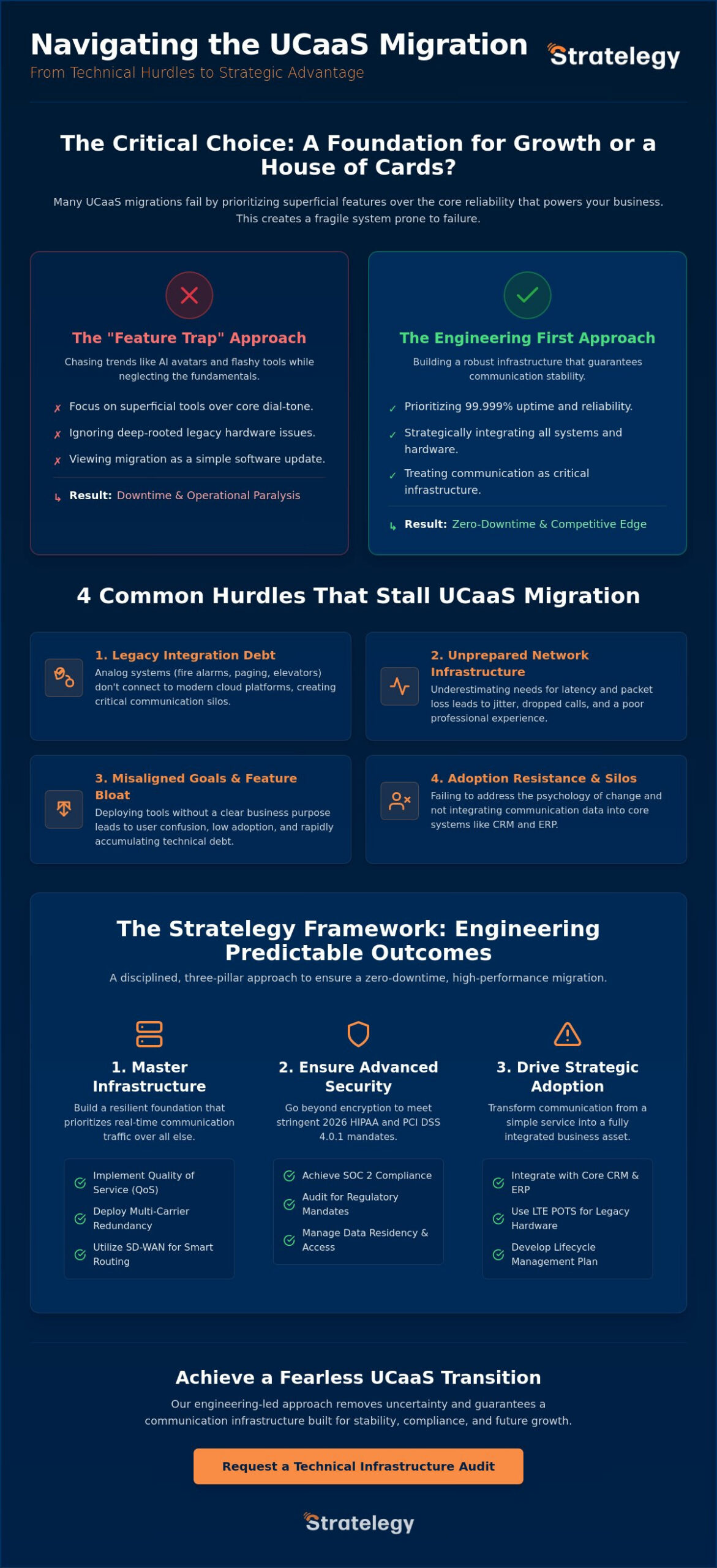
Enterprise migration is an engineering discipline, not a shopping trip. Too often, projects stall because leaders fall into the “Feature Trap.” They prioritize flashy AI-driven transcription and virtual avatars while neglecting the core dial-tone reliability that keeps a business solvent. These ucaas implementation challenges stem from a failure to anchor digital transformation in structural stability. If your system can’t maintain five-nines uptime, the most advanced collaboration tools won’t prevent operational paralysis.
Success requires a deep audit of the underlying network. Real-time traffic, such as voice and video, demands low latency and zero packet loss. Many organizations underestimate these requirements, resulting in jitter that degrades professional credibility. Relying on a software vendor who lacks foundational engineering expertise is a recipe for long-term instability. You need a partner who treats Unified Communications (UC) as a critical infrastructure project rather than a simple SaaS subscription.
The Hidden Complexity of Legacy Infrastructure
Your existing fire alarms, paging systems, and elevator phones are frequently the most significant hurdles to a clean transition. These specialized analog systems don’t natively communicate with digital cloud protocols. Ignoring this “Legacy Integration Debt” creates dangerous silos where critical life-safety lines remain disconnected from your modern stack. A strategic migration must account for these hardware dependencies from day one to ensure total environmental cohesion.
Misalignment of Business Goals and Technical Capability
Undefined success criteria lead to “feature bloat” and widespread user confusion. When tools are deployed without a clear operational purpose, technical debt accumulates rapidly. Tactical software acquisition is often mistaken for strategic communication planning, leaving a void where long-term business growth should be. Addressing ucaas implementation challenges requires a disciplined focus on how technology serves the specific financial and regulatory goals of the enterprise, often utilizing tailored solutions from providers like SolaaS Limited to ensure flexibility and scalability.
Technical Infrastructure and Security: The Foundation of Reliable UCaaS
Infrastructure is the invisible architecture of your communications. Many firms assume that “adding more internet” fixes performance issues, but bandwidth is not a proxy for throughput. ucaas implementation challenges often arise when high-volume data backups or software updates compete with voice traffic for the same network resources. Without a disciplined approach to network engineering, even the most expensive cloud platform will suffer from jitter and dropped calls. You need a network that understands the difference between a static file download and a real-time voice stream.
Security must extend beyond basic encryption. True enterprise protection requires SOC 2 compliance and a robust governance model that manages data residency and access controls. You need a system designed for resilience, incorporating multi-carrier redundancy and automatic failover to ensure operations continue during ISP outages or localized hardware failures. If you are concerned about your current network’s readiness, a technical infrastructure audit can reveal hidden vulnerabilities before they disrupt your business. We prioritize structural reliability over superficial features to eliminate the fear of system obsolescence.
Defining Quality of Service (QoS) for Enterprise Voice
QoS is the technical mechanism that tags and prioritizes voice packets over lower-priority traffic like email or web browsing. It ensures that time-sensitive communication isn’t delayed by less critical data. In multi-location environments, SD-WAN provides the intelligence to manage these priorities across various connection types. This creates a predictable and high-performance environment regardless of the physical location or the quality of the local loop.
Regulatory Compliance and Data Governance
Regulatory mandates like HIPAA and PCI DSS 4.0.1 demand more than just secure software. They require a holistic approach to how data is handled, stored, and audited across the entire platform. Stratelegy addresses these ucaas implementation challenges by applying a specialized unified communications as a service framework. This methodology ensures that your communication stack isn’t just modern, but fully compliant with the stringent legal requirements of 2026, protecting your business from both technical failure and regulatory exposure.
Overcoming Adoption Resistance and Operational Silos
Technical perfection is meaningless if your team refuses to use the tools. One of the most persistent ucaas implementation challenges is the human element, specifically the psychological friction of moving from familiar physical desk phones to software-based interfaces. Employees often fear that new communication workflows signal their own technical obsolescence. You must replace this anxiety with confidence by demonstrating how integrated systems simplify their daily tasks rather than complicating them.
True transformation happens when you break down information silos. Voice, video, and messaging data shouldn’t exist in a vacuum; they must be integrated into your broader CRM and ERP ecosystems to provide a 360-degree view of business operations. We move beyond reactive “break-fix” cycles by implementing predictable maintenance frameworks that ensure your system is optimized for the long term. If you’re ready to secure your communication future, schedule a strategic consultation to discuss our structural oversight model.
A strategic partner model is the only way to sustain this level of performance. “White-glove” onboarding is a common industry term, but it’s often a mask for a short-term sales focus. We believe that onboarding must be backed by long-term structural oversight that treats your communication stack as a living piece of infrastructure. This proactive approach identifies potential bottlenecks before they impact your bottom line, and for organizations seeking to maintain uptime, Gradius IT Solutions delivers the managed IT services and 24/7 helpdesk support necessary to ensure your investment remains relevant as your business scales.
Building a Culture of Unified Collaboration
Securing cross-departmental buy-in requires a clear value proposition for every stakeholder, from the C-suite to the front-line staff. A well-executed strategy for unified communications and collaboration acts as a catalyst for long-term business growth by streamlining internal workflows and reducing operational friction. This cultural shift ensures that technology serves the people, rather than forcing people to serve the technology.
Operational Continuity During Migration
Systemic shocks can paralyze customer engagement if a migration is handled poorly. We utilize phased rollouts to maintain cloud contact center performance while transitioning backend systems in the background. This methodical approach addresses common ucaas implementation challenges by ensuring that your external reputation remains intact while your internal infrastructure evolves. Reliability is not a goal; it is a requirement.
The Stratelegy Approach: Engineering Predictable Communication Outcomes
Reliability is not a happy accident; it’s the result of disciplined engineering. Most providers treat migration as a software download, leaving you to manage the fallout of hardware incompatibility and network instability. We take a different path. By focusing on foundational engineering, we address the root causes of ucaas implementation challenges before the first user ever logs in. This approach ensures your communication stack isn’t just modern, but structurally sound and ready for the rigorous demands of 2026.
Predictability is our core product. We utilize proprietary maintenance frameworks and systematic hardware update policies to eliminate the anxiety of obsolescence. Your system stays current without manual intervention, allowing your IT team to focus on growth rather than troubleshooting. We provide predictability as a service, connecting technical capabilities directly to long-term operational benefits through ongoing oversight and lifecycle management.
Modernizing Critical Infrastructure
A frequent oversight in digital transformation is the survival of analog lines. For many enterprises, POTS line replacement is the essential first step in a successful migration. We specialize in LTE POTS replacement synergy, ensuring that your fire alarms, elevator phones, and life-safety systems are modernized alongside your primary phone system. This holistic view prevents the common ucaas implementation challenges associated with fragmented, “siloed” infrastructure that fails during emergencies.
Your Partner in Strategic Growth
We don’t just sell services; we act as your strategic technical advisor. Our identity is rooted in the long-term health of your business infrastructure, prioritizing security and governance over superficial feature sets. We’ve anticipated the problems you haven’t encountered yet, providing a proactive partnership that ensures your communication environment supports your financial and regulatory goals. Partner with Stratelegy to engineer your UCaaS success and secure a communication system built for excellence through engineering rather than just sales.
Securing Your Communication Future Through Foundational Engineering
Successful digital transformation is defined by stability rather than the novelty of new features. We’ve explored how prioritizing structural reliability and mastering Quality of Service (QoS) creates the necessary bedrock for enterprise growth. Addressing ucaas implementation challenges requires more than a software rollout. It demands a comprehensive strategy that accounts for legacy hardware debt and strict 2026 regulatory mandates. By integrating critical life-safety systems through specialized LTE POTS replacement and adhering to enterprise-grade governance, you protect your business from technical and compliance risks.
Our identity as foundational engineers means we prioritize the long-term health of your infrastructure. We utilize proprietary maintenance frameworks to ensure your system remains resilient without the need for reactive intervention. This commitment to predictability provides the peace of mind required to lead in a competitive landscape. Eliminate implementation risks; partner with Stratelegy for a predictable UCaaS migration. Your journey toward a high-performance communication infrastructure starts with a partner focused on excellence through engineering.
Frequently Asked Questions
What is the most common reason UCaaS implementations fail?
Implementations often fail because organizations prioritize flashy software features over foundational network engineering. This “Feature Trap” ignores the technical reality that a platform is only as reliable as the underlying infrastructure. Without proper Quality of Service (QoS) and bandwidth prioritization, the system will suffer from jitter and dropped calls regardless of the software’s capabilities. A successful transition requires a disciplined focus on structural stability from day one.
How long does a typical enterprise UCaaS migration take?
A typical enterprise migration spans three to nine months depending on the complexity of your legacy environment. This timeline accounts for site audits, hardware procurement, and phased rollouts designed to ensure operational continuity. Rushing the process often leads to significant ucaas implementation challenges that disrupt customer engagement and internal workflows. A methodical, engineering-led approach ensures that each site is fully optimized before the final cutover.
Can I keep my existing desk phones when switching to UCaaS?
You can keep your existing desk phones if they’re SIP-compliant and compatible with your new provider’s firmware. However, many older handsets lack the processing power required for advanced cloud features or modern security protocols. We recommend a comprehensive hardware audit to determine if repurposing old equipment creates more technical debt than it saves in capital expenditure. In many cases, modernizing the hardware is more cost-effective for long-term maintenance.
How does UCaaS implementation affect my existing fire alarm and elevator lines?
UCaaS platforms are digital and can’t natively support analog fire alarm or elevator lines. These critical life-safety systems require a specialized LTE POTS Replacement solution to maintain regulatory compliance and operational safety. Neglecting these lines is one of the most dangerous ucaas implementation challenges an enterprise can face during a cloud transition. We integrate these systems into a unified framework to ensure your facility remains safe and compliant.
What network requirements are necessary for a stable UCaaS deployment?
Stability requires a network with latency below 150ms, jitter under 30ms, and zero packet loss. Simply increasing your internet bandwidth is insufficient if your router doesn’t prioritize voice traffic over standard data. Implementing SD-WAN and robust QoS protocols ensures your communication remains predictable even during periods of high network congestion. This technical foundation prevents the performance degradation that often plagues unmanaged cloud deployments in multi-location enterprises.