
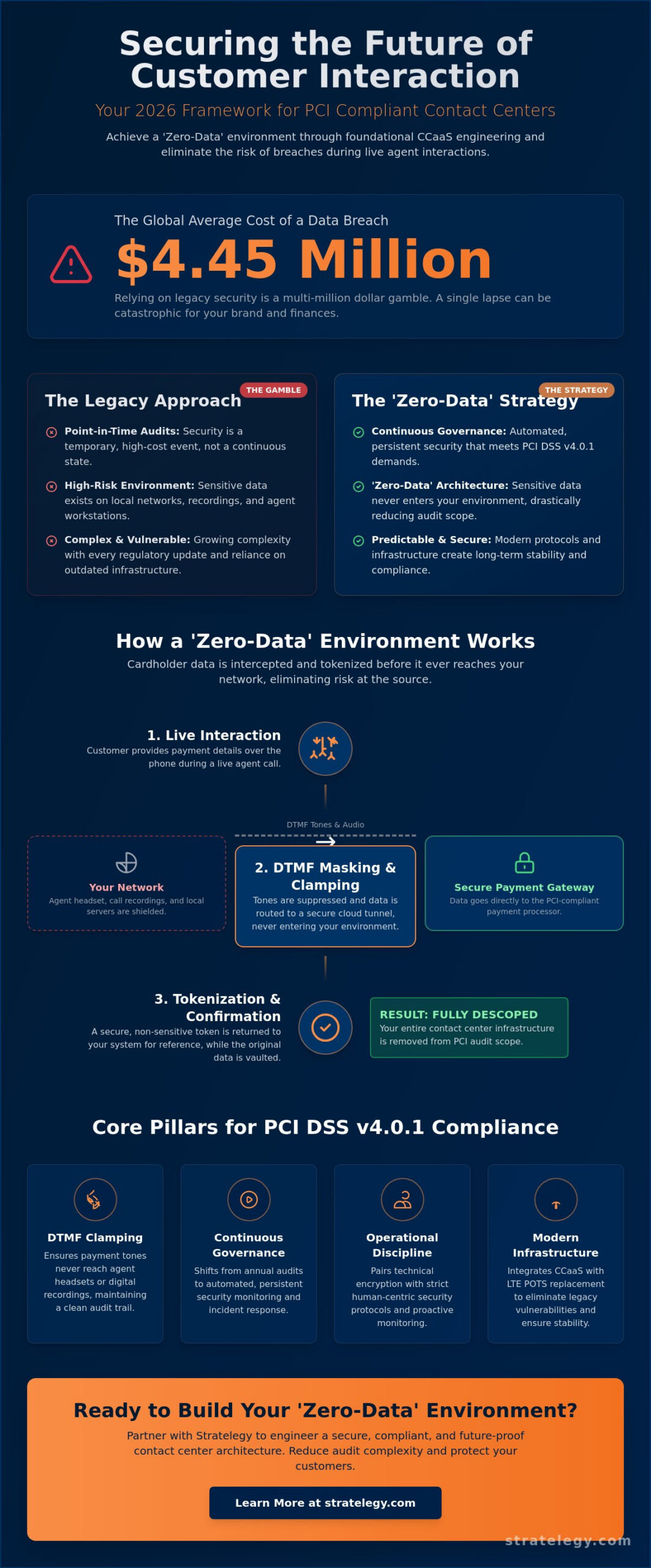
Relying on legacy security for live agent interactions is a multi-million dollar gamble. With the global average cost of a data breach hitting $4.45 million, the financial risk of a single security lapse is catastrophic. You likely view the annual audit process as a high-cost, complex burden that grows more difficult with every regulatory update. It’s a common frustration for leaders who want to prioritize growth but find themselves bogged down by infrastructure that wasn’t built for modern encryption. Implementing pci compliant contact center solutions shouldn’t feel like a constant battle against obsolescence.
True security is achieved by engineering environments where sensitive data never exists in a usable form. This article provides a strategic framework for 2026 to help you achieve a fully descoped environment through foundational CCaaS engineering. You’ll learn how to meet the rigorous requirements of PCI DSS v4.0.1 while reducing audit complexity and eliminating the fear of breaches during live interactions. We’ll examine how advanced tokenization and modern protocols create a predictable, secure infrastructure that protects your business and your customers.
Key Takeaways
- Engineering a ‘zero-data’ environment. This architecture removes sensitive cardholder information from your local network to drastically reduce audit scope and infrastructure complexity.
- Deploy pci compliant contact center solutions with DTMF clamping. This technology ensures that payment tones never reach agent headsets or digital recordings, maintaining a clean audit trail.
- Shift to continuous automated governance. Modern frameworks move beyond point-in-time audits to meet the persistent security demands of PCI DSS v4.0.1.
- Prioritize disciplined operational governance. Technical encryption is most effective when paired with strict human-centric security protocols and proactive monitoring.
- Integrate CCaaS with LTE POTS replacement. This combination eliminates legacy copper vulnerabilities and creates a foundation for long-term infrastructure stability and regulatory compliance.
The High Stakes of PCI Compliant Contact Center Solutions in 2026
Modern commerce demands structural integrity. At its core, pci compliant contact center solutions are cloud-based platforms specifically engineered to process, store, and transmit cardholder data while adhering to the Payment Card Industry Data Security Standard (PCI DSS). In 2026, compliance is no longer a seasonal checkbox. It’s a continuous, automated cycle of data governance. We’ve moved past the era of ‘point-in-time’ audits where a business was only secure for a few weeks a year. Today, infrastructure must be self-healing and perpetually monitored to prevent the catastrophic fallout of a security lapse.
Enterprise contact centers are the primary targets for modern social engineering. Attackers don’t just attempt to hack code; they hack humans. A single agent mistake or a legacy recording system can expose millions of records to unauthorized parties. The financial reality is sobering. While the cost of implementing high-tier compliance is a measurable operational expense, the cost of failure is often terminal. Between regulatory fines and the loss of customer trust, a Level 1 breach can devastate a brand’s long-term health. We view compliance as a foundational engineering requirement rather than a peripheral IT task.
PCI DSS 4.0 and the Contact Center
The transition to PCI DSS v4.0.1 introduced rigorous shifts in how live agent interactions are handled. Multi-factor authentication (MFA) is now a mandatory requirement for all administrative access to the cardholder data environment. This prevents unauthorized lateral movement within your network. Additionally, the standard now requires sophisticated automated monitoring and incident response protocols. Your system must be able to detect anomalies and trigger defensive scripts instantly, ensuring that human error doesn’t lead to a systemic failure.
The Intersection of CCaaS and Unified Communications
Many organizations overlook how internal collaboration tools expand their risk profile. When you integrate unified communications as a service, you inadvertently expand your compliance perimeter. Internal chat, video calls, and file-sharing tools can become accidental backdoors for sensitive data if they aren’t properly siloed. A single-vendor approach for both UC and pci compliant contact center solutions simplifies this complexity. It ensures that security policies are uniform across every communication channel. This strategic alignment creates a hardened shell around your data, making governance predictable and eliminating the vulnerabilities created by fragmented, multi-vendor environments.
Technical Architecture: Engineering the ‘Zero-Data’ Environment
Security is a structural choice. For enterprise leaders, the most effective pci compliant contact center solutions are those that rely on the principle of descoping. Descoping isn’t a simple security patch; it’s an architectural strategy that removes your local network, servers, and agent workstations from the audit boundary entirely. By ensuring that cardholder data never touches your internal infrastructure, you eliminate the primary point of failure for most data breaches. This engineering-first approach aligns with the rigorous frameworks established by the PCI Security Standards Council (PCI SSC), shifting the burden of compliance to hardened cloud environments.
A ‘Zero-Data’ environment utilizes specific technologies to intercept sensitive information before it enters your ecosystem. This includes the use of secure Interactive Voice Response (IVR) systems for self-service payments and advanced suppression technologies for live agent calls. When a customer provides payment details, the data is routed through a secure cloud tunnel directly to the payment processor. This allows your agents to remain on the line to provide assistance without ever being exposed to the raw financial data. It creates a seamless customer experience while maintaining a disciplined security posture.
DTMF Masking and Audio Suppression
Dual-Tone Multi-Frequency (DTMF) masking, often called ‘hush’ technology, is a critical component of a secure voice architecture. This system identifies the specific frequencies generated by a telephone keypad and replaces them with flat, non-sensitive tones in real time. This ensures that even if a call is being monitored or recorded for quality assurance, the sensitive digits are never audible or stored. DTMF clamping ensures that sensitive credit card digits are never captured by the CRM or local storage systems. This allows you to maintain comprehensive call recordings for coaching and compliance without inadvertently creating a high-risk database of cardholder information.
Cloud-Native Tokenization Frameworks
Tokenization is the superior choice for long-term data lifecycle management. While encryption hides data behind a key, tokenization replaces the data entirely with a non-sensitive placeholder, or ‘token.’ We utilize these frameworks to ensure that if a breach were to occur, the stolen information would be mathematically useless to an attacker.
- Non-Reversible: Unlike encrypted data, tokens cannot be ‘decrypted’ because there is no mathematical relationship between the token and the original data.
- Reduced Scope: Since the local server only stores tokens, the vast majority of your infrastructure falls outside the scope of a full Report on Compliance (ROC).
- Gateway Integration: Data is sent directly to third-party payment gateways, ensuring your local network remains a clean, ‘zero-data’ zone.
Integrating these structural safeguards into your CCaaS environment ensures long-term operational health and regulatory peace of mind. By focusing on foundational engineering rather than superficial features, you build an infrastructure that is secure by design and ready for the challenges of 2026.
Descoping Strategies: Reducing Audit Complexity and Cost
Audit complexity is a direct result of network scope. When sensitive data traverses your primary business network, every connected device becomes a potential audit point. By engineering pci compliant contact center solutions that utilize an ‘Off-Network’ approach, you keep payment data strictly within a secure cloud tunnel. This isolation ensures that the Cardholder Data Environment (CDE) is confined to the service provider’s hardened environment rather than your local office. Effective descoping your contact center transforms compliance from a global infrastructure headache into a localized, manageable process.
Strategic mapping of data flows is essential to prevent unnecessary touchpoints. Many businesses suffer from ‘scope creep’ when they link their communication platforms to CRM or ERP systems without proper siloing. If your cloud contact center architecture is designed correctly, these integrations only handle non-sensitive identifiers. This methodology ensures that your central business databases never store raw payment information, significantly lowering the financial and operational burden of annual compliance cycles. We prioritize this structural separation to give business owners peace of mind and long-term infrastructure stability.
Segmenting the Network for Compliance
Engineering air-gapped segments for payment processing is a non-negotiable requirement for high-security environments. By isolating payment traffic from general office traffic, you eliminate the risk of lateral movement during a security event. This is where modern hardware plays a critical role. Utilizing LTE POTS replacement for backup security lines or emergency communication ensures that your most critical pathways are not reliant on vulnerable legacy copper. These modern cellular links provide a secure, manageable alternative that fits perfectly within a disciplined compliance framework.
Automating the Compliance Trail
CCaaS platforms excel at generating the documentation required for modern audits. Instead of manual data collection, these systems provide automated logging that creates an audit-ready trail of every transaction and interaction. This automation reduces the heavy lifting traditionally required from internal IT staff during the Self-Assessment Questionnaire (SAQ) process. Proactive monitoring replaces reactive fire-fighting. By utilizing real-time compliance dashboards, you can identify and remediate potential vulnerabilities before they become audit failures, turning compliance into a predictable, low-friction component of your daily operations.
Operational Governance: The Human Element of Security
Technical encryption is a vital shield, but it’s not a complete solution. Operational governance is the disciplined framework that prevents human error from undermining your security architecture. For pci compliant contact center solutions to be truly effective, the physical and behavioral environment must be engineered with the same rigor as the digital network. This means moving beyond simple training sessions and implementing systematic policies that govern every agent interaction. Security isn’t just about what your software does; it’s about how your people are permitted to work within it.
A ‘Clean Room’ protocol is a cornerstone of this approach. This involves creating a physical workspace where personal devices, recording equipment, and even traditional writing tools are strictly prohibited during payment processing. This ensures that even if an agent sees sensitive data during a transaction, they have no means to record or transmit it. We view this as engineering a physical environment that matches your digital security standards. When the workspace is controlled, the risk of internal data theft drops significantly.
Systematic hardware update policies further reinforce this governance. Outdated endpoints are often the weakest link in a security chain, providing entry points for vulnerability exploits. By maintaining a strict lifecycle management schedule for all agent hardware, you eliminate the threat of unpatched firmware or legacy vulnerabilities. Predictability in hardware maintenance leads to predictability in security. This proactive stance ensures your infrastructure remains resilient against evolving threats without requiring constant emergency interventions from your IT staff.
Agent Workflow Optimization
Designing payment scripts that guide customers without exposing data is essential for maintaining a secure environment. ‘Pause and Resume’ features play a critical role here. These tools automatically halt call and screen recordings the moment a payment portal is accessed, ensuring no sensitive data is ever stored in your quality assurance archives. This automation protects customer privacy and significantly reduces agent anxiety. When the workflow is predictable and secure, agents can focus on service excellence rather than compliance fears. You can build a more resilient operation by choosing engineered CCaaS solutions that prioritize long-term governance over temporary fixes.
Continuous Monitoring and Threat Detection
AI is now a core component of continuous monitoring within the modern contact center. These systems analyze behavior in real time, detecting anomalies such as an agent staying on a payment screen for an unusual duration. When the system identifies a potential compliance breach, it triggers immediate alerts for supervisors to intervene. A foundational engineer approaches proactive threat hunting by building these detection capabilities directly into the communication fabric rather than treating them as an afterthought. This ensures that your pci compliant contact center solutions are always one step ahead of potential internal or external threats.
The Stratelegy Framework: Built for Compliance and Impact
Stratelegy approaches security as a structural engineering discipline. We don’t just provide software; we build foundational environments that prioritize long-term infrastructure stability. Our pci compliant contact center solutions are designed to eliminate the inherent vulnerabilities of legacy systems. By shifting your operations to a managed, cloud-based framework, you replace unpredictable risk with structural predictability. This transition is critical for organizations that view regulatory governance as a strategic asset rather than a secondary burden.
True reliability requires a holistic view of the communication stack. This is why our CCaaS solutions integrate seamlessly with pots line replacement. While many providers focus solely on the application layer, we address the physical connectivity that powers your most critical systems. A strategic specialist anticipates the infrastructure problems you haven’t encountered yet. We operate as a partner in your long-term success, ensuring your security posture remains resilient against both digital threats and hardware obsolescence.
Beyond Software: Foundations of Reliability
Reliability begins with the connection. We utilize LTE-based connectivity to ensure that critical life safety and security systems remain operational during primary network failures. This focus on the ‘long-term health’ of your infrastructure is a hallmark of our approach. We implement systematic maintenance frameworks and proprietary hardware update policies to ensure your endpoints never become a liability. You gain the peace of mind that comes from knowing your foundation is maintained by experts who prioritize security and governance over superficial features. We aim to eliminate the fear of obsolescence for every business owner we serve.
Getting Started with Stratelegy
Our engagement begins with a disciplined discovery process. We assess your current compliance gaps and identify the systemic vulnerabilities in your existing environment. From there, we engineer a customized migration path that moves your operations into a hardened, PCI-compliant cloud without disrupting your daily workflows. This methodical approach ensures that every step of your digital transformation is intentional and controlled. Our goal is to guide you from legacy operational challenges to a comprehensive, managed solution that supports your business for years to come. Contact Stratelegy today for a strategic infrastructure assessment.
Future-Proofing Your Compliance Infrastructure
Engineering a resilient contact center requires a shift from reactive security to proactive structural integrity. You’ve seen how descoping your network through tokenization and DTMF clamping eliminates the primary targets for data theft. These technical safeguards, combined with disciplined operational governance and automated monitoring, ensure your business remains compliant with the latest PCI DSS 4.0.1 standards. Transitioning to modern pci compliant contact center solutions is an investment in the long-term health and predictability of your enterprise.
Stratelegy provides the technical expertise and foundational engineering necessary to navigate this complex landscape. Our approach is rooted in infrastructure stability, utilizing a PCI DSS 4.0 Ready Architecture and proprietary maintenance frameworks to prevent obsolescence. You don’t have to manage these regulatory burdens alone. By choosing a partner dedicated to specialized technical support and lifecycle management, you can focus on growth while we secure your communication fabric.
Secure Your Enterprise Infrastructure with Stratelegy and build a foundation that is ready for the challenges of 2026 and beyond.
Frequently Asked Questions
Is PCI compliance mandatory for all contact centers?
PCI compliance is mandatory for any contact center that processes, stores, or transmits branded credit card data. If your agents or IVR systems handle cardholder information, you must adhere to the standards established by the PCI Security Standards Council. Failure to comply can result in monthly fines ranging from $5,000 to $100,000 and the potential loss of your ability to process credit card transactions entirely. It is a foundational requirement for maintaining business legitimacy and customer trust.
How does DTMF masking work in a cloud-based contact center?
DTMF masking technology intercepts the dual-tone frequencies generated by a customer’s telephone keypad before they enter your network. The system replaces these sensitive tones with flat, non-identifiable frequencies in real time. This ensures that payment data never reaches the agent’s headset or your call recordings. By utilizing this technology within pci compliant contact center solutions, you keep sensitive digits out of your local environment and significantly reduce your security risk profile.
What is the difference between PCI DSS Level 1 and Level 2 providers?
The primary difference lies in the transaction volume and the rigor of the required assessment. Level 1 providers process over six million transactions annually and must undergo an intensive external audit by a Qualified Security Assessor (QSA). Level 2 providers handle between one and six million transactions and typically complete a Self-Assessment Questionnaire (SAQ). Choosing a Level 1 certified partner ensures your infrastructure meets the most stringent security benchmarks available in the industry.
Can I record calls and still remain PCI compliant?
You can record calls while remaining compliant by utilizing automated suppression or “pause and resume” technology. PCI standards strictly prohibit the storage of sensitive authentication data, such as CVV codes, after a transaction is authorized. Modern CCaaS platforms automatically halt recordings the moment a payment portal is accessed. This ensures that no sensitive cardholder data is captured in your quality assurance or training archives, maintaining a clean audit trail.
How do I reduce the scope of my PCI audit?
Reducing audit scope is achieved through descoping strategies that remove your local network from the Cardholder Data Environment (CDE). By utilizing cloud-native tokenization and secure IVR paths, you ensure that sensitive data never touches your internal servers or agent workstations. This “zero-data” approach limits the number of systems that fall under the auditor’s preview. It effectively lowers the complexity and cost of your annual compliance assessment while improving overall infrastructure stability.
Does using a PCI compliant CCaaS vendor guarantee my company is compliant?
Using a compliant vendor does not automatically guarantee your company’s total compliance. While a CCaaS provider secures the cloud infrastructure, your organization remains responsible for internal operational governance, such as agent training and physical workspace security. Compliance is a shared responsibility model. You must ensure that your internal processes and pci compliant contact center solutions work in tandem to meet the full requirements of PCI DSS v4.0.1.
What happens if a contact center fails a PCI audit?
Failing a PCI audit leads to immediate financial penalties and increased regulatory scrutiny. Credit card companies often levy substantial monthly fines and may move your organization into a higher risk category, necessitating more frequent and expensive assessments. In severe cases, you may lose the ability to accept credit card payments entirely. Beyond these costs, an audit failure indicates systemic vulnerabilities that significantly increase your risk of a multi-million dollar data breach.
How often should I conduct PCI compliance training for agents?
PCI DSS requirements mandate that you conduct security awareness training for all agents upon hire and at least once every twelve months. However, a disciplined governance framework often includes quarterly refreshers to address evolving social engineering tactics. Regular training ensures that agents stay vigilant and follow specific protocols, such as “Clean Room” policies. This ongoing education is a critical component of maintaining the long-term health and security of your business infrastructure.