
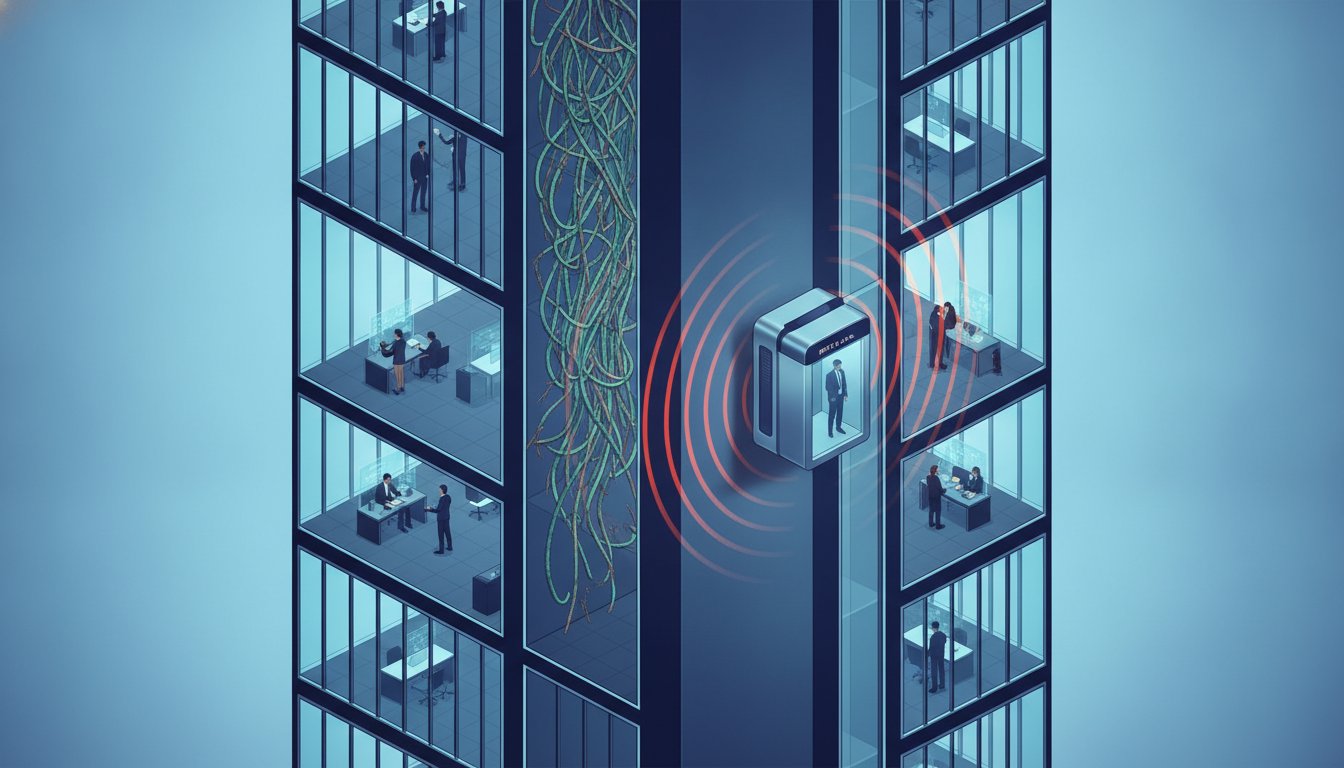
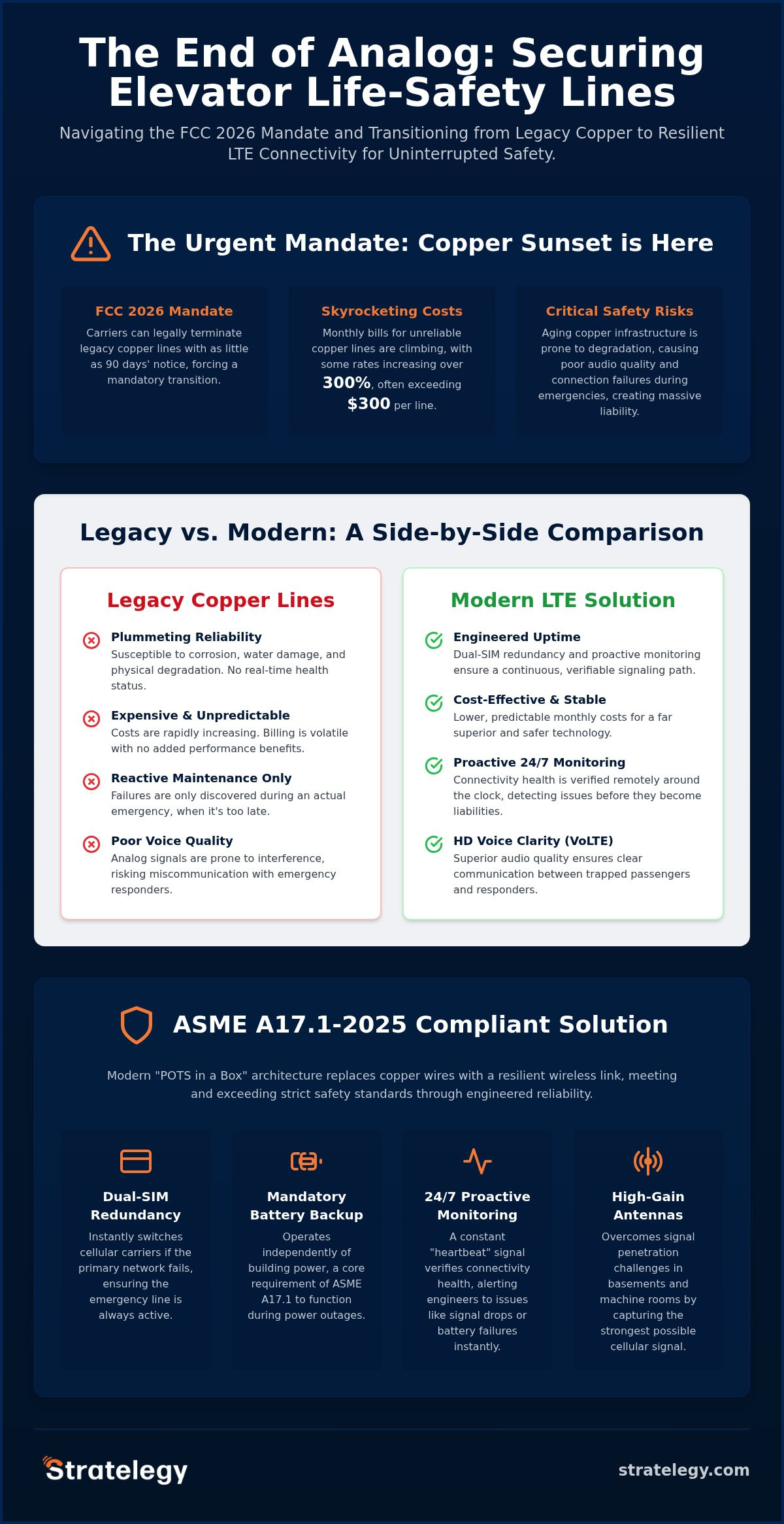
With the FCC’s 2026 Network and Services Modernization Order now in full effect, carriers can legally terminate your elevator’s life-safety lines with as little as 90 days’ notice. You’ve likely watched your monthly bills for legacy copper climb as high as $300 per line while the reliability of those aging wires continues to plummet. It’s a precarious position for any building owner. Implementing a reliable pots replacement for elevator lines isn’t just about cutting costs. It’s about ensuring your property remains compliant with the strict ASME A17.1-2025 safety standards.
We believe that infrastructure stability is the foundation of your business security. This guide provides a clear roadmap to transition your critical life-safety systems from obsolete copper to resilient LTE connectivity while maintaining absolute uptime. We’ll examine the current regulatory landscape, the structural advantages of managed cellular bridges, and the systematic approach required to satisfy inspectors and protect your tenants.
Key Takeaways
- Understand why the FCC’s 2026 mandate and the ongoing “Copper Sunset” make transitioning legacy lines a critical priority for building safety.
- Discover how “POTS in a Box” architecture utilizes cellular bridges to maintain reliable communication without relying on building power or local internet.
- Navigate the complexities of ASME A17.1-2025 to ensure your pots replacement for elevator lines meets mandatory battery backup and signaling requirements.
- Learn how dual-SIM redundancy and proactive monitoring protect your facility from carrier outages and potential entrapment liabilities.
- Explore the benefits of a managed service model that treats life-safety connectivity as a foundational engineering requirement rather than a simple hardware purchase.
The Urgent Necessity of POTS Replacement for Elevator Lines
The era of analog telecommunications has reached its definitive end. For building owners, pots replacement for elevator lines is no longer a discretionary upgrade; it’s a mandatory transition from decaying copper to digital LTE or 5G wireless bridges. Major carriers are aggressively executing what industry experts call the “Copper Sunset,” a systematic retirement of the Plain Old Telephone Service (POTS) infrastructure that has served as the backbone of elevator communications for decades. As maintenance costs for these legacy networks soar, carriers have passed those expenses to consumers, with some enterprise rates increasing by more than 300% in recent years. This shift is a core component of broader pots line replacement initiatives aimed at modernizing aging facility infrastructure.
The Escalating Cost of Inaction
Maintaining these “vampire” copper lines creates a significant financial leak in your operational budget. In 2026, the cost of a single analog line often exceeds the price of a comprehensive digital solution. These legacy lines also lack the proactive diagnostic capabilities found in modern cellular routers. While a digital bridge can alert facility managers to a connectivity issue in real time, a copper line often remains silent until an actual emergency occurs and the phone fails to dial out. Proactive replacement eliminates the financial unpredictability of legacy billing while providing the data visibility required for modern facility management.
Life-Safety Risks of Decaying Infrastructure
Physical copper wire is susceptible to corrosion, water damage, and environmental degradation, all of which directly impact emergency voice clarity. In a life-safety scenario, poor audio quality can lead to miscommunication between trapped passengers and emergency responders. We define communications uptime as the continuous, verifiable availability of a signaling path that meets all regulatory safety requirements for building occupancy. Relying on pots replacement for elevator lines ensures that your emergency systems operate on modern, monitored hardware rather than neglected wires. Waiting for a line failure to trigger an upgrade isn’t just poor management; it’s a massive liability that puts lives and property at risk.
How LTE POTS Replacement Ensures Elevator Connectivity
Modern elevator connectivity relies on a sophisticated hardware bridge often referred to as “POTS in a Box.” This architecture functions by converting traditional analog signals from the elevator cab into encrypted digital packets suitable for cellular transmission. By leveraging the regulatory framework established by the FCC Accelerating Network Modernization initiative, this technology replaces physical copper wires with a resilient wireless link. High-definition emergency communication is further enhanced through Voice over LTE (VoLTE), which provides the superior audio clarity required for critical life-safety interactions.
Reliability is engineered into the system through dual-SIM redundancy. This configuration allows the device to switch carriers instantly if a primary network experiences an outage, ensuring the emergency line remains active during localized cellular failures. Most importantly, these cellular bridges integrate directly with your existing elevator cab hardware. This design choice eliminates the need for invasive and expensive rewiring projects, making pots replacement for elevator lines a seamless transition for facility managers who prioritize structural integrity.
Overcoming Signal Penetration Challenges
Elevator machine rooms are frequently located in reinforced concrete basements or deep within a building’s core where cellular signals struggle to reach. We solve this by deploying external high-gain antennas that bypass structural interference to capture the strongest possible signal. In 2026, the widespread adoption of 5G Standalone (SA) networks provides even greater indoor penetration and lower latency, ensuring that your life-safety systems remain reachable even in the most challenging architectural environments.
Managed Failover and Monitoring
A life-safety line is only effective if it’s functional at the exact moment of an emergency. Proactive monitoring provides a 24/7 heartbeat for your connectivity, allowing our engineers to verify the health of the wireless link remotely. If a signal drops or a battery backup fails, we detect the anomaly before it becomes a liability. If you’re ready to secure your infrastructure against obsolescence, exploring a managed LTE solution can provide the predictability and security your facility requires.
ASME A17.1 Compliance and Safety Standards in 2026
Compliance in 2026 hinges on strict adherence to the ASME A17.1/CSA B44 safety code. This standard dictates that every passenger elevator must maintain a reliable, two-way emergency communication system at all times. When implementing a pots replacement for elevator lines, the hardware must support specific signaling protocols that traditional VoIP often fails to handle correctly. Modern codes also introduce requirements for “two-way visual communication.” This ensures that hearing-impaired passengers can communicate with emergency personnel via text or visual indicators if they can’t hear voice prompts. These features are no longer optional; they’re foundational requirements for modern building occupancy.
Foundational engineering requires that life-safety systems remain operational during total building power failures. Most jurisdictions now mandate a minimum of 24 hours of standby battery backup for cellular elevator bridges. Additionally, any hardware used to bridge the gap between legacy cabs and the cloud should carry UL 864 or similar safety certifications. These certifications verify that the equipment can withstand the rigorous demands of life-safety signaling without failure. Relying on uncertified consumer-grade hardware creates a liability gap that most insurance providers won’t cover.
Navigating Regulatory Audits
Inspectors now look for verifiable proof of connectivity during annual audits. Simply having a dial tone isn’t enough. You must demonstrate that the system meets the latest signaling and power redundancy standards. Using FCC-certified equipment is a non-negotiable requirement for passing these inspections. If you need to verify your building’s current compliance status, our experts can provide a comprehensive life-safety infrastructure assessment to ensure you meet all 2026 mandates.
Security and Data Integrity
Physical safety and digital security are now inextricably linked. A cellular bridge must be isolated from the public internet to prevent unauthorized access or hacking attempts. We ensure that your elevator safety protocols align with your broader unified communications as a service security standards. This unified approach protects your building’s operational data while maintaining the integrity of the life-safety signaling path.
Future-Proofing Your Facility with Stratelegy’s Managed Solutions
Transitioning away from legacy copper requires moving beyond a simple vendor-client relationship. At Stratelegy, we position ourselves as foundational engineers who prioritize the long-term structural reliability of your building’s communications. A managed service model eliminates the recurring burden of technological obsolescence by shifting the responsibility of hardware updates and regulatory monitoring to our specialists. This proactive approach ensures that your pots replacement for elevator lines remains compliant and functional throughout its entire lifecycle.
Modernizing your elevator lines is often the first step in a broader digital transformation. Integrating these critical safety systems into a holistic cloud contact center or UCaaS strategy creates a unified communication fabric across your entire enterprise. We specialize in bridging the gap between legacy analog hardware and 2026 digital performance, providing the technical expertise needed to navigate this transition without compromising security or operational predictability.
Strategic Infrastructure Audits
Facility managers should conduct a thorough audit to identify vulnerabilities within their portfolio. Use this checklist to evaluate your current readiness:
- Review monthly billing for legacy lines with costs exceeding $100 per month.
- Inspect physical copper termination points for signs of environmental degradation or corrosion.
- Verify that current hardware meets the 24-hour battery backup mandate.
- Confirm that signaling protocols match the latest ASME A17.1 requirements.
A unified approach to pots replacement for elevator lines significantly reduces long-term operational expenditures (OpEx) by consolidating disparate legacy bills into a single, predictable managed service fee.
Next Steps: Securing Your Life-Safety Lines
The transition to LTE connectivity is designed to be seamless. Our engineers coordinate the deployment to ensure there is zero elevator downtime during the switchover. We handle the technical heavy lifting, from signal testing to final compliance verification. If you’re ready to eliminate the risks of the copper sunset and secure your facility’s future, consult with Stratelegy’s engineers for an elevator line compliance audit today.
Secure Your Infrastructure Against the Copper Sunset
The window for proactive migration is closing as carriers accelerate their decommissioning schedules. Transitioning to a managed LTE bridge is the only way to maintain the structural reliability required for critical life-safety systems. By prioritizing ASME A17.1 compliance and high-definition VoLTE communication, you eliminate the risk of communication failure during an emergency. Implementing a robust pots replacement for elevator lines ensures your facility remains operational and legally compliant as legacy carriers retire their aging networks.
Stratelegy brings an engineering-led approach to every deployment, focusing on structural infrastructure reliability rather than superficial features. Our specialized LTE solutions include proactive 24/7 monitoring and proprietary maintenance frameworks designed to anticipate failures before they occur. You don’t have to navigate these regulatory hurdles alone. Partner with experts who treat your building’s safety as a foundational engineering priority.
Upgrade Your Elevator Safety with Stratelegy’s Managed POTS Replacement today and gain the peace of mind that comes with a future-proofed facility.
Frequently Asked Questions
Is cellular POTS replacement legal for elevator emergency phones?
Yes, cellular POTS replacement for elevator lines is fully legal and compliant with ASME A17.1/CSA B44 standards. National safety codes permit wireless communication as long as the system provides reliable two-way voice capability and meets specific power redundancy mandates. Modern LTE solutions are often preferred by local inspectors because they offer superior reliability compared to the decaying copper infrastructure that carriers are currently abandoning.
How long does the battery backup last on an elevator cellular bridge?
A compliant elevator cellular bridge must provide at least 24 hours of standby power during a building-wide outage. This requirement ensures that trapped passengers can reach emergency services even if the primary power grid fails. We utilize industrial-grade batteries specifically engineered to handle the high-current demands of life-safety signaling while maintaining long-term lifecycle stability through our managed maintenance frameworks.
Will my elevator phone work if the building loses power?
Yes, your elevator phone remains fully operational during a power loss if you have implemented a proper pots replacement for elevator lines. The system relies on its own internal battery backup and connects directly to cellular towers, which also maintain their own redundant power sources. This independence from the building’s local electrical and internet infrastructure is exactly what makes cellular bridges a superior life-safety choice.
What happens to my elevator line during the 2G/3G sunset?
Any elevator lines still relying on 2G or 3G technology have already faced total service termination or significant signal degradation. Carriers have retired these older networks to make room for 4G LTE and 5G. If your hardware hasn’t been updated to support modern VoLTE protocols, your emergency phone is likely non-functional. This creates a massive liability and an immediate failure of code compliance.
Can I use a standard cellular router for my elevator emergency phone?
No, a standard consumer-grade cellular router is not suitable for life-safety applications. Compliance requires specialized hardware that can handle the specific voltage and signaling requirements of analog elevator phones. These dedicated bridges also include the necessary UL certifications and the mandatory 24-hour battery backup that standard IT routers don’t provide. Using uncertified hardware can lead to failed inspections and insurance claim denials.