

What if your contact center wasn’t just a necessary expense, but a high-performance engine engineered for growth? You likely already know the frustration of watching high transfer rates erode customer trust while your most expensive specialists sit underutilized. It’s a common symptom of legacy infrastructure that simply can’t keep pace with the demands of modern omnichannel communication. Implementing effective skills-based routing for customer service is no longer just a software feature. It’s a fundamental requirement for operational stability and predictable scaling in 2026.
We understand that moving beyond basic call queues requires more than just a new interface. It demands a strategic framework that prioritizes governance and technical excellence over superficial features. In this guide, you’ll discover how to transform your workload distribution into an intelligent system that matches every inquiry to the right expert. We’ll break down the specific engineering steps needed to move from manual queue management to a managed CCaaS environment that eliminates obsolescence and secures the long-term health of your business infrastructure.
Key Takeaways
- Move beyond legacy “first-in, first-out” models by implementing intelligent distribution that prioritizes specific agent competencies.
- Discover how skills-based routing for customer service simplifies administration by replacing complex, static queues with dynamic attribute matching.
- Execute a systematic skills audit to map your human capital against your most critical and frequent customer requirements.
- Build a sustainable routing logic that balances technical proficiency with operational efficiency to ensure long-term infrastructure health.
- Leverage managed CCaaS frameworks to transform your contact center into a predictable engine for growth and lifecycle stability.
What is Skills-Based Routing and Why Does Legacy Queueing Fail?
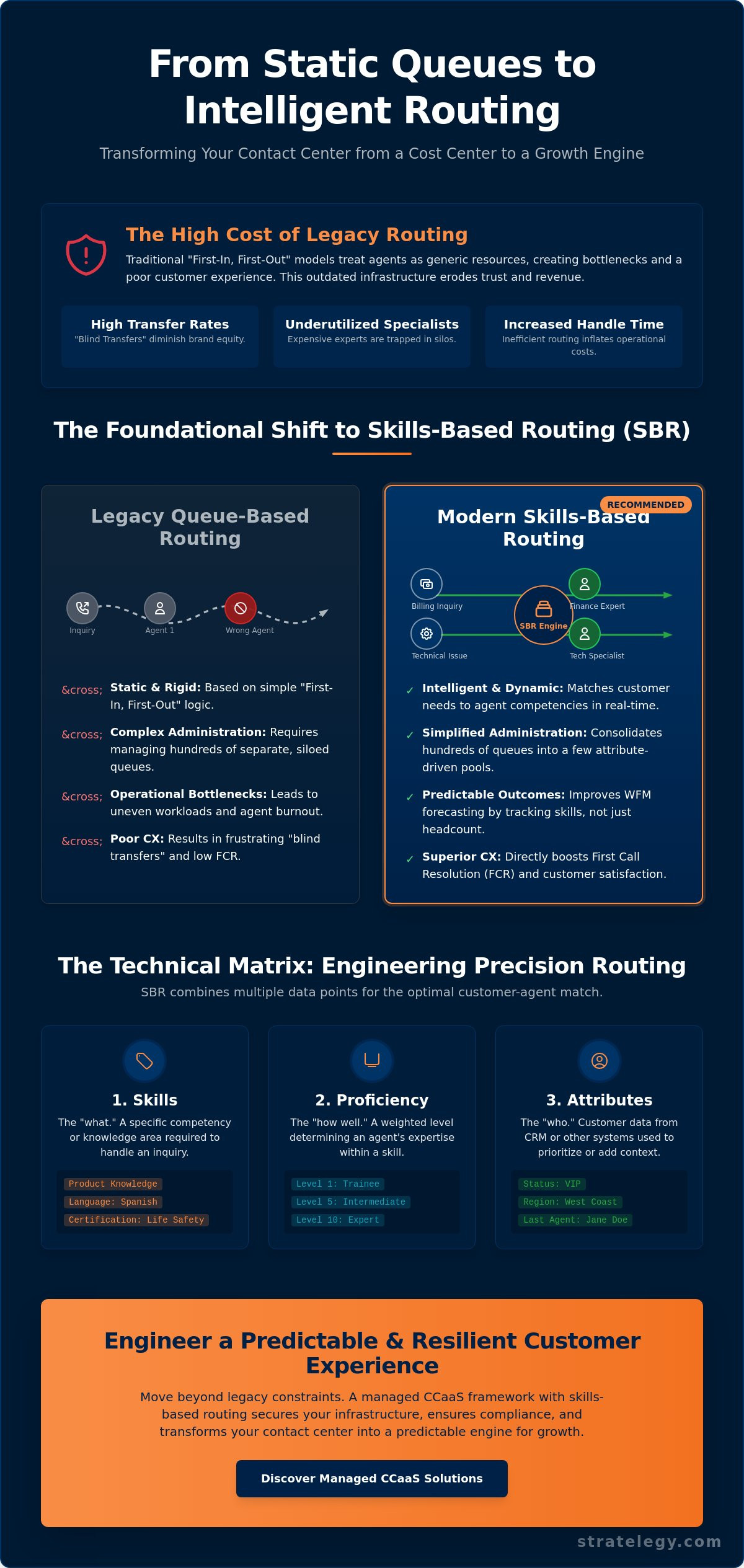
Effective workload distribution is the bedrock of contact center reliability. What is Skills-Based Routing at its core? It’s the intelligent distribution of work items based on specific agent competencies rather than simple arrival time. Legacy systems rely on First-In, First-Out (FIFO) or round-robin models. These methods treat every agent as a generic resource, which creates a glass ceiling for your operational efficiency. They ignore the nuances of human capital and technical specialization.
We view communication architecture as the structural foundation of your customer experience. If the foundation is rigid, the CX will eventually crack under pressure. By 2026, the standard has moved beyond voice to encompass omnichannel skill matching across chat, email, and SMS. Modern skills-based routing for customer service ensures that a technical inquiry via SMS reaches an engineer, while a billing dispute on chat goes to a financial specialist, all within a unified CCaaS environment. This level of precision is only possible through engineered workload distribution.
The Downfall of Static Call Queues
Static queues force agents into silos. When an agent is trapped in a specific queue, they can’t assist where their expertise is most needed, which naturally increases average handle time (AHT). The “Blind Transfer” is perhaps the most expensive failure in this model. Every time a customer is passed between departments without context, you lose money through redundant labor and diminished brand equity. It’s a symptom of an infrastructure that can’t see beyond the next call in line.
SBR as a Strategic Growth Engine
Skills-based routing is a mechanism that converts technical capacity into predictable customer outcomes. By ensuring the most qualified agent handles the request the first time, businesses see a direct correlation with First Call Resolution (FCR). In 2026, FCR isn’t just a metric; it’s a primary driver of lifecycle management and long-term profitability. Proper routing turns your contact center from a cost sink into a disciplined engine for customer retention.
SBR vs. Queue-Based Routing: A Performance Comparison
Traditional queue-based routing relies on static priority. It is a linear model that often leads to operational bottlenecks and uneven agent workloads. In contrast, skills-based routing for customer service utilizes dynamic attribute matching to evaluate both the agent and the caller in real-time. This shift significantly reduces administrative overhead. By consolidating hundreds of legacy queues into a few streamlined, attribute-driven pools, you simplify oversight while maintaining high-level technical authority over your operations.
Predictability is a core benefit of this engineered approach. SBR provides granular data that improves workforce management (WFM) forecasting. You’re no longer just tracking headcounts; you’re tracking specific competencies. While some smaller support teams assume SBR is too complex for their needs, the reality is that modern CCaaS platforms make these frameworks highly accessible. It’s about building a stable foundation that eliminates the fear of technical obsolescence as you scale.
The Technical Matrix: Skills, Proficiency, and Attributes
Precision in routing requires a clear distinction between skills and proficiency. A skill represents a category, such as “Product Knowledge,” whereas proficiency levels (trainee, intermediate, expert) determine the weighting within the routing logic. Attribute-based routing (ABR) evolves this concept further by integrating customer data directly from your CRM. It can automatically prioritize a VIP status or route a caller to the same specialist they spoke with previously, ensuring a sense of partnership and continuity.
Compliance and Regulatory Routing
For high-stakes sectors like life safety and fire alarm monitoring, routing is a matter of governance and security. SBR ensures that critical technical queries only reach agents who possess the specific certifications required by regional or industry regulations. This systematic approach eliminates the risk of human error inherent in manual transfers. If you are looking to secure your infrastructure against these types of operational vulnerabilities, exploring a managed CCaaS solution is a logical next step for maintaining long-term compliance.
Implementing Skills-Based Routing: A 2026 Roadmap
Transitioning to a modern distribution model requires a disciplined, step-by-step engineering approach. It’s not a “set and forget” feature. It’s a foundational shift in how your business manages its human capital. Successful implementation of skills-based routing for customer service begins with a comprehensive skills audit. You must map your team’s specific competencies to the technical requirements of your most frequent customer inquiries. This ensures that your routing logic is grounded in reality rather than assumptions.
- Step 1: Conduct a Skills Audit. Document every agent’s language proficiency, product knowledge, and technical certifications.
- Step 2: Define Routing Logic. Establish weightings that balance agent proficiency with acceptable wait times. A perfect match is useless if the customer abandons the session due to excessive delay.
- Step 3: Infrastructure Modernization. Move away from legacy silos and transition to an integrated cloud contact center. This provides the structural reliability needed to support dynamic, omnichannel routing.
- Step 4: Iterative Testing. Use built-in reporting tools to monitor real-time KPIs. Refine your skill matrix based on actual performance data to ensure long-term lifecycle stability.
Overcoming the Complexity Barrier
Complexity often stalls progress. Avoid the temptation to build an intricate, multi-layered matrix on day one. Start by identifying “Core Skills” that cover the majority of your traffic. Once these are stable, you can layer in more advanced attribute-based logic. Modern systems now utilize AI to assist in this process. Agentic AI can auto-tag customer intent based on natural language processing, which feeds the routing engine more accurate data for real-time decisions. This phased approach ensures your skills-based routing for customer service remains manageable and effective.
Integrating with Unified Communications
Intelligent routing shouldn’t exist in a vacuum. It works best when anchored in a unified communications and collaboration framework. This ensures that data flows seamlessly between your CRM and your CCaaS platform. When your infrastructure is unified, agents have the context they need the moment a session is delivered. If you’re ready to eliminate operational silos and modernize your architecture, contact our technical specialists to begin your infrastructure audit.
The Stratelegy Approach: Engineering Predictable CX
Stratelegy operates as a technical advisor rather than a mere service provider. We anticipate operational challenges before they impact your bottom line. Our focus on lifecycle management ensures that your implementation of skills-based routing for customer service isn’t a static configuration. Instead, it’s a dynamic system that evolves alongside your business requirements. Every CCaaS deployment we manage prioritizes security, governance, and predictability. We provide the peace of mind that comes from knowing your infrastructure is engineered for excellence and long-term oversight.
Moving away from traditional vendor-client relationships is essential for maintaining operational stability. You need a strategic engineering partnership that understands the deep connection between technical capability and financial business outcomes. We focus on achieving excellence through disciplined engineering rather than superficial sales promises. This methodical approach builds trust by guiding you from legacy operational challenges to a comprehensive, managed solution.
Beyond Software: Structural Reliability
Foundational engineering is about more than just routing logic. It requires total structural reliability across all communication layers. This includes critical back-end components like POTS line replacement to ensure uptime for life-safety systems. Our proprietary maintenance frameworks provide a systematic approach to hardware and software updates. In a cloud-first world, these frameworks act as brand anchors that protect your business from technical obsolescence. We prioritize the long-term health of your infrastructure over the novelty of a single product.
Your Next Step in CX Evolution
The transition to skills-based routing for customer service represents the final step in eliminating legacy operational risks. It’s the point where technical prowess meets strategic intent. We invite you to a strategic infrastructure audit to evaluate your current posture and identify vulnerabilities in your workload distribution. This proactive, disciplined assessment is the starting point for a modern, managed solution. Let’s build a foundation that supports your growth for years to come through precision engineering.
Securing Your Operational Future Through Strategic Engineering
Legacy queueing models are no longer just inefficient; they’re a liability to your operational stability. Transitioning to skills-based routing for customer service allows you to leverage your human capital with precision, turning a standard contact center into a high-performance engine. This framework eliminates the silos that lead to high transfer rates and customer frustration. It replaces them with a disciplined, attribute-driven system that ensures predictability and technical governance at every touchpoint. You’ve already invested in your team’s expertise; your infrastructure should finally reflect that investment.
At Stratelegy, we prioritize the long-term health of your business infrastructure. We provide national support for critical life-safety infrastructure and leverage proprietary maintenance frameworks to ensure your CCaaS environment remains cutting-edge. Our focus is on achieving excellence through engineering rather than superficial sales promises. Schedule a Strategic Infrastructure Audit with Stratelegy to begin modernizing your workload distribution. We’ll help you build a foundational architecture that secures your business against obsolescence and drives sustainable growth. You have the specialists; it’s time to give them the infrastructure they deserve.
Frequently Asked Questions
What is the difference between skills-based routing and attribute-based routing?
Skills-based routing focuses primarily on agent competencies such as language proficiency or product knowledge. Attribute-based routing (ABR) is an evolution of this model that incorporates a wider data set, including customer-specific information like VIP status, purchase history, or current intent. While SBR ensures the agent can handle the task, ABR ensures the interaction aligns with broader strategic business priorities and customer lifecycle management.
Can skills-based routing work with legacy on-premise phone systems?
Most legacy on-premise systems lack the processing power and data integration capabilities required for dynamic skills-based routing for customer service. While some basic queueing is possible, true omnichannel SBR requires a modern CCaaS framework to function effectively. Transitioning to a cloud-based infrastructure is a necessary step to eliminate the operational risks associated with aging hardware and to ensure your routing logic can scale with your business.
How does skills-based routing impact First Call Resolution (FCR)?
First Call Resolution improves significantly when inquiries are matched to the most qualified specialist on the first attempt. SBR eliminates the need for “blind transfers” and reduces the time customers spend repeating information to multiple agents. By engineering your workload distribution to prioritize expertise, you increase the probability of a successful resolution, which directly supports long-term profitability and predictable customer outcomes.
Will implementing skills-based routing increase my agents’ workload?
Intelligent routing optimizes workload distribution rather than increasing it. Agents receive tasks that match their specific proficiency levels, which reduces the mental fatigue of handling inquiries outside their expertise. This systematic approach ensures that high-value specialists focus on complex issues while trainees handle foundational tasks. It creates a more disciplined environment where technical capacity is utilized with maximum efficiency across the entire team.
What are the most common skills used in contact center routing?
The most frequent skills utilized in skills-based routing for customer service include language proficiency, technical product certifications, and specialized department knowledge like billing or claims. Modern frameworks also include soft skills such as conflict resolution or VIP account management. Mapping these competencies during a skills audit allows you to create a robust routing matrix that secures your infrastructure against service gaps and operational silos.