
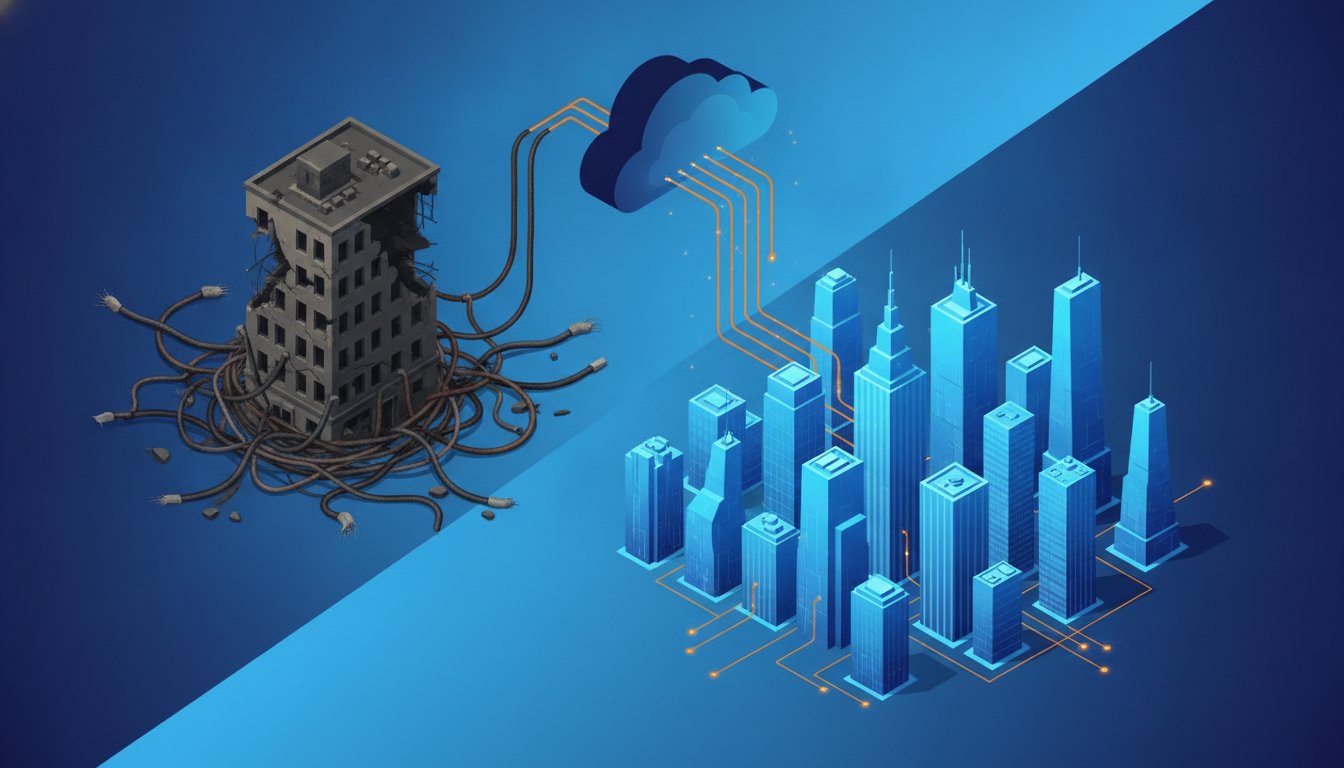
Your aging copper infrastructure is no longer just a maintenance headache; it’s a 90-day countdown to a total operational blackout. Following the FCC order on March 26, 2026, carriers can now retire legacy POTS networks with as little as three months’ notice. You likely feel the strain of rising maintenance costs and the fragmentation of global departments, all while worrying if your critical life safety systems will hold up when they’re needed most. Understanding the strategic benefits of cloud communications for enterprise is no longer an optional IT exercise. It’s a requirement for structural survival in a landscape where major carriers are aggressively phasing out copper footprints through 2027.
We’re here to help you move from reactive repairs to proactive engineering. You’ll discover how cloud-based communication architectures eliminate infrastructure obsolescence while driving operational efficiency and life safety reliability. This guide provides a future-proof communication roadmap, showing you how to reduce operational overhead through the seamless integration of voice, video, and safety systems. By shifting the conversation from superficial software features to foundational structural reliability, you can secure the long-term health of your business infrastructure.
Key Takeaways
- Understand why legacy copper infrastructure is a structural liability and how a centralized framework integrates UCaaS and CCaaS for long-term stability.
- Discover the core benefits of cloud communications for enterprise, from deploying global communication nodes in minutes to gaining deep operational visibility through centralized analytics.
- Identify the critical role of LTE POTS replacement in modernizing fire and life safety systems without compromising regulatory compliance or reliability.
- Learn how to execute a controlled migration by conducting a thorough infrastructure audit and mapping communication technology to specific business outcomes.
The Enterprise Shift: Why Legacy Infrastructure Is No Longer Sustainable
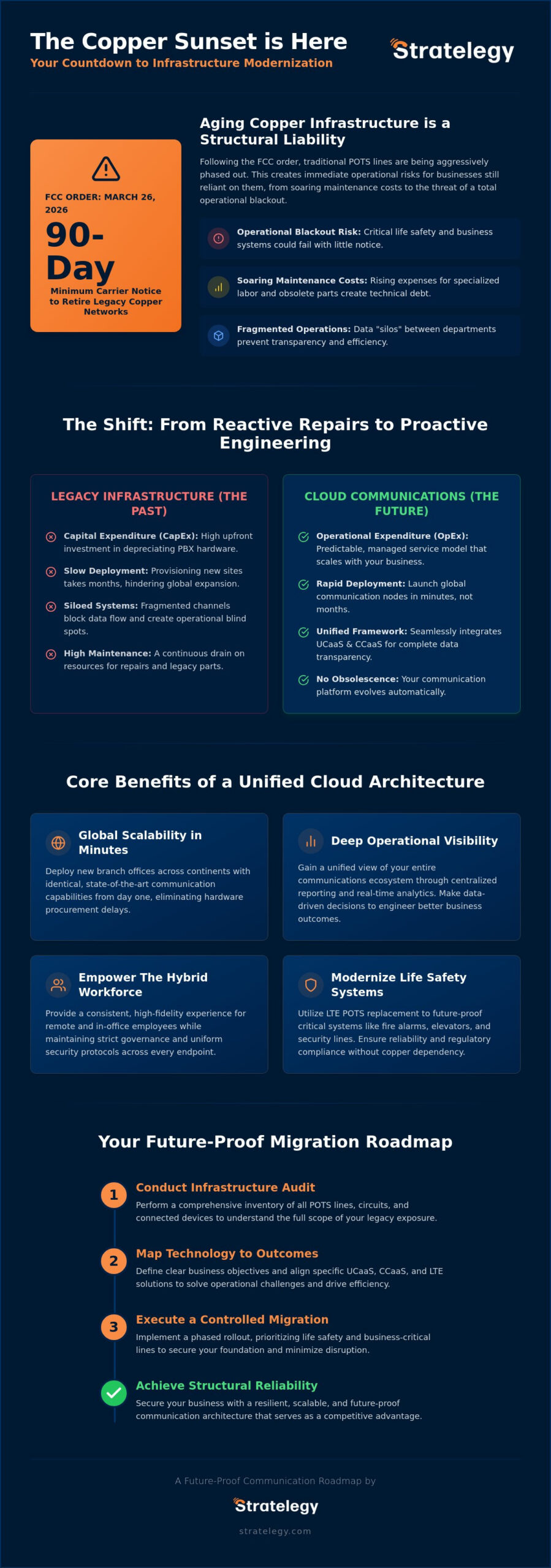
Legacy hardware has become a structural anchor dragging down corporate agility. In 2026, cloud communications is defined as a centralized framework that seamlessly integrates Unified Communications as a Service (UCaaS) and Contact Center as a Service (CCaaS) into a single, managed ecosystem. This transition marks the finality of the “Copper Sunset.” Traditional Plain Old Telephone Service (POTS) lines are no longer just outdated; they’re a liability. With the FCC’s March 2026 ruling allowing carriers to retire copper networks with only 90 days’ notice, enterprises still tethered to legacy lines face immediate operational risks.
One of the primary benefits of cloud communications for enterprise is the financial shift from capital-intensive hardware (CapEx) to predictable, managed service models (OpEx). Instead of sinking funds into depreciating PBX systems, organizations invest in scalable infrastructure that evolves automatically. This architecture also eliminates the “silo effect” highlighted in Spectrum’s analysis, where fragmented channels prevent data from flowing between departments. By unifying these streams, you create a transparent environment where governance and security are baked into the foundation.
From Tactical Tools to Strategic Infrastructure
Viewing communications as a simple utility limits your growth potential. Modern enterprises treat connectivity as a strategic asset rather than a monthly bill. In 2026, unified communications as a service serves as the backbone for hybrid workforces and AI-driven workflows. It’s the difference between merely making calls and engineering a responsive, global business environment that can pivot as fast as the market demands.
The Cost of Inaction: Maintenance and Obsolescence
Maintaining aging copper infrastructure is a continuous drain on resources. Hidden expenses include specialized labor for legacy repairs and the rising cost of parts that are no longer in production. This technical debt slows down broader IT modernization efforts. When you’re forced to manage the benefits of cloud communications for enterprise under the pressure of a carrier’s disconnection notice, you lose the ability to plan for longevity. Proactive migration ensures that your infrastructure remains a competitive advantage rather than a point of failure.
Strategic Benefits of Cloud Communications for Global Enterprises
Global expansion shouldn’t depend on local hardware procurement or circuit provisioning. One of the primary benefits of cloud communications for enterprise is the ability to deploy communication nodes across multiple continents in minutes rather than months. This scalability ensures that a new branch office in London or Singapore has the exact same technical capabilities as the corporate headquarters on day one. MultiCaaS represents the strategic convergence of internal collaboration and external customer engagement into a single, unified architectural layer. This unified approach eliminates interoperability barriers between voice, video, and CRM data, ensuring that information flows where it’s needed most.
Operational visibility is another cornerstone of a modernized infrastructure. By utilizing cloud contact centers, organizations gain access to centralized reporting and real-time analytics. You’re no longer guessing about performance metrics; you’re engineering outcomes based on hard data. Consulting with technical infrastructure specialists can help you map these capabilities to your specific regulatory requirements and governance standards.
Empowering the Hybrid Workforce
A hybrid model only works if there’s parity of experience. Remote employees must have access to the same high-fidelity voice and secure messaging tools as their in-office counterparts. Cloud architecture provides this consistency while maintaining strict governance. It protects enterprise data across every endpoint, ensuring that security protocols remain uniform even when the workforce is decentralized.
Driving Customer Engagement through CCaaS
Integrating AI-driven insights directly into the contact center workflow transforms the customer experience. Modern CCaaS platforms use conversational AI to provide real-time transcription and sentiment analysis, which is projected to save companies as much as $80 million in labor costs by 2026. A centralized contact center improves CX metrics by providing agents with the context they need to resolve issues during the first interaction, eliminating the friction of data silos.
Beyond Software: Modernizing Critical Life Safety and POTS Infrastructure
Reliability is often the primary hurdle for enterprises considering a move away from legacy hardware. Many facility managers fear that cloud-based systems can’t match the “always-on” nature of traditional copper for emergency services. This is a misconception. In reality, one of the most critical benefits of cloud communications for enterprise is the move toward managed cellular connectivity, which offers far greater predictability than decaying analog lines. Managed LTE POTS replacement ensures that fire alarms, elevator phones, and security monitoring systems remain functional even when local ISP infrastructure fails. Unlike copper, which degrades silently underground, cellular gateways provide real-time status monitoring and automated alerts, allowing for proactive maintenance before a crisis occurs.
The Reality of POTS Obsolescence
Carriers are no longer investing in copper maintenance. For a facility manager, this means that a line failure in 2026 might not be repairable at any price. Keeping life safety systems on unmaintained legacy lines creates a significant liability. If a fire alarm panel can’t dial out due to a degraded copper pair, the resulting safety risk and regulatory fines can be catastrophic. These legacy lines are increasingly prone to cross-talk and moisture interference, making them a weak point in your safety architecture.
LTE as the Reliable Alternative
Cellular-based solutions provide redundant, mission-critical connectivity that meets or exceeds stringent NFPA 72 and UL standards. These systems utilize dual-SIM technology to switch between carriers instantly if a signal drops. This level of oversight is impossible with analog lines. By transitioning to modern alternatives, you achieve a level of structural reliability that legacy systems simply can’t provide. It’s about engineering a system that works every time, without exception. To secure your facility’s future, you can partner with our foundational engineers to audit your current life safety dependencies and implement a robust migration strategy.
Executing Your Migration: From Copper to Cloud Connectivity
Successful migration requires a disciplined, multi-phase roadmap. It begins with a comprehensive infrastructure audit to identify every legacy dependency, from fax machines to SCADA systems hidden in remote facilities. Once the audit is complete, Phase 2 involves strategic mapping. Here, you align VoIP and UCaaS goals with specific business outcomes to ensure the technology serves your growth. Phase 3 focuses on implementation, where we deploy cellular POTS replacement alongside cloud platforms to secure your life safety systems. Finally, Phase 4 establishes ongoing oversight. This phase utilizes proprietary maintenance frameworks to ensure the long-term health and security of your communication architecture. By following this methodical approach, you can realize the full benefits of cloud communications for enterprise without the chaos of a rushed transition.
Choosing a Partner, Not Just a Vendor
Future-Proofing through Managed Services
Predictability is the ultimate goal of any infrastructure shift. We achieve this through systematic hardware update policies that prevent technical debt from accumulating over time. By treating communications as a managed service, you ensure that your systems remain modern without the need for future capital-intensive overhauls. These engineered solutions provide the operational stability needed to scale globally with total confidence. Ongoing oversight means your infrastructure is monitored, maintained, and optimized for the entire lifecycle of the technology.
Securing Your Infrastructure Against Obsolescence
The transition from legacy copper to resilient cloud architecture is a requirement for operational survival in 2026. You’ve seen how integrating UCaaS and CCaaS into a single framework eliminates silos and drives global scalability. More importantly, modernizing your life safety systems through LTE replacement ensures that your most critical endpoints remain compliant and functional despite carrier sunsets. The strategic benefits of cloud communications for enterprise are rooted in predictability and long-term health rather than temporary technical trends. Success requires a disciplined approach to engineering that accounts for every physical and digital layer of your network.
We are the foundational engineers who prioritize security, governance, and structural reliability. Our team specializes in LTE POTS replacement for critical systems and enterprise-grade UCaaS and CCaaS integration. Partner with Stratelegy to modernize your enterprise infrastructure today. By choosing a specialist who anticipates technical debt before it accumulates, you can secure your business against the risks of aging hardware. It’s time to build a communication roadmap that supports your vision for the next decade.
Frequently Asked Questions
What are the primary benefits of cloud communications for enterprise in 2026?
The primary benefits of cloud communications for enterprise in 2026 center on global scalability and the elimination of infrastructure obsolescence. By moving to a managed cloud environment, organizations replace unpredictable maintenance costs with a stable operational expense model. This centralized architecture integrates UCaaS and CCaaS, ensuring that your communication channels are no longer siloed. It provides the technical foundation needed to deploy new nodes in minutes while maintaining strict governance across a decentralized workforce.
Is cloud communication reliable enough for fire alarms and life safety systems?
Cloud-based communications are exceptionally reliable for life safety when implemented through managed LTE POTS replacement. Managed cellular gateways provide redundant, mission-critical connectivity that adheres to NFPA 72 and UL requirements. These systems offer active monitoring and automated alerts, which is a significant upgrade over the silent failure risks associated with decaying copper lines. You gain peace of mind knowing your emergency systems won’t fail when they’re needed most.
How does UCaaS improve enterprise productivity compared to legacy PBX?
UCaaS drives productivity by consolidating fragmented communication channels into a single, high-performance platform. One of the key benefits of cloud communications for enterprise is the ability to support a hybrid workforce with total parity of experience. Legacy PBX systems create data silos that slow down decision-making. Cloud platforms allow for seamless transitions between voice and messaging, enabling AI-powered features that streamline workflows and reduce the administrative burden on your staff.
What happens to my elevator phones if I move to cloud communications?
Elevator phones require a dedicated cellular gateway to maintain functionality as traditional copper lines are retired. A managed LTE replacement ensures that these critical emergency lines remain compliant with building codes and safety regulations. This solution operates independently of your primary network, providing a battery-backed connection that functions during power outages or ISP failures. It’s a structural upgrade that replaces the uncertainty of aging analog circuits with reliable, modern connectivity.
Can cloud communications integrate with my existing enterprise security systems?
Cloud communications integrate directly with existing enterprise security systems through advanced API-driven architectures. This connectivity allows for unified monitoring where security alerts can trigger immediate, automated responses across your entire communication network. By bridging the gap between physical security hardware and digital communication channels, you enhance situational awareness and streamline incident management. This integration ensures that your security protocols are as modern and responsive as your voice and data systems.