

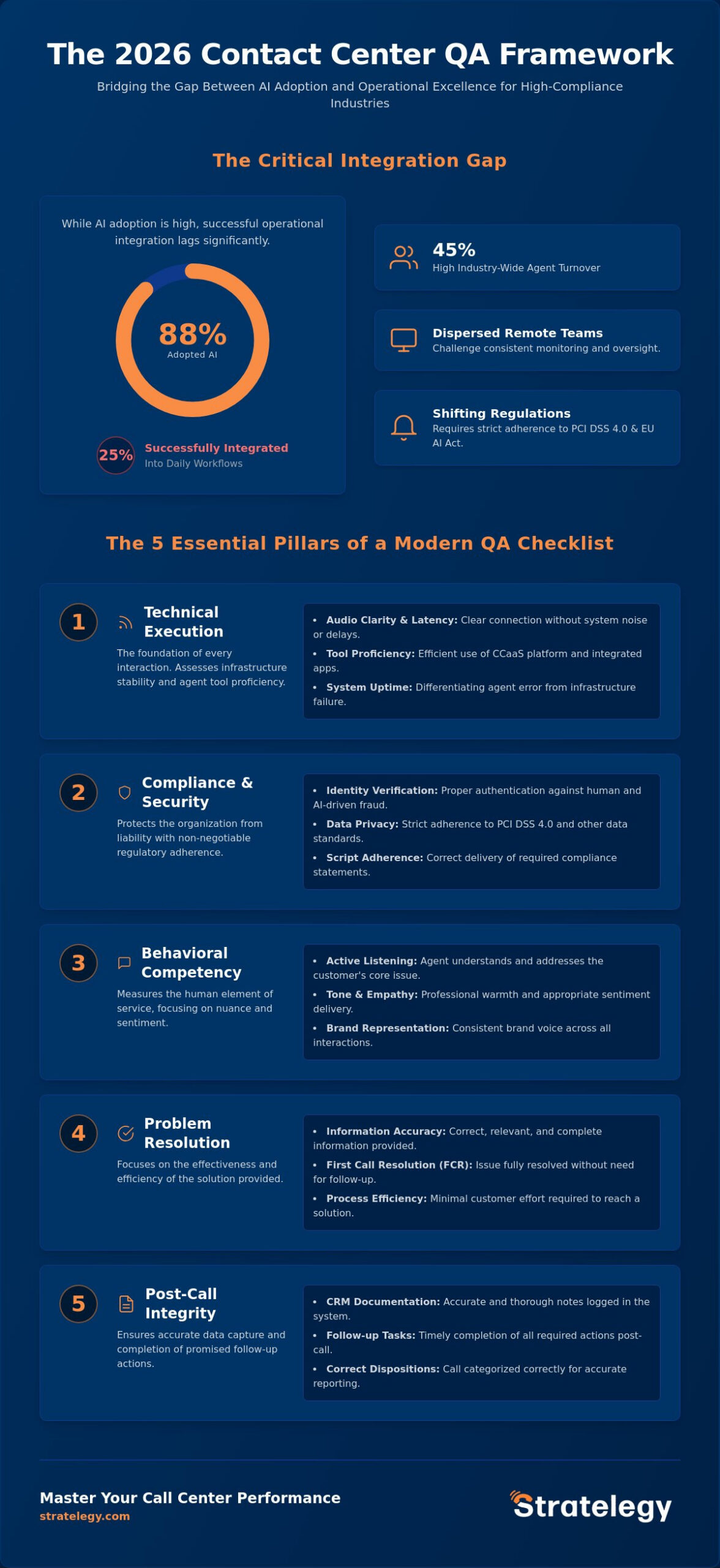
While 88% of contact centers have adopted AI by mid-2026, only 25% of those organizations have successfully integrated automation into their daily operational workflows. This gap leaves many businesses vulnerable to inconsistent customer experiences and systemic compliance failures. Without a rigorous contact center quality assurance checklist, your technical infrastructure remains a collection of features rather than a cohesive strategy for excellence.
We understand that monitoring dispersed, cloud-based teams while staying ahead of shifting regulations like PCI DSS 4.0 and the EU AI Act is a complex undertaking. It’s difficult to maintain oversight on remote interactions when agent turnover rates across the industry remain as high as 45%. You need a way to stabilize your operations and protect your brand’s reputation through disciplined, predictable oversight rather than reactive management.
This article provides a strategic framework to master call center performance in high-compliance industries. You’ll learn how to implement a repeatable evaluation process that improves First Call Resolution (FCR) rates and generates actionable data for agent coaching. We’ll break down the essential criteria for 2026, from verifying identity against AI-generated fraud to ensuring every digital interaction meets your strict governance requirements.
Key Takeaways
- Define quality assurance as a strategic governance framework to align interaction quality with high-level business objectives and KPIs.
- Implement a comprehensive contact center quality assurance checklist that balances technical performance with strict adherence to security protocols.
- Protect the organization by weighting scorecards toward non-negotiable compliance items and establishing automatic “Pass/Fail” triggers for regulatory breaches.
- Transition to CCaaS environments to unlock real-time coaching capabilities and advanced AI reporting that replaces reactive monitoring with proactive oversight.
- Build a repeatable framework that improves First Call Resolution (FCR) and ensures the long-term stability of your customer service infrastructure.
What is a Contact Center Quality Assurance Checklist?
Excellence in customer support isn’t accidental. It’s engineered through disciplined oversight and technical precision. A contact center quality assurance checklist is a structured diagnostic tool that ensures every customer interaction meets brand and regulatory standards. Rather than a simple list of tasks, this checklist serves as a strategic governance framework. It allows leadership to measure granular interaction quality against high-level business KPIs, ensuring that technical performance aligns with corporate goals.
The checklist provides the essential foundation for your QA scorecard and calibration process. It establishes a baseline of “what good looks like,” which prevents subjective bias during call evaluations. Effective QA functions as a critical component of Customer Service Assurance, aligning technical execution with customer expectations. By 2026, the industry has transitioned from “compliance-only” checklists to “experience-driven” models. This shift means modern frameworks don’t just check if a script was read; they evaluate if the agent utilized the right tools to resolve the issue efficiently and empathetically.
The Role of QA in CCaaS Environments
Modern CCaaS platforms have fundamentally changed how we manage quality. These cloud-based environments enable automated data collection, which feeds directly into your checklist. You no longer have to manually hunt for recordings or metadata. Instead, the system surfaces the necessary technical details, such as latency or tool proficiency, for immediate review.
Visibility is the primary challenge for decentralized, remote agent workforces. When your team is spread across different time zones, you can’t rely on floor walking to maintain standards. A robust contact center quality assurance checklist provides the necessary oversight to ensure predictability across all locations. It bridges the gap between remote infrastructure and operational excellence, giving you peace of mind that your standards are being met regardless of where the agent sits.
The 2026 Contact Center Quality Assurance Checklist: 5 Essential Pillars
A strategic contact center quality assurance checklist categorizes performance into five essential pillars. This structure allows leadership to isolate technical failures from behavioral gaps, ensuring that coaching remains fair and data-driven. By organizing your scorecard around these core areas, you create a repeatable framework for operational excellence.
- Technical Execution: Assessing audio clarity, latency, and agent proficiency with cloud-based tools. It’s the baseline for every digital interaction.
- Compliance & Security: Verifying caller identity and adhering to script requirements and data privacy standards like PCI DSS 4.0. This pillar protects the organization from regulatory liability.
- Behavioral Competency: Measuring active listening, tone, and the delivery of empathy during high-stakes interactions.
- Problem Resolution: Evaluating the accuracy of provided information and its impact on First Call Resolution (FCR) rates.
- Post-Call Integrity: Checking CRM documentation for accuracy and confirming the completion of follow-up tasks.
Technical Readiness: The Often-Overlooked Metric
Infrastructure stability is a non-negotiable prerequisite for high performance. If an agent’s hardware or connection fails, their ability to deliver a quality experience is compromised. Incorporating Contact Center Quality Assurance Best Practices means accounting for LTE-backed connectivity and UCaaS uptime. Evaluators must distinguish “system noise” from agent error. A dropped call caused by legacy infrastructure shouldn’t be penalized as a human failure. Modernizing your CCaaS environment provides the visibility needed to identify these systemic vulnerabilities before they impact your scorecard.
Behavioral Nuance and Sentiment Analysis
By 2026, the focus has shifted from binary checklists to nuanced interaction analysis. It’s no longer enough to ask if an agent used the required greeting. You must evaluate if the greeting was delivered with professional warmth and appropriate sentiment. Integrating automated sentiment scores into your manual checklist provides a 360-degree view of the customer experience. This method ensures that your team isn’t just following a script, but is actually resolving the customer’s emotional and technical needs. Identifying these nuances requires a disciplined approach to coaching that values the quality of engagement over simple compliance.
Designing Your QA Scorecard for Maximum ROI and Compliance
Excellence requires precision. A successful contact center quality assurance checklist requires a weighting system that reflects your organization’s specific risk profile. You can’t treat a missing greeting the same as a data privacy breach. Establishing non-negotiable compliance items ensures that agents prioritize security over speed. To protect the organization from severe liability, implement a “Pass/Fail” trigger for critical regulatory breaches. This means an interaction fails automatically if an agent fails to verify a caller’s identity or mishandles sensitive financial data during the session.
Consistency creates trust. Leadership teams must create a monthly calibration schedule where multiple evaluators score the same interaction and discuss discrepancies. This process ensures that every evaluator interprets the contact center quality assurance checklist through the same lens. A well-calibrated scorecard reduces agent friction and improves the predictability of customer outcomes. By aligning on what constitutes a “passing” score, you eliminate the perception of favoritism and build a culture of professional accountability.
Weighting Soft Skills vs. Hard Metrics
Balancing Average Handle Time (AHT) with quality scores is a necessary engineering task. If you weight AHT too heavily, agents will rush customers to meet targets, which ultimately damages your First Call Resolution (FCR) rates. Instead, reward “extra mile” behaviors like proactive problem-solving or exceptional empathy. Incorporating Call Center Quality Assurance Best Practices involves creating incentives that value the resolution’s depth as much as its speed. This approach stabilizes the customer experience while maintaining operational efficiency.
Regulatory Alignment in Regulated Industries
Checklists must be tailored for high-stakes sectors like finance, healthcare, or life safety. For these industries, Stratelegy’s focus on security and governance serves as the baseline for any effective QA program. Ensuring your technical infrastructure supports these requirements is the only way to maintain long-term operational health and avoid obsolescence. If you are ready to modernize your oversight and secure your infrastructure, contact our technical experts to build a more resilient contact center today.
Integrating QA with Enterprise Call Center Software
Modern quality assurance requires more than a static document. It demands a technical ecosystem that supports real-time oversight and data integrity. Integrating your contact center quality assurance checklist with advanced CCaaS platforms allows you to transition from reactive auditing to proactive, “in-the-moment” coaching. Legacy systems often lack the granular visibility needed to identify technical bottlenecks or behavioral shifts as they happen. By migrating to a cloud-native environment, you unlock automated reporting and AI insights that turn raw interaction data into a strategic asset.
Your enterprise call center software must support seamless recording and rapid retrieval for QA audits. If your software cannot reliably capture every digital interaction, your compliance framework remains incomplete. This technical capability is essential for meeting the strict transparency requirements of the EU AI Act and PCI DSS 4.0. Predictability in your monitoring process builds trust with both your agents and your regulatory partners.
Reliability starts at the physical layer. Implementing LTE POTS replacement ensures that critical call paths remain open and stable. If a legacy copper connection fails, the recording session is lost, and your QA data becomes fragmented. Structural reliability is the prerequisite for accurate monitoring. You cannot evaluate what you cannot record, making infrastructure modernization a foundational step for any quality program.
From Data to Action: The Coaching Loop
QA results should never exist in a vacuum. Use the findings from your contact center quality assurance checklist to drive personalized agent development plans. This targeted approach addresses specific technical or behavioral gaps discovered during audits. Closing the loop ensures that individual performance improvements contribute to the overall stability of the organization. High-level QA data also informs broader business strategy, signaling when it’s time for infrastructure upgrades or systemic process changes to maintain your competitive edge.
Future-Proofing Your Operational Excellence
Operational stability in 2026 relies on the successful marriage of technical precision and human behavioral excellence. You’ve seen how a robust contact center quality assurance checklist serves as the strategic backbone of this approach, bridging the gap between infrastructure and customer outcomes. By prioritizing regulatory compliance and leveraging real-time data, you move beyond simple monitoring into a state of proactive governance. This disciplined framework ensures your organization remains resilient against both technical obsolescence and shifting market demands.
Your quality framework is only as strong as the infrastructure supporting it. At Stratelegy, we specialize in building the foundations that make high-level oversight possible. We provide enterprise-grade security and governance alongside proactive technical support and maintenance to ensure your systems never fail your standards. Our solutions offer seamless integration with modern business infrastructure, giving you the visibility needed to lead with confidence. Optimize your contact center performance with Stratelegy’s CCaaS solutions.
Take the first step toward a more predictable and secure service environment today. We’re ready to partner with you to achieve lasting excellence through superior engineering.
Frequently Asked Questions
What are the most important elements of a call center QA checklist?
The most important elements focus on technical execution, regulatory compliance, and behavioral competency. A comprehensive contact center quality assurance checklist must verify caller identity, assess tool proficiency, and measure the accuracy of the resolution provided. These criteria ensure every interaction aligns with brand standards and mandates like PCI DSS 4.0. This structure protects the organization from liability while maintaining service quality.
How often should we update our quality assurance scorecard?
Organizations should review their scorecard quarterly to maintain alignment with business objectives. Immediate updates are required when regulatory requirements change or when you implement new CCaaS features. Regular lifecycle management of your QA tools prevents them from becoming obsolete. It ensures your team remains focused on the most relevant performance indicators.
Can AI replace manual call center quality assurance checklists?
AI functions as an augmentation tool rather than a total replacement for manual checklists. It excels at scanning 100% of interactions for compliance triggers and keywords, but it lacks the ability to judge deep emotional nuance. Human evaluators provide the final layer of judgment for complex problem-solving. This “human-in-the-loop” model ensures both scale and accuracy in your quality program.
How do I handle an agent who disagrees with a QA score?
Resolve score disagreements by referencing objective data and your established calibration standards. Sit with the agent to review the recording while highlighting specific requirements in the contact center quality assurance checklist. This transparent approach eliminates perceived bias and reinforces the predictability of your evaluation process. It transforms a dispute into a disciplined development session.
What is a good quality assurance score for a contact center?
A benchmark for high-performing centers typically falls between 85% and 90% for overall quality. Compliance-critical items, however, require a mandatory 100% success rate to avoid systemic vulnerabilities. Focus on achieving a steady, logical progression in scores rather than chasing an arbitrary number. This ensures that improvements are grounded in real behavioral change rather than score inflation.