
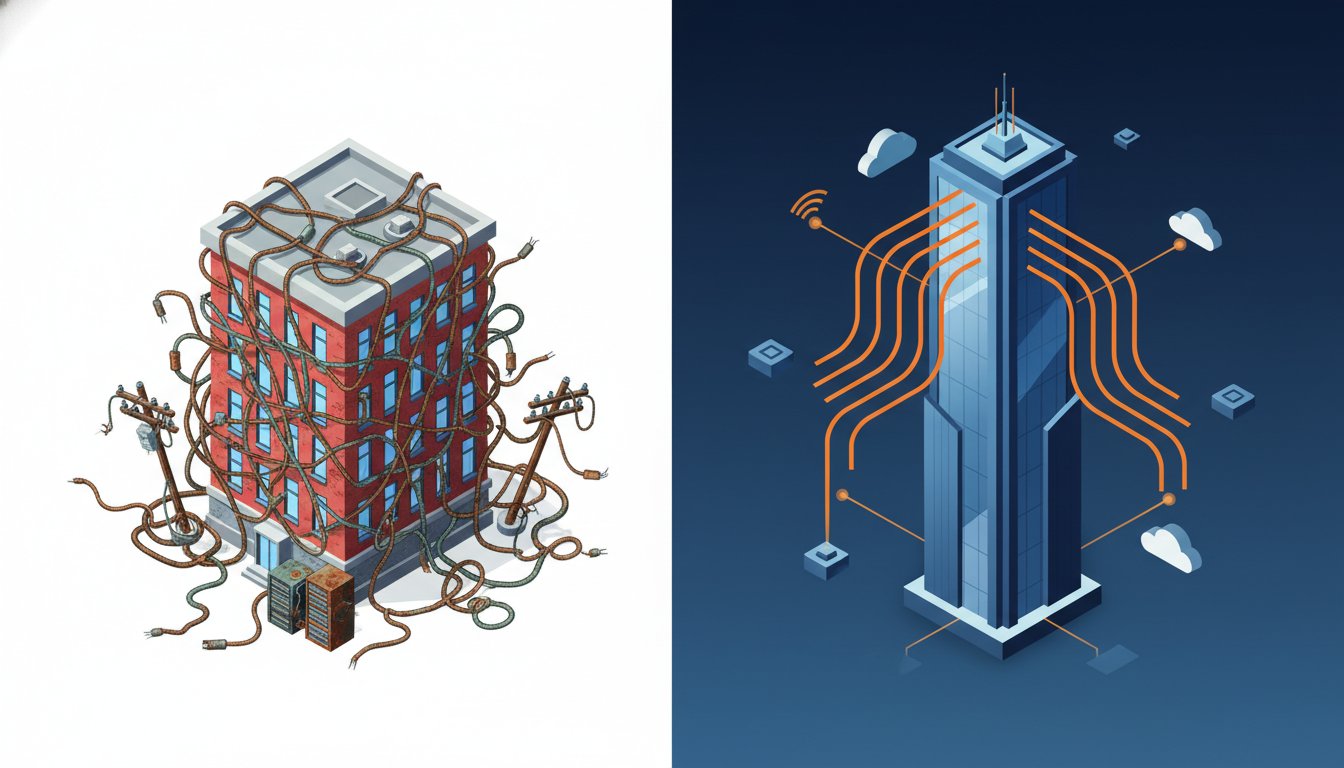
Some enterprises are now reporting monthly bills as high as $6,000 for a single legacy connection. The cost of maintaining copper phone lines is no longer a standard utility expense; it’s a compounding financial and regulatory liability that threatens your business continuity. You’ve likely noticed the unpredictable billing spikes and felt the growing difficulty of finding qualified technicians to service your aging infrastructure. It’s an increasingly precarious position, especially when fire marshal inspections and life safety compliance hang in the balance of a failing, decommissioned wire center.
We understand that infrastructure stability is the foundation of your operational success. This article uncovers the hidden financial risks of legacy POTS lines and outlines the strategic transition to secure LTE alternatives. We’ll examine the FCC’s 2026 retirement mandates, the impact of widespread technician scarcity, and the systematic framework required to modernize your safety systems. You’ll learn how to replace constant patching with a proactive engineering approach that guarantees predictable monthly costs and long-term regulatory compliance. It’s time to move beyond the fear of obsolescence and toward a modernized, managed infrastructure that prioritizes security and governance.
Key Takeaways
- Learn how FCC Order 19-72 and de-tariffing have eliminated price protections. This regulatory shift has fundamentally changed the cost of maintaining copper phone lines from a standard utility expense to a major financial liability.
- Assess the growing knowledge gap within the telecommunications workforce. The scarcity of technicians trained in legacy analog systems creates significant delays and risks for your critical infrastructure repairs.
- Protect your facility from immediate shutdowns and fines by securing your fire and life safety systems. You’ll learn why legacy lines often fail fire marshal inspections in the current decommissioning environment.
- Explore the ROI of LTE POTS replacement as a permanent engineering solution. This transition replaces unpredictable patching with a modernized infrastructure that ensures long-term stability and predictable monthly costs.
The Regulatory Shift: Why Copper Line Costs Are Skyrocketing
The financial landscape for enterprise communication changed fundamentally with the implementation of FCC Order 19-72. This directive removed the long-standing requirement for carriers to provide copper services at regulated, capped rates. Copper de-tariffing is the legal removal of price caps on legacy POTS infrastructure. By stripping away these protections, the FCC transitioned the Public Switched Telephone Network (PSTN) from a protected public utility to a market-driven commodity.
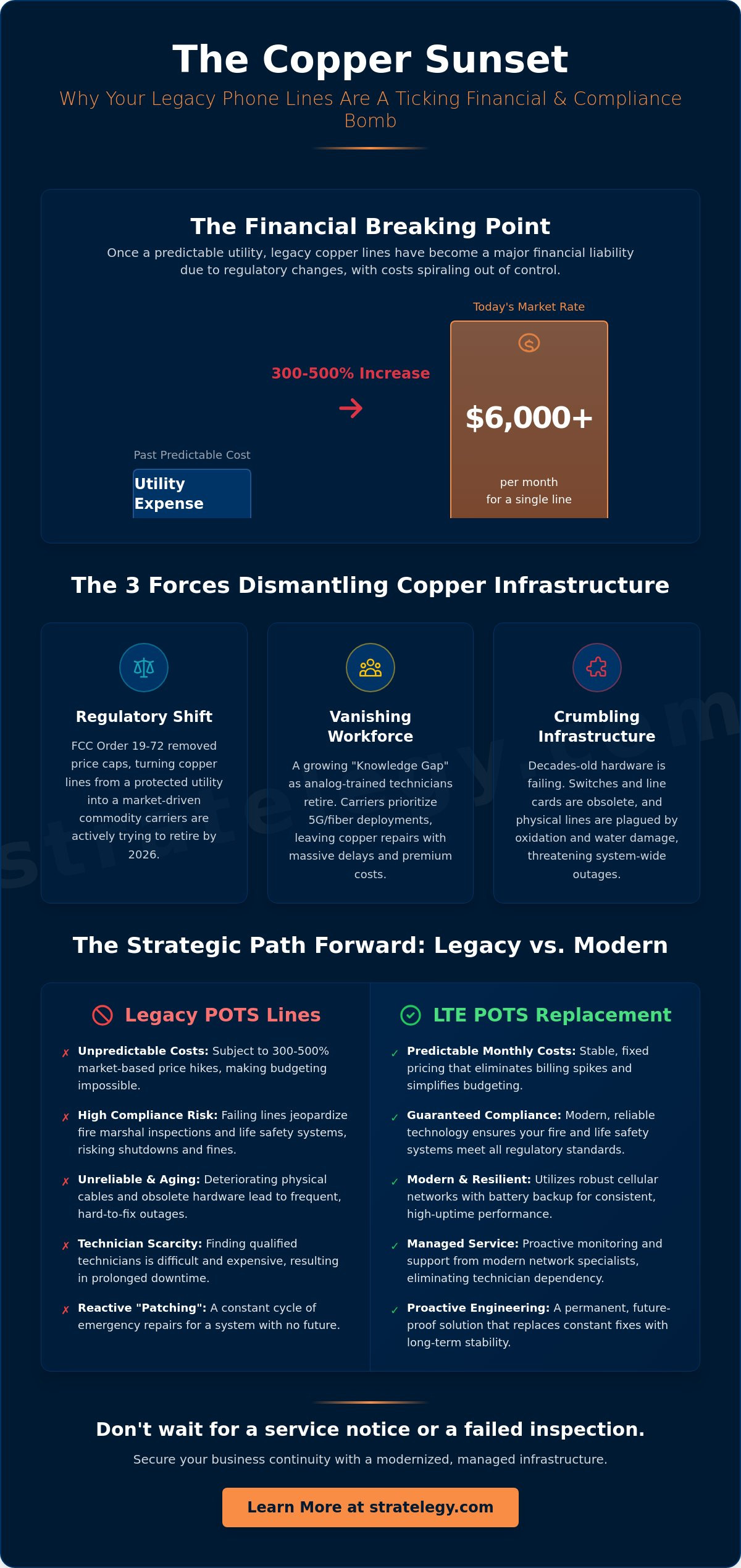
This shift has directly caused the cost of maintaining copper phone lines to skyrocket across every industry. Without regulatory oversight, carriers have implemented aggressive price hikes, with many enterprises seeing increases of 300% to 500% for their legacy lines. It’s a deliberate strategy. Carriers are using these costs to force customers off brittle, aging infrastructure that requires billions in annual upkeep. For most businesses, the copper sunset isn’t just a technical transition; it’s a financial forced march designed to clear the path for modern fiber and wireless networks.
The End of Price Protections
Major carriers no longer view copper as a vital service they’re obligated to maintain. It’s now a legacy burden. Enterprise POTS has shifted from predictable “standard rates” to “market-based pricing,” where the monthly bill reflects a carrier’s desire to retire the network. You aren’t just paying for a dial tone. You’re paying a premium for a system the provider is actively trying to dismantle. This lack of protection makes budgeting for communication expenses nearly impossible for organizations still tied to the wall.
Decommissioning Notices and Service Sunsets
Facility managers now face the reality of short-notice shutdowns. In 2026, receiving a decommissioning notice with only a few months to migrate critical systems is a standard operational risk. These sunsets happen when a local wire center is consolidated or retired entirely. If your fire alarms or elevator phones rely on these lines, a sudden service termination can lead to immediate safety compliance failures and building shutdowns. Waiting for a notice to arrive is no longer a viable strategy for infrastructure stability.
The Physical Burden: Maintenance and Technician Scarcity
Beyond the regulatory price hikes, businesses face a deteriorating physical reality. The actual cost of maintaining copper phone lines is driven by a critical shortage of specialized labor and obsolete hardware. As the generation of engineers trained in complex analog telephony reaches retirement, a “Knowledge Gap” has emerged. There are simply fewer people left who understand how to troubleshoot a cross-connect or splice a degraded copper pair. This labor shortage directly impacts your uptime and repair speed.
Carrier behavior has shifted to reflect this reality. Most major providers now prioritize their workforce for 5G and fiber deployments, leaving legacy copper repairs at the bottom of the queue. This is supported by FCC actions to accelerate the transition, which allow carriers to bypass the “red tape” that once forced them to maintain aging networks. The result is a “last mile” infrastructure plagued by oxidation and water damage, where a single rainstorm can disrupt your entire safety system.
The Cost of Technician Specialization
Finding a qualified POTS technician now often requires paying premium emergency service rates. Because these systems are frequently unmapped or poorly documented after decades of “patch-and-repair” work, diagnostic time has tripled. You aren’t just paying for a fix; you’re paying for hours of investigative labor. Transitioning to a managed LTE solution removes this dependency on disappearing specialists and provides a modernized, documented infrastructure.
Hardware Obsolescence and Sourcing
The switches and line cards required to run traditional Central Offices (CO) are no longer in mass production. Sourcing these analog components in a digital-first manufacturing world means relying on refurbished parts or “cannibalizing” old equipment. This makes the cost of maintaining copper phone lines unsustainable. Temporary patches often become permanent vulnerabilities, leaving your fire alarms and emergency phones connected to a system that could fail without warning.
Hidden Operational Liabilities: Fire Safety and Compliance
The true cost of maintaining copper phone lines extends far beyond the monthly service invoice. It’s now a significant factor in your organization’s risk profile. When an analog line fails, it isn’t just a communication hurdle; it’s a potential safety violation. Fire alarm panels, elevator emergency phones, and blue light stations depend on these connections to meet strict life safety codes. If a line goes dead without immediate detection, your facility becomes a legal liability overnight.
Failed inspections are becoming a frequent reality for facility managers. A fire marshal discovering an unresponsive alarm pathway can issue an immediate “Fire Watch” order or even shut down a building until the system is restored. Because repairing these lines now takes weeks rather than days, the resulting operational downtime is devastating. We define the compliance gap as the space between legacy technology and modern safety code requirements. Closing this gap is no longer optional for businesses that prioritize security and governance.
Life Safety Uptime Requirements
NFPA 72 requirements for fire alarm signaling mandate specific uptime and monitoring standards that aging copper infrastructure can no longer reliably provide. Elevator emergency phones are currently the most common point of failure in facility audits. These systems require a constant dial tone to ensure passenger safety, yet they’re often the first to fail during the physical decay of the last-mile copper loops discussed earlier. One missed inspection can lead to heavy fines and increased liability insurance premiums.
Corporate Governance and Risk Mitigation
Infrastructure management has shifted from being a simple IT problem to a critical legal and compliance challenge. Enterprise leaders must now account for how legacy systems might void liability coverage in the event of an emergency. Implementing Stratelegy’s POTS line replacement ensures predictable governance by providing a modernized, supervised connection. This proactive engineering approach eliminates the uncertainty of analog failures and keeps your safety systems fully compliant with current regulations.
Don’t wait for a failed inspection to expose your facility’s vulnerabilities. Contact our technical experts to secure your compliance framework today.
Strategic Cost Recovery: The Case for LTE POTS Replacement
Modernizing your infrastructure requires moving beyond temporary patches. LTE-based POTS replacement serves as a once-and-for-all engineering solution that addresses the systemic vulnerabilities of analog wires. It’s a structural shift. While the cost of maintaining copper phone lines continues to climb at an unsustainable rate, LTE provides a fixed, transparent pricing model. This transition isn’t just about changing a service provider; it’s about shifting to a managed service framework that includes remote monitoring, automatic hardware updates, and 24/7 oversight. Stratelegy acts as your foundational partner, providing the technical expertise needed to eliminate the fear of obsolescence through superior engineering.
The ROI of this transition is immediate and compounding. When you compare the accelerating expenses of legacy maintenance against the stable costs of a wireless gateway, the financial choice becomes clear. By stabilizing the cost of maintaining copper phone lines through replacement, you reclaim control over your operational budget. You’re no longer at the mercy of carrier de-tariffing or the scarcity of specialized labor. Instead, you gain a managed solution designed for longevity and structural reliability.
Predictable Financial Planning
Future-Proofing Critical Infrastructure
LTE and 5G connectivity offer a level of reliability that brittle, water-damaged copper simply cannot match. These modern pathways ensure that your fire and life safety systems remain operational even when local wire centers are decommissioned. Integrating this solution with unified communications as a service creates a holistic enterprise strategy. By treating your communication stack as a single, modernized ecosystem, you achieve both operational excellence and long-term infrastructure stability. This isn’t just a technical upgrade; it’s a commitment to the long-term health of your business infrastructure.
Securing Your Infrastructure for the Next Decade
The transition from analog to digital infrastructure is an engineering necessity that demands immediate attention. As we’ve examined, the escalating cost of maintaining copper phone lines is no longer a standard utility expense but a strategic risk that impacts your bottom line and regulatory standing. Relying on a shrinking pool of specialists and decaying physical loops puts your fire and life safety compliance at risk. Proactive leaders must shift from reactive patching to a managed, modernized framework to ensure long-term stability.
Stratelegy acts as your strategic partner in this evolution. We specialize in enterprise-grade fire and life safety modernization, utilizing an engineering-first approach that prioritizes structural reliability. Our managed services eliminate the risk of legacy infrastructure failure by providing a foundation built for governance and security. Modernize your critical infrastructure with Stratelegy’s LTE POTS replacement solutions.
Take the first step toward a predictable and secure operational future today. Our technical specialists are ready to help you build a communication foundation that you can depend on for years to come.
Frequently Asked Questions
Why has the cost of my POTS lines increased so drastically in 2026?
The surge in your monthly bill is a direct result of FCC Order 19-72. This regulatory shift allowed carriers to remove price caps on legacy services through a process known as de-tariffing. Because providers now spend billions annually on aging infrastructure, they’ve implemented aggressive price hikes to incentivize a move to modern networks. The cost of maintaining copper phone lines is now market-driven rather than regulated, leading to the 300% to 500% increases seen across the industry.
Is LTE POTS replacement compliant with fire marshal and NFPA 72 standards?
Yes, enterprise-grade LTE POTS replacement solutions are designed specifically to meet NFPA 72 and fire marshal requirements. These systems utilize specialized hardware that provides the necessary dial tone, voltage, and loop current required for fire alarm signaling. By incorporating dual-path connectivity and internal battery backups, these solutions often exceed the reliability standards of traditional copper wires, which are prone to physical degradation and signal loss during environmental events.
What happens if I don’t replace my copper lines before the carrier sunsets the service?
Failure to migrate before a service sunset leads to immediate termination of your dial tone, which can trigger severe operational consequences. Without a working connection, your fire alarms and elevator phones will fail, likely resulting in Fire Watch orders or building shutdowns during inspections. You also face the risk of losing your existing phone numbers. It’s critical to act before receiving a decommissioning notice to avoid the rush and premium costs of emergency infrastructure replacement.
Can LTE POTS replacement support legacy equipment like fax machines and elevator phones?
Modern LTE gateways are engineered to provide full analog support for legacy devices, including fax machines, elevator phones, and SCADA systems. These devices convert analog signals into digital packets that travel over secure cellular networks without requiring changes to your existing hardware. This approach preserves your investment in specialized equipment while stabilizing the cost of maintaining copper phone lines by removing the dependency on brittle, last-mile physical wires.
How long does it take to transition from copper to an LTE-based replacement solution?
A typical transition can be completed in a matter of weeks, which is significantly faster than waiting for a carrier to repair or install new copper facilities. The process involves a site survey, hardware configuration, and a coordinated cutover to ensure minimal downtime for your safety systems. Because these solutions don’t require new trenching or physical wire pulls from the central office, they offer a streamlined path to infrastructure modernization and long-term financial predictability.