
A “five nines” uptime guarantee is no longer a competitive advantage; it’s the bare minimum for survival in an era where a five-minute outage can derail a global enterprise. You understand that even the briefest system failure during a critical client meeting or a life-safety emergency is unacceptable. Many organizations continue to face the frustration of hidden downtime, such as jitter or high latency, which disrupts operations just as effectively as a total blackout. Establishing true ucaas platform reliability and uptime requires moving beyond marketing slogans to focus on the rigorous engineering discipline behind your communication stack.
This strategic guide provides a clear framework for evaluating provider architecture to ensure zero-disruption communication for your entire workforce. You’ll discover the architectural requirements necessary to maintain mission-critical uptime, including the integration of active-active geo-redundancy and LTE fail-safe connectivity. We’ll also examine how recent regulatory shifts, including the June 2026 FCC rules for NG911 reliability and the May 20, 2026 IP transition mandate, impact your long-term infrastructure health and compliance. This methodical approach ensures your communication systems remain predictable, secure, and resilient against future disruptions.
Key Takeaways
- Establish the “Five Nines” (99.999%) benchmark as your baseline for mission-critical operations and learn how to quantify its impact on your annual downtime.
- Evaluate the engineering requirements of active-active geo-redundancy to ensure your communication services remain uninterrupted during regional node failures.
- Develop a rigorous framework for auditing provider SLAs to ensure that ucaas platform reliability and uptime promises are backed by enforceable service credit models.
- Secure the last mile of your connectivity by integrating LTE POTS replacement as a primary failover mechanism against local ISP outages.
Defining UCaaS Platform Reliability: Why Five Nines Is the Minimum Standard
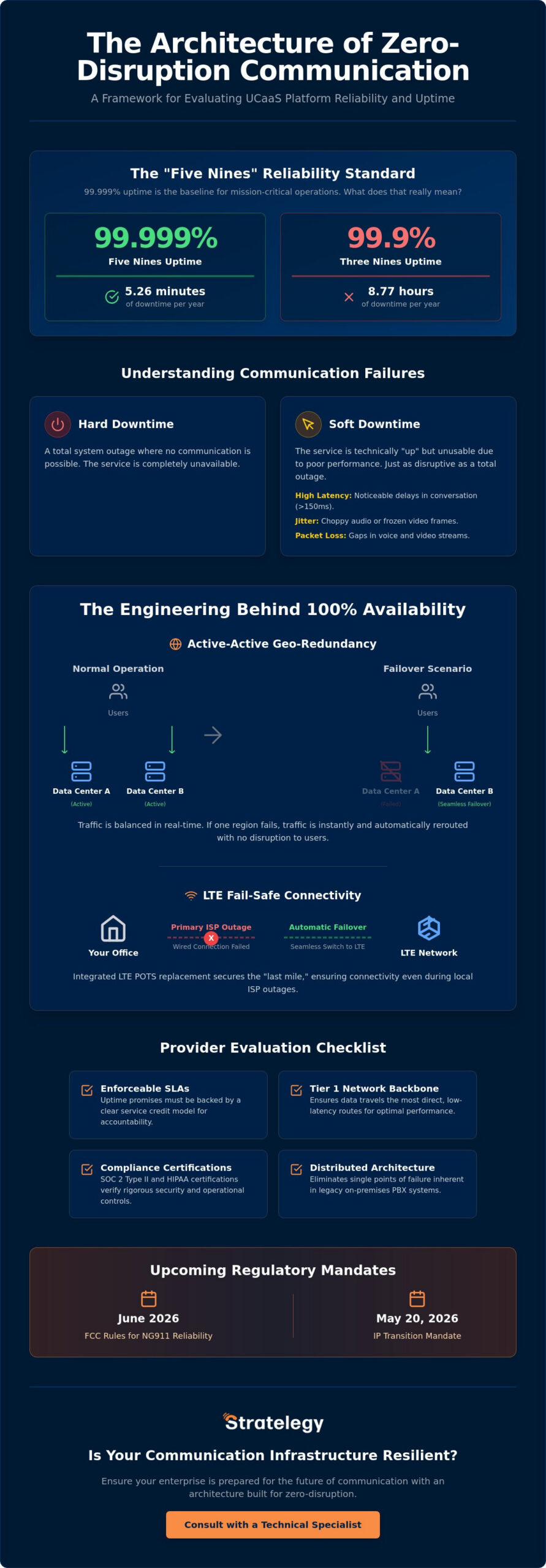
Reliability in a cloud environment is often misunderstood as a simple binary state. True ucaas platform reliability and uptime encompasses the consistent availability and high-fidelity performance of voice, video, and messaging services across the entire enterprise. The industry benchmark for this stability is “Five Nines,” or 99.999% availability. This rigorous standard allows for only 5.26 minutes of unplanned downtime per calendar year. While marketing teams often highlight this figure, it represents the baseline for mission-critical Unified Communications (UC) operations.
Maintaining high ucaas platform reliability and uptime requires a deep understanding of infrastructure health. This level of technical oversight is often provided by specialists like Uptime Co., which provides managed IT services Brea CA and has decades of experience in network administration. Engineers distinguish between hard downtime and soft downtime. Hard downtime refers to a total system outage where no communication is possible. Soft downtime is more insidious, involving high latency, jitter, or packet loss that renders services unusable despite the system technically being “up.” Mean Time Between Failures (MTBF) serves as the primary metric for assessing the long-term health and predictability of the underlying infrastructure.
The Financial and Operational Impact of Communication Failures
A single hour of downtime can cost an enterprise thousands in lost revenue and catastrophic drops in employee productivity. Beyond the balance sheet, communication failures pose severe risks to life-safety sectors and emergency services where every second of connectivity is vital. Infrastructure stability isn’t a luxury; it’s a prerequisite for operational continuity and brand integrity. Proactive organizations treat communication architecture as a foundational pillar of their risk management strategy.
Beyond the Dial Tone: Performance Metrics to Monitor
High-quality enterprise voice requires latency to remain strictly under 150ms to prevent perceptible delays. Jitter, or the variation in packet arrival times, must also be minimized to avoid choppy audio or frozen frames in real-time video collaboration tools. Monitoring these granular metrics ensures that your platform delivers professional-grade communication consistently. When these performance indicators slip, the resulting “soft downtime” can be just as damaging to business operations as a total system failure.
The Engineering Behind 100% Availability: Geo-Redundancy and Active-Active Architecture
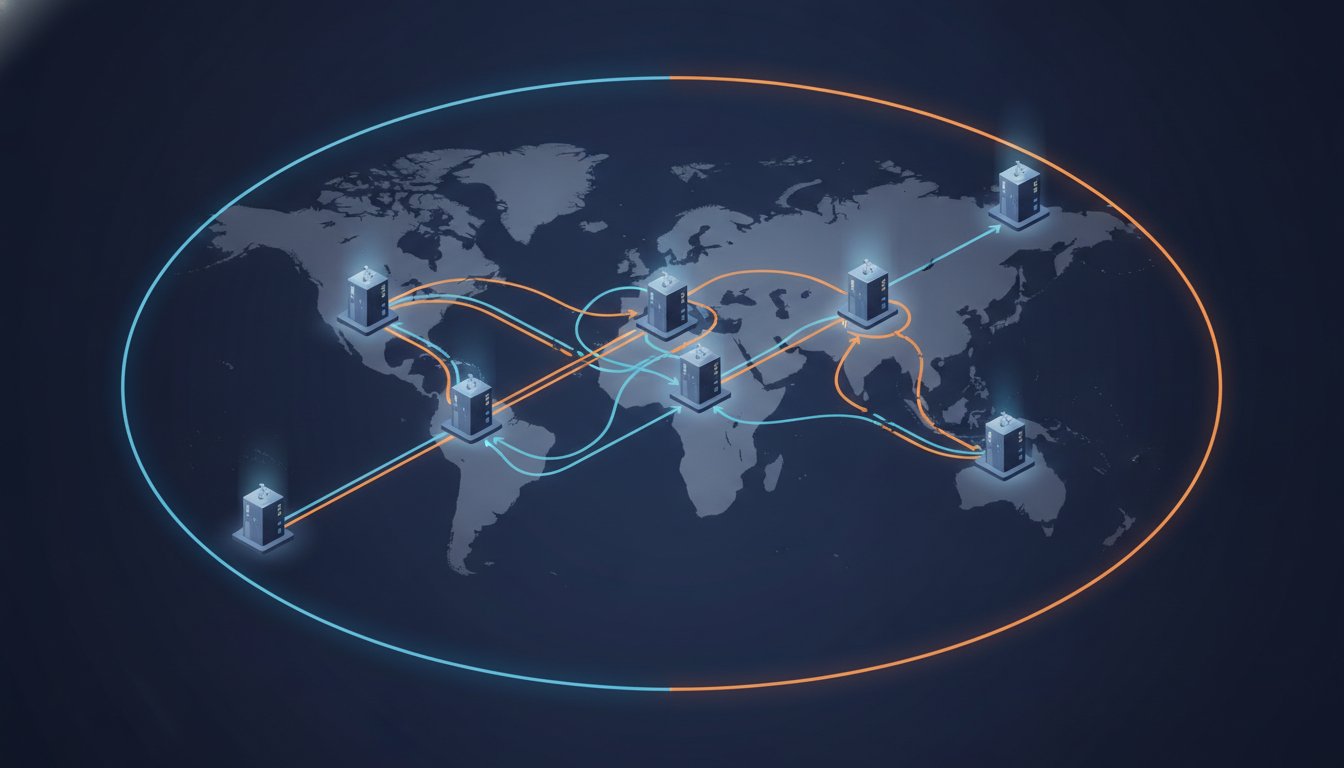
Achieving total availability isn’t a matter of luck. It’s the result of disciplined engineering. Active-active geo-redundancy ensures that your services run across multiple, geographically dispersed data centers simultaneously. Unlike legacy systems that rely on a standby backup, an active-active model balances traffic in real-time. If one region faces a catastrophic event, automated failover instantly reroutes traffic. This transition happens so quickly that users don’t experience a dropped call or a frozen video stream. This level of ucaas platform reliability and uptime provides the peace of mind necessary for global operations.
Reliability also depends on the network backbone. Foundational engineers utilize Tier 1 network providers to maintain backbone stability and minimize latency. This carrier-grade infrastructure ensures that your data travels the most direct routes possible. Security and uptime are inextricably linked, which is why SOC 2 Type II and HIPAA compliance are non-negotiable. These certifications confirm that the provider maintains rigorous, audited controls over their physical and digital environments. You can verify these standards by consulting with technical specialists who prioritize structural integrity.
Distributed Architecture vs. Centralized Risks
Legacy on-premises PBX systems created a single point of failure. If the local hardware failed, the entire office went dark. Modern unified communications as a service decentralizes this risk. By distributing workloads across global clusters, the platform eliminates the vulnerability of a central hub. This architectural shift aligns with Gartner’s definition of UCaaS, which highlights the multi-tenant, cloud-based nature of modern enterprise tools.
The Role of AI in Predictive Maintenance
In 2026, ucaas platform reliability and uptime are increasingly managed by artificial intelligence. Platforms now use AI-driven diagnostics to identify network bottlenecks before they result in service degradation. Automated load balancing dynamically adjusts resources to handle traffic spikes during peak enterprise usage. This proactive approach transforms maintenance from a reactive chore into a disciplined, automated process that safeguards the user experience.
Assessing Provider SLAs: How to Evaluate Uptime Guarantees
The Service Level Agreement (SLA) serves as the foundational contract for platform accountability. It’s the only mechanism that transforms marketing promises into enforceable technical standards. A robust SLA clearly defines the Service Credit model, which dictates how providers compensate your business for missed ucaas platform reliability and uptime targets. These credits shouldn’t be viewed as a revenue stream. Instead, they function as a financial penalty that incentivizes the provider to maintain peak operational standards at all times.
Transparency regarding scheduled maintenance is equally critical. High-tier providers often exclude scheduled maintenance from their uptime calculations; however, these windows must be communicated well in advance and kept within reasonable limits. You should prioritize “End-to-End” SLAs. These agreements cover the entire communication path, ensuring that ucaas platform reliability and uptime aren’t just limited to the provider’s cloud core but extend to the edge of your enterprise network.
Critical Questions for Your UCaaS Vendor
- Transparency: Do you provide real-time, public status pages for immediate visibility during incidents?
- Proven Performance: What is your verified historical uptime over the last 36 months, excluding scheduled maintenance?
- Scope: Does your SLA cover “soft downtime” metrics like latency and jitter, or only total “hard” outages?
To ensure your own organization meets these transparency standards, you can learn more about StatusPulse and its comprehensive platform for public status pages and uptime monitoring.
Verification and Reporting Tools
Internal governance requires more than just taking a vendor at their word. You must utilize third-party monitoring tools to verify provider claims independently. This data-driven approach is essential for understanding unified communications and collaboration reporting dashboards. These tools allow your IT team to maintain oversight of system health and hold vendors accountable to their contractual obligations. To ensure your current infrastructure meets these 2026 standards, you can request a comprehensive architecture audit from our strategic specialists.
The Last-Mile Solution: Integrating LTE for Fail-Safe Connectivity
High-tier cloud architecture is only as resilient as the connection that reaches your physical office. While providers focus on data center redundancy, local internet service provider (ISP) failures remain the primary cause of communication outages. True ucaas platform reliability and uptime requires you to secure this “last mile” against physical damage or provider instability. Integrating LTE POTS replacement offers a wireless failover mechanism that completely bypasses local wireline disruptions. This ensures that critical business lines remain active even when the primary fiber connection fails. Cellular-based connectivity is no longer an optional add-on; it’s a mandatory redundant path for fire, life safety, and security systems. Stratelegy bridges the gap between cloud-first tools and physical infrastructure by acting as foundational engineers for your entire communication stack.
Modernizing Critical Infrastructure
The transition from legacy copper to digital pots line replacement is a strategic necessity for 2026. Enterprise fire and security systems require specialized LTE connectivity to maintain 100% uptime and comply with evolving safety regulations. These systems cannot rely on a single internet pipe that might be severed during construction or weather events. Foundational engineers prioritize these wireless paths to eliminate single points of failure at the site level, providing a layer of protection that software-only solutions can’t match.
Strategic Implementation for 2026
Your roadmap for the coming year should involve a multi-layered approach to ucaas platform reliability and uptime. This includes combining sophisticated cloud contact center solutions with managed LTE failover to protect both internal and external communication flows. By addressing the last-mile vulnerability, you ensure that your organization remains operational regardless of local infrastructure challenges. This methodical integration of cloud agility and wireless resilience builds a communication foundation that’s truly future-proof. To secure your infrastructure and eliminate the fear of obsolescence, Partner with Stratelegy for engineered reliability.
Future-Proofing Your Mission-Critical Communication Infrastructure
Infrastructure stability is the cornerstone of the modern enterprise. You’ve explored how “Five Nines” uptime is achieved through active-active geo-redundancy and why an end-to-end SLA is the only way to ensure true provider accountability. Maintaining superior ucaas platform reliability and uptime requires a holistic approach that connects high-level cloud architecture with physical site resilience. By integrating wireless failover and modernizing legacy infrastructure, you protect your organization from both regional outages and local ISP failures.
Stratelegy serves as your strategic partner, offering specialized LTE POTS replacement for critical life-safety systems and enterprise-grade UCaaS and CCaaS backed by carrier-grade redundancy. Our technical advisors focus on structural reliability and regulatory compliance to eliminate the risk of obsolescence for your business. We prioritize the long-term health of your infrastructure over superficial features, ensuring your communication stack is built for longevity and predictability.
Secure your enterprise communications with Stratelegy’s high-reliability UCaaS solutions.
With a resilient architecture in place, you can lead your organization with the confidence that your mission-critical systems are built to endure and excel in a cloud-first world.
Frequently Asked Questions
What is the difference between reliability and uptime in UCaaS?
Uptime measures the raw percentage of time a system is operational and accessible, while reliability refers to the quality and consistency of that service. A platform might be technically “up” but suffer from such high packet loss that voice calls become unintelligible. High ucaas platform reliability and uptime require both a functional connection and the high-fidelity performance necessary for professional communication.
Does a 99.999% uptime guarantee include scheduled maintenance windows?
Most 99.999% uptime guarantees exclude pre-announced scheduled maintenance from their primary calculations. These windows allow providers to perform critical infrastructure updates without technically violating their Service Level Agreement (SLA). You must scrutinize the “Exclusions” section of your contract to understand the true total availability of your communication services over a calendar year.
How can I maintain UCaaS reliability if my office internet goes down?
You can maintain connectivity during a local ISP outage by implementing an LTE POTS replacement solution as an automated failover path. This wireless link acts as a secondary redundant connection that bypasses severed fiber lines or local network hardware failures. It’s a mandatory requirement for life-safety systems and critical business operations that require 100% site-level availability.
Why is geo-redundancy critical for enterprise communication platforms?
Geo-redundancy eliminates the risk of a single regional event causing a total platform blackout for your organization. By distributing services across multiple geographically dispersed data centers, providers ensure that traffic is instantly rerouted if one region fails. This active-active architecture is a foundational requirement for achieving enterprise-grade ucaas platform reliability and uptime in a globalized environment.
What are the common causes of jitter and latency in UCaaS systems?
Jitter and latency are typically caused by network congestion, improper Quality of Service (QoS) settings, or inefficient routing between your office and the cloud. High latency often results from data traveling too many “hops” before reaching the provider’s core. Jitter occurs when packets arrive out of order, which is frequently a symptom of unstable local bandwidth or outdated networking hardware.