
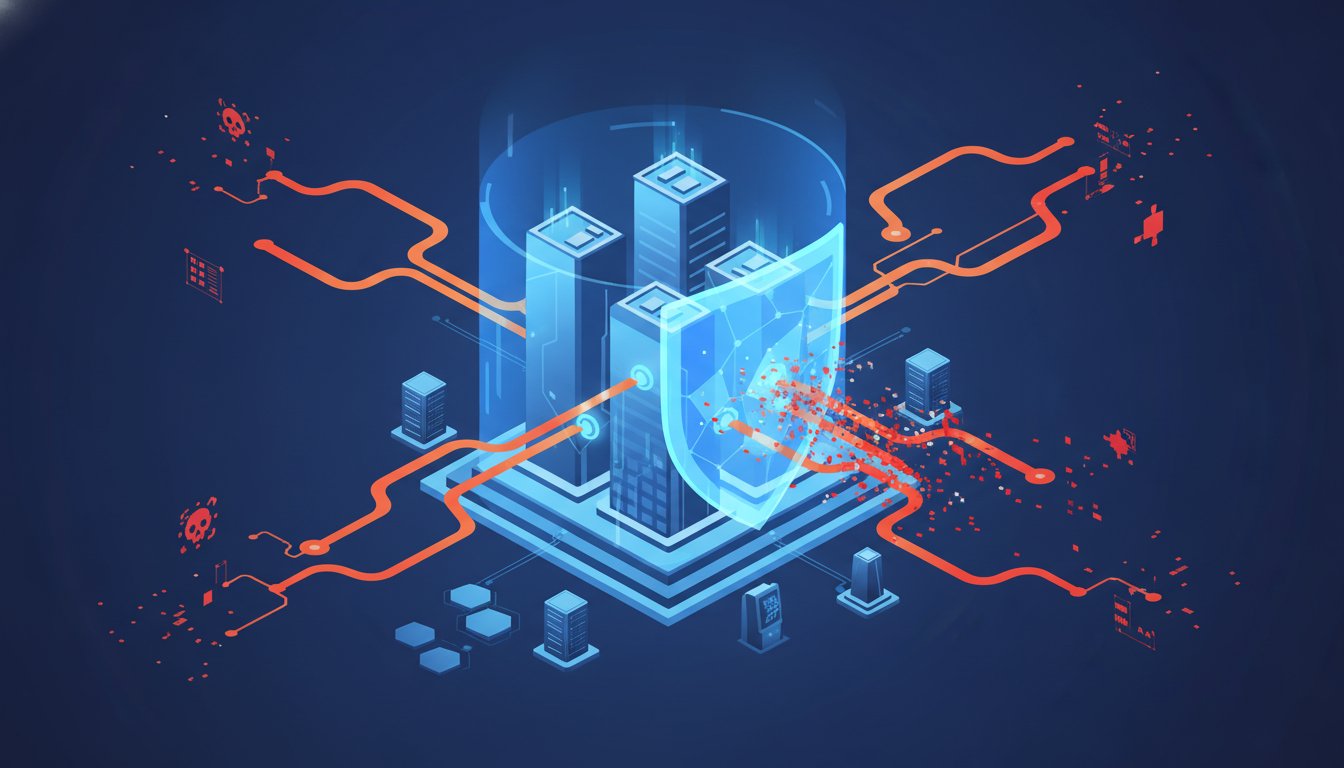
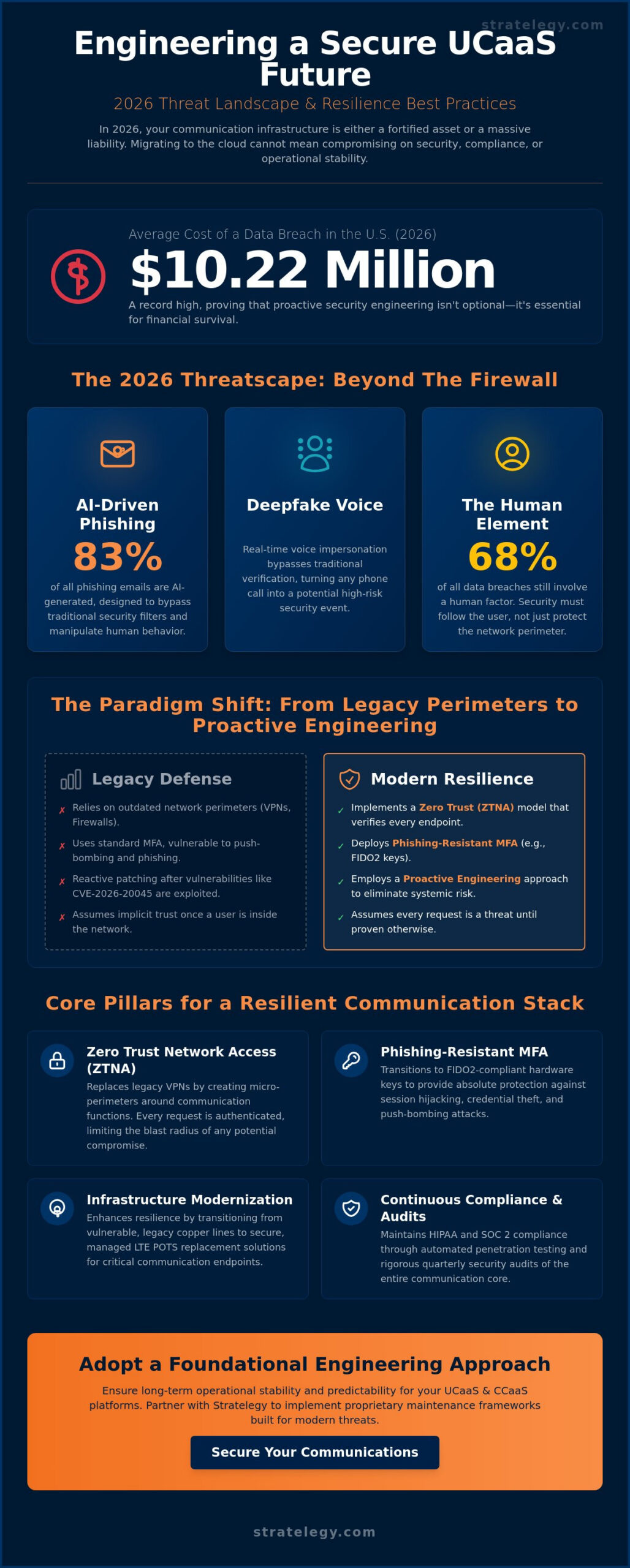
The average cost of a data breach in the United States reached a record $10.22 million in 2026. This reality proves that your communication infrastructure is either a fortified asset or a massive financial liability. Implementing enterprise-grade ucaas security best practices isn’t just about checking a box for your IT department. It’s about engineering a resilient environment that can withstand sophisticated remote exploits like the recent CVE-2026-20045 vulnerability.
You know that migrating to the cloud shouldn’t mean compromising on governance or risking HIPAA and SOC2 compliance failures. The fear of downtime during complex network transitions is valid, especially when 68% of breaches still involve a human element. This guide will help you master the architectural protocols necessary to secure your UCaaS and CCaaS platforms against modern threats. We’ll break down the transition to zero-trust architecture, AI-powered monitoring, and the lifecycle management strategies that ensure your enterprise remains both compliant and operational through 2026 and beyond.
Key Takeaways
- Master modern ucaas security best practices by shifting from legacy perimeter defenses to a Zero Trust Network Access (ZTNA) model that verifies every communication endpoint.
- Protect your enterprise against 2026-era threats like deepfake voice impersonation and AI-driven phishing by implementing phishing-resistant Multi-Factor Authentication.
- Enhance infrastructure resilience and eliminate systemic vulnerabilities by transitioning from legacy copper lines to secure, managed LTE POTS replacement solutions.
- Maintain continuous regulatory compliance for HIPAA and SOC 2 through automated penetration testing and quarterly security audits of your communication core.
- Adopt a foundational engineering approach to communications, utilizing proprietary maintenance frameworks to ensure long-term operational stability and predictability.
Understanding the UCaaS Threat Landscape in 2026
Modern communication security has moved beyond simple password protection. In 2026, AI-generated phishing accounts for 83% of all phishing emails. This isn’t just text anymore. Deepfake voice impersonation allows attackers to bypass traditional voice verification in real-time, making a simple phone call a high-risk event. These threats target the human element, which remains involved in 68% of all data breaches. Relying on legacy security models in this environment is a recipe for operational paralysis.
The technical reality is that your communication stack is now a primary target for sophisticated remote code execution. For example, the CVE-2026-20045 vulnerability exploited in early 2026 proved that even industry-standard platforms are susceptible to unauthenticated command execution. Implementing robust ucaas security best practices requires a shift from reactive patching to proactive engineering. You aren’t just protecting data; you’re protecting the ability of your business to function. A breach today doesn’t just result in a leak. It causes total downtime, complex regulatory fines, and potential life-safety risks in sectors like healthcare or emergency services. For organizations where physical safety is as paramount as digital integrity, Stone Security Services provides the specialized executive protection needed to mitigate these real-world risks.
The Shift from Perimeter to Identity-Centric Threats
The corporate firewall is no longer your primary defense line. In a distributed UCaaS environment, every user endpoint is a potential entry point. Once an attacker gains a foothold, they use lateral movement to navigate your communication hierarchy. They look for high-value targets like C-suite accounts or administrative consoles. Understanding Unified communications management is essential here, as it provides the foundational layer where identity and access must be governed. If you don’t control the identity, you don’t control the network. Security must follow the user, regardless of their location or device.
API and Integration Vulnerabilities
Connecting third-party apps to your UCaaS core creates hidden risks that many business owners overlook. Your CCaaS platform likely shares a “handshake” with your CRM and enterprise data lake through various APIs. These integrations are often the weakest link in the chain. Insecure webhooks can lead to unauthorized data exfiltration without ever triggering a standard login alert. To maintain ucaas security best practices, you must treat every integration as a potential vulnerability. This requires strict oversight of API permissions and continuous monitoring of the data flow between your communication tools and your broader business infrastructure. We view these connections as structural components that require the same engineering discipline as your physical hardware.
Core Technical Best Practices: Securing the Communication Stack
Technical security is a structural requirement. It isn’t an optional layer you add after deployment. To achieve a predictable environment, enterprise leaders must enforce a rigid set of ucaas security best practices that prioritize identity and encryption at every layer. This begins with replacing legacy VPNs with Zero Trust Network Access (ZTNA). Unlike traditional models that trust a user once they are on the network, ZTNA assumes every request is a potential threat. This approach is vital for protecting against unauthenticated remote command execution like the recent CVE-2026-20045 vulnerability.
Identity protection must evolve alongside these network shifts. Standard MFA is no longer sufficient when 83% of phishing emails are AI-generated to bypass simple prompts. Organizations should transition to phishing-resistant MFA, such as FIDO2-compliant hardware keys. These tools eliminate the risk of session hijacking and push-bombing attacks. Additionally, deploying automated Session Border Controllers (SBCs) provides a critical defense against SIP-based attacks and toll fraud. These controllers act as the gatekeepers for your voice traffic, ensuring only legitimate packets enter your environment. If you want to ensure your infrastructure remains resilient, you need a partner who understands these foundational engineering principles.
Implementing Zero Trust for Voice and Video
Voice traffic requires a specific engineering approach to Zero Trust. You must define micro-perimeters around specific communication functions, such as call routing or video conferencing. This limits the blast radius if an endpoint is compromised. Continuous authentication is also necessary; the system should verify identity throughout the session, not just at the initial login. Applying least-privilege access to administrative and contact center roles ensures that users only access the specific customer data required for their current task.
Advanced Encryption Standards for 2026
Encryption is the final line of defense for your data. While TLS 1.2 was once the standard, 2026 demands post-quantum cryptographic readiness to protect against future decryption threats. This involves implementing End-to-End Encryption (E2EE) for all data-at-rest and data-in-transit. When following UCaaS Security Best Practices, the debate often centers on key management. While provider-managed keys offer convenience, high-compliance industries often require client-held keys to maintain total sovereignty over call recordings and transcriptions. This ensures that even if a service provider is breached, your sensitive communications remain unreadable to unauthorized parties.
Beyond the App: Network Security and Infrastructure Resilience
True infrastructure resilience is the ability of a communication system to maintain secure operations during a primary network failure. It’s a foundational requirement that many organizations overlook when focusing solely on software settings. Relying on the public internet for enterprise voice traffic introduces unnecessary exposure to man-in-the-middle attacks and latency-driven vulnerabilities. Implementing ucaas security best practices at the network layer requires a shift toward private circuits and SD-WAN architectures. These technologies allow you to create encrypted, prioritized tunnels that shield your communication data from the chaos of the public web.
Network security is inseparable from physical reliability. If your primary fiber connection is severed, your security protocols are useless if the system goes dark. We design for 99.999% availability by integrating automated failover protocols that trigger the moment a disruption is detected. This ensures that your UCaaS and CCaaS platforms remain reachable, maintaining the predictable environment your stakeholders expect. By utilizing upstream scrubbing centers, you can also mitigate the risk of DDoS-induced downtime, ensuring that malicious traffic is neutralized before it ever reaches your enterprise perimeter.
POTS Line Replacement as a Security Strategy
Aging copper lines represent a significant physical security risk for critical infrastructure. These legacy circuits are brittle, difficult to monitor, and increasingly prone to failure as carriers deprioritize their maintenance. A modern POTS line replacement strategy eliminates these vulnerabilities by transitioning life-safety systems to secure cellular paths. Whether it’s fire alarms or emergency elevator phones, moving to encrypted LTE tunnels ensures that your most critical communications are protected from both physical tampering and environmental degradation. This isn’t just an upgrade; it’s a necessary step in hardening your foundational engineering against obsolescence.
Network Redundancy and Failover Protocols
Achieving high availability requires more than just a backup internet connection. It demands a disciplined approach to redundancy that doesn’t compromise your security posture during a failover event. When a primary link fails, your system must transition to secure wireless paths without dropping encryption or bypassing identity verification. This seamless handoff is critical for maintaining ucaas security best practices in a high-threat environment. By treating network redundancy as an engineering discipline rather than a simple fail-safe, you ensure that your communication infrastructure remains a stable, governed asset regardless of external network conditions.
Establishing Governance: Compliance, Audits, and the Human Firewall
Governance is the anchor of infrastructure stability. Technical controls provide the “how” of security, but governance provides the “why” and the “is it working.” Implementing ucaas security best practices requires more than software configurations; it demands a rigorous framework that aligns your communication stack with SOC 2 Type II, HIPAA, and GDPR requirements. Without this oversight, even the most advanced encryption becomes a liability when an audit reveals missing documentation or unauthorized data residency.
The human element remains a critical vulnerability. Statistics show that 68% of data breaches in 2026 involve human error or social engineering. You can’t engineer out every mistake, but you can build a “Human Firewall” through role-specific awareness training. This goes beyond generic phishing simulations. It involves teaching contact center agents to recognize real-time deepfake voice impersonation and instructing IT administrators on the dangers of credential exposure during cloud migrations. Organizations take an average of 241 days to identify and contain a breach. A proactive governance strategy aims to slash that timeline through automated penetration testing and a communication-specific incident response plan.
Navigating the 2026 Regulatory Landscape
Compliance is a moving target. Documenting your security posture for unified communications as a service is now a mandatory requirement for enterprise stakeholders. You must ensure that voice data and call recordings stay within authorized geographic boundaries to meet local data residency laws. Managing eDiscovery and legal hold in a cloud environment is equally complex. Your governance framework must define exactly how messaging data is archived and retrieved during legal inquiries without compromising the privacy of your users.
The Audit Checklist for IT Leaders
Regular audits are the only way to validate your security assumptions. We recommend a quarterly cadence for reviewing administrative access logs to identify anomalous behavior. Your audit should also extend to your downstream partners. Validating the security posture of SIP trunking providers ensures that your ucaas security best practices aren’t undermined by a weak link in the supply chain. Finally, you must test your automated threat detection alerts. If an alert triggers and no one responds, the technology has failed. Build a compliant communication foundation with our enterprise governance frameworks.
Stratelegy’s Engineering-First Approach to UCaaS Security
Security is a structural discipline. It isn’t a software toggle you flip during installation. At Stratelegy, we define ourselves as foundational engineers rather than simple service providers. This distinction is critical for business leaders who prioritize long-term infrastructure health over superficial features. Implementing ucaas security best practices requires a commitment to ongoing oversight that many vendors simply don’t provide. By integrating cloud contact center security into your broader business strategy, we ensure that every customer touchpoint is fortified against the sophisticated threats discussed in this guide.
We don’t just sell software; we engineer stability. Our role extends far beyond the initial deployment phase. We manage the entire lifecycle of your communication assets, ensuring that every LTE POTS replacement and UCaaS endpoint remains hardened against intrusion. This systematic approach eliminates the systemic vulnerabilities that often plague unmanaged cloud transitions. We bridge the gap between legacy reliability and modern innovation, providing a predictable environment where security is built into the architecture from the ground up.
Proprietary Maintenance and Long-Term Support
Ongoing oversight eliminates the “set and forget” security trap that leaves many enterprises vulnerable. Our proprietary maintenance frameworks are designed to anticipate vulnerabilities before they manifest as operational failures. We prioritize predictability as a core security feature. This managed lifecycle approach ensures that your configurations remain aligned with evolving compliance standards like SOC 2 and HIPAA. We act as a strategic partner, providing the technical prowess needed to mitigate threats while you focus on core business growth. This relationship ensures your infrastructure remains resilient against the 4.8 million unfilled cybersecurity positions currently stressing internal IT teams.
Engineering for Structural Reliability
Technical excellence translates directly to long-term operational benefits. Our systematic hardware update policies prevent device-level obsolescence, which is a common but frequently overlooked entry point for attackers. We treat your communication stack as a critical piece of physical infrastructure. This disciplined approach guarantees that your ucaas security best practices are supported by solid engineering rather than just temporary software patches. It’s about achieving excellence through proactive discipline. Secure your infrastructure today by consulting with our specialists to build a resilient, future-proof communication environment that protects your bottom line and your reputation.
Fortifying Your Enterprise Architecture for 2026
Securing your communication stack is a matter of structural integrity, not just software updates. We’ve explored how transitioning to Zero Trust models and auditing the API handshake between your UCaaS and CCaaS platforms creates a predictable environment. Implementing ucaas security best practices ensures your business remains compliant while neutralizing sophisticated AI-driven threats. By hardening your network layer and replacing vulnerable copper lines with secure cellular paths, you eliminate the single points of failure that lead to operational paralysis. It’s about building a foundation that supports long-term health rather than temporary convenience.
Stratelegy brings an engineering-first strategic approach to your digital transformation. As LTE POTS replacement specialists, we provide the foundational reliability that modern cloud communications demand. Our proprietary maintenance frameworks move your organization away from reactive patching and toward proactive, systematic lifecycle management. This disciplined oversight provides the peace of mind necessary to lead in a high-threat landscape where legacy systems are no longer viable. Consult with a Stratelegy engineer to secure your communications infrastructure today. You’ve already anticipated the risks; now it’s time to engineer the solution that protects your enterprise for the decade to come.
Frequently Asked Questions
What are the most common UCaaS security risks in 2026?
AI-generated social engineering and unauthenticated remote code execution are the primary risks facing modern platforms. Specifically, vulnerabilities like CVE-2026-20045 highlight the danger of unpatched communication stacks in a high-threat environment. Attackers also target insecure API webhooks between your UCaaS and CRM platforms to exfiltrate sensitive data. These methods allow malicious actors to bypass traditional perimeter defenses and cause total operational paralysis through lateral movement within your distributed network.
Is end-to-end encryption (E2EE) standard for all UCaaS providers?
While E2EE is a standard expectation in 2026, it isn’t universally implemented across all vendors. Many providers offer encryption for data-at-rest but may not provide true end-to-end encryption for real-time voice or video sessions. Enterprises should verify that their provider supports post-quantum cryptographic readiness to protect against future decryption threats. You must also decide between provider-managed and client-held keys to maintain total sovereignty over your sensitive communication data recordings.
How does Zero Trust Architecture apply to business phone systems?
Zero Trust replaces the traditional trusted network model with a continuous verification process for every communication endpoint. In business phone systems, this means verifying user identity and device health for every session rather than just at the initial login. It limits lateral movement by creating micro-perimeters around specific communication functions. This disciplined approach ensures that a single compromised device cannot lead to a broader breach of your entire enterprise communication infrastructure.
What is the role of POTS replacement in communication security?
POTS replacement eliminates the physical security risks associated with aging, unmonitored copper lines. Transitioning to LTE-based solutions allows for encrypted tunnels for critical life-safety systems like fire alarms and emergency elevators. This shift modernizes your foundational engineering and ensures that emergency communications remain resilient against physical tampering or environmental degradation. It’s a proactive step that protects your business from the obsolescence and systemic vulnerabilities inherent in legacy analog circuits.
How often should an enterprise conduct a UCaaS security audit?
We recommend a quarterly cadence for comprehensive security audits to maintain the long-term health of your infrastructure. These audits should include automated penetration testing and a thorough review of administrative access logs. Regular oversight ensures that your configuration remains aligned with ucaas security best practices as new remote exploits and social engineering tactics emerge. Consistent auditing builds trust with stakeholders and provides a verifiable record of your commitment to security.
Can UCaaS platforms be HIPAA or SOC 2 compliant?
Yes, UCaaS platforms can achieve these certifications, but compliance is a shared responsibility between the provider and the customer. You must ensure that your specific configuration supports data residency requirements and secure archiving for eDiscovery. Incorporating ucaas security best practices into your governance framework involves documenting these protocols to provide proof of compliance. This methodical approach ensures that your communication data remains protected within highly regulated industries like healthcare and finance. To learn how Pentesys Limited helps organizations navigate these complex requirements, read more about securing special category data.
What happens to security during a network failover event?
Security protocols must remain active during a failover to prevent fail-open vulnerabilities that attackers can exploit. A resilient system automatically transitions to a secure wireless path, such as an encrypted LTE tunnel, without bypassing identity verification or encryption layers. This seamless handoff ensures that your communication infrastructure maintains its security posture even when the primary fiber connection is severed. It is a critical component of maintaining structural reliability in a high-threat environment.
How do I train employees to recognize UCaaS-specific phishing attacks?
Training should focus on role-specific scenarios like real-time deepfake voice impersonation and fraudulent messaging within collaboration apps. Employees need to understand that attackers can now mimic the voices of C-suite executives with high accuracy using AI tools. Implementing phishing-resistant MFA is a critical technical backstop, but ongoing awareness programs are necessary to address the human element involved in most breaches. This builds a human firewall that complements your technical engineering efforts.