

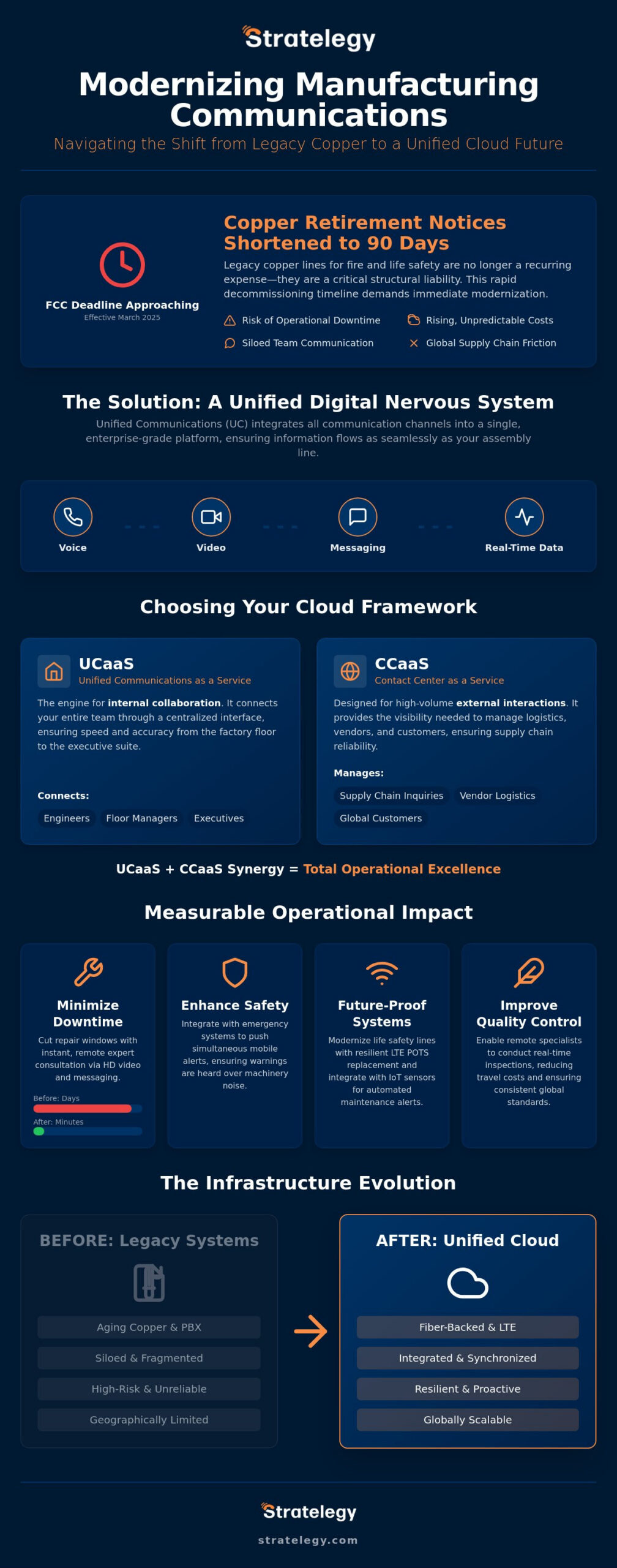
With the FCC shortening copper retirement notices to just 90 days as of March 2025, your factory’s legacy fire and life safety lines are no longer just a recurring expense. They’re now a structural liability. You likely recognize the daily friction caused by siloed communication between your production floor and the back office. It’s difficult to maintain a global supply chain when legacy infrastructure fails and costs continue to climb without warning.
We understand that operational downtime isn’t an option for your business. This guide demonstrates how implementing unified communications for manufacturing industry can bridge the gap between factory floor operations and corporate strategy using integrated cloud frameworks. You’ll learn how to secure your life safety systems with LTE POTS replacement and transition to a UCaaS model that offers predictable costs and seamless global collaboration. We’ll break down the technical shift from aging copper to a resilient, fiber-backed communication infrastructure that ensures your business remains competitive through 2026 and beyond.
Key Takeaways
- Bridge the gap between production floors and corporate strategy by deploying unified communications for manufacturing industry to eliminate operational silos.
- Minimize production downtime and improve facility safety through real-time messaging and integrated emergency notification protocols.
- Mitigate the risks of copper infrastructure retirement by modernizing fire and life safety systems with resilient LTE POTS replacement.
- Scale your global communication capabilities by transitioning from legacy hardware to high-performance cloud contact center frameworks.
The Architecture of Modern Manufacturing: Defining Unified Communications
Modern production demands more than just dial tones. It requires a synchronized digital nervous system. Integrating Unified Communications (UC) into the factory floor is no longer optional. This strategic framework for unified communications for manufacturing industry combines voice, video, instant messaging, and real-time data into a single, enterprise-grade platform. It’s the foundational layer that ensures information flows as fast as your assembly lines.
We’re witnessing a decisive migration from rigid, siloed PBX systems toward unified communications as a service. This transition enables global scalability that local hardware simply can’t match. By moving to the cloud, manufacturers eliminate the geographic barriers that previously separated design teams in one country from production facilities in another.
The year 2026 represents the tipping point for the digital workplace on the factory floor. With the rapid decommissioning of copper infrastructure and the rise of smart sensors, manufacturers must bridge the gap between operational technology (OT) and information technology (IT). A unified framework allows machine-level alerts to reach the right technician’s mobile device instantly, turning reactive maintenance into proactive optimization.
UCaaS vs. CCaaS: Which Does Your Plant Need?
UCaaS serves as the engine for internal collaboration. It connects engineers, floor managers, and executives through a centralized interface, ensuring that technical specifications and production quotas are always aligned. It’s about internal speed and accuracy.
The synergy between UCaaS and CCaaS ensures that internal production agility translates directly into external supply chain reliability, creating a closed loop of operational excellence that drives measurable ROI.
Operational Impact: Driving Productivity and Safety Through Integration
Operational silence is a silent killer of manufacturing margins. When a critical machine fails on a factory floor in Ohio, the solution shouldn’t depend on whether an expert in Germany is checking their email. By implementing unified communications for manufacturing industry, facilities replace fragmented response times with instant, cross-continental consultation. High-definition video and instant messaging allow floor managers to transmit live diagnostics to remote specialists, cutting repair windows from days to minutes.
Safety protocols also see a fundamental shift in reliability. Modern UC frameworks integrate directly with emergency notification systems, pushing mobile alerts to every device on the plant floor simultaneously. This ensures that safety warnings aren’t lost in the ambient noise of heavy machinery. This proactive approach to risk management protects your workforce while maintaining compliance with evolving 2026 safety standards.
While digital alerts are vital, physical safety measures like professional floor markings are equally critical for guiding staff; you can learn more about StripeGuys Warhouse Line Striping to see how expert floor striping enhances facility safety and organization.
Strategic unified communications and collaboration tools drive faster project completion by synchronizing the supply chain. Omnichannel platforms allow procurement teams to communicate with vendors across multiple formats within a single interface. This prevents the data loss that typically occurs when switching between phone calls, texts, and emails.
Asset Management and IoT Synergy
The convergence of communication and the Internet of Things (IoT) creates a self-reporting factory floor. Integrating UC platforms with IoT sensors allows for automated maintenance alerts that bypass the need for manual inspection. If a bearing exceeds a temperature threshold, the system automatically triggers a conference bridge for the maintenance team. This level of IT network infrastructure oversight is essential for managing multi-state facilities from a central hub.
Quality Assurance and Remote Expertise
Quality inspections no longer require expensive international travel. Remote specialists can now conduct real-time inspections via high-bandwidth video conferencing, ensuring that global sites maintain identical standards. This virtual presence reduces operational overhead and allows your most experienced engineers to oversee multiple production lines in a single afternoon. It’s an engineering-first solution to the talent gap facing the industry today.
The Infrastructure Shift: Replacing Legacy POTS and Copper Lines
Legacy copper is a ticking clock. In 2026, the sunset of Plain Old Telephone Service (POTS) has moved from a theoretical concern to a critical operational hazard. Major carriers have accelerated their retirement schedules, leaving manufacturers with skyrocketing maintenance fees for infrastructure that’s no longer supported. For unified communications for manufacturing industry to be effective, it must rest on a modern foundation. This requires a decisive shift from analog lines to resilient digital and cellular alternatives.
Many facilities still rely on copper for their most sensitive systems. However, the risk of keeping fire alarms, security panels, and elevator phones on traditional POTS lines is now unacceptable. A single outage doesn’t just disrupt communication; it can halt production entirely due to safety code violations. Prioritizing pots line replacement is the only way to ensure these mission-critical systems remain online and compliant with current building codes.
LTE POTS Replacement for Life Safety
Ensuring regulatory compliance is a primary driver for infrastructure modernization. Cellular-based fire alarm communicators provide a redundant, supervised connection that meets NFPA standards, which is essential for maintaining insurance eligibility. This transition guarantees that emergency elevator phones and security monitoring systems remain operational even during local network outages. LTE serves as the foundational alternative, offering a level of signal reliability that aging copper simply can’t provide.
Eliminating Technical Debt
Transitioning to cloud-based connectivity removes the ongoing burden of legacy hardware repair. Instead of chasing intermittent faults in decades-old wiring, your team can focus on high-value engineering tasks that actually drive production. Fixed-cost LTE solutions provide financial predictability, eliminating the volatile pricing associated with the forced retirement of copper lines. To secure your facility’s future, you should evaluate your current infrastructure for LTE-based modernization to protect your life safety systems.
Implementing a Future-Proof Strategy with Stratelegy
Stratelegy operates as a foundational engineering partner rather than a mere service provider. Deploying unified communications for manufacturing industry requires a disciplined methodology that prioritizes structural reliability over superficial software features. Our approach is rooted in the long-term health of your business infrastructure. We facilitate the migration from fragmented legacy hardware to a scalable cloud contact center framework, ensuring your global engagement remains as robust as your production lines.
Security and governance are not afterthoughts in our process. We implement proprietary maintenance frameworks and systematic hardware update policies to eliminate the risk of technical obsolescence. This proactive oversight ensures that every communication touchpoint, from the corporate office to the factory floor, adheres to strict regulatory and security standards. Our goal is to provide peace of mind through disciplined engineering and ongoing lifecycle management.
Assessing Your Current Infrastructure
Success begins with a systematic audit of your existing environment. We perform a detailed evaluation of legacy lines, network capacity, and cybersecurity readiness to identify potential vulnerabilities. This process uncovers critical blind spots in fire and life safety communication that often go unnoticed during standard IT reviews. By addressing these gaps early, we establish a stable, secure baseline for your digital transformation.
Choosing a Strategic Specialist
Manufacturers require a partner who understands the high stakes of industrial uptime. While many providers focus solely on software novelty, Stratelegy prioritizes infrastructure stability and long-term predictability. In 2026, the value of a technical specialist lies in their ability to navigate complex regulatory certifications and specialized technical niches. We provide the engineering expertise needed to ensure your communication systems are resilient, secure, and built for longevity.
Securing Your Operational Foundation for 2026 and Beyond
The transition to a digital factory floor is no longer a matter of convenience; it’s a requirement for structural reliability. As legacy copper networks continue to sunset, the risk to your fire alarms and life safety systems grows daily. Implementing unified communications for manufacturing industry isn’t just about software features. It’s about building a resilient infrastructure that bridges the gap between your production line and your corporate strategy. By adopting a cloud-based framework, you eliminate technical debt and gain the scalability needed for a global supply chain.
Success in this landscape requires a partner who views communication through the lens of foundational engineering. Stratelegy provides the technical authority and proprietary maintenance frameworks necessary to ensure your systems remain secure and compliant. We specialize in LTE POTS replacement for critical life safety systems and offer a disciplined approach to UCaaS and CCaaS integration. Modernize your manufacturing infrastructure with Stratelegy’s enterprise-grade UCaaS and LTE POTS replacement solutions today.
You’ve built a business on precision and reliability. Your communication infrastructure should reflect those same standards. We’re ready to help you engineer a future-proof environment that drives long-term operational excellence.
Frequently Asked Questions
What is the difference between UCaaS and traditional VoIP for manufacturers?
VoIP primarily handles voice over the internet, while UCaaS provides a comprehensive enterprise platform. For a factory, this means your floor managers can switch from a voice call to a live video diagnostic or a data-sharing session within the same application. This shift to a unified model eliminates the need for multiple disconnected software subscriptions and ensures your technical teams remain synchronized regardless of their physical location.
Why are POTS lines being phased out for manufacturing life safety systems?
POTS lines are becoming obsolete due to FCC deregulation and the physical retirement of copper infrastructure by major carriers. These analog lines are increasingly expensive and unreliable for mission-critical systems like fire alarms and elevator phones. Transitioning to LTE POTS replacement ensures your facility remains compliant with safety codes while providing a supervised connection that legacy copper can no longer guarantee.
Can UCaaS integrate with my existing factory floor IoT sensors?
Modern UCaaS platforms utilize open APIs to bridge the gap between operational technology and your communication stack. By integrating unified communications for manufacturing industry with IoT sensors, your machines can automatically trigger service alerts directly to the maintenance team’s mobile devices. This synergy transforms machine data into actionable insights, allowing your staff to address equipment failures before they cause significant production delays.
How does unified communication improve manufacturing supply chain efficiency?
Unified communication streamlines the supply chain by providing a single, omnichannel interface for all vendor and logistics interactions. This reduces the risk of data loss that occurs when switching between disparate email chains and phone calls. Real-time collaboration tools allow procurement teams to resolve logistical bottlenecks instantly, ensuring that materials arrive exactly when they’re needed on the assembly line.
Is cloud-based communication secure enough for enterprise-grade manufacturing?
Cloud-based communication is engineered with zero-trust security frameworks that often exceed the protections of on-premise hardware. Enterprise-grade security for unified communications for manufacturing industry includes end-to-end encryption, multi-factor authentication, and proactive governance protocols. These systems are designed for high-stakes environments where data integrity and regulatory compliance are non-negotiable, providing a level of structural reliability that local servers can’t match.