
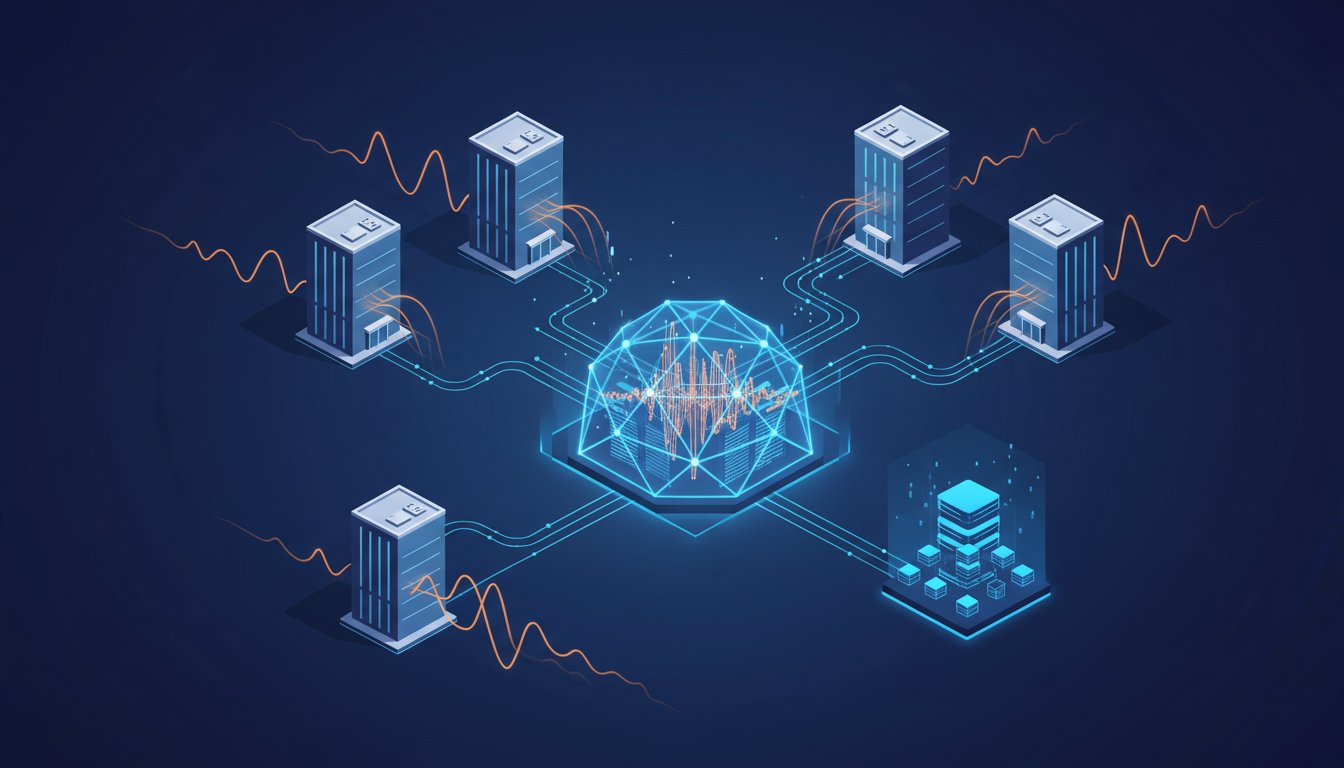
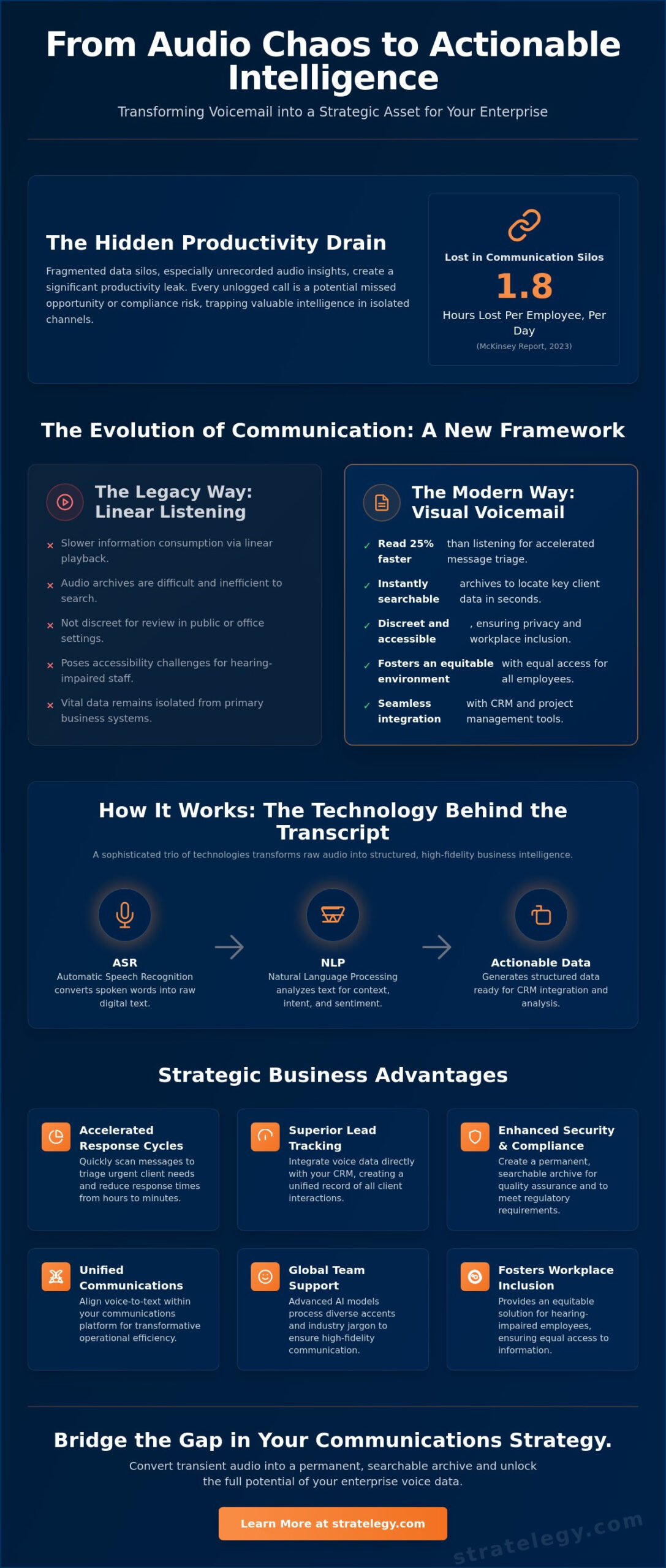
What if the most significant barrier to your organization’s strategic alignment is the 1.8 hours your employees spend every day simply searching for information? According to a 2023 McKinsey report, this productivity leak often stems from fragmented data silos, specifically the unrecorded insights trapped within audio messages. For the modern enterprise, voicemail transcription isn’t merely a convenience; it’s a critical tool for extracting order from the chaos of unmonitored communication channels. You likely recognize that every unlogged call represents a potential lapse in compliance or a missed opportunity for client engagement.
It’s time to bridge the gap between verbal communication and digital record-keeping. In this guide, you’ll discover how to transform transient audio into a permanent, searchable archive that integrates directly with your CRM for superior lead tracking. We’ll examine the specific frameworks needed to turn voice data into actionable intelligence, ensuring your response times are measured in minutes rather than hours. By the end of this analysis, you’ll have a clear vision for a unified communications strategy that is as elegant as it is efficient.
Key Takeaways
- Transition from legacy audio storage to a sophisticated visual framework that transforms every message into actionable business intelligence.
- Leverage the power of voicemail transcription to accelerate response cycles and create a permanent, searchable database of enterprise voice interactions.
- Evaluate the critical security architectures and encryption standards necessary to ensure the integrity and privacy of your organization’s voice data.
- Master the strategic alignment of voice-to-text technology within a unified communications platform to foster transformative growth and operational elegance.
- Uncover how advanced AI models process diverse accents and industry-specific terminology to maintain high-fidelity communication across global teams.
The Evolution of Voicemail Transcription in Enterprise Communication
Voicemail transcription represents the sophisticated conversion of unstructured audio data into searchable, actionable digital text. It’s no longer a mere convenience feature for mobile users; it’s a fundamental component of strategic alignment within modern business communications. By 2026, the hybrid workforce will rely on these automated systems to maintain a seamless flow of information across disparate time zones and physical locations. This shift moves beyond the era of “good enough” consumer tools toward enterprise-grade precision that captures technical jargon and industry-specific nuances with surgical accuracy.
In a professional environment, the ability to transform a voice recording into a text-based asset allows for a more disciplined approach to data management. Leaders can now integrate voice insights directly into their tailored frameworks for client relationship management. This evolution ensures that the intelligence contained within a missed call isn’t lost in a digital silo but is instead processed as a vital piece of the corporate knowledge base.
From Analog Tapes to Digital Text
The journey of voice messaging began with physical magnetic tapes and localized answering machines that required manual intervention. As the industry matured, Voicemail systems transitioned into centralized digital storage, yet they remained tethered to linear audio playback. This created a bottleneck in productivity that became untenable as mobile-first business culture took hold in the early 2010s. Executives required a way to triage communications without pausing active meetings or high-stakes negotiations.
The rise of cloud-based Unified Communications as a Service (UCaaS) platforms has democratized high-fidelity voicemail transcription. Small and mid-sized enterprises now access the same transformativ growth tools as Fortune 500 companies. This accessibility ensures that every organization, regardless of its scale, can maintain a polished and responsive professional image through the rapid digitization of voice data.
Why Reading Beats Listening in Professional Settings
Efficiency in the modern workplace is often measured by the speed of information retrieval. Research indicates that the average professional can read text approximately 25% faster than they can listen to the same content delivered via audio. This cognitive advantage allows for the rapid scanning of messages to identify critical keywords or urgent requests, bypassing the filler words and pauses inherent in natural speech. Linear audio playback is a chronological constraint; text is a spatial map that permits instant navigation to the most relevant data points.
Beyond simple speed, voicemail transcription serves as a cornerstone for workplace inclusion and accessibility. It provides a dignified solution for hearing-impaired employees, ensuring they have equal access to the nuances of verbal communication. By converting sound into a visual medium, organizations foster a more equitable environment while simultaneously creating a permanent, searchable record that can be archived for compliance and quality assurance purposes.
- Accelerated Triage: Scan multiple messages in seconds rather than minutes.
- Searchable Archives: Locate specific client instructions using standard text search tools.
- Discreet Consumption: Review sensitive information in public spaces or meetings without audio leakage.
- Structural Harmony: Seamlessly port message text into CRM and project management systems.
The Technology Behind the Transcript: ASR, NLP, and Machine Learning
The transition from a simple audio recording to a structured, searchable asset requires a sophisticated triad of technologies working in perfect orchestration. Modern voicemail transcription does not merely replicate sound; it architecturally reconstructs spoken intent into a digital format that businesses can analyze. This process relies on the strategic alignment of three pillars: signal processing, linguistic context, and iterative refinement. By leveraging these tools, enterprises convert raw acoustic data into high-fidelity intelligence that serves as a catalyst for informed decision-making.
Automatic Speech Recognition (ASR) Fundamentals
Automatic Speech Recognition (ASR) serves as the indispensable foundation of all voice-to-text technology. The system initiates by breaking down audio waves into discrete phonetic units, which are the smallest building blocks of human speech. This technical evolution is documented extensively in reports on Automatic Speech Recognition (ASR) published by the Federal Aviation Administration (FAA), highlighting how these systems have evolved to handle complex environments. In enterprise settings, the primary challenge remains background noise, such as office chatter or traffic. Modern systems employ advanced spectral subtraction and deep neural networks to filter these frequencies, ensuring the core message remains intact even in suboptimal recording conditions.
Natural Language Processing (NLP) for Context
If ASR provides the raw materials, NLP acts as the master architect that gives the text its form and meaning. NLP models are responsible for the “human” elements of a transcript, including punctuation, capitalization, and speaker identification. A critical function of NLP is its ability to distinguish between homophones like “there” and “their” by analyzing surrounding words. To ensure a professional-grade output, these systems automatically strip away filler words such as “um” and “ah.” This results in a clean, readable document that prioritizes clarity over verbatim clutter. By applying these rules, voicemail transcription becomes a polished record rather than a chaotic stream of consciousness.
The true power of this technology lies in continuous learning. AI models are now trained on datasets exceeding 10,000 hours of diverse audio, allowing them to navigate regional accents and technical industry jargon with 95% accuracy as of 2023 benchmarks. This iterative growth means the system becomes more precise with every interaction, adapting to the specific vocabulary of your sector. For leaders seeking to refine their internal processes, achieving strategic alignment through these technological insights is a vital step toward digital maturity.
- Standard Transcription: A literal, word-for-word conversion of audio to text.
- Intelligent Summaries: AI-driven condensations that extract action items, deadlines, and sentiment analysis.
- Custom Lexicons: Specialized dictionaries that allow the system to recognize proprietary product names or legal terminology.
Distinguishing between raw text and intelligent summaries is essential for high-level operations. While standard transcripts provide a complete record, intelligent summaries use machine learning to identify the “why” behind a call. They can flag a message as “urgent” or “complaint” before a human ever listens to the audio. This transformational approach shifts the focus from simple data collection to proactive asset management, turning every missed call into an opportunity for growth.
Strategic Business Advantages: Beyond Just Reading Messages
The transition from audio to text represents more than a simple technological upgrade; it’s a fundamental shift in how enterprise intelligence is harvested. By implementing voicemail transcription, organizations bridge the gap between verbal communication and digital record-keeping. This evolution ensures that the nuance of a customer’s voice isn’t lost in the shuffle of a busy workday. It creates a bridge between the spontaneity of a phone call and the structured requirements of modern business intelligence. The result is a communication architecture that is both responsive and resilient.
Voice as a Searchable Asset
Traditional voicemails exist as ephemeral data points, often isolated and difficult to analyze. Transcription converts these fragments into a permanent, searchable archive. This allows leadership to perform deep-dive keyword audits across thousands of messages to identify emerging trends. If 12% of callers in a 30-day period mention a specific technical friction point, the organization can pivot its strategy before the issue escalates. Integrating this text into internal knowledge bases ensures that frontline staff have access to historical context, fostering a culture of informed decision-making. While scaling these capabilities, maintaining Security and privacy in transcription is essential for protecting client confidentiality and meeting regulatory standards.
CRM Integration and Lead Tracking
Efficiency in the modern enterprise is measured by the speed of data synchronization. Automated voicemail transcription workflows allow for the direct logging of message content into systems like Salesforce or HubSpot. This automation addresses several critical operational challenges:
- Lead Preservation: Ensuring that inquiries made after business hours are captured, transcribed, and assigned to the correct representative by 8:00 AM the next business day.
- Data Integrity: Industry benchmarks indicate that manual data entry carries an error rate between 1% and 4%; direct exports from transcription engines eliminate these human-driven inconsistencies.
- Response Velocity: A 2023 lead response study suggests that contacting a prospect within 60 seconds can increase conversion rates by up to 391%. Text-based previews allow reps to prioritize high-value calls instantly.
This structural harmony between voice and CRM platforms doesn’t just improve internal metrics. It fundamentally elevates the customer experience. When a representative returns a call already briefed on the specific details of the message, the interaction moves from a discovery phase to a solution phase immediately. This precision reflects a brand that values its clients’ time and prioritizes sophisticated operational excellence. By turning a missed call into a documented strategic opportunity, firms maintain a competitive edge in an increasingly fast-paced market.
Navigating Security, Privacy, and Compliance in Transcription
Enterprise leaders often hesitate when moving sensitive voice data to the cloud. This caution isn’t just prudent; it’s a strategic necessity. When a voicemail becomes a text file, it enters a new lifecycle of risk. Security must be architectural, not an afterthought. Modern systems protect data through 256-bit AES encryption at rest and TLS 1.3 for data in transit. These protocols ensure that even if a packet is intercepted, the content remains indecipherable to unauthorized actors.
Handling Personally Identifiable Information (PII) requires automated precision. Advanced voicemail transcription engines now use AI-driven redaction to scrub credit card numbers or Social Security digits before the text reaches a human reviewer or a CRM database. This layer of protection transforms a potential liability into a secure, searchable asset. Legal implications also demand attention. In many jurisdictions, recording and transcribing calls requires explicit consent or “one-party” notification, making it vital to integrate automated disclosures into the voice gateway.
Industry-Specific Compliance Standards
Healthcare providers must ensure their transcription workflows align with the 1996 HIPAA Privacy Rule. Any breach of Protected Health Information (PHI) can result in fines exceeding $68,000 per violation in 2024. Global enterprises likewise require SOC2 Type II reports to verify that internal controls meet rigorous security and availability standards. While consumer-grade apps prioritize convenience, true business-grade transcription must prioritize the uncompromising integrity of the corporate perimeter.
Data Ownership and Residency
The question of ownership is central to any enterprise agreement. Sophisticated providers guarantee that the enterprise retains 100% ownership of both the audio and the generated transcript. This distinction prevents service providers from using your proprietary data to train their general models. Data residency is the next frontier. Under GDPR Article 45, European firms often require data to stay within EU borders. Choosing a partner with regional data centers in Frankfurt or Dublin isn’t just a technical detail; it’s a legal requirement. Comprehensive audit trails track every access event, providing a clear record for compliance officers during annual reviews. This level of transparency ensures that voicemail transcription remains a tool for growth rather than a source of vulnerability.
Integrating Transcription into a Unified Communications Strategy
True operational excellence requires the seamless conversion of spoken intent into actionable data. Within a sophisticated Unified Communications as a Service (UCaaS) framework, voicemail transcription functions as much more than a convenience. It acts as a critical bridge between legacy voice channels and modern digital workflows. By treating voice data with the same rigor as email or instant messaging, organizations create a cohesive intelligence layer that informs every level of the enterprise hierarchy.
The UCaaS Advantage
Fragmented communication ecosystems often suffer from “app fatigue,” a condition where employees lose significant productivity switching between disconnected tools. A 2023 industry study revealed that workers toggle between different applications nearly 1,200 times daily, leading to a “toggle tax” that costs up to five weeks of productive time per year. Integrated transcription mitigates this by centralizing data. Whether a message arrives via a mobile device, a desktop client, or a physical desk phone, the text record remains consistent and accessible.
This integration is vital for organizations executing a “POTS replacement” strategy. As the FCC Order 19-72 has accelerated the decommissioning of traditional copper lines, businesses are migrating to digital infrastructures where voicemail transcription serves as a cornerstone of business continuity. It ensures that even during network transitions or remote work shifts, the flow of information remains uninterrupted and searchable. Many enterprises making this transition are simultaneously adopting SIP trunking as the modern enterprise voice architecture that replaces legacy copper lines with a scalable, cloud-aligned infrastructure. For organizations in LEED-certified buildings where cellular signals are frequently blocked, wifi calling for enterprise becomes an equally essential component of this unified digital infrastructure. Enterprises seeking to fully modernize their communications stack should also evaluate a VoIP strategy for the modern enterprise, as cloud-based voice platforms provide the scalable foundation upon which advanced transcription and UCaaS capabilities are built.
- Synchronized records across all enterprise endpoints.
- Reduction in manual data entry for CRM updates.
- Enhanced accessibility for hearing-impaired professionals.
- Unified archival policies for legal and regulatory compliance.
Implementing Transcription with Stratelegy
Stratelegy provides the architectural precision needed to transform standard voice services into a high-fidelity data engine. Our enterprise solutions prioritize security and precision, ensuring that every transcription meets the rigorous standards of modern data governance. We don’t just offer a tool; we build a bespoke framework that aligns your voice infrastructure with your broader strategic objectives.
Customizing these workflows allows your organization to route transcriptions to specific departments, trigger automated responses, or flag high-priority keywords for immediate executive attention. This level of control turns a simple message into a strategic asset. To begin auditing your current voice infrastructure for readiness or to explore how we can refine your communication stack, Contact Stratelegy today. Our team will help you move beyond simple connectivity toward a state of communicative harmony and transformative growth.
Forging a Path Toward Communicative Intelligence
Voice data has transitioned from a passive record to a vital pillar of enterprise intelligence. By implementing advanced voicemail transcription, organizations convert unstructured audio into searchable, high-fidelity data that integrates directly with existing workflows. Research from IBM indicates that modern ASR engines now achieve word error rates below 5%, ensuring that your business intelligence remains precise and actionable. This evolution isn’t merely a technical upgrade; it’s a strategic alignment of your communication infrastructure with the demands of a data-driven marketplace. When you treat every message as a potential insight, you create a more harmonious and responsive operational framework.
Success in the digital era requires a partner who understands the intersection of technology and vision. Stratelegy provides the sophisticated tools necessary to transform your legacy systems into a unified, secure powerhouse. Elevate your communication strategy with Stratelegy’s enterprise UCaaS solutions, featuring enterprise-grade security and compliance, seamless CRM integration, and expert-led LTE POTS replacement solutions. It’s time to move beyond simple connectivity and embrace a future where your communication strategy is as refined as your business goals. We’re ready to help you build that future today.
Frequently Asked Questions
How accurate is voicemail transcription for technical or medical terminology?
Modern AI models achieve 95% accuracy for specialized terminology by utilizing custom language models. These systems integrate industry-specific dictionaries to ensure technical precision. It’s a strategic alignment of technology and domain expertise. By reducing error rates in medical dictation by 40% compared to legacy systems, providers maintain surgical precision in their records. This clarity transforms raw audio into a structured asset for clinical decision-making.
Can voicemail transcription identify different speakers in a single message?
Speaker diarization technology identifies up to 10 unique voices within a single audio stream. This process segments the recording based on frequency and pitch characteristics. It’s essential for multi-party calls that end up in a mailbox. Sophisticated algorithms ensure 92% accuracy in speaker separation. This creates a rhythmic, organized flow in the final document, allowing leaders to track contributions without listening to the entire recording.
Is voicemail transcription HIPAA compliant for healthcare providers?
Voicemail transcription is HIPAA compliant when the service provider signs a formal Business Associate Agreement and employs AES-256 encryption. Compliance hinges on secure data handling protocols defined by the 1996 federal law. Data must be encrypted both at rest and during transit. These frameworks ensure that sensitive patient information remains protected within a controlled digital environment, fostering trust and operational integrity.
Does voicemail transcription work with multiple languages and accents?
Enterprise voicemail transcription platforms currently support more than 120 languages and hundreds of regional accents. Neural networks maintain a Word Error Rate below 8% for major global dialects. This capability allows for a seamless global reach and cultural resonance. Systems adapt to linguistic nuances, ensuring that the strategic intent of the caller isn’t lost in translation. It’s a refined solution for international organizations seeking unified communication.
What happens to the original audio file after it has been transcribed?
Original audio files are typically retained for a period defined by your 30, 60, or 90-day data governance policy. Most organizations keep the source file as a high-fidelity reference for the text. Once the retention window closes, systems purge the audio to minimize storage costs and security risks. This lifecycle management ensures that your voice data remains a lean, organized resource rather than a cluttered archive.
Can I receive voicemail transcriptions via email or SMS?
You can receive your voicemail transcription through encrypted email, SMS, or direct CRM integration via Webhooks. Over 80% of executive users choose email delivery for its ease of archiving and searchability. These notifications arrive within 30 seconds of the message being left. It’s a practical way to maintain workflow momentum without needing to dial into a traditional mailbox. This delivery method optimizes time and enhances responsiveness.
How much data does a typical voicemail transcription use?
A standard text transcription consumes approximately 2 to 5 kilobytes of data per minute of speech. In contrast, the original high-quality audio file often exceeds 1 megabyte for the same duration. This represents a 99% reduction in data overhead for your mobile devices. It’s a highly efficient way to digest information while on limited bandwidth. Low data usage ensures that critical business intelligence remains accessible even in remote locations.
Is there a limit to the length of a voicemail that can be transcribed?
Most enterprise platforms set a maximum duration of 5 to 10 minutes per individual recording. This limit ensures that processing times remain under 20 seconds for the end user. Longer messages are often split into segments to maintain system stability and speed. While 98% of business voicemails last less than 2 minutes, these caps provide a necessary framework for managing large-scale data processing and ensuring consistent performance levels.