
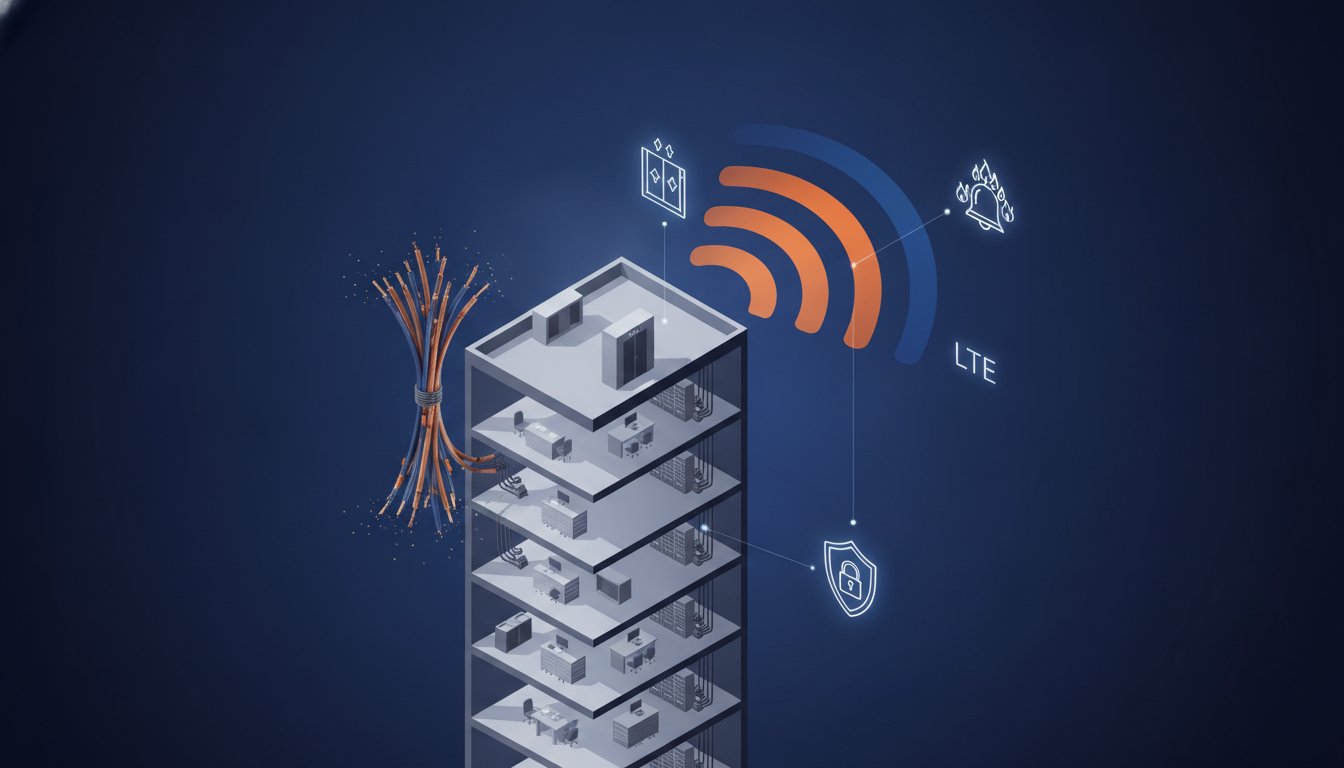
Did you know that the FCC recently accelerated the retirement of copper networks, giving carriers the authority to discontinue service with as little as 90 days of notice? This regulatory shift makes finding a reliable wireless replacement for analog lines a critical priority for business owners in 2026. You can’t afford to wait for a service interruption to address the systems that keep your facility safe and compliant.
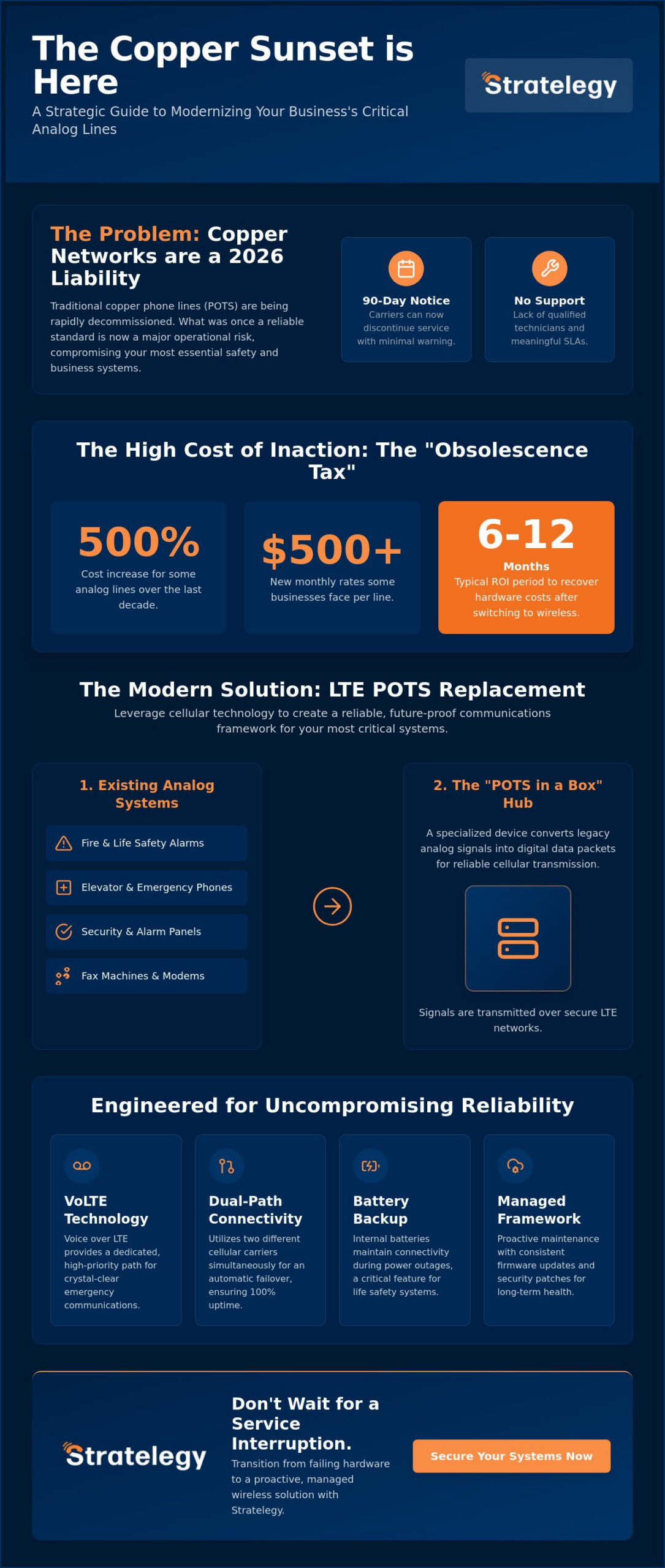
It’s no secret that legacy POTS costs have reached unsustainable levels, with some businesses reporting monthly bills that have increased by 500 percent over the last decade. You’re likely feeling the pressure of these rising expenses paired with a lack of qualified technicians to service aging copper. We recognize that your goal is to transition from unmanaged, failing hardware to a proactive communications framework that offers both security and predictability.
This article provides a strategic roadmap for modernizing your life safety and business systems using LTE-based technology. You’ll learn how to eliminate copper dependence, maintain 100 percent uptime for emergency lines, and significantly reduce your operational expenses through a managed wireless approach. We’ll move past the technical jargon to focus on the structural reliability your business requires.
Key Takeaways
- Understand how “POTS in a Box” technology converts legacy analog signals into digital packets to maintain compatibility with existing hardware.
- Executing a strategic wireless replacement for analog lines requires a comprehensive audit of hidden dependencies, such as fax machines and emergency elevator phones.
- Utilize VoLTE engineering to provide the high-level stability and voice clarity required for critical fire and life safety communications.
- Transition from unmanaged hardware to a proactive maintenance framework that ensures your systems receive consistent firmware updates and security patches.
- Eliminate the systemic vulnerabilities of the copper sunset by migrating to a reliable, LTE-based infrastructure designed for long-term operational health.
The Obsolescence of Copper: Why Analog Lines Are a 2026 Liability
Copper infrastructure has reached a breaking point. What was once the gold standard for connectivity is now a primary source of systemic vulnerability for modern enterprises. A wireless replacement for analog lines leverages LTE or 5G cellular networks to transmit signals that were traditionally handled by the physical Plain Old Telephone Service (POTS). In 2026, the “POTS Sunset” is no longer a future threat; it’s a daily operational risk that compromises the integrity of your most critical systems.
Carriers are aggressively decommissioning their copper plants, leading to a phenomenon known as the “obsolescence tax.” This means businesses are paying significantly higher rates for a service that is actively deteriorating. Service Level Agreements (SLAs) for analog lines have degraded to the point of being non-existent. It’s difficult to find technicians with the specialized skills required to repair legacy copper, making these lines unsuitable for mission-critical operations such as fire alarms, elevator phones, and security monitoring.
The Regulatory Catalyst: FCC Order 20-152 and Beyond
Federal mandates have fundamentally shifted the telecommunications landscape. FCC Order 20-152, combined with the March 2026 order, accelerated the retirement of the Public Switched Telephone Network (PSTN). Carriers are no longer legally required to maintain aging copper infrastructure. Consequently, they’ve reduced notification periods for service discontinuation from 180 days to just 90 days. This lack of regulatory protection has triggered rapid price hikes as providers attempt to force customers off their books and onto modern fiber or wireless alternatives.
The High Cost of Inaction
Maintaining legacy lines is a losing financial strategy that drains resources without providing a return on stability. When you analyze the ROI of a wireless replacement for analog lines, the hardware costs are typically recovered within 6 to 12 months through drastically reduced monthly service fees. The financial urgency is clear, as the average cost of a single analog line has increased by 300 to 500 percent over the last decade, with some monthly rates now exceeding $500 per line. Proactive migration secures your budget and ensures that critical life safety systems remain operational during the final stages of the copper phase-out.
LTE POTS Replacement: The Engineering Behind Wireless Connectivity
Engineering defines the difference between a temporary fix and a permanent infrastructure upgrade. A wireless replacement for analog lines utilizes specialized hardware, frequently categorized as “POTS in a Box,” to convert legacy signals into digital data packets suitable for cellular transmission. This process isn’t a simple pass-through. It involves a sophisticated translation of analog dial tones and frequency-shift keying into modern IP-based protocols. The necessity of this transition is underscored by the FCC order accelerating the retirement of copper lines, which has forced a move toward more resilient, software-defined network architectures.
At the core of this technology is VoLTE (Voice over LTE), which provides a dedicated, high-priority path for voice traffic. Unlike standard cellular data, VoLTE ensures that emergency communications receive the bandwidth they require without interference from other network activity. This structural reliability is further enhanced by dual-path connectivity. By utilizing two different cellular carriers simultaneously, these systems provide a failover mechanism that far exceeds the reliability of a single, aging copper pair. Our team of specialists focuses on this foundational engineering to ensure your mission-critical systems never lose a heartbeat. You can review our LTE POTS Replacement framework to understand how we prioritize these connections.
Critical Signal Integrity for Life Safety
Life safety systems like fire alarm panels and security monitors require precise signal timing to communicate with central stations. Wireless communicators are engineered to handle these specialized handshakes without the latency issues common in consumer-grade equipment. Additionally, these devices include internal battery backups. This ensures that even during a local power outage, your emergency lines remain active for the duration required by NFPA 72 and other regulatory standards.
Managed LTE vs. Unmanaged Cellular
There is a significant gap between a managed enterprise solution and a generic cellular bridge. Consumer-grade devices often operate on “best effort” networks, which are prone to congestion and lack the security protocols necessary for business governance. A managed framework provides ongoing oversight, including remote monitoring and proactive updates. This disciplined approach eliminates the risk of hardware obsolescence and ensures that your wireless infrastructure remains secure against evolving digital threats.
For organizations looking to secure their infrastructure, JP Technical offers managed IT services that provide the oversight and expertise required for a seamless transition to modern wireless systems.
Deployment Strategy: Transitioning Critical Life Safety Systems
Transitioning to a wireless replacement for analog lines requires more than just procurement; it demands a disciplined deployment strategy. You must begin by cataloging every hidden dependency within your facility. Many organizations overlook secondary systems like gate controllers, fax machines, and out-of-band management ports that still rely on legacy copper. A comprehensive site survey is the next mandatory step. This assessment determines cellular signal penetration throughout the building and identifies specific locations where external antennas are necessary to maintain a stable link.
Executing a phased migration is the most effective way to mitigate risk. Rather than a “rip and replace” approach, we recommend a systematic cutover that allows for parallel testing of new cellular paths while the copper remains active. This methodical process ensures that every critical communication point is verified before the legacy service is permanently decommissioned. It’s a proactive way to maintain operational continuity and eliminate the anxiety of a service gap during the transition.
Compliance and Certification Standards
Security and fire monitoring systems aren’t just about connectivity; they’re about strict adherence to life safety codes. Your chosen solution must carry UL 864 and UL 1610 certifications to be considered valid for fire and security applications. NFPA 72 requires that any emergency communication path must provide a level of reliability and supervised monitoring equivalent to traditional copper lines. By following these standards, you ensure that your wireless replacement for analog lines meets the rigorous demands of local fire marshals and insurance underwriters.
Solving the Elevator Connectivity Gap
High-rise environments present unique challenges for emergency elevator phones, often involving signal attenuation within steel and concrete shafts. Modern engineering solves this by integrating these lines into a unified wireless management platform. This approach provides centralized oversight of every cab’s communication status, replacing unmonitored analog pairs with a supervised digital link. If you’re ready to secure your facility’s future, you can consult with our strategic specialists to build your modernization roadmap.
Stratelegy Managed POTS Replacement: Stability Beyond the Hardware
Hardware is only half the solution. A successful wireless replacement for analog lines requires a managed framework that prioritizes long-term structural reliability over simple connectivity. Stratelegy functions as a strategic specialist, providing oversight that extends through the entire equipment lifecycle. This approach ensures your infrastructure remains resilient long after the initial installation.
We utilize proprietary maintenance frameworks to ensure every wireless communicator in your network is running the latest firmware and security patches. Legacy copper systems failed because they were left to rot without oversight. Our systematic hardware update policies prevent this obsolescence by proactively managing device health and security protocols. This disciplined governance transforms a standard hardware swap into a sustainable enterprise asset.
Proactive Monitoring and Governance
Real-time visibility is essential for managing a national footprint. Our platform provides instantaneous data on signal strength and device health, allowing our team to identify and resolve issues before they impact your operations. This proactive stance eliminates the burden of manual troubleshooting for your facility teams. Instead of reacting to a failed line, you gain the peace of mind that comes from a supervised, engineered environment.
The Future-Proof Enterprise
Transitioning your life safety lines is the first step toward a broader unified communications as a service strategy. By modernizing these foundational links, you create a stable architecture that supports more advanced technologies like a cloud contact center. We define ourselves as foundational engineers because we focus on the structural health of your business communications. Our goal is to provide a predictable, secure, and modern digital environment that scales with your organizational needs.
Securing Your Infrastructure for the Post-Copper Era
The transition from legacy copper to modern digital architecture is no longer optional. As the regulatory landscape shifts and maintenance costs for aging plants soar, businesses must act to protect their mission-critical operations. A reliable wireless replacement for analog lines provides the structural stability needed for fire alarms, elevator phones, and security systems. This modernization effort eliminates the fear of obsolescence and creates a predictable foundation for your long-term communication strategy.
Choosing a managed approach ensures your systems remain compliant with NFPA 72 and UL standards while benefiting from national deployment and continuous oversight. Our proprietary maintenance frameworks and systematic hardware update policies guarantee that your infrastructure remains secure and up to date. You don’t have to navigate these technical complexities alone. We’re here to serve as your strategic partner and foundational engineers.
Contact Stratelegy to begin your strategic POTS modernization today. It’s time to trade legacy vulnerabilities for modern reliability and peace of mind.
Frequently Asked Questions
Is a wireless replacement for analog lines as reliable as copper?
Modern wireless solutions often exceed the reliability of legacy copper infrastructure. While aging copper lines suffer from physical degradation and a dwindling pool of qualified repair technicians, wireless systems utilize dual-path LTE and 5G networks to ensure constant connectivity. This engineered approach provides a level of supervised monitoring that traditional analog lines cannot match in the current 2026 landscape.
Will my existing fire alarm panel work with an LTE replacement?
Legacy fire alarm panels are fully compatible with LTE-based replacement hardware. The conversion device translates analog signals, such as Contact ID or SIA, into digital packets for secure transmission over cellular networks. You don’t need to replace your existing panels or internal wiring to achieve a successful migration. This allows you to modernize your infrastructure without the capital expense of a total system overhaul.
Does wireless POTS replacement meet NFPA 72 requirements?
Compliant wireless POTS replacements meet or exceed NFPA 72 standards for emergency signal transmission. To ensure full compliance, the solution must be UL 864 and UL 1610 certified. These certifications verify that the hardware includes necessary features like supervised communication paths and internal battery backups. A managed service framework ensures these standards are maintained through consistent firmware updates and performance monitoring.
How long does it take to install a wireless replacement for analog lines?
A standard installation for a wireless replacement for analog lines typically concludes within a few hours per site. Once a site survey confirms signal strength, the physical deployment involves mounting the hardware and connecting it to your existing equipment. This process is significantly faster than waiting for a carrier to repair or install new copper pairs. A phased migration strategy ensures that your life safety systems remain active throughout the entire cutover.
What happens to my wireless phone line during a power outage?
Your communication path remains fully operational during a power outage thanks to integrated battery backup systems. These units are designed to meet strict regulatory requirements, providing standby power for 24 hours or more depending on the configuration. Because the system relies on national cellular towers, which have their own hardened power redundancies, your emergency lines stay live even when the local electrical grid fails.