

Most enterprises treat cloud migration as a simple software upgrade, but the reality is that a successful transition is a foundational engineering project. You’ve likely felt the friction of fragmented tools and the rising costs of failing copper lines. It’s frustrating to manage app fatigue while worrying about potential downtime during a major shift. This ucaas implementation guide for enterprise leaders provides the technical roadmap you need to move forward with confidence.
We’ll show you how to master the complexities of large-scale migration while prioritizing infrastructure stability and security. You’ll learn to navigate the 2026 regulatory environment, replace aging POTS infrastructure with resilient LTE solutions, and ensure your critical systems remain online throughout the transition. We focus on predictable maintenance and structural reliability to eliminate the fear of technical obsolescence. This guide breaks down the transition into manageable service pillars, from network readiness assessments to end-to-end cybersecurity integration, ensuring your communication stack is built for longevity and performance.
Key Takeaways
- Shift your focus from superficial software features to structural reliability by treating UCaaS as an engineering project rooted in network stability.
- Use this ucaas implementation guide for enterprise to conduct a comprehensive audit of network bandwidth, latency, and legacy endpoints before deployment.
- Protect critical life-safety systems by integrating LTE POTS replacement into your phased migration strategy to maintain fire alarm and elevator connectivity.
- Ensure long-term operational health through proprietary maintenance frameworks and systematic hardware update policies that proactively prevent technological obsolescence.
Beyond the Software: Why Enterprise UCaaS Implementation Starts at the Foundation
Enterprise UCaaS implementation is the strategic migration of voice, video, and collaboration to a resilient cloud-based framework. In 2026, software is only as reliable as the network infrastructure supporting it. Many organizations suffer from communication sprawl, where fragmented tools overwhelm users and create security gaps. This sprawl isn’t just a poor software choice. It’s often a symptom of infrastructure neglect. As foundational engineers, we prioritize high-availability dial tones and video clarity by treating the network as the bedrock of the enterprise.
Infrastructure Stability vs. Superficial Features
Technical experts prioritize security, governance, and predictability over flashy messaging features that offer little long-term value. A successful transition to unified communications as a service requires a robust IT network audit before any software is deployed. This ucaas implementation guide for enterprise leaders focuses on creating a strategic engineering partnership rather than a simple vendor-client transaction. A comprehensive audit should evaluate:
- Bandwidth Capacity: Ensuring enough throughput for simultaneous HD video streams.
- Quality of Service (QoS): Prioritizing voice traffic over standard data to eliminate jitter.
- Security Protocols: Integrating end-to-end encryption across all cloud endpoints.
The Hidden Risk of Legacy Copper (POTS)
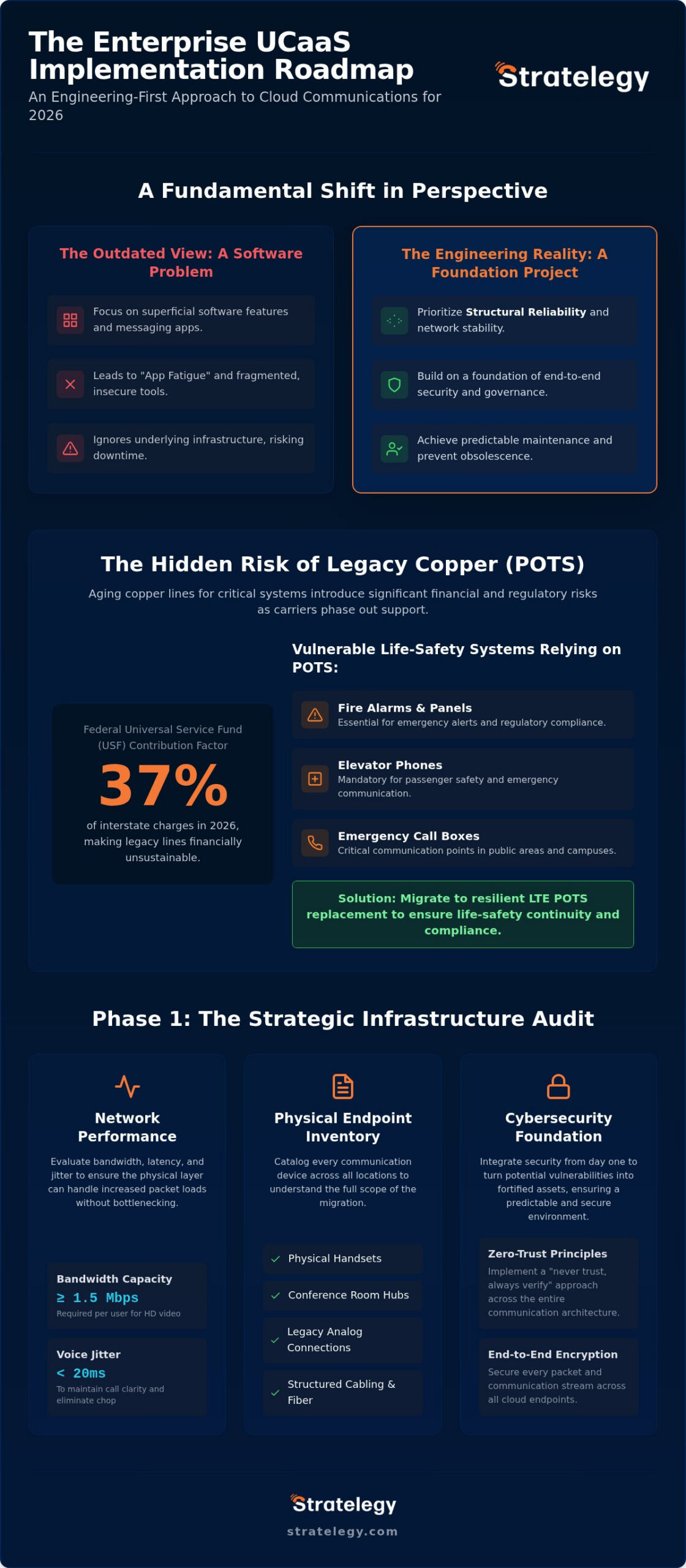
Critical systems often hide on aging copper infrastructure. Maintaining legacy POTS lines in 2026 introduces significant financial and regulatory risks as carriers phase out support. The financial burden of the Federal Universal Service Fund (USF) contribution factor, which sits at 37% of interstate charges in 2026, makes legacy lines increasingly unsustainable. Systems like fire alarms, elevator phones, and emergency call boxes require modern LTE POTS replacement to ensure life-safety continuity. This ucaas implementation guide for enterprise environments identifies these vulnerable endpoints to prevent downtime and ensure your critical infrastructure meets current safety regulations.
Phase 1: The Strategic Audit of Network Readiness and Critical Infrastructure
Enterprise migration fails when physical realities are ignored. This phase of our ucaas implementation guide for enterprise begins with a granular inventory of every communication endpoint. We don’t just look at software logins; we catalog physical handsets, conference room hubs, and legacy analog connections across all national locations. Assessing the network for bandwidth, latency, and jitter is non-negotiable. Industry standards for 2026 suggest HD video calls require at least 1.5Mbps per user, while voice needs low jitter, ideally under 20ms, to maintain clarity. We also evaluate existing structured cabling and fiber capacity to ensure the physical layer can handle the increased packet load without bottlenecking.
Conducting a Comprehensive POTS Audit
pots line replacement is a critical prerequisite for total cloud migration. You must map elevator phones, fire panels, and alarm systems that still rely on copper. Doing nothing isn’t an option. As carriers retire legacy infrastructure, the cost of maintaining these lines spikes while reliability plummets. Transitioning these systems to LTE ensures life-safety continuity and regulatory compliance. Our engineering team specializes in identifying these tethered systems to prevent a single analog line from stalling your entire digital transformation.
Network Infrastructure and End-to-End Cybersecurity
We analyze current network bottlenecks that could derail UCaaS performance before they impact your daily operations. Integrating zero-trust principles into the communication architecture from day one is essential for modern governance. This proactive approach secures every packet across your IT network infrastructure, turning a potential vulnerability into a fortified asset. By auditing the physical and digital layers simultaneously, we build a predictable environment where security and performance coexist. This methodical preparation ensures your migration is grounded in structural reliability rather than just software deployment.
Executing the Migration: Integration, Governance, and Life-Safety Continuity
Execution is the most volatile stage of any enterprise-scale transition. This ucaas implementation guide for enterprise leaders utilizes phased rollout strategies to minimize operational friction and prevent systemic downtime across your national footprint. This approach allows for departmental validation and testing before a full-scale deployment. Consolidation remains a critical pillar of this phase. We integrate UCaaS and CCaaS into a single managed engagement platform to eliminate tool fragmentation. This unified architecture ensures that data flows seamlessly between back-office teams and customer facing agents, creating a cohesive communication ecosystem.
Modernizing Critical Infrastructure with LTE POTS Replacement
High-stakes systems like fire alarms, elevator phones, and security panels cannot experience a single second of downtime. We deploy cellular-based LTE alternatives to replace aging copper lines, maintaining strict 2026 regulatory compliance for fire and life-safety applications. This transition provides infrastructure peace of mind by removing dependencies on failing legacy hardware and unpredictable carrier maintenance schedules. Our engineers prioritize these critical endpoints to ensure your business remains protected throughout the migration. If you are ready to secure your critical endpoints, partner with our technical experts for a specialized infrastructure audit.
Integrating Cloud Contact Center Solutions
Aligning cloud contact center features with your enterprise-wide UCaaS stack is vital for long-term operational efficiency. This integration bridges the gap between internal collaboration and front-line engagement, allowing agents to access back-office expertise in real-time. We establish clear governance policies for user access, multi-factor authentication, and data retention to ensure security remains consistent across all communication channels. This ucaas implementation guide for enterprise environments prioritizes this technical synergy to drive predictable ROI and eliminate the fear of technological obsolescence.
Post-Implementation Governance: Ensuring Predictability and Long-Term ROI
Success doesn’t end at the go-live date. This ucaas implementation guide for enterprise environments concludes with a shift toward proactive lifecycle management. We implement proprietary maintenance frameworks that monitor ongoing infrastructure health across all national locations. This transition from foundational engineering to continuous oversight ensures that your communication stack remains resilient against shifting demands. By establishing systematic hardware update policies, we proactively prevent technological obsolescence. This disciplined approach protects your capital investments from the rapid decay typical of unmanaged systems.
Measuring ROI in 2026 involves more than comparing monthly bills. It’s found in the significant reduction of technology debt and the achievement of total infrastructure stability. A predictable environment allows your internal teams to focus on strategic growth rather than reactive troubleshooting. When your foundation is engineered for longevity, every dollar spent on maintenance becomes an investment in operational continuity.
Lifecycle Management and Predictable Maintenance
Modern voip management requires ongoing oversight to maintain peak performance. It’s not a one-time install. We establish a rigorous cadence for infrastructure security audits and firmware updates to stay ahead of 2026 regulatory requirements. This methodical oversight ensures that every router, switch, and LTE communicator operates with the latest security patches. Maintaining this level of discipline is essential for preserving the peace of mind we promise our partners.
Future-Proofing the Enterprise Ecosystem
Strategic partnerships allow you to anticipate the operational problems of 2027 before they emerge. A consolidated cloud framework provides long-term benefits like centralized governance and simplified data retention policies. By moving away from fragmented legacy systems, you gain the agility to adopt future AI integrations or security protocols without a complete structural overhaul. This methodical approach to post-implementation governance ensures your business remains modern, secure, and ready for whatever comes next.
Securing Your Communication Bedrock for 2026 and Beyond
Modernizing your communication stack is a structural necessity that requires more than a simple license purchase. This ucaas implementation guide for enterprise leaders emphasizes that longevity depends on the physical layer. You’ve seen how auditing network readiness and replacing failing copper lines with LTE POTS solutions prevents critical system failures. We prioritize foundational engineering to ensure your life-safety and security systems meet 2026 regulatory standards without interruption. This methodical approach transforms a volatile migration into a predictable business asset.
True peace of mind comes from a partnership built on technical expertise and end-to-end cybersecurity. We focus on long-term operational health through proprietary maintenance frameworks rather than superficial features. Our specialists anticipate the infrastructure challenges you haven’t encountered yet, providing a clear path away from technological obsolescence. If you’re ready to transition to a predictable, high-availability environment, Secure Your Enterprise Infrastructure with a Stratelegy UCaaS Consult. Your business deserves a foundation engineered for excellence.
Frequently Asked Questions
How long does a typical enterprise UCaaS implementation take in 2026?
A typical enterprise UCaaS implementation for national organizations ranges from three to nine months. This timeline accounts for a comprehensive network audit, physical endpoint inventory, and a phased rollout strategy. Large-scale transitions require this methodical pace to ensure critical system continuity and complete integration with existing security protocols. Rushing the process often leads to infrastructure instability and operational friction that can derail your long-term return on investment.
Can we keep our existing fire and life-safety systems when moving to UCaaS?
You can maintain your existing life-safety systems, but they must transition away from legacy copper. Our engineering approach utilizes LTE POTS replacement to connect fire panels and elevator phones to modern networks. This ensures your critical endpoints meet 2026 regulatory standards for fire alarm communicators. Modernizing these specific connections provides the structural reliability needed to eliminate the fear of obsolescence while your primary communication moves to the cloud.
What are the most common security risks during a UCaaS migration?
The primary risks include unencrypted data transit, insecure API integrations, and vulnerabilities at the network edge. This ucaas implementation guide for enterprise prioritizes end-to-end cybersecurity to mitigate these threats from day one. We integrate zero-trust principles and multi-factor authentication to secure every communication channel. Proactive governance and regular firmware updates are essential to protect your infrastructure from evolving digital threats during and after the migration process.
How does LTE POTS replacement fit into a unified communications strategy?
LTE POTS replacement serves as the critical bridge for systems that cannot natively move to the cloud. It ensures that your fire, life-safety, and security applications remain operational on a resilient cellular network. Integrating this into your unified communications strategy eliminates dependencies on expensive, failing copper lines. This modernization provides a predictable maintenance framework and ensures that your entire business infrastructure remains compliant with national safety codes and regulatory requirements.
What is the difference between UCaaS implementation and simple VoIP setup?
UCaaS implementation is a comprehensive engineering project, whereas a simple VoIP setup is often just a software deployment. A strategic implementation integrates voice, video, and collaboration into your IT network infrastructure with a focus on high availability. It requires structured cabling audits, bandwidth optimization, and ongoing lifecycle management. This ucaas implementation guide for enterprise environments focuses on building a stable foundation that supports your long-term business goals through expert oversight.