

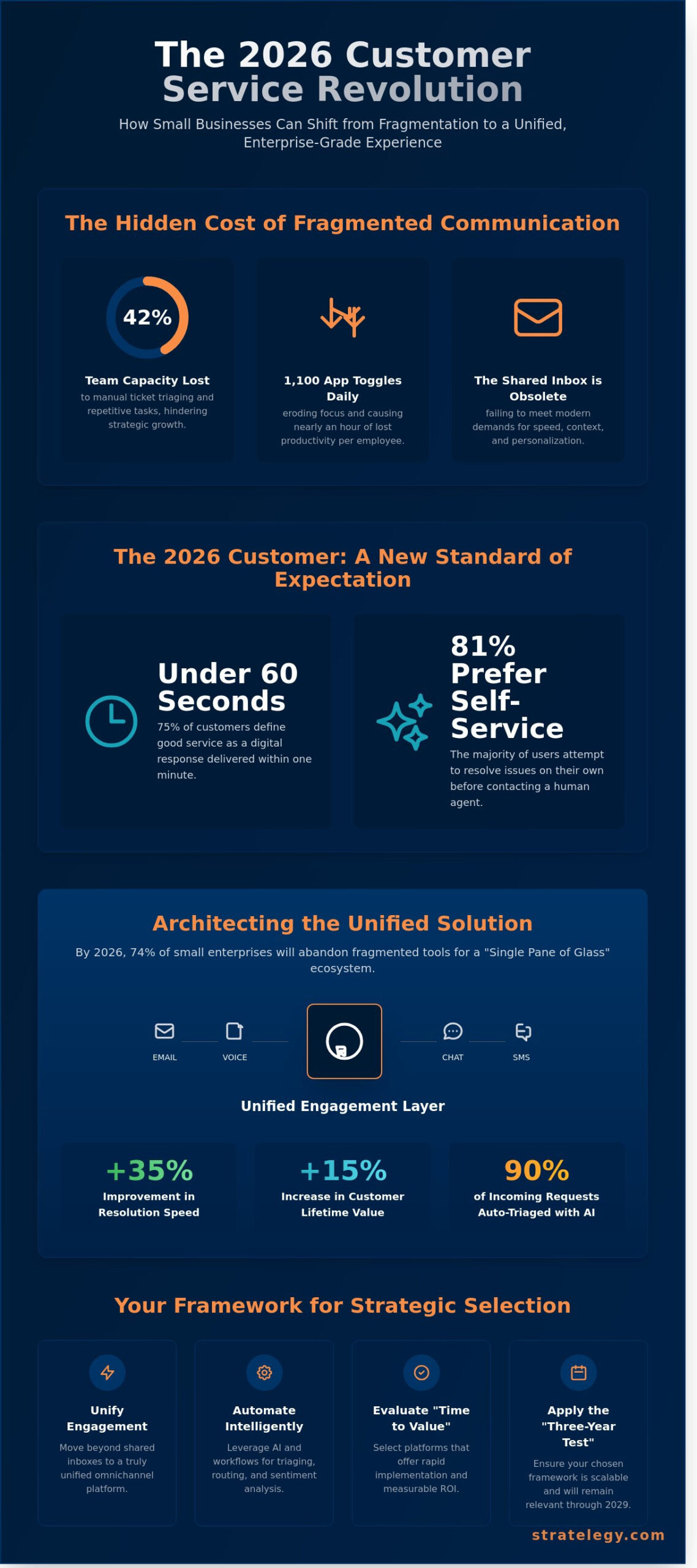
In 2026, the true differentiator between a struggling venture and a market leader isn’t headcount, but the structural harmony of their digital infrastructure. You’ve likely noticed that fragmented communication channels don’t just cause delays; they erode the professional trust you’ve worked to build. When 42% of a small team’s capacity is lost to manual ticket triaging, sustainable growth becomes a secondary concern to daily survival. Finding the ideal customer service software for small business is no longer a tactical upgrade, it’s a fundamental requirement for strategic alignment and professional longevity.
We agree that your staff’s intellect shouldn’t be wasted on repetitive tasks that a machine can handle with 99% accuracy. This guide promises to show you how to transition from reactive firefighting to a sophisticated customer experience through a unified communication strategy. We’ll examine the tailored frameworks and automated workflows that allow your brand to project an image of enterprise-level excellence while maintaining the agility of a boutique partner.
Key Takeaways
- Understand why a shared inbox is no longer sufficient and how to transform your support into a unified engagement layer for the 2026 landscape.
- Identify the critical omnichannel features and intelligent automation workflows required when selecting the right customer service software for small business.
- Learn to evaluate platforms based on their “Time to Value” and scalability to ensure your technology stack evolves alongside your growth ambitions.
- Apply the “Three-Year Test” to your selection process, allowing you to minimize technical debt and secure a framework that remains relevant through 2029.
- Discover the strategic necessity of bridging the gap between your service desk and enterprise-grade communication infrastructure for a truly harmonious customer experience.
The Strategic Shift: Customer Service Software for Small Business in 2026
The traditional boundary between sales, marketing, and support has dissolved into a unified engagement layer. By 2026, successful firms view customer service software for small business not as a reactive utility, but as the primary engine for retention and revenue. This transition marks the end of the “support as a cost” era. Forward-thinking leaders now treat every interaction as a data point for strategic alignment, ensuring that the service desk functions as a value center.
Agile firms previously struggled with the administrative weight of enterprise-grade tools. Today, sophisticated software levels the playing field, allowing a three-person team to deliver the same structural harmony as a Fortune 500 corporation. Historically, Help desk software focused on simple ticket management; however, the 2026 landscape demands a transformative growth framework that integrates every touchpoint into a single, elegant workflow.
The End of Fragmented Communication
Context switching remains a silent profit killer. Research from the 2021 Qatalog and Cornell University study indicated that employees toggle between apps 1,100 times a day, a friction point that erodes focus and wastes nearly an hour of daily productivity. Modern customer service software for small business eliminates this fragmentation by centralizing social media, email, and voice data into a single source of truth. This synchronization ensures that response lag is eradicated, providing a 35% improvement in resolution speed for agile teams. When data flows without interruption, the business achieves a state of operational elegance that was once the exclusive domain of global enterprises.
Meeting the 2026 Customer Expectation
Consumer patience has reached a historical low point. By 2026, 75% of customers define “good service” as a response delivered within 60 seconds on digital channels. This demand for immediacy makes a shared email inbox an obsolete relic of a slower era. Small businesses must pivot toward self-service portals, as 81% of users now attempt to resolve issues independently before reaching out to a human agent. Personalization is no longer an optional luxury; it’s a structural requirement. Using integrated data, businesses can deliver bespoke experiences that feel intimate and intentional, even when these interactions are automated at scale.
Architecting the Experience: Essential Features for Modern Support
Selecting the right customer service software for small business isn’t merely a technical procurement; it’s a foundational architectural decision that defines your brand’s relationship with its market. By early 2026, data suggests that 74% of small enterprises will have abandoned fragmented tools in favor of unified ecosystems. This shift requires a platform that synchronizes voice, SMS, chat, and email into a single, coherent interface. We don’t want agents toggling between disconnected tabs. We need a “single pane of glass” where context flows as freely as the conversation itself.
Modern customer service software for small business must transcend the limitations of the basic auto-responder. Sophisticated workflow triggers now react to specific customer behaviors or data points in real-time. If a client’s subscription is within 30 days of renewal, the system should automatically route their query to a senior retention specialist. Reporting must also evolve to measure metrics that drive transformative growth, such as the 15% improvement in customer lifetime value seen when support is integrated with billing systems. Connecting these platforms via robust APIs ensures your team operates with a full financial and behavioral profile of every user.
This level of strategic alignment ensures that your support infrastructure isn’t just functional; it’s an asset that contributes directly to the bottom line.
The Role of Accessible AI
AI has transitioned from a speculative luxury to an operational necessity for the agile small business. Automated triaging leverages machine learning to categorize 90% of incoming requests, ensuring that urgent technical failures take precedence over routine billing inquiries. Sentiment analysis acts as an early warning system, identifying frustrated tones before they lead to churn. As the U.S. Small Business Administration highlights regarding how small businesses are using chatbots, these tools allow smaller teams to maintain a 24/7 presence without the overhead of a global call center. Suggested responses empower agents with AI-generated drafts, reducing composition time by 40% while maintaining a consistent brand voice. Platforms that incorporate agent assist technology take this further, equipping frontline staff with real-time contextual guidance that reduces Average Handle Time and elevates First Call Resolution rates.
Omnichannel Voice Integration
Voice remains the critical path for resolving complex or emotionally charged issues. Statistics from late 2025 indicate that 52% of high-stakes B2B resolutions still require a direct conversation. By integrating cloud-based telephony directly into your ticketing interface, you eliminate the friction of manual logging and data entry. It’s essential to utilize systems that offer automatic call recording and transcription. These features provide a 100% audit trail for quality assurance, allowing leaders to refine scripts and identify training gaps. When voice is woven into the omnichannel fabric, the transition from a chat session to a phone call becomes a seamless, professional experience for the client.
The 2026 Roundup: Top Customer Service Platforms Evaluated
Selecting the ideal customer service software for small business is a strategic exercise in balancing immediate utility with long-term architectural integrity. We evaluate these platforms through the dual lenses of Time to Value (TTV) and the Scalability Ceiling. TTV measures how quickly your team reaches 80% operational proficiency; the Scalability Ceiling identifies the precise point where a tool’s architecture begins to hinder a 25% annual growth rate. A successful deployment requires a calm, methodical assessment of whether your organization prioritizes data-driven CRM depth or the rapid-fire agility of specialized ticketing systems.
CRM-Centric Solutions for Sales-Service Alignment
Salesforce Starter Suite, refined in late 2024, offers a 14-day setup path for data-heavy organizations. It’s built for those who view customer support as an extension of the sales funnel. HubSpot Service Hub remains a favorite for teams already anchored in the HubSpot ecosystem; it maintains a 92% user satisfaction rating for its unified contact record. For budget-conscious firms, Zoho Desk provides a 30% lower total cost of ownership while offering a customized framework that rivals enterprise competitors. These tools excel in complex case management where historical context is the primary driver of resolution.
Agile Ticketing and Help Desk Specialists
Zendesk for Small Business provides enterprise-grade logic through a streamlined interface that supports over 100 native integrations. It’s designed for speed. Freshdesk offers a “Zero-Training” environment that reduces agent onboarding time by 4 days compared to traditional suites. For teams that refuse to sacrifice personal touch, Help Scout is the premier choice. It maintains an email-like interface that’s essential for delivering big customer service without the cold, automated feel of a standard help desk. These specialists are built for high-velocity environments where response time is the key performance indicator.
Collaboration-First Support Tools
Monday service treats every ticket as a multi-dimensional project entity, making it perfect for businesses where support requires cross-departmental input. Front manages shared inboxes with a sophisticated internal commenting system, resulting in a 20% faster response rate for high-stakes client accounts. Intercom leads the 2026 market in proactive engagement; its AI-driven messenger now handles 70% of routine inquiries autonomously. Your choice should reflect your team’s internal rhythm. If your support involves complex, collaborative workflows, a project-centric tool will provide the structural harmony that a traditional ticket queue lacks.
Beyond the Feature List: A Framework for Strategic Selection
Selecting customer service software for small business isn’t a simple procurement task; it’s a foundational architectural decision. Before you evaluate dashboards, audit your existing technical debt. Research from 2024 indicates that organizations lose 23% of their operational efficiency when legacy systems fail to communicate with new tools. A platform that requires complex workarounds from day one is a liability that will stifle your agility. True strategic alignment requires a platform that absorbs complexity rather than creating it.
Apply the Three-Year Test to every candidate. If your 2029 roadmap includes doubling your headcount or expanding into three new international territories, your software must scale without a total rebuild. Scalability isn’t just about adding user seats. It involves the depth of the API, the flexibility of the data schema, and the ability to maintain performance as your ticket volume grows by 50% or more.
The sticker price is often a deceptive metric. Total Cost of Ownership (TCO) includes hidden variables like 15% annual maintenance hikes or the $4,500 cost of custom middleware. An elegant UI is a functional requirement, not a luxury. A 2025 study by the User Experience Professionals Association found that intuitive interfaces reduce staff onboarding time by 40%. High adoption rates ensure your strategy actually reaches the front line, turning software into a catalyst for transformative growth.
The Integration Audit
Map your ecosystem with precision. Your CRM, VoIP provider, and e-commerce platform must form a unified intelligence layer. Identify “must-have” native integrations to avoid the high cost of custom development. Test data migration with a 5% sample size before signing a multi-year contract. This prevents the data silo trap that frequently stalls small business expansion. Seamless data flow is the heartbeat of a sophisticated operation.
Security and Compliance Considerations
Small businesses face 43% of all targeted cyberattacks, making security a non-negotiable pillar. Ensure your customer service software for small business meets SOC 2 Type II standards or HIPAA requirements if you handle sensitive health data. Robust access controls and audit logs aren’t just for enterprises; they’re the structural pillars of a trustworthy brand. Data residency rules now require local storage for 18% of global jurisdictions, making geographic server choice a vital strategic priority.
Align your technology with your long-term vision and eliminate operational friction. Request a strategic audit to ensure your tech stack supports your 2029 growth goals.
The Stratelegy Advantage: Unifying Software with Enterprise CCaaS
Selecting the right customer service software for small business represents a foundational strategic decision, yet software alone acts as a thin veneer if the underlying communication infrastructure is fragile. A 2025 study by Metrigy revealed that organizations integrating their CCaaS and CRM systems experienced a 32% increase in first-contact resolution rates. Stratelegy moves beyond the surface level. We bridge the gap between unified communications and collaboration (UCaaS) and Contact Center as a Service (CCaaS) to ensure every customer interaction flows through a single, cohesive channel. While many providers offer standalone customer service software for small business, Stratelegy treats software as one component of a larger, integrated whole.
We transform the traditional call center, often a cost center defined by reactive responses, into a sophisticated engagement center. This shift relies on a harmonious ecosystem where the service desk doesn’t exist in isolation. It’s a vision where data moves with the speed of thought. Every agent gains the context of a customer’s entire history at their fingertips, regardless of whether the initial contact was a voice call, a web chat, or an automated ticket. Tracking the health of these relationships through a well-structured net promoter score framework allows leadership to translate every resolved interaction into a measurable indicator of long-term brand loyalty.
Strategic Alignment of Tools and Infrastructure
Stratelegy embeds advanced CCaaS features directly into your chosen software environment to eliminate technical friction. We prioritize life safety reliability, targeting 99.999% uptime for critical business communications to ensure your operations remain resilient during peak volatility. Our customized frameworks are designed to scale; as your organizational complexity increases by 20% or 50%, the infrastructure adapts without requiring a total system overhaul. This alignment ensures that your technology stack remains an asset rather than a bottleneck.
- Intelligent Routing: Connecting customers to the right expert based on real-time data.
- Omnichannel Synchronization: Maintaining a single thread of conversation across all digital and voice platforms.
- Resilient Architecture: Redundant systems that guarantee connectivity during high-traffic events.
Your Partner in Transformative Growth
We reject the transactional vendor model in favor of a strategic partnership. Stratelegy consults on what we call Elegant Architecture, a philosophy where efficiency meets aesthetic functionalism. We analyze your unique workflows to remove friction, ensuring your support structure is as beautiful in its logic as it is in its performance. Our experts don’t just implement tools; they craft a vision for how your business communicates with the world. Consult with a Stratelegy expert on your communication strategy to begin your evolution from a simple service desk to a visionary engagement hub that drives long-term loyalty and measurable growth.
Mastering the 2026 Service Landscape
The operational environment of 2026 demands a shift from reactive support to proactive engagement. Research indicates that 75% of high-growth firms now prioritize integrated platforms over siloed applications to maintain a unified customer view. Selecting the right customer service software for small business requires a vision that extends beyond immediate ticket volume to encompass long-term scalability and technical resilience. It’s no longer enough to simply answer queries; you must architect an ecosystem where every interaction builds brand equity and drives transformative growth.
Stratelegy provides the sophisticated framework necessary to navigate this complexity. We deliver enterprise-grade UCaaS and CCaaS solutions with 99.999% reliability, ensuring your communication remains uninterrupted across every channel. Our expertise in critical infrastructure, particularly in 4G LTE POTS replacement for emergency systems, offers a level of security that standard vendors can’t match. Through rigorous strategic consulting, we ensure your technology stack achieves perfect alignment with your broader business objectives. Sustaining this level of excellence also requires investing in your people; a robust workforce engagement management framework ensures your agents remain motivated and equipped to deliver the experience your customers expect. It’s time to transform your support center into a hub of strategic value and aesthetic precision.
Elevate your customer engagement with Stratelegy’s CCaaS solutions
Your journey toward a more sophisticated service model begins with a single, well-planned step. Let’s build a future where your infrastructure is as ambitious as your vision.
Frequently Asked Questions
What is the best customer service software for a very small business?
Zoho Desk and Zendesk are the premier choices for micro-enterprises requiring both structure and scalability. Zoho Desk offers a free tier for up to 3 agents, while Zendesk’s foundational suite starts at $19 per user monthly. These platforms provide a tailored framework that allows a 2-person team to maintain the professional appearance of a much larger corporation.
How much does customer service software typically cost for small businesses?
Small businesses should budget between $15 and $55 per agent monthly for high-quality customer service software for small business. Entry-level plans from providers like Freshdesk begin at $15, while comprehensive platforms with advanced automation average $49. Selecting an annual billing cycle usually reduces these fixed costs by 20% compared to month-to-month subscriptions.
Can I integrate my existing business phone system with help desk software?
Yes, 85% of modern help desk platforms offer native integrations with VoIP providers like RingCentral, Aircall, or Dialpad. You can link your existing hardware via Computer Telephony Integration (CTI) in less than 30 minutes. This connection ensures that 100% of call logs and recordings sync automatically with your digital customer tickets for a unified history.
What is the difference between a help desk and a CRM?
A help desk manages reactive support interactions through tickets, while a CRM tracks proactive sales data and long-term relationship cycles. Salesforce research indicates that 72% of high-performing teams integrate both to create a single source of truth. The help desk serves as your resolution engine; the CRM acts as your strategic database for customer lifetime value.
Does a small business really need AI in their customer service software?
AI is a critical component for 2026 operations as 60% of routine inquiries are now resolved through automated systems. Small teams use these tools to summarize long ticket histories, which saves an average of 4 minutes per interaction. Implementing basic AI features reduces manual workloads by 30% without the need to increase your current headcount.
How long does it take to implement a new customer service platform?
A standard deployment for a small team typically requires 14 to 21 days to reach full operational capacity. This timeline includes 3 days for data migration and 5 days for dedicated agent training. While complex custom API hooks might extend the process to 45 days, most out-of-the-box solutions go live within 2 weeks of purchase.
Is there free customer service software available for startups?
HubSpot and Freshdesk offer robust “Free Forever” plans that include essential ticketing and email management tools. These tiers support unlimited agents in some instances, though they lack the advanced reporting found in paid versions. Statistics show that 40% of startups utilize these free frameworks for their first 12 months before upgrading to more sophisticated automation tiers.