

What if your most reliable legacy systems become your primary operational liability by the start of 2027? As the UK PSTN switch-off looms and North American 5G penetration surpasses 79 percent, the copper infrastructure that once anchored your enterprise is rapidly reaching its end-of-life. Successfully future-proofing business communication systems requires more than just a software update. It demands a total structural rethink that prioritizes engineering stability over superficial features.
You likely feel the mounting pressure of rising costs for aging POTS lines and the friction of fragmented tools that hinder hybrid collaboration. It’s a valid concern for any leader who values predictability and security over temporary fixes. This article provides a roadmap to master the transition from legacy hardware to a resilient, cloud-integrated communication framework. We’ll explore the strategic shift toward UCaaS and CCaaS, the critical role of LTE POTS replacement for safety systems, and the maintenance frameworks needed to ensure your infrastructure remains compliant and cost-effective through 2026 and beyond.
Key Takeaways
- Understand why traditional copper lines represent a systemic risk to your operations and why the “Copper Sunset” makes legacy infrastructure obsolete.
- Explore the technical advantages of UCaaS and CCaaS for creating a unified environment for internal collaboration and omnichannel customer engagement.
- Secure your most vulnerable assets by utilizing LTE POTS replacement for life-safety hardware, a critical component in future-proofing business communication systems.
- Master a structured migration roadmap that begins with a deep-dive audit and prioritizes critical infrastructure to eliminate service gaps.
- Shift your strategy toward foundational engineering to ensure your communication stack remains compliant, predictable, and resilient against future technological shifts.
Beyond the Dial Tone: Why Traditional Communication Systems are Obsolete in 2026
Future-proofing business communication systems is the strategic ability to adapt to technological shifts without experiencing systemic downtime. In 2026, this isn’t a luxury. It’s a survival requirement. The “Copper Sunset” has moved from a theoretical phase-out to a hard reality. Traditional Plain Old Telephone Service (POTS) lines are no longer a viable business utility. They’re expensive, fragile, and increasingly unsupported by major carriers who have pivoted entirely to fiber and 5G. With the UK PSTN shutdown scheduled for January 2027, the window for proactive migration is closing fast. Businesses still clinging to legacy PBX hardware face escalating costs for parts that are no longer manufactured and support contracts that offer diminishing returns.
Fragmented legacy systems also create significant security vulnerabilities. In a 2026 threat landscape, isolated voice, fax, and messaging tools are easy targets for sophisticated cyberattacks. These systems lack the centralized encryption and real-time monitoring capabilities found in modern Unified Communications frameworks. When your infrastructure is a patchwork of aging hardware and disconnected software, you aren’t just losing efficiency. You’re maintaining a massive surface area for potential data breaches and compliance failures.
The Escalating Risks of Legacy Infrastructure
Maintenance scarcity is the primary indicator of a failing system. The pool of technicians qualified to repair physical copper switches is shrinking as the workforce retires. This leads to longer repair windows and unpredictable downtime that can paralyze an enterprise. Furthermore, regulatory pressure is mounting as outdated systems fail to meet modern data governance standards. Operational silos represent a hidden tax on your growth. The lack of integration between voice and digital channels creates friction that modern competitors have already eliminated. Legacy systems simply cannot provide the oversight required for rigorous security audits or the flexibility needed for a global, hybrid workforce.
The 2026 Shift: From Utility to Strategic Asset
Communication systems have evolved from simple utilities into primary drivers of enterprise data insights. In 2026, every interaction is a data point that can be analyzed to improve customer experience and operational efficiency. Foundational engineering is the bedrock of modern communication uptime, focusing on the structural integrity of the network rather than just the features of the software. This approach ensures that your infrastructure can support the high bandwidth and low latency required for real-time AI and omnichannel engagement. By prioritizing infrastructure stability, you transform your communication stack into a resilient strategic asset. This transition is the first step in future-proofing business communication systems for a data-driven economy.
The Three Pillars of a Resilient Communication Infrastructure
Resiliency is built on structural integrity, not just software features. To achieve true future-proofing business communication systems, an enterprise must integrate three distinct but interconnected pillars. These aren’t just tools; they’re the foundational layers of a modern business architecture. By unifying voice, video, and messaging into a single managed platform, you eliminate the friction of legacy silos and ensure operational continuity across a global workforce. This approach moves beyond superficial updates and focuses on recognising communication as critical infrastructure that drives long-term value and predictability.
UCaaS: The Engine of Workplace Collaboration
Internal communication has moved beyond the desk phone. A robust unified communications as a service (UCaaS) solution integrates mobile and desktop endpoints into a seamless user experience. This allows your team to transition between devices without dropping calls or losing context. Scalability is no longer a hardware problem. You can add or remove users instantly as your business grows. This flexibility is essential for supporting hybrid work models without sacrificing security or governance. It’s about creating a unified environment where technical prowess meets operational simplicity.
CCaaS: Modernizing the Customer Experience
Customer expectations in 2026 demand omnichannel accessibility. A cloud contact center (CCaaS) enables your business to engage with clients on their preferred digital platforms; this includes SMS, web chat, and voice. Unlike legacy systems, CCaaS provides deep data-driven insights. These reporting tools allow you to identify friction points, reduce churn, and improve engagement through real-time analytics. It’s a strategic shift from reactive support to proactive relationship management that directly impacts the bottom line.
Infrastructure Stability: LTE Connectivity
The final pillar is the physical connection. Standard VoIP often fails for critical infrastructure like fire alarms and elevators because it lacks the necessary power and signal redundancy. LTE POTS replacement bridges this gap. It provides the reliability of traditional copper with the scalability of the cloud. This ensures your safety systems remain operational even during power outages or network disruptions. Prioritizing these three pillars is the only way to ensure your efforts in future-proofing business communication systems result in a stable, permanent solution. If you’re ready to audit your current setup, consider how a managed communication strategy can stabilize your long-term operations.
Critical Infrastructure: Bridging the Gap Between Legacy Hardware and Cloud Scalability
Software-first providers often ignore the physical reality of your building’s infrastructure. Fire alarms, elevators, and security panels represent the most difficult challenge in any modernization strategy. These systems require consistent loop current and specific signaling frequencies that standard VoIP cannot reliably replicate. If the local internet goes down or the power is cut, a standard VoIP line becomes useless. This is unacceptable for life-safety applications where failure isn’t an option. Future-proofing business communication systems requires a solution that functions independently of your local network and the aging copper grid. It demands a transition from fragile wires to resilient, engineered connectivity.
LTE POTS Replacement: A Non-Negotiable Strategy
LTE POTS replacement is the only viable path forward for these critical systems. By deploying specialized hardware that mimics a dial tone while transmitting data over secure cellular networks, you maintain the integrity of your existing panels. A strategic POTS line replacement ensures you remain compliant with NFPA 72 and UL 864 standards without the capital expense of replacing entire life-safety systems. These units include dedicated battery backups, often providing 24 hours of standby power. This engineering-first approach guarantees that your most vital lines have 99.999% uptime. It’s a permanent fix for a problem that legacy carriers are no longer interested in solving.
Security and Governance in the Connectivity Layer
Physical security is often overlooked in the digital age. Traditional copper lines are susceptible to physical tapping and environmental degradation that can go unnoticed for weeks. Moving to an LTE-based framework eliminates these vulnerabilities. Every critical endpoint across your national footprint is brought under a centralized management system. This provides a level of visibility that legacy lines never could. You can monitor signal strength, battery health, and line status in real time across all locations.
Encrypted cellular tunnels provide a layer of protection that physical copper never could. This level of oversight is a core component of future-proofing business communication systems. It transforms a legacy liability into a managed, secure asset. By prioritizing the connectivity layer, you ensure that your security and governance policies extend to the very edge of your infrastructure. This disciplined approach builds the predictability and peace of mind that modern enterprises require for long-term health and regulatory compliance.
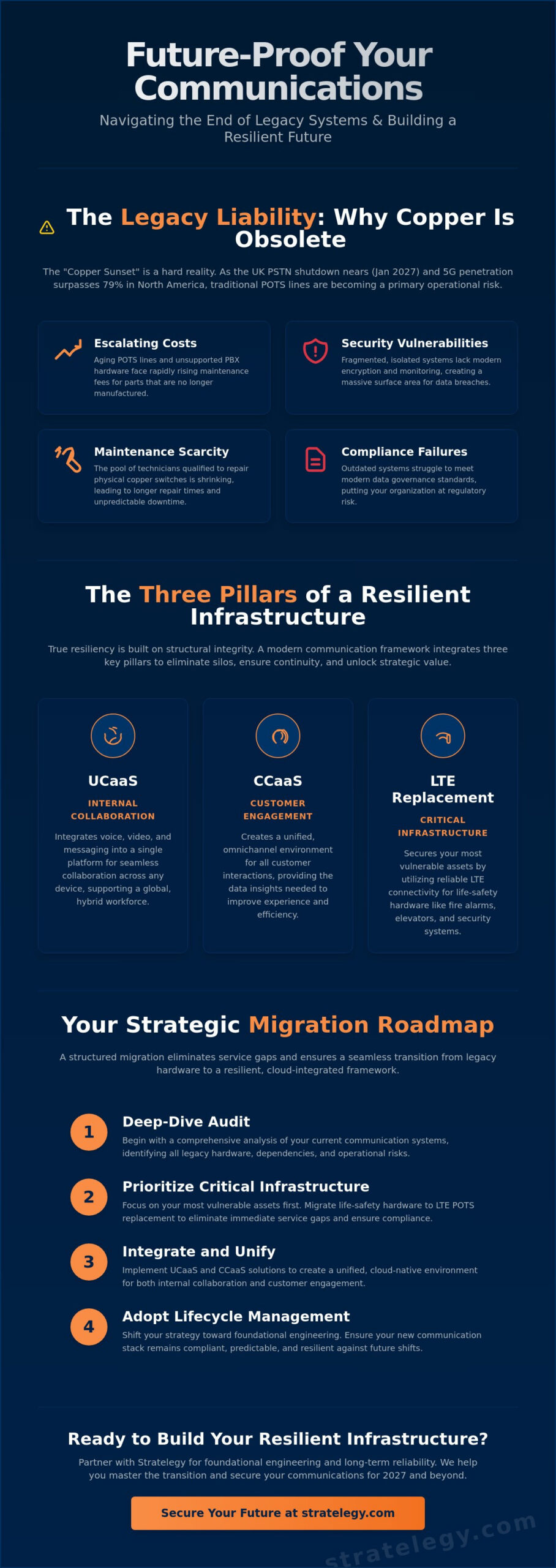
Implementing a Strategic Migration: From Audit to Lifecycle Management
Migration is a disciplined engineering project. It requires a methodical approach to ensure zero operational downtime and long-term infrastructure stability. Many organizations treat the transition to the cloud as a simple software swap. This is a mistake. True future-proofing business communication systems involves a five-step process that accounts for both the digital interface and the physical connectivity layer. By prioritizing risk and establishing a rigorous maintenance schedule, you eliminate the unpredictability that plagues legacy environments.
- Step 1: Conduct a comprehensive infrastructure audit to identify every active line.
- Step 2: Prioritize migration based on risk, addressing life-safety systems before moving to UCaaS.
- Step 3: Select a partner who operates as a foundational engineer rather than a software vendor.
- Step 4: Execute a phased rollout that maintains service continuity across all departments.
- Step 5: Establish a systematic hardware update policy to prevent future technical debt.
The Audit: Finding the Hidden Copper
Successful modernization starts with visibility. You can’t secure what you haven’t identified. Most enterprises carry “ghost lines” that have been forgotten for years but still appear on monthly invoices. These lines often support critical but overlooked endpoints like gate entries, elevator phones, and warehouse fax machines. Transitioning these to virtual faxing and LTE-based connectivity is essential for closing the gap between old-world hardware and modern standards. During this phase, you must also evaluate your current bandwidth to ensure it can support the high-definition voice and video requirements of a global workforce.
Lifecycle Management: Avoiding Future Obsolescence
A “set it and forget it” mindset is a liability in 2026. Technology cycles move too fast for passive management. Future-proofing business communication systems requires ongoing oversight and proprietary maintenance frameworks. This includes scheduled firmware updates and systematic hardware refreshes that keep your infrastructure ahead of the 5G evolution. Security protocols must be updated as new threats emerge in the connectivity layer. By treating your communication stack as a living asset rather than a static utility, you ensure governance and predictability. If you’re ready to secure your enterprise’s future, request a comprehensive infrastructure audit from our technical specialists today. This proactive approach builds the peace of mind that comes from knowing your systems are engineered for longevity.
Stratelegy: Your Partner in Foundational Engineering and Long-Term Reliability
Reliability isn’t a software feature. It’s an engineered outcome. Stratelegy operates as a strategic specialist rather than a traditional service vendor. We prioritize security, governance, and predictability in every deployment to ensure your enterprise remains resilient. By integrating enterprise-grade UCaaS and CCaaS with the structural stability of LTE POTS replacement, we build frameworks that survive technological shifts. Our goal is to eliminate the fear of obsolescence for business owners by providing infrastructure that’s resilient by design. We don’t just sell licenses; we build the bedrock for your future operations.
Why Foundational Engineering Matters
Software features are temporary. Structural reliability is permanent. We shift the conversation from superficial tools to the underlying health of your network. As foundational engineers, we focus on the integrity of the connectivity layer. This proactive approach allows us to anticipate systemic vulnerabilities before they impact your daily operations. Whether you’re managing a single site or a national-scale footprint, our deployment capabilities ensure consistent performance across every endpoint. We’ve built our reputation on the disciplined application of technical prowess to solve complex infrastructure challenges. This commitment to engineering excellence provides the stability that modern businesses demand.
Securing Your Future Today
A managed communication stack transforms a legacy cost center into a modern growth engine. Transitioning away from fragmented copper lines isn’t just a technical upgrade. It’s a strategic move that anchors your business in financial and regulatory predictability. The peace of mind that comes from a fully managed, compliant environment allows you to focus on your core objectives. We anchor modern digital communication jargon in financial and regulatory business terminology to ensure your leadership team has total clarity. Future-proofing business communication systems requires a partner who values engineering over sales and longevity over novelty.
Your infrastructure shouldn’t be a source of anxiety. It should be the most dependable part of your business. By implementing proprietary maintenance frameworks and systematic hardware update policies, we ensure your systems remain cutting-edge without the risk of downtime. It’s time to stop reacting to the “Copper Sunset” and start building a resilient foundation for 2026 and beyond. Contact Stratelegy today to audit your critical infrastructure and begin your transition to a resilient, cloud-integrated communication framework. This proactive step builds the long-term health and security your organization requires to thrive in a digital-first economy.
Engineering Your Communication Legacy for 2026 and Beyond
The “Copper Sunset” is no longer a distant threat; it’s a hard deadline requiring immediate enterprise action. Successful modernization requires moving beyond superficial software features to prioritize the foundational engineering of your most critical systems. Effective future-proofing business communication systems relies on a disciplined integration of cloud scalability and cellular redundancy for life-safety endpoints. By auditing your hidden infrastructure and establishing a rigorous maintenance framework, you eliminate the risk of obsolescence and ensure long-term operational health.
Stratelegy provides the technical expertise needed to manage this transition. We specialize in critical life-safety POTS replacement and deliver enterprise-grade UCaaS and CCaaS solutions with 99.999% uptime targets. Our systematic maintenance frameworks are designed to keep your infrastructure secure, compliant, and predictable. Secure your enterprise infrastructure with Stratelegy’s expert solutions. Your path from legacy fragility to modern resilience is a strategic investment in the longevity of your business. We’re ready to engineer that future with you.
Frequently Asked Questions
What does future-proofing business communication systems mean in 2026?
Future-proofing business communication systems involves a strategic transition from rigid, hardware-dependent utilities to resilient, software-defined environments. It requires decoupling your communication stack from the physical limitations of the aging copper grid. This shift ensures your business can integrate emerging technologies like AI and omnichannel engagement without requiring a total infrastructure overhaul. It’s about building for long-term health and operational predictability rather than reacting to immediate equipment failures as they occur.
Why is POTS replacement critical for future-proofing?
POTS replacement is critical because the global copper network is no longer a sustainable business utility. Carriers have shifted their investments to fiber and 5G, leaving traditional lines to degrade without adequate support or technicians. Maintaining these systems results in unpredictable outages and escalating monthly costs. Transitioning to LTE-based solutions ensures your enterprise stays ahead of carrier sunsets while gaining modern oversight and reliability for your most essential voice and data circuits.
Can cloud-based systems support fire alarms and elevator phones?
Standard VoIP typically fails to support fire alarms and elevator phones due to strict power and signaling standards. These life-safety systems require the consistent loop current and dial tone mimicry that only specialized LTE POTS replacement hardware can provide. These engineered solutions include dedicated battery backups to maintain 99.999% uptime during local power failures. They bridge the gap between old-world safety panels and new-world digital connectivity without requiring expensive panel replacements.
How does UCaaS improve business continuity during disasters?
UCaaS improves continuity by virtualizing your entire communication layer and removing the single point of failure inherent in on-premise PBX systems. If a physical location becomes inaccessible due to a disaster, your team can instantly transition to mobile or desktop endpoints from any internet-connected site. This flexibility maintains your professional presence and keeps customer engagement active. It transforms your telephony into a portable, cloud-managed asset that isn’t tied to a specific building or wire.
What are the security risks of keeping legacy communication hardware?
Legacy hardware creates significant security risks because it lacks modern encryption and real-time monitoring capabilities. These systems often run on outdated firmware that’s no longer patched against new vulnerabilities. Physical copper lines are also susceptible to interception and environmental degradation that can compromise your data integrity. Transitioning to a managed, cloud-integrated framework allows for centralized security governance and proactive threat detection that legacy on-premise systems simply can’t match in 2026.
How long does a full transition to cloud communication typically take?
The duration of a transition depends on the number of locations and the complexity of your existing infrastructure. A phased rollout is the most disciplined approach to ensure zero operational downtime. While a single-site migration might happen quickly, national-scale deployments require a methodical audit and prioritized migration of life-safety systems first. This structured timeline allows your technical partner to address “ghost lines” and bandwidth requirements before the final cutover occurs.
Is LTE a reliable alternative to traditional landlines for businesses?
LTE is a highly reliable alternative that often provides better performance than the aging landline grid. Modern LTE communicators utilize high-speed cellular networks to provide low-latency connections for both voice and critical data. They include managed hardware with internal battery backups to ensure functionality during local network outages. This creates a redundant, secure tunnel for your communications that is immune to the physical vulnerabilities of exposed copper wiring and environmental damage.
What should I look for in a communication systems partner?
You should seek a partner who identifies as a foundational engineer rather than just a software vendor. A strategic specialist prioritizes the long-term health of your infrastructure and understands the technical nuances of critical safety systems. They should offer proprietary maintenance frameworks and systematic hardware update policies to prevent future obsolescence. Ensure they have the technical prowess to manage complex, multi-site migrations while focusing on security, governance, and predictable operational costs.