

Your team’s output isn’t limited by their talent, but by the friction of a fragmented communication infrastructure. When employees must navigate five or more disconnected tools, critical data inevitably vanishes into silos. Learning how to improve team productivity with ucaas starts with recognizing that software alone won’t solve these operational bottlenecks. Real efficiency requires a structural shift toward a single pane of glass. By 2026, the global UCaaS market has reached $70.56 billion, yet many organizations still struggle with the high latency of legacy systems and the rising 37% Federal Universal Service Fund contribution factor.
You likely recognize the frustration of meeting delays caused by unreliable hardware or the hidden costs of unmanaged AI add-ons. We’re here to help you move beyond superficial features to achieve true infrastructure stability. This article provides a strategic framework to consolidate your communications into a unified, cloud-based platform. We’ll show you how to eliminate context switching, reduce operational costs, and build a secure, predictable collaboration environment for your hybrid workforce.
Key Takeaways
- Quantify the hidden cognitive costs of “app fatigue” and learn how fragmented communication tools create systemic delays in enterprise workflows.
- Discover how to improve team productivity with ucaas by consolidating disparate channels into a single pane of glass to eliminate context switching.
- Execute a strategic audit of your current communication stack to identify friction points and ensure deep interoperability with existing CRM and ERP systems.
- Understand why structural reliability and LTE POTS replacement are essential engineering prerequisites for a high-performance cloud environment.
- Establish a long-term governance framework that prioritizes security and predictable connectivity for an increasingly mobile and hybrid workforce.
The Productivity Drain: Why Fragmented Tools Stifle Enterprise Output
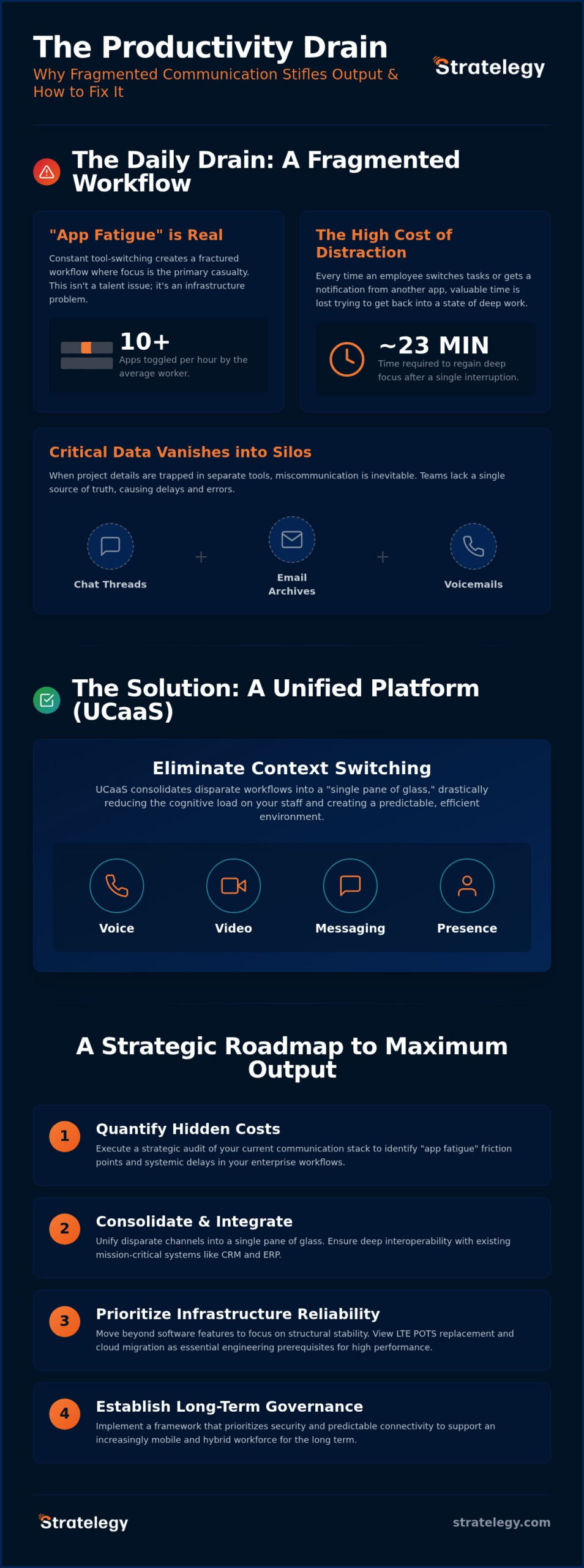
Enterprise efficiency is frequently undermined by a phenomenon known as app fatigue. Recent studies suggest the average knowledge worker toggles between 10 different applications every hour. This constant movement creates a fractured workflow where focus is the primary casualty. Research indicates that once a worker is distracted by a notification or a tool switch, it takes approximately 23 minutes to regain deep focus. Understanding how to improve team productivity with ucaas requires addressing these cognitive leaks at the infrastructure level rather than just adding more software.
Fragmented data silos represent the second major drain on output. When critical project details are trapped in isolated chat threads, disconnected voicemails, or legacy email archives, miscommunication becomes inevitable. Projects stall not because of a lack of effort, but because the team lacks a single source of truth. Transitioning from a reactive communication posture to a proactive, unified strategy is a foundational engineering requirement for any modern business aiming for excellence.
The High Cost of Legacy “Copper” Thinking
Relying on aging copper infrastructure creates systemic vulnerabilities that software cannot fix. Unreliable dial tones and high-latency connections aren’t just technical nuisances; they represent lost billable hours and eroded client trust. A business built on legacy connectivity is fundamentally unpredictable. We view the move to the cloud as an engineering necessity to ensure long-term operational health and security across your entire network architecture.
The 2026 Definition of Unified Communications
In the current landscape, the industry has moved far beyond simple VoIP. Modern Unified Communications integrates voice, video, messaging, and presence into a single pane of glass. This evolution into a comprehensive unified communications as a service model allows teams to operate within a controlled, secure environment. By centralizing these pillars, organizations can finally solve the question of how to improve team productivity with ucaas through structural reliability rather than superficial feature sets.
Eliminating Context Switching: The UCaaS Mechanism for Efficiency
Efficiency isn’t just about speed; it’s about reducing friction. UCaaS serves as the central nervous system for your business, consolidating disparate workflows into a single interface. This consolidation significantly lowers the cognitive load on your staff. When employees don’t have to hunt for information across multiple apps, they maintain a higher state of focus. Research from Forbes suggests that adopting UCaaS is a smart strategy for organizations looking to reclaim lost time.
Presence awareness is a critical component of this framework. It eliminates “ping-pong” messaging by providing real-time visibility into colleague availability. If you see a specialist is in a meeting, you don’t send an urgent chat that will go unanswered. Instead, you can schedule a follow-up or route the query elsewhere. This transparency is vital for a national, hybrid workforce that lacks physical proximity. It’s a fundamental step in how to improve team productivity with ucaas.
Unified search capabilities further accelerate output. Finding a specific file or a buried conversation across voice, chat, and video channels happens instantly. This is how to improve team productivity with ucaas at scale. By removing these small but frequent delays, you create a predictable environment where work flows without technical interruption. If you’re considering modernizing your communication stack, these structural efficiencies should be your primary focus.
Streamlining Cross-Departmental Collaboration
Breaking down silos requires more than a shared folder. Integrated unified communications and collaboration tools allow teams to co-edit documents and share insights in real-time within the call window. This immediate feedback loop ensures that engineering, sales, and support remain aligned on technical requirements without leaving their primary communication environment.
The Role of AI and Automation in 2026 UCaaS
By 2026, GenAI-enabled applications have become standard in over 80% of enterprises. In a UCaaS context, this means automated meeting summaries and instant action item extraction are now baseline requirements. Intelligent call routing leverages these data points to ensure that inbound queries reach the correct expert immediately. This automation reduces administrative overhead, allowing your team to focus on high-value technical tasks rather than manual coordination.
A Strategic Roadmap: Implementing UCaaS for Maximum Team Output
Successful implementation requires more than just a software license; it demands a comprehensive engineering audit. You must begin by identifying every redundant cost and friction point within your current communication stack. Many organizations pay for overlapping services across different departments, which creates both financial waste and technical confusion. A clean inventory allows you to consolidate these into a single managed environment, which is the first step in how to improve team productivity with ucaas.
Interoperability is your next priority. Your UCaaS platform shouldn’t operate as an island. It must integrate deeply with your existing CRM and ERP systems to ensure data flows automatically between departments. This integration eliminates manual data entry and ensures your team has the right context before they even pick up a call. We recommend a phased migration strategy to move from legacy hardware to the cloud. This methodical approach prevents operational downtime and allows for rigorous testing of your voip infrastructure before full deployment. If you’re ready to modernize your stack, you can schedule a strategic infrastructure audit with our engineering team today.
Technical deployment is only 50% of the productivity equation. The remaining half depends on user adoption training. Your staff must understand how to leverage advanced features like presence awareness and automated meeting summaries to see real gains. Without a disciplined training framework, even the most advanced tools will fail to deliver their full potential.
Evaluating UCaaS for Scalability and ROI
Scaling your organization shouldn’t require a massive investment in physical hardware. By transitioning to a cloud-based model, you can add seats and features instantly as your workforce grows. This flexibility is critical in 2026, where the Federal Universal Service Fund contribution factor has reached 37%, making efficient lifecycle management more important than ever for your bottom line.
Ensuring Security and Compliance
Security is a foundational pillar of productivity. We implement end-to-end encryption and strict governance protocols to protect your sensitive business data. Our framework ensures compliance with 2026 regulatory standards, including the latest FCC prohibitions on foreign-produced logic-bearing hardware. This focus on security provides the peace of mind necessary for your team to collaborate without fear of systemic vulnerabilities.
Beyond the Software: Infrastructure Reliability as a Productivity Pillar
A cloud platform’s output is strictly limited by the network it runs on. If your underlying connectivity is fragile, even the most advanced UCaaS features will fail to deliver value. True insight into how to improve team productivity with ucaas requires looking at the physical layer of your enterprise. High latency and jitter are productivity killers that no software update can fix. We prioritize structural reliability because a stable connection is the baseline for any successful collaboration effort.
Legacy copper lines represent a significant risk to modern operations. They are increasingly expensive, difficult to maintain, and prone to sudden failure. We view pots line replacement as a non-negotiable prerequisite for UCaaS success. Without this transition, your cloud communications remain tethered to an obsolete, unreliable foundation that can’t support the bandwidth requirements of 2026 workflows.
Reliability also means planning for the unexpected. We implement LTE backup and failover solutions to ensure your communication uptime remains constant during local network outages. This level of redundancy is how to improve team productivity with ucaas at a structural level. Stratelegy’s approach is rooted in foundational engineering; we prioritize predictable performance and long-term infrastructure health over superficial novelty.
Modernizing Critical Infrastructure
Integrating life safety and security systems is an essential part of a modern communication strategy. Your fire panels, alarm systems, and elevator phones shouldn’t be left on aging copper infrastructure. Transitioning to reliable LTE-based POTS alternatives ensures these critical systems remain functional and compliant. This shift provides the peace of mind that your entire facility is supported by modern, monitored connectivity.
Predictability Over Novelty
Strategic oversight and proprietary maintenance frameworks are the true drivers of uptime. We don’t just act as a vendor; we function as a specialist partner who anticipates infrastructure bottlenecks before they disrupt your team. This proactive discipline ensures your business infrastructure remains healthy. By focusing on engineering excellence and systematic hardware updates, we eliminate the fear of obsolescence and ensure your team stays productive.
Securing Your Operational Future Through Strategic Consolidation
True efficiency is built on a foundation of structural reliability rather than a collection of disconnected features. By eliminating the cognitive drain of app fatigue and consolidating your communication stack, you create a predictable environment where organizational output can accelerate. We’ve seen that the path to discovering how to improve team productivity with ucaas requires a disciplined shift toward a single pane of glass and the modernization of aging copper infrastructure. A cloud strategy is only as robust as the network that supports it.
Our engineering team specializes in enterprise-grade UCaaS and CCaaS solutions designed for national scale. We provide proactive technical oversight through proprietary maintenance frameworks and lead the industry in LTE POTS replacement for critical safety systems. This methodical approach ensures your business infrastructure remains modern, secure, and resilient against obsolescence. You can partner with Stratelegy to modernize your communication infrastructure and achieve long-term operational health. Your team deserves a platform that works as hard as they do.
Frequently Asked Questions
How does UCaaS specifically reduce operational costs while improving productivity?
UCaaS reduces operational costs by consolidating multiple communication subscriptions into a single cloud-based platform. This elimination of redundant service fees and maintenance for on-site hardware directly impacts your bottom line. Productivity improves because employees no longer waste time toggling between disconnected apps. By centralizing voice, video, and messaging, organizations effectively reduce the 23-minute recovery time typically lost to context switching after a distraction.
Can UCaaS integrate with our existing CRM and project management tools?
Modern UCaaS platforms are built for deep interoperability with existing CRM and ERP systems through robust APIs. This integration ensures that customer data and project updates flow automatically into your communication interface. When your team has immediate access to relevant context during a call, they provide faster and more accurate service. This seamless data exchange is a primary method for how to improve team productivity with ucaas at the enterprise level.
What is the difference between a standard VoIP service and a comprehensive UCaaS platform?
VoIP is a specific technology used to transmit voice over the internet, whereas UCaaS is a comprehensive communication ecosystem. While a standard VoIP service primarily handles phone calls, a UCaaS platform unifies voice, video conferencing, team messaging, and presence awareness into a single pane of glass. This structural consolidation provides a level of workflow predictability and security that isolated voice services simply can’t match.
How does UCaaS support a remote or hybrid workforce in 2026?
UCaaS supports hybrid work by providing a consistent communication experience across any device or location. In 2026, the normalization of remote models requires a platform that isn’t tethered to a physical office or specific hardware. Features like presence awareness and mobile-first collaboration allow distributed teams to stay aligned in real-time. This ensures that how to improve team productivity with ucaas remains a priority regardless of where your staff is physically located.
What happens to our legacy phone numbers and hardware during a UCaaS migration?
Your existing phone numbers are typically ported to the new cloud environment to ensure business continuity without customer disruption. During the migration, legacy hardware is often replaced with modern IP-based devices or integrated using specialized adapters. We prioritize a phased transition that includes LTE POTS replacement for critical systems. This ensures that your life safety and security infrastructure remains functional as you move away from aging copper lines.