

Telephony onboarding is no longer a simple IT checklist. It is the integration of communication governance into your employee lifecycle. When a new hire struggles with credentials or fails to adopt advanced CCaaS features, you aren’t just losing time. You’re facing security vulnerabilities and wasted spend on your enterprise communication ecosystem. Effectively onboarding employees to a new phone system requires a disciplined approach to lifecycle management that prioritizes predictable results over superficial features.
It’s frustrating when manual provisioning errors delay a new hire’s productivity or when complex tools remain underutilized. We understand that your business infrastructure demands stability and long-term health. This framework provides the technical and operational steps to achieve zero-day productivity while adhering to the FCC’s “Know Your Customer” (KYC) rules released in May 2026. We’ll break down how to automate access, secure your communication tools, and ensure your team utilizes every capability of your UCaaS or CCaaS platform from day one.
Key Takeaways
- Establish zero-day operational readiness by treating communication onboarding as a systematic provisioning process rather than a simple IT task.
- Protect your ecosystem from security vulnerabilities by implementing strict governance through license audits and Single Sign-On (SSO) integration.
- Streamline the process of onboarding employees to a new phone system by utilizing tiered training that balances basic handling with advanced CCaaS features.
- Prevent information overload and drive higher feature adoption rates through the use of targeted micro-learning modules during the first week.
- Ensure long-term infrastructure stability by partnering with experts to manage the technical complexities of cloud migration and POTS replacement.
Beyond the Dial Tone: Why Communication Onboarding Dictates Initial Productivity
Communication onboarding is the systematic provisioning of unified communication tools designed to ensure zero-day operational readiness. It’s a foundational engineering requirement, not a secondary HR task. When onboarding employees to a new phone system, the primary goal is immediate, secure integration into the enterprise ecosystem. If a new hire cannot access their dialer or collaboration suite within the first hour, the organization has already failed a critical productivity milestone.
The transition from legacy hardware to unified communications as a service represents a strategic shift toward a central hub for collaboration. Modern systems are no longer just voice tools; they are the primary interface for video, chat, and file sharing. Treating this transition as a simple software installation ignores the structural reliability required for modern business. Proper onboarding ensures that these advanced features are utilized rather than ignored.
Poorly executed onboarding creates technical friction that leads to “shadow IT.” When employees find the official system difficult to navigate, they revert to personal devices or unauthorized messaging apps. This bypasses your security protocols and creates significant governance vulnerabilities. Successful implementation relies on sound organizational change management to bridge the gap between technical deployment and daily user adoption. You don’t just want the system to work; you want the team to work within the system.
The Strategic Link Between Connectivity and Retention
Professional-grade tools signal organizational maturity to new hires. A seamless setup process provides peace of mind and reinforces the brand’s identity as a technical leader. For remote and hybrid teams, reliable cloud contact center tools are essential for engagement. When the infrastructure is stable and predictable, employees feel supported and are less likely to experience the frustration that leads to early turnover. High-performance communication is a retention strategy built on engineering excellence.
The Provisioning Phase: Configuring Access, Governance, and Security
Provisioning is the technical backbone of the employee lifecycle. It transforms a broad communication strategy into a functional, governed reality. When onboarding employees to a new phone system, the provisioning phase must be precise and secure to prevent early operational friction. This is where technical experts establish the guardrails for your communication ecosystem.
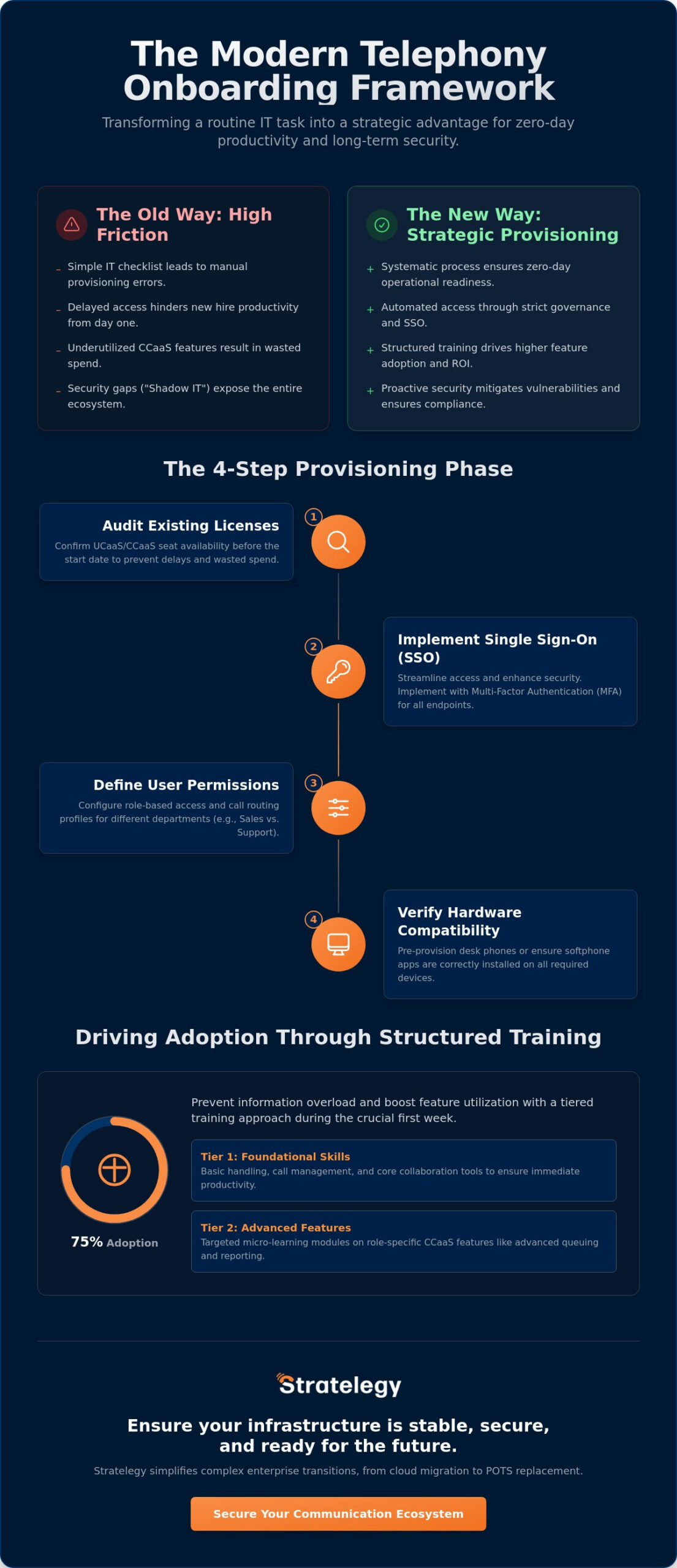
Follow this disciplined sequence to ensure zero-day readiness:
- Audit existing licenses: Confirm that the correct UCaaS or CCaaS seat is available well before the start date. This prevents wasted spend and ensures the new hire has the specific tools their role requires.
- Implement Single Sign-On (SSO): Streamline access while maintaining strict security protocols. SSO reduces credential fatigue and minimizes the risk of unauthorized access.
- Define user permissions: Configure call routing profiles based on departmental needs. A sales professional needs different queuing and outbound capabilities than a support agent.
- Verify hardware compatibility: Ensure desk phones are pre-provisioned or softphone applications are correctly installed on mobile devices.
Executing these steps correctly ensures that new hires are productive from their first login. It also provides valuable reskilling opportunities for your internal team to master modern communication governance. If you want to eliminate the complexity of these transitions, partnering with technical specialists can ensure your infrastructure remains stable and predictable.
Integrating Security and Compliance into Onboarding
Security is a foundational requirement, not an optional feature. Set up Multi-Factor Authentication (MFA) for all communication endpoints to mitigate credential-based vulnerabilities. Additionally, ensure all user profiles comply with industry-specific regulations for call recording and data storage. This proactive approach protects your organization from regulatory risks and systemic vulnerabilities.
Automation and Managed Provisioning
Manual data entry is an operational liability. Automated workflows reduce entry errors and IT overhead, allowing your staff to focus on strategic initiatives. Managed service partners play a critical role in handling bulk provisioning during large-scale hiring phases. This level of oversight provides the predictability and scalability required for enterprise-grade growth. To ensure your HR processes are just as robust as your IT systems, you can learn more about Sullivan Group HR and their professional outsourcing solutions.
Driving Adoption through Structured Training and Support
Technical provisioning is only half the battle. True operational success depends on user adoption. When onboarding employees to a new phone system, you must move beyond the “welcome kit” approach. We recommend a tiered training strategy that categorizes learning into basic call handling, advanced collaboration, and initial troubleshooting. This structured method prevents information overload and ensures long-term system health.
Micro-learning modules are the most effective way to deliver this information during the first week. Instead of a single four-hour session, provide short, punchy guides focused on specific tasks. This helps new hires retain information while they manage other onboarding requirements. Modern interfaces are designed for simplicity. They reduce the learning curve significantly compared to legacy voip systems that often required specialized knowledge just to transfer a call.
Establishing a clear “Path to Support” is equally critical. New hires need to know exactly where to go for technical communication issues without creating security risks. Integrating this path into your broader Cybersecurity governance framework ensures that support requests are handled through authorized channels. If you’re looking to streamline this process and ensure zero-day productivity, contact our technical advisors to learn how we manage adoption for enterprise transitions.
Feature Mastery: Moving Beyond the Basics
Advanced feature adoption is where you see the greatest return on your communication spend. Train your team on video conferencing integration, presence settings, and mobile app hand-offs. Encourage the use of built-in AI tools for transcription and call summarization. These capabilities turn a simple phone system into a high-performance collaboration engine that drives measurable business results.
Monitoring and Iterative Feedback
Don’t leave adoption to chance. Use system analytics to track new hire adoption rates and identify specific training gaps. Collecting direct feedback on the onboarding experience allows you to refine the process for future hires. This iterative approach ensures your communication infrastructure remains a strategic asset rather than an operational burden. Continuous oversight is the key to maintaining infrastructure stability.
Managed Implementation: How Stratelegy Simplifies Enterprise Transitions
Enterprise transitions are complex technical maneuvers that require more than just a software license. Stratelegy serves as a foundational partner, managing the structural reliability of your communication ecosystem. We specialize in the technical complexity of pots line replacement and cloud migration to ensure your digital foundation is modern and secure. This managed approach removes the technical burden from your internal staff, allowing them to focus on core business objectives while we handle the intricate details of connectivity.
Infrastructure stability is the most critical factor when onboarding employees to a new phone system. Our proprietary maintenance frameworks provide the ongoing oversight required to prevent system failures before they occur. We don’t just set up the tools; we ensure they remain operational through systematic update policies and proactive monitoring. This level of discipline ensures that new team members enter a stable environment where communication tools work exactly as intended from their first login.
A managed implementation delivers long-term operational predictability. We prioritize security and governance, ensuring every communication endpoint remains compliant and protected. This disciplined focus on engineering excellence eliminates the fear of obsolescence. It provides business owners with genuine peace of mind, knowing their communication infrastructure is built for longevity and performance.
The Stratelegy Advantage in Critical Infrastructure
Critical communication systems require specialized expertise that goes beyond standard UCaaS deployments. We ensure consistent connectivity for fire, security, and emergency communications where downtime is never an option. Our engineers anticipate deployment hurdles long before they impact your new team members. By identifying potential infrastructure bottlenecks early, we guarantee a seamless transition that maintains the long-term health of your business communications.
Securing Operational Excellence for the Modern Workforce
Achieving zero-day productivity requires a shift from viewing telephony as an IT expense to seeing it as a governed asset. By prioritizing secure provisioning and tiered adoption strategies, you eliminate the risks of shadow IT and underutilized features. Successfully onboarding employees to a new phone system is about maintaining infrastructure stability during periods of rapid organizational growth. Technical excellence in the employee lifecycle is the only way to ensure long-term operational health.
Stratelegy provides the engineering expertise needed to navigate these transitions with confidence. Our deep specialization in UCaaS and CCaaS governance, combined with proprietary maintenance frameworks for 2026 standards, ensures your business remains predictable. We also offer specialized expertise in LTE POTS replacement for life safety systems, effectively bridging the gap between legacy reliability and modern connectivity.
Partner with Stratelegy to modernize your enterprise communication infrastructure today. We’re ready to help you build a resilient foundation for your team’s success.
Frequently Asked Questions
How long should it take to onboard an employee to a new phone system?
Zero-day operational readiness is the standard for modern enterprises. Technical provisioning, including license allocation and SSO configuration, must be finalized before the hire’s start date. The training phase usually occurs during the first week. By utilizing micro-learning modules rather than a single marathon session, you ensure the employee retains technical knowledge without sacrificing their initial productivity. This methodical approach maintains infrastructure stability and builds early confidence in the system.
What are the most common mistakes when provisioning new phone extensions?
The most frequent mistakes include failing to audit existing UCaaS licenses and neglecting to define departmental call routing profiles. These errors lead to manual provisioning delays and productivity gaps. Another common oversight is ignoring hardware compatibility for remote endpoints. When these technical details are missed, new hires often resort to shadow IT; this introduces significant security vulnerabilities and bypasses your established communication governance.
Is it better to use desk phones or softphones for new employees?
The decision should be based on the employee’s specific role and mobility requirements. Softphones are essential for hybrid and remote workers who require flexibility across various devices. Desk phones remain the preferred choice for dedicated workstations where physical hardware reliability is paramount. Many organizations now adopt a softphone-first policy for all users, providing desk phones only for specialized roles that demand high-performance audio and physical presence.
How can I ensure my new hires are using all the features of our UCaaS platform?
Full utilization requires a tiered training approach that focuses on advanced collaboration tools after basic call handling is mastered. Use system analytics to monitor adoption rates and pinpoint where users are struggling. When onboarding employees to a new phone system, demonstrating the value of built-in AI transcription and video conferencing integration helps transition them from voice-only users to high-performance collaborators. Continuous feedback loops ensure training remains relevant.
What security measures are essential when onboarding remote employees to the phone system?
Multi-Factor Authentication (MFA) and Single Sign-On (SSO) are the foundational security measures for remote onboarding. These protocols mitigate the risk of credential-based breaches on unsecured networks. Additionally, ensure all remote communication profiles adhere to regulatory requirements for call recording and data residency. When onboarding employees to a new phone system, these security guardrails provide peace of mind and protect the long-term health of your communication infrastructure.