
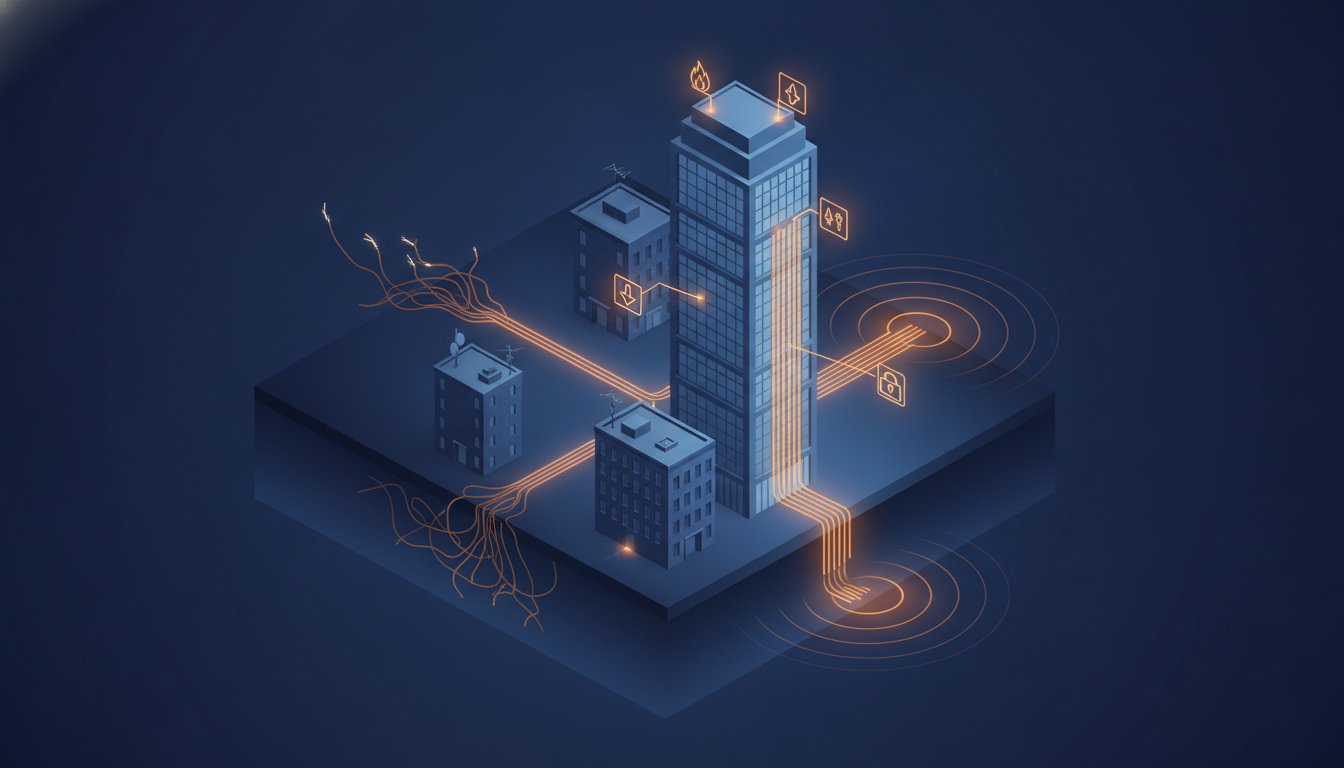
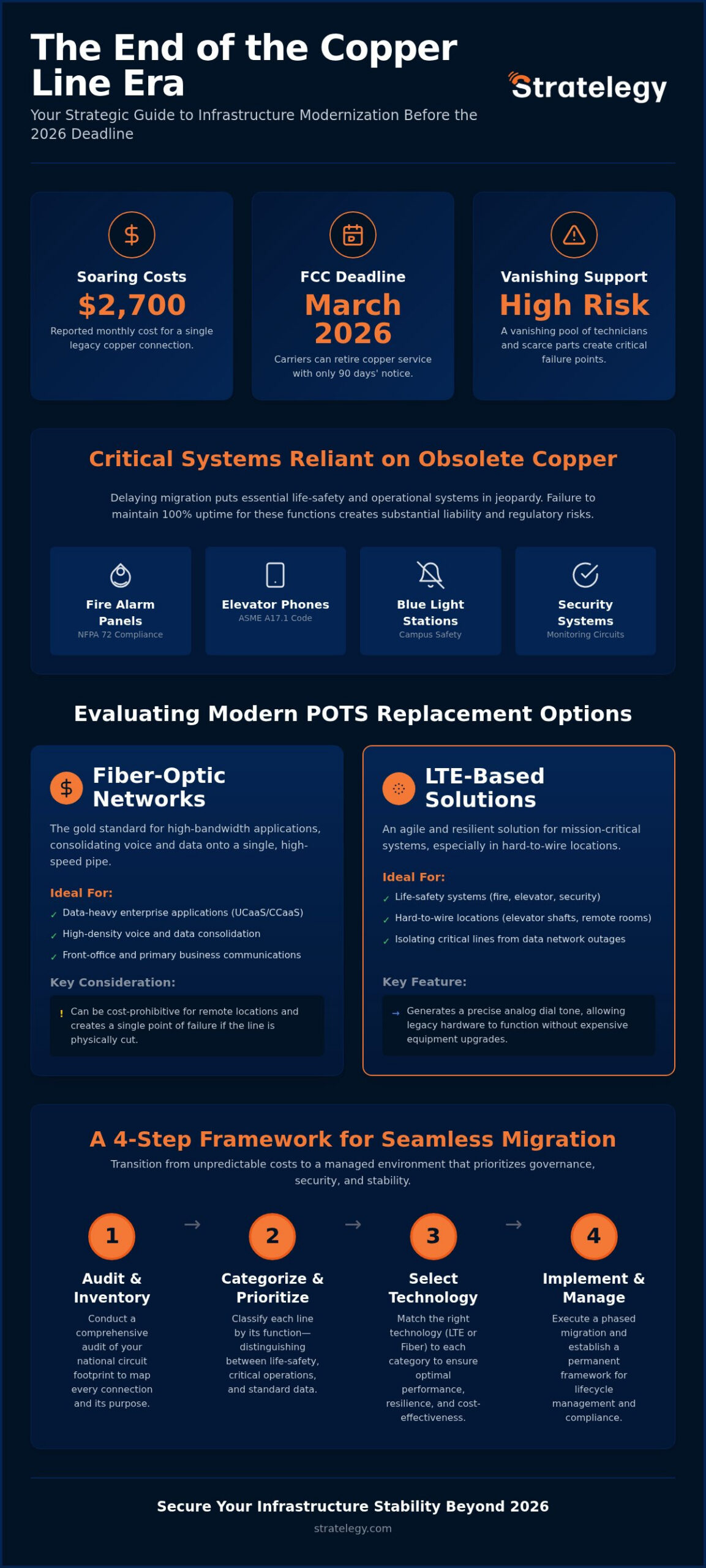
With some organizations now reporting monthly costs as high as $2,700 for a single copper connection, the era of legacy telecommunications has reached its breaking point. Following the FCC’s March 2026 ruling that allows carriers to retire service with only 90 days of notice, the search for reliable pots line replacement options has shifted from a long-term goal to an immediate engineering necessity. You are likely facing the dual pressure of exponentially increasing invoices and a vanishing pool of technicians capable of maintaining aging infrastructure. It is a precarious position, especially when fire alarms, elevator phones, and life-safety systems are at stake.
We understand that infrastructure stability is the bedrock of your business. This guide provides a clear roadmap for decommissioning your copper assets and replacing them with resilient, modern alternatives. You will learn how to leverage LTE and fiber technologies to secure your critical systems while achieving long-term cost predictability. By the end of this transition guide, you will have the technical insights needed to eliminate technical debt and establish a permanent framework for lifecycle management and regulatory compliance.
Key Takeaways
- Understand why the FCC’s March 2026 ruling creates an immediate need to decommission legacy copper lines to avoid sudden service disruptions and rapid price hikes.
- Compare the technical advantages of fiber-optic networks for data-heavy applications against LTE-based pots line replacement options for mission-critical life safety systems.
- Follow a structured four-step framework to audit your national circuit footprint and categorize lines by function to ensure a seamless infrastructure migration.
- Shift from unpredictable maintenance costs and aging copper infrastructure to a predictable, managed environment that prioritizes governance and security.
- Focus on foundational engineering and proprietary maintenance frameworks to ensure your new digital infrastructure remains compliant and resilient through 2026 and beyond.
Understanding the POTS Sunset and the Urgency for Replacement
The POTS Sunset is the systematic decommissioning of the copper-based Public Switched Telephone Network (PSTN) by major national carriers. For decades, Plain Old Telephone Service (POTS) provided the foundational backbone for business communications. That era has reached its conclusion. As carriers prioritize digital transformation, the FCC Order 19-72 has removed the mandate for providers to maintain these aging networks, leading to a rapid decline in service availability.
Maintaining legacy copper is no longer a viable strategy for modern enterprises. Finding specialized technicians to repair analog switches is becoming nearly impossible as the skilled workforce retires. Spare parts are frequently scavenged from decommissioned sites because they are no longer in production. This scarcity creates a high risk of permanent system failure for organizations that delay evaluating pots line replacement solutions. Delaying this transition introduces systemic vulnerabilities that can disrupt operations without warning.
The Financial Impact of Copper Obsolescence
Carriers are currently executing an aggressive price-out strategy. By inflating monthly rates by 300% or more, they are incentivizing customers to abandon the copper network. Beyond the monthly invoice, the hidden costs of legacy lines include emergency repair premiums and the significant financial risks associated with downtime. Securing modern pots line replacement options is a move toward financial predictability and long-term governance.
Critical Systems at Risk
Specific infrastructure components require unwavering reliability to meet safety and regulatory standards. These critical systems include:
- Fire alarm control panels (FACPs)
- Elevator emergency communication lines
- Campus blue light safety stations
- Security system monitoring circuits
Maintaining 100% uptime for these systems is a regulatory necessity. Failure to migrate these circuits to stable, modern infrastructure before a copper outage occurs creates substantial liability. Relying on a dying network for life-safety functions is no longer a defensible engineering choice. It is a risk that modern infrastructure management must eliminate.
Evaluating Infrastructure: Fiber vs. LTE POTS Replacement Options
Selecting the right infrastructure requires matching the technology to the specific operational demand. Fiber-optic networks provide the gold standard for high-bandwidth unified communications as a service and data-heavy enterprise applications. This technology allows organizations to consolidate voice and data onto a single, high-speed pipe. Such consolidation is a prerequisite for businesses transitioning to cloud contact center platforms that require low latency and high throughput for customer engagement.
Fiber excels in the front office but faces physical limitations in remote facility zones. Hard-to-wire locations like elevator shafts or outdoor mechanical rooms often make fiber installation cost-prohibitive. In these scenarios, LTE-based pots line replacement options offer a more agile and resilient solution. These specialized systems use a “POTS in a Box” architecture to generate a precise analog dial tone. This allows your legacy hardware to function without expensive equipment upgrades, maintaining the exact signaling required by older analog devices. It effectively bridges the gap between 19th-century hardware and 21st-century networks, a process often facilitated by professional technology systems firms like UTD Technology Corp.
Fiber for Voice and Data Consolidation
Fiber delivers the massive throughput required for modern digital communication. It supports the high-density traffic essential for CCaaS environments. However, relying solely on fiber for every circuit can create single points of failure. If a construction crew cuts a main fiber trunk, every connected system goes dark. Diversifying your infrastructure with cellular alternatives ensures that critical safety lines remain isolated from standard data outages.
LTE for Life Safety and Fire Alarms
Life safety systems demand a higher tier of engineering. Fire code compliance, specifically NFPA 72 and ASME A17.1, requires communication paths that remain active during power failures and network disruptions. Modern LTE solutions provide this through dual-path communication and integrated battery backups. These systems stay operational for at least 24 hours during a local power loss. Because they don’t rely on local building power or IT routers, they offer a level of reliability that degrading copper can’t provide. If you’re ready to secure your safety lines, our team can help you audit your current infrastructure for potential vulnerabilities.
Strategic Implementation: A 4-Step Framework for Migration
Infrastructure transition requires a disciplined engineering approach rather than a simple hardware swap. A successful migration eliminates technical debt while ensuring that critical safety systems remains online. To achieve this, organizations must follow a structured framework that prioritizes visibility and functional requirements over speed.
- Step 1: National Circuit Audit. Identify every active copper circuit across your entire footprint. Most enterprises discover “ghost” lines that have been billing for years despite being inactive.
- Step 2: Functional Categorization. Group your lines into three categories: Voice, Data, and Life Safety. This categorization determines which pots line replacement options are technically appropriate for each specific use case.
- Step 3: Site Readiness Assessment. Evaluate cellular signal penetration and existing structured cabling at every facility. Signal integrity is the most critical factor for LTE-based emergency communicators.
- Step 4: Phased Execution. Execute the migration in waves. Starting with non-critical voice lines allows you to refine your deployment process before transitioning high-stakes fire and life safety circuits.
If you are managing a complex national footprint, you can request a strategic infrastructure audit to identify your most vulnerable legacy circuits.
The Line Audit: Finding Hidden Infrastructure
Critical analog circuits often hide in plain sight. We frequently find “forgotten” lines powering gate entries, pool alarms, or legacy document exchange systems. For organizations still relying on paper-based workflows, virtual faxing adapters provide a modern, secure alternative. These adapters allow you to maintain document compliance while removing the need for a dedicated copper line. Before decommissioning any circuit, verify your current carrier contracts to avoid unexpected early termination fees.
Compliance and Testing Protocols
Regulatory compliance is non-negotiable. Fire marshals and insurance providers require documented proof that emergency signals reach the central monitoring station. Your post-transition checklist must include signal strength verification, battery backup discharge tests, and dual-path failover confirmation. Ensuring these protocols are met protects your organization from liability and ensures your safety systems are truly resilient.
Securing Infrastructure Stability with Stratelegy Engineering
Stability is not a feature; it is the foundation. Stratelegy operates as foundational engineers who prioritize structural reliability over superficial software capabilities. This distinction is vital when evaluating pots line replacement options for national enterprises with complex, high-stakes requirements. We don’t just provide hardware; we establish a permanent framework for network governance and operational predictability.
Complex migrations across a national footprint require more than a simple vendor relationship. They demand a strategic partnership rooted in technical expertise. We provide specialized enterprise support that bridges the gap between legacy analog systems and modern digital infrastructure. Specialized technology partners such as Flux Group SARL exemplify this commitment to technical excellence, helping organizations secure their vital communication channels. Our focus is on the long-term health of your business communications, ensuring that your transition from copper is disciplined, secure, and compliant with all current regulatory standards.
Systematic Hardware Update Policies
Hardware doesn’t last forever. To prevent the accumulation of technical debt, we implement systematic hardware update policies that manage equipment lifecycles from deployment to decommissioning. Our team proactively monitors every LTE and fiber connection within your enterprise network. This proactive oversight allows us to identify and resolve potential signal degradation before it impacts your life safety systems. By maintaining a rigorous update schedule, we ensure your infrastructure remains current through 2026 and beyond.
Transitioning to a Managed Ecosystem
Many providers offer “set and forget” boxes that eventually become obsolete or fall out of compliance. These solutions often fail because they lack the ongoing oversight required for critical systems. Stratelegy offers a managed ecosystem that integrates our deep voip expertise with robust maintenance frameworks. This approach eliminates the fear of infrastructure obsolescence and provides total peace of mind. You gain a predictable communication environment where security and uptime are guaranteed through engineering excellence rather than luck.
Future-Proofing Your Enterprise Infrastructure for 2026 and Beyond
The window for reactive planning has closed. With the 2026 landscape defined by rapid copper decommissioning and aggressive carrier pricing, the transition to modern infrastructure is an immediate operational priority. You now have the framework to evaluate pots line replacement options based on functional requirements rather than simple availability. By prioritizing a hybrid strategy that leverages fiber for data density and LTE for life safety resilience, you can eliminate technical debt and ensure long-term regulatory compliance.
Securing your critical systems requires more than a vendor; it requires a strategic partner with a commitment to foundational engineering. Stratelegy provides specialized LTE POTS replacement for life safety and proprietary maintenance frameworks designed to keep your network stable for the next decade. Our enterprise-grade UCaaS and CCaaS expertise ensures that your entire communication ecosystem remains secure, predictable, and fully managed.
Partner with Stratelegy for a secure, engineered transition to POTS alternatives. You can move forward with the confidence that your infrastructure is built for longevity and excellence.
Frequently Asked Questions
Why are POTS lines being discontinued in 2026?
Major carriers are decommissioning copper infrastructure due to the FCC’s March 2026 ruling, which eliminated the federal approval process for retirement. This regulatory shift allows providers to shut down service with as little as 90 days’ notice. The transition is driven by the extreme cost of maintaining aging analog switches and a growing shortage of specialized technicians. Most providers are now using aggressive price hikes to encourage migration to modern pots line replacement options.
Is fiber more reliable than copper for emergency fire alarm systems?
Fiber provides superior bandwidth and lower latency, but reliability for fire alarms depends on the specific engineering of the path. While copper is degrading and prone to environmental failure, fiber requires complex power backup to remain active during outages. For life safety systems, a hybrid approach or specialized LTE is often preferred. This ensures that the emergency signal remains independent of the local building’s power grid or primary IT network.
Can I use LTE for my elevator phones and still meet safety codes?
You can absolutely use LTE for elevator phones while maintaining full compliance with ASME A17.1 and NFPA 72 standards. The solution must utilize a specialized architecture that provides a minimum of 24 hours of battery backup and dual-path communication. These cellular systems are designed to mimic analog signaling perfectly. This allows your existing elevator hardware to communicate with emergency dispatch centers without requiring a complete mechanical overhaul.
What is the typical ROI when transitioning from POTS to fiber or LTE?
Most enterprises realize a full return on investment within 12 to 18 months of completing the transition. While we don’t quote specific pricing, industry data indicates that moving to digital alternatives can reduce monthly recurring costs by 40% to 60%. These savings are primarily driven by the elimination of carrier-imposed copper maintenance surcharges. Beyond the direct financial gains, you also eliminate the high cost of emergency repairs and the liability risks of system failure.
How long does a full enterprise transition from POTS to fiber alternatives take?
A comprehensive national migration typically requires three to six months from the initial audit to final testing. The timeline depends heavily on the accuracy of your current circuit inventory and the accessibility of your facility mechanical rooms. Large-scale deployments are best handled in phases to ensure zero downtime for critical safety lines. Working with foundational engineers allows you to streamline the site readiness assessments and hardware deployment across your entire portfolio.