

Your employees are likely already using non-compliant messaging apps to close deals, and every unarchived text is a ticking regulatory time bomb. It’s a reality that shadow IT remains a primary bottleneck for institutional governance. Implementing robust secure messaging for financial institutions is no longer a peripheral feature; it’s a foundational requirement for survival in a landscape where NYDFS Part 500 enforcement and universal MFA are now standard. With the average cost of a financial sector data breach projected to exceed $6 million in 2026, the stakes for your communication infrastructure couldn’t be higher.
You’ve likely felt the frustration of legacy systems that can’t keep pace with the speed of modern business. We agree that balancing rapid communication with rigid SEC and FINRA record-keeping requirements often feels like an impossible trade-off. This guide will show you how to architect an enterprise-grade framework that achieves zero-trust security and automated audit archiving. We’ll explore the transition from fragmented tools to a unified, high-availability communication stack that ensures both compliance and operational excellence through disciplined engineering. By the end, you’ll have a strategic roadmap to modernize your stack without sacrificing the predictability your business demands.
Key Takeaways
- Learn to mitigate the operational risks of shadow IT by aligning institutional communication with strict SEC and FINRA record-keeping mandates.
- Identify the technical requirements for zero-trust identity management, including the seamless integration of SSO and multi-factor authentication.
- Discover how to implement secure messaging for financial institutions as a core component of a unified UCaaS strategy rather than a siloed application.
- Understand the architectural distinctions between encryption protocols to ensure high-availability and data integrity across your entire network infrastructure.
- Explore the benefits of partnering with foundational engineers to build a communication stack focused on long-term structural reliability and automated compliance.
The Regulatory Landscape: Why Financial Institutions Require Secure Messaging
Institutional communication is no longer a matter of convenience. It’s a matter of structural integrity. By 2026, the traditional “dial tone” has evolved into a multi-modal exchange where every byte is scrutinized for regulatory adherence. Implementing secure messaging isn’t just about protecting a conversation; it’s about establishing a verifiable chain of custody for every interaction across your IT network infrastructure.
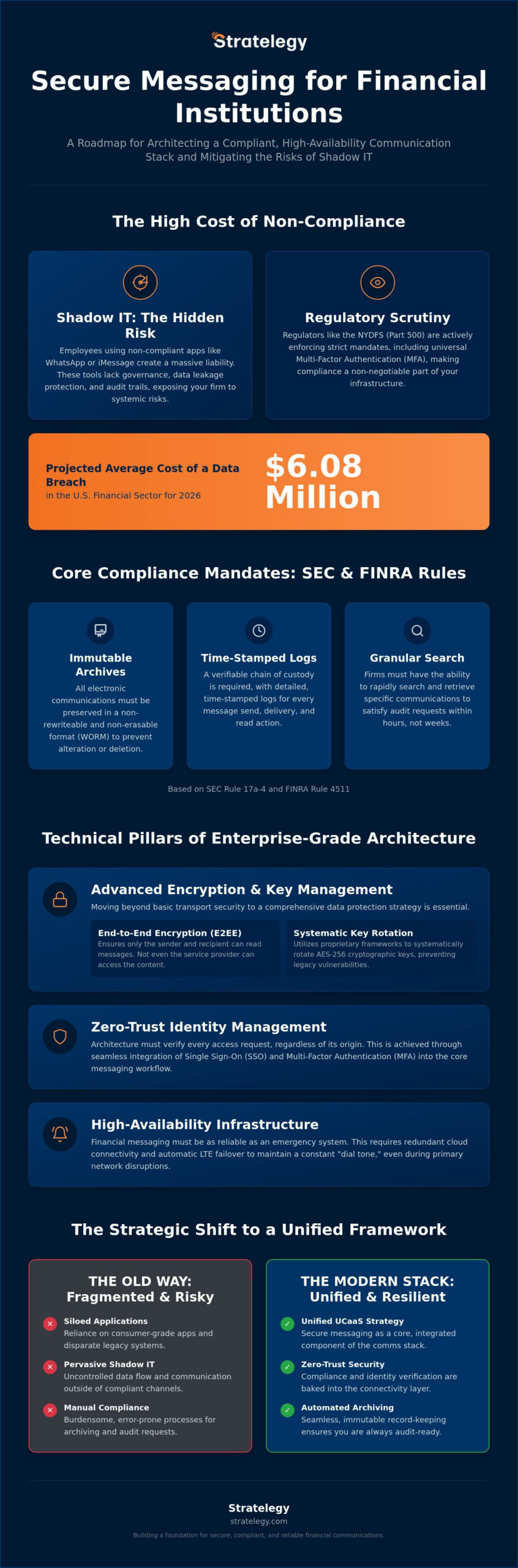
Consumer-grade apps like WhatsApp or iMessage create a dangerous liability known as Shadow IT. These tools lack the governance required to prevent data leakage or satisfy federal oversight bodies. Without a centralized framework, your firm faces systemic risks that simple encryption cannot solve. You need a unified solution that ensures every message is captured, archived, and accessible for audit, regardless of the device used by your team.
FINRA and SEC Compliance Standards
Compliance hinges on meticulous record-keeping. SEC Rule 17a-4 and FINRA Rule 4511 mandate that electronic communications must be preserved in a non-rewriteable and non-erasable format. Effective secure messaging for financial institutions must provide:
- Immutable archives that prevent any message alteration or unauthorized deletion.
- Time-stamped logs for every read, send, and delivery action to ensure transparency.
- Granular search capabilities that allow your team to satisfy rapid audit requests within hours, not weeks.
These requirements turn messaging from a simple software feature into a critical pillar of your institutional governance.
To effectively manage the vast amounts of data generated by these compliant systems, many institutions explore Legal Support and eDiscovery Services to streamline their response to regulatory audits and litigation.
The High Cost of Non-Compliance
The financial consequences of administrative oversight are staggering. In 2025, the U.S. financial sector experienced 739 data compromises, and the average cost of a data breach is expected to reach $6.08 million in 2026. Beyond external threats, regulators like the NYDFS are actively enforcing mandates like Part 500, which requires universal Multi-Factor Authentication (MFA) for all information system access. Foundational engineering eliminates these vulnerabilities by baking compliance into the connectivity layer. This proactive approach transforms your communication stack from a potential risk center into a reliable, high-availability asset.
Technical Pillars of Enterprise-Grade Messaging Architecture
Architecture dictates compliance. For a communication stack to be truly resilient, it must move beyond the superficial features of consumer apps. Modern secure messaging for financial institutions requires a shift from simple transport security to comprehensive zero-trust frameworks. While Transport Layer Security (TLS) protects data in transit, End-to-End Encryption (E2EE) ensures that not even the service provider can access sensitive financial records. This distinction is vital for meeting the FTC Safeguards Rule, which demands rigorous access controls and specific data protection standards for non-public personal information.
Encryption Protocols and Key Management
AES-256 encryption serves as the industry baseline for secure document exchange. However, encryption is only as strong as your key management strategy. We utilize proprietary maintenance frameworks to ensure that cryptographic keys are rotated systematically and stored in secure hardware modules. This disciplined approach prevents the “set it and forget it” mentality that often leads to legacy vulnerabilities. By prioritizing structural reliability over novelty, we ensure your data remains unreadable to unauthorized parties throughout its entire lifecycle.
High-Availability Infrastructure
Reliability is a structural requirement, not a luxury. Financial messaging must mirror the “always-on” nature of emergency systems. We apply the same logic found in our expertise with LTE POTS replacement to messaging uptime. By leveraging redundant cloud-based connectivity and LTE failover, institutions maintain a constant communication “dial tone” even during primary network disruptions. This level of predictability is essential for maintaining client trust and satisfying regulatory uptime expectations.
Zero-trust access starts with identity. Integrating messaging into your existing SSO and MFA workflows eliminates the credential sprawl that invites phishing attacks. These API-driven architectures also allow for automated compliance. Instead of manual exports, your messaging logs flow directly into immutable vaults. This automation reduces human error during high-stakes audits. If you’re looking to strengthen your perimeter, our team can help you audit your current IT network infrastructure to identify potential communication gaps.
Strategy: Integrating Messaging into the UCaaS Framework
Siloed applications are the primary enemies of governance. When secure messaging for financial institutions exists as a standalone tool, it creates friction that drives employees back to shadow IT. Integrating secure messaging for financial institutions into a unified communications as a service framework ensures that security is invisible but omnipresent. This approach provides a seamless transition between chat, voice, and video without leaving the encrypted perimeter.
Modernizing the front office requires more than just a phone line. By integrating secure chat with cloud contact center solutions, institutions can offer conversational banking that meets 2026 consumer expectations. This isn’t just about CX. It’s about ensuring that every client interaction is logged within your proprietary maintenance framework to satisfy ongoing oversight. It builds trust through predictability rather than just superficial features.
The Unified Communications Advantage
A unified stack eliminates the need for multiple logins and fragmented audit trails. By leveraging a robust voip infrastructure, firms can create integrated messaging hubs that synchronize across mobile and desktop environments. This ensures that a secure message sent from a trader’s tablet is captured with the same rigor as a recorded desk phone call. It’s a strategic shift from managing software to managing structural reliability.
Legacy Modernization Pathways
The transition from legacy copper-reliant systems to cloud-based messaging must be methodical. We prioritize structural reliability during this shift, ensuring that critical life-safety and security systems remain integrated. Our engineering-first approach focuses on maintaining connectivity uptime through redundant paths. This prevents the operational outages that often plague firms attempting to “bolt on” new software to crumbling infrastructure. We anticipate the problems you haven’t encountered yet to ensure a steady transition.
Ready to unify your communication stack and eliminate the risks of siloed data? Consult with our foundational engineers to build a modern, compliant communication roadmap.
Future-Proofing Financial Communications with Stratelegy
Engineering excellence is the only defense against technical obsolescence. We don’t just provide software; we act as foundational engineers who prioritize the long-term health of your communication stack. Secure messaging for financial institutions requires more than a simple installation. It demands a partnership rooted in security, governance, and predictable performance. We focus on specialized technical niches to ensure your communication “dial tone” remains unbroken by regulatory shifts or infrastructure failures.
Proactive Lifecycle Management
Reliability is built through discipline. Our proprietary maintenance frameworks ensure that your hardware and software are never a liability. In high-stakes finance, a “set it and forget it” approach leads to systemic failure. We implement systematic update policies that keep your infrastructure ahead of emerging threats. This oversight provides the peace of mind that your governance remains intact. When you partner with us, you gain access to technical experts who have already anticipated the problems you haven’t encountered yet.
Next Steps for Institutional Modernization
Modernizing your stack begins with a clear understanding of your current vulnerabilities. Many firms struggle with legacy bottlenecks that prevent the adoption of zero-trust messaging. A strategic pots line replacement is often the first step toward a cloud-first environment. This transition allows you to decommission aging copper lines while maintaining the high-availability required for life-safety systems. It’s a methodical move from software to structural reliability.
To begin your transition, we recommend focusing on these critical infrastructure pillars:
- Assess your current identity management for universal MFA and SSO integration.
- Evaluate the data sovereignty and encryption protocols of your existing messaging providers.
- Review the archiving capabilities of your current UCaaS and CCaaS stacks to ensure SEC/FINRA compliance.
Auditing your infrastructure shouldn’t be an afterthought. Our strategic specialists are ready to help you architect a framework that satisfies rigid requirements while maximizing operational efficiency. We guide your institution from legacy operational challenges to a comprehensive, managed solution. It’s time to move beyond superficial features and invest in excellence through engineering. Contact us today to schedule your comprehensive infrastructure audit.
Securing Your Institutional Perimeter Through Engineering Excellence
Reliability is a strategic choice. Modernizing your communication stack is an investment in institutional stability that transcends simple software updates. We’ve examined how transitioning from legacy bottlenecks to a unified, cloud-based framework eliminates the regulatory blind spots caused by shadow IT. By prioritizing zero-trust architecture and high-availability connectivity, your firm maintains a compliant “dial tone” that satisfies rigorous SEC and FINRA audits. Implementing secure messaging for financial institutions is about engineering a foundation that scales with your specific governance needs.
Our team provides the enterprise-grade UCaaS and CCaaS expertise required to navigate this complex transition. We specialize in critical infrastructure and POTS replacement, focusing on the structural reliability that consumer-grade vendors often overlook. Don’t wait for a regulatory audit to expose vulnerabilities in your current stack. Consult with a Stratelegy specialist to modernize your institutional communications. We’re ready to partner with you to build a resilient, future-proof communication roadmap that ensures peace of mind for years to come.
Frequently Asked Questions
What is the difference between secure messaging and standard SMS for banks?
Secure messaging for financial institutions provides a proprietary, encrypted environment that standard SMS cannot match. While standard SMS travels over open cellular networks in plain text, secure messaging utilizes enterprise-grade encryption to protect non-public personal information. This infrastructure allows for centralized administrative control, ensuring that all communications are logged and archived according to institutional governance policies. It transforms a simple text into a compliant, manageable data point within your IT network infrastructure.
How does secure messaging meet FINRA record-keeping requirements?
Compliance is achieved through automated, immutable archiving of every interaction. Systems designed for financial environments capture time-stamped logs and metadata that satisfy FINRA Rule 4511 and SEC Rule 17a-4. These platforms prevent the alteration or deletion of records, creating a verifiable audit trail that your team can access instantly during regulatory inquiries. This eliminates the manual burden of searching through fragmented communication silos and ensures long-term data integrity.
Can secure messaging platforms integrate with existing legacy phone systems?
Modern platforms integrate seamlessly with existing infrastructure through unified communications (UCaaS) frameworks. By utilizing API-driven architectures, institutions can bridge the gap between legacy hardware and cloud-based messaging. This transition often begins with LTE POTS replacement to ensure that even critical life-safety systems remain connected during the shift. This methodical approach allows for a steady modernization of your communications without disrupting daily operations or compromising reliability.
What are the risks of using consumer messaging apps in a financial environment?
Consumer apps create systemic vulnerabilities by bypassing institutional oversight and record-keeping mandates. These tools lack the necessary audit trails and administrative controls required to prevent data leakage or satisfy NYDFS Part 500 MFA requirements. Using non-compliant platforms exposes your firm to significant regulatory fines and increases the risk of a data breach. In 2025, data compromises in the financial sector reached 739 incidents, making shadow IT a liability you can’t afford.
Is end-to-end encryption mandatory for financial institutions in 2026?
While specific regulations may not use the exact phrase “mandatory,” end-to-end encryption is the de facto standard for satisfying the FTC Safeguards Rule and NYDFS mandates. In 2026, the expectation for safeguarding customer information requires robust access controls and encryption for all sensitive data in transit and at rest. Implementing E2EE ensures that your institution meets the highest standards of data integrity, effectively future-proofing your communications against evolving regulatory scrutiny and sophisticated cyber threats.