

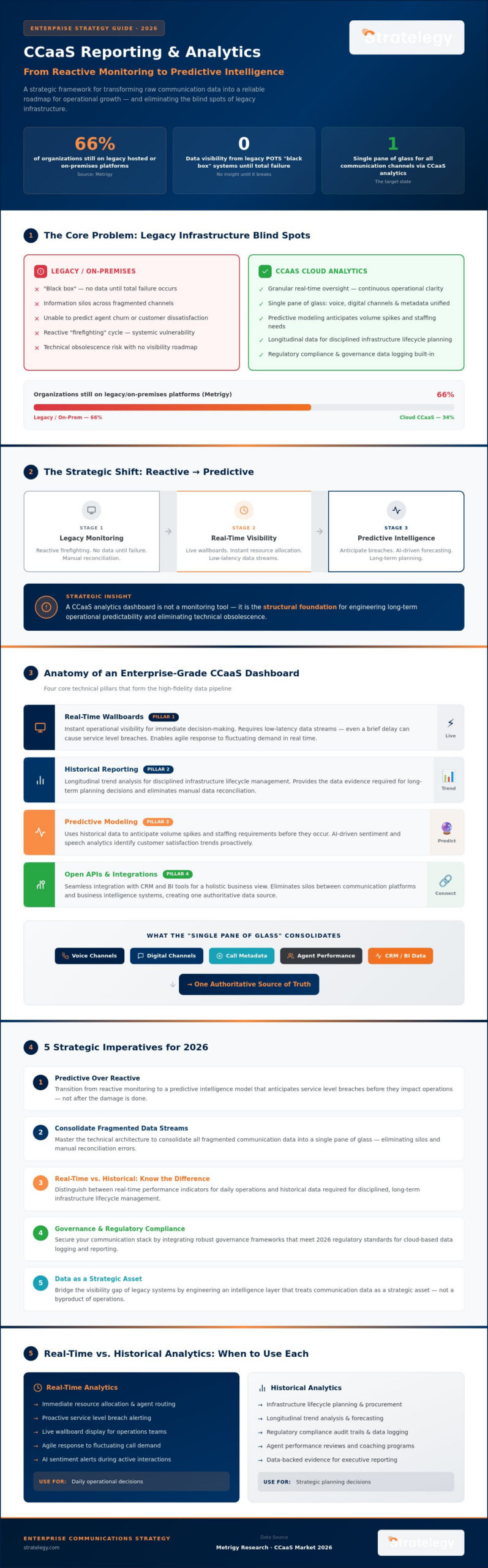
While 66% of organizations still cling to legacy hosted or on-premises platforms, the market leaders of 2026 have realized that a ccaas reporting and analytics dashboard is far more than a simple monitoring tool. It’s the structural foundation for engineering long-term operational predictability. You likely understand the friction caused by information silos between fragmented communication channels. It’s difficult to predict agent churn or customer dissatisfaction when your data remains siloed. Worse, the transition from legacy POTS to cloud infrastructure often carries a lingering fear of technical obsolescence.
This guide will help you master the technical architecture and strategic implementation of CCaaS analytics to transform raw data into a reliable roadmap for growth. We’ll show you how to move beyond superficial features to establish a single pane of glass for all communications. You’ll learn how to implement proactive alerting to prevent service level breaches and secure the data-backed evidence required for disciplined, long-term infrastructure planning. We’re moving past the novelty of cloud software and focusing on the structural reliability of your enterprise communications stack.
Key Takeaways
- Transition from reactive monitoring to a predictive intelligence model that anticipates service level breaches before they impact your operations.
- Master the technical architecture of a ccaas reporting and analytics dashboard to consolidate fragmented data streams into a single pane of glass.
- Distinguish between real-time performance indicators and the historical data required for disciplined, long-term infrastructure lifecycle management.
- Secure your communication stack by integrating robust governance frameworks that meet 2026 regulatory standards for cloud-based data logging.
- Bridge the visibility gap of legacy systems by engineering an intelligence layer that treats data as a strategic asset rather than a byproduct.
The Strategic Shift from Reactive Monitoring to Predictive CCaaS Analytics
Data is the structural foundation of modern customer engagement. A ccaas reporting and analytics dashboard functions as the centralized engine that powers this foundation, moving beyond simple call logging to provide deep operational insights. Legacy copper lines represent a significant visibility gap for business owners. These systems are essentially “black boxes” that offer no data until a total failure occurs. Transitioning to a cloud-based model replaces this uncertainty with granular, real-time oversight. This shift is a prerequisite for any successful pots line replacement strategy. You aren’t merely swapping out hardware; you’re installing an intelligence layer that eliminates the fear of technical obsolescence by ensuring your infrastructure remains measurable and maintainable.
The Cost of Information Silos in Legacy Infrastructure
Fragmented data creates systemic vulnerabilities. When communication channels are siloed within legacy hardware, operational friction becomes inevitable. Metrigy reports that 66% of companies still operate on hosted or on-premises platforms, leaving them trapped in a cycle of reactive “firefighting.” Adopting a unified communications as a service model breaks these silos. It allows for the aggregation of data across every touchpoint, ensuring that agent performance and customer dissatisfaction are no longer hidden behind technical barriers. By consolidating these streams, you transform a liability into a predictable asset.
Visibility as a Competitive Advantage in 2026
Data transparency is no longer optional. In 2026, it’s a core requirement for regulatory compliance and corporate governance. The strategic deployment of AI in the customer experience has accelerated the need for high-fidelity reporting. An enterprise-grade ccaas reporting and analytics dashboard allows you to engineer predictability through continuous oversight. This doesn’t just improve daily metrics; it provides the longitudinal data required for disciplined infrastructure planning. We view analytics as a tool for engineering excellence rather than just a software feature, providing the peace of mind that comes from total operational clarity.
Anatomy of an Enterprise-Grade CCaaS Reporting and Analytics Dashboard
An enterprise-grade ccaas reporting and analytics dashboard isn’t just a visual interface. It’s a high-fidelity data pipeline engineered to provide total transparency across your communication stack. For modern cloud contact center management, this dashboard acts as a single pane of glass. It consolidates voice, digital channels, and metadata into one authoritative source. This architectural approach eliminates the need for manual data reconciliation and reduces the risk of human error in reporting. Building a robust analytics environment requires several core technical pillars:
- Real-time wallboards: These provide instant operational visibility for immediate decision-making.
- Historical reporting: This allows for longitudinal trend analysis and disciplined infrastructure lifecycle management.
- Predictive modeling: These tools use historical data to anticipate volume spikes and staffing requirements.
- Open APIs: These facilitate seamless integration with CRM and BI tools for a holistic view of the business.
Real-Time Visualization and Wallboards
Real-time wallboards aren’t just for show. They require low-latency data streams to enable immediate resource allocation. In high-stakes environments, even a brief delay in data can lead to service level breaches. Engineering these systems requires a focus on data throughput and reliability. This ensures that what you see reflects the current state of your infrastructure, allowing for agile responses to fluctuating demand. Partnering with technical specialists ensures these advanced tools are integrated into a stable, secure network architecture.
AI-Driven Sentiment and Speech Analytics
Modern platforms leverage Natural Language Processing (NLP) for automated quality assurance. This moves beyond simple call recording. AI-driven sentiment analysis identifies emerging trends in customer dissatisfaction before they escalate into systemic issues. This represents a shift toward proactive governance. With Gartner forecasting that 20% of all customer interactions will be fully automated by the end of 2026, the ability to monitor these automated flows is critical. Instead of auditing a random sample of calls, you can now monitor 100% of interactions for compliance and quality. This level of oversight is essential for maintaining long-term operational excellence and protecting your brand’s reputation.
Actionable Insights: Utilizing Metrics for Long-Term Operational Excellence
A ccaas reporting and analytics dashboard should not be relegated to reactive troubleshooting. It serves as a strategic instrument for predictive governance. While real-time metrics allow for immediate firefighting, historical data provides the evidence required for long-term infrastructure health. To move from maintenance to optimization, you must prioritize three core metrics: Service Level Agreements (SLA), First Contact Resolution (FCR), and Average Handle Time (AHT). These aren’t just performance indicators. They are the pulse of your technical architecture.
Identifying Performance Pitfalls Before They Scale
Modern dashboards allow you to set conditional alerts that trigger before a service level breach occurs. This proactive approach relies on automated root cause analysis. By drilling down into specific data segments, you can identify whether a spike in AHT is due to a technical latency issue or a training gap. This level of granular oversight ensures that minor operational friction doesn’t scale into systemic failure. If your current systems lack this depth, it’s time to partner with specialized engineers to modernize your communication stack.
The Role of Historical Data in Workforce Optimization
Agent attrition remains a significant challenge in 2026, with industry turnover rates currently between 30% and 45% according to SQM Group. Strategic use of a ccaas reporting and analytics dashboard helps mitigate this by identifying burnout patterns early. Historical reporting allows you to forecast staffing needs with precision, reducing the strain on your human capital. Beyond staffing, this data justifies your hardware update policies. By connecting performance dips to aging infrastructure, you can present data-backed evidence for ongoing maintenance and systematic hardware replacement. This methodical approach ensures financial predictability and a measurable return on investment for your foundational communications infrastructure.
Integrating Analytics into Your Strategic Communications Infrastructure
Engineering a stable, data-driven communication stack requires more than just picking a software vendor. It demands a technical partner who understands the intersection of cloud agility and infrastructure stability. A ccaas reporting and analytics dashboard should be viewed as a primary pillar of your enterprise voip and UCaaS ecosystem. We don’t just provide tools. We architect solutions that ensure your reporting capabilities evolve alongside your business requirements, providing the peace of mind that comes from a future-proofed environment.
Security and Governance in Data Reporting
Partnering for Infrastructure Longevity
Transitioning legacy contact centers into a modernized CCaaS environment is a complex technical undertaking. It’s a process that requires a clear strategy for moving from siloed hardware to an integrated cloud model without disrupting critical operations. Our proprietary maintenance frameworks ensure your ccaas reporting and analytics dashboard stays current with the latest security patches and feature updates. We prioritize structural reliability over superficial novelty, treating your communications stack as a long-term business asset. If you are ready to eliminate the fear of obsolescence and build a predictable, data-driven future, consult with our foundational engineers today.
Engineering Long-Term Operational Predictability
The transition toward predictive analytics marks a definitive turning point for enterprise communication. You’ve seen how a ccaas reporting and analytics dashboard serves as the vital intelligence layer of a modernized stack, moving your operations from reactive firefighting to disciplined, data-backed oversight. By consolidating fragmented channels and prioritizing structural reliability, you eliminate the visibility gaps that once plagued legacy hardware. This approach ensures that every interaction becomes a strategic asset rather than a fleeting data point.
Stratelegy operates as foundational engineers and B2B infrastructure experts. Our national-scale experience as an LTE POTS replacement specialist ensures that your cloud transition is grounded in stability rather than superficial software features. We utilize proprietary maintenance frameworks to protect the long-term health of your communications ecosystem, ensuring your data remains secure and compliant with 2026 regulatory standards. It’s time to move beyond the fear of infrastructure obsolescence and embrace a system built for longevity.
Consult with our foundational engineers to modernize your CCaaS reporting infrastructure and secure a predictable roadmap for your business growth. We’re ready to help you build a more resilient future.
Frequently Asked Questions
What is a CCaaS reporting and analytics dashboard?
A ccaas reporting and analytics dashboard is a centralized engine for operational oversight that aggregates communication metrics across multiple channels into a single interface. It functions as the intelligence layer of your contact center, transforming raw interaction data into actionable insights. Beyond basic call logging, these tools provide the technical visibility needed to monitor agent performance, customer sentiment, and infrastructure health in real-time.
How does real-time analytics differ from historical reporting in a contact center?
Real-time analytics provide immediate visibility into active queue statuses and agent availability for tactical resource management. Historical reporting focuses on longitudinal data to identify long-term performance trends and infrastructure lifecycle needs. While real-time tools help prevent immediate service level breaches, historical data is essential for disciplined workforce optimization and justifying your long-term hardware update policies.
Can CCaaS dashboards integrate with existing CRM systems?
Yes, enterprise-grade dashboards utilize open APIs to facilitate seamless data exchange with CRM and Business Intelligence platforms. This integration creates a unified view of the customer journey by combining communication metadata with existing customer records. It eliminates information silos, allowing your team to correlate specific interaction metrics with long-term customer lifetime value and broader business outcomes; to learn more about applying similar intelligence to detect anomalies in financial data, click here.
How does AI improve the accuracy of CCaaS analytics in 2026?
AI enhances accuracy by automating the categorization of 100% of interactions through Natural Language Processing. Unlike manual sampling, which often misses systemic issues, AI-driven analytics provide a comprehensive view of sentiment and compliance across every channel. This automation reduces human bias in quality assurance and allows for the proactive identification of emerging friction points before they impact your service levels.
Is CCaaS reporting secure enough for highly regulated industries?
Modern CCaaS reporting is engineered with robust security frameworks that meet rigorous 2026 standards such as SOC2, HIPAA, and PCI-DSS. These systems prioritize data encryption and strict access controls to ensure compliance in sensitive sectors like healthcare and finance. By focusing on specialized technical niches and disciplined governance, we ensure your analytics environment remains a secure, stable component of your foundational communications infrastructure.