

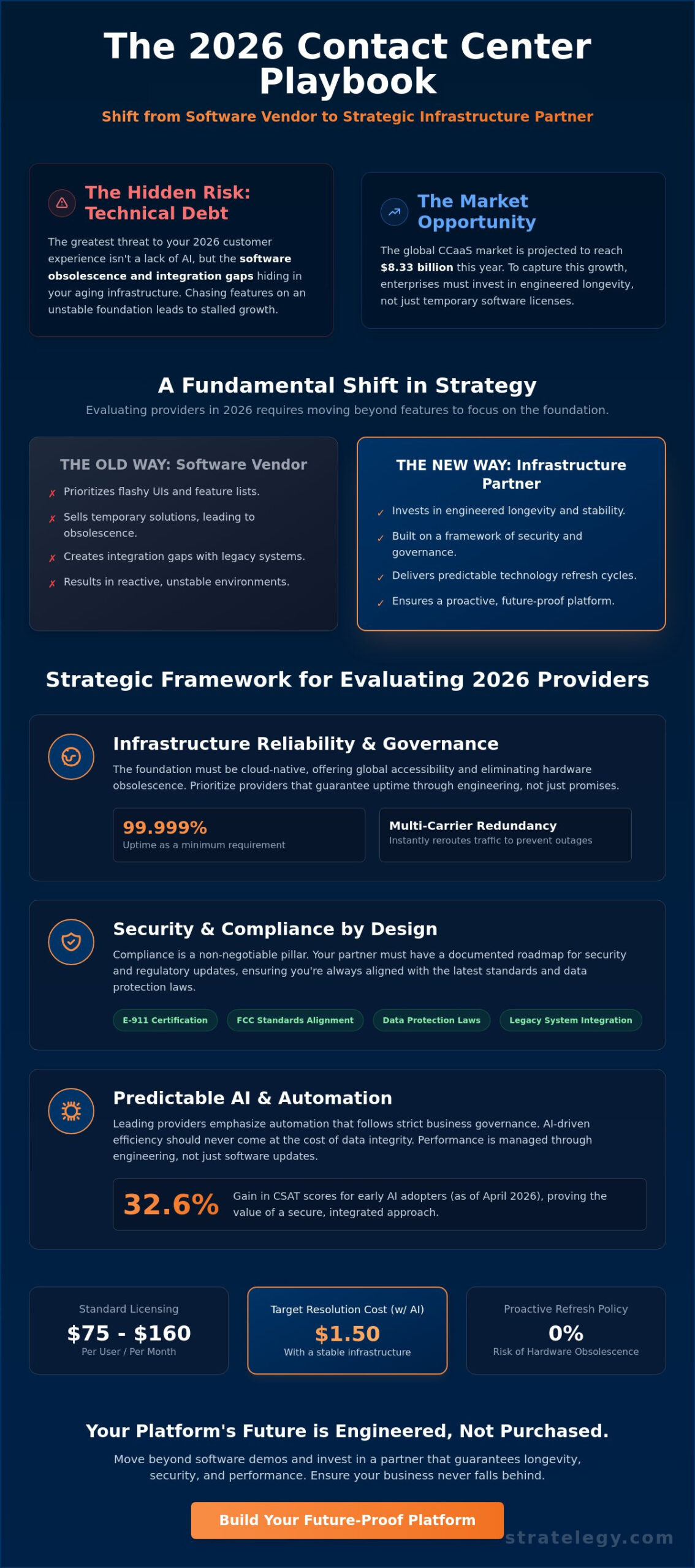
What if the greatest risk to your 2026 customer experience isn’t a lack of AI features, but the technical debt hiding in your infrastructure? While the global CCaaS market is projected to reach $8.33 billion this year, many enterprises remain trapped by software obsolescence and integration gaps that stall growth. You’ve likely realized that chasing the latest bot won’t fix a foundation that’s fundamentally unstable. Selecting the right contact center providers in 2026 requires a shift from buying software features to investing in engineered longevity.
We’ll help you evaluate the market with a strategic framework that prioritizes security, governance, and predictable technology refresh cycles. You’ll learn how to move beyond standard $75 to $160 per-user licensing rates to achieve a truly future-proof communication platform. This guide breaks down the 2026 market leaders, the impact of the March 2026 FCC offshore call center proposals, and how to leverage AI to hit the median $1.50 resolution cost without sacrificing infrastructure stability. Our goal is to provide the engineering clarity needed to ensure your business never falls behind.
Key Takeaways
- Shift your perspective from software vendors to infrastructure partners. You’ll learn why foundational stability is more critical than a list of temporary features.
- Evaluate contact center providers using a strategic framework built on security and governance. This approach helps you avoid the trap of prioritizing flashy interfaces over operational compliance.
- Address the critical infrastructure gap by identifying the risks of aging copper lines. We’ll show you how to transition to the cloud without compromising your legacy requirements.
- Leverage a proactive technology refresh policy to eliminate hardware obsolescence. This strategy ensures your communication platform stays current so your business never falls behind.
The 2026 Landscape of Contact Center Providers
The role of contact center providers has fundamentally changed. In 2026, a provider is no longer just a source for software licenses. They are strategic infrastructure partners responsible for the backbone of your customer experience. This shift represents a move toward “Communication Excellence,” where engineering stability takes precedence over temporary feature sets. Modern businesses now demand a transition from reactive, voice-only environments to proactive, AI-driven engagement hubs that prioritize security, governance, and predictable scaling. To understand how we reached this point, a foundational overview of contact centers reveals a long journey from simple phone banks to the complex, multichannel ecosystems we manage today.
From Legacy Call Centers to Cloud-Native CCaaS
Traditional on-premise hardware has become a liability for the modern enterprise. It’s expensive to maintain, difficult to scale, and prone to failure. Static systems cannot keep pace with 2026 consumer expectations. Cloud-native architecture is now the minimum requirement for ensuring 99.999% uptime and global accessibility. This resilient foundation allows organizations to move away from siloed communication channels. By integrating into a broader unified communications as a service framework, businesses ensure every customer touchpoint is supported by a managed infrastructure. This transition eliminates the risk of hardware obsolescence while providing the agility needed to deploy new services in days rather than months.
The Role of AI and Automation in 2026
Artificial intelligence is the dominant force in the current market. Features like sentiment analysis and real-time coaching have standardized agent performance across the industry. However, leading contact center providers now emphasize “Predictable AI.” This refers to automation that follows strict business governance and compliance protocols. While early adopters saw a 32.6% gain in CSAT scores as of April 2026, data security remains the primary barrier to enterprise-wide AI adoption. Strategic engineers solve this by building security directly into the communication layer. This proactive approach ensures that AI-driven efficiency never comes at the cost of data integrity or regulatory compliance. Performance is managed through engineering, not just software updates.
Strategic Criteria for Evaluating Contact Center Solutions
Most contact center providers sell you on the interface. They show you vibrant heat maps and sleek agent consoles during the demo. While usability matters, it shouldn’t be your primary decision metric. True communication excellence is built on governance and infrastructure longevity. You need a partner that engineers for the long term, ensuring your platform doesn’t become obsolete before your contract ends. A strategic framework prioritizes foundational stability over flashy UI features that may change with the next software patch.
Developing such a framework is a core part of digital strategy; you can discover Sterck to learn more about their approach to guiding organizations through technological transformation.
While Gartner’s definition of CCaaS emphasizes the shift to cloud-based delivery, the real value lies in how that cloud integrates with your existing stack. This includes legacy requirements like CRM synchronization and virtual faxing protocols that many modern vendors overlook. If your provider can’t bridge the gap between your cloud ambitions and your current operational realities, they aren’t an integration partner; they’re just another vendor.
Infrastructure Reliability and Governance
Enterprise scale requires more than just a reliable internet connection. It demands multi-carrier redundancy to prevent single points of failure. If one carrier experiences an outage, your traffic must reroute instantly without agent intervention. Compliance is another non-negotiable pillar. E-911 certification for life-safety systems is essential, especially if your contact center manages physical facilities or high-stakes customer interactions. Your provider should offer a clear, documented roadmap for security and regulatory updates. This ensures you’re always aligned with the latest FCC standards and data protection laws.
Device Lifecycle and Technology Refresh Policies
Avoid the maintenance trap. Many businesses buy hardware once and watch it degrade over five years, leading to unpredictable failure rates. A strategic “Refresh Policy” is the most critical factor in your long-term ROI. By choosing a “Zero CapEx” model, you eliminate the massive upfront costs of equipment. Instead, your infrastructure is managed and refreshed on a set schedule. This ensures your agents always use supported, next-generation technology without unexpected budget spikes. If you want to eliminate the fear of falling behind, you can consult with a strategic architect to evaluate your current infrastructure health.
Top Contact Center Providers: A Comparison of 2026 Leaders
The 2026 market for contact center providers is split between vendors selling software licenses and partners offering engineered solutions. Choosing the right one depends on your specific use case, whether you’re a global enterprise or a high-security organization. According to Gartner’s analysis of top CCaaS providers, the leaders in this space are now defined by their ability to unify AI capabilities with foundational infrastructure stability. Businesses must prioritize providers that offer a cohesive blend of cloud contact center features and UCaaS integration to avoid the friction of siloed communication tools.
- Global Enterprise: Leading enterprise-grade platforms remain primary choices for massive, multi-site deployments. As of January 2026, their pricing tiers often range from $75 to $155 per month, offering extensive digital and voice capabilities for complex environments.
- Strategic Infrastructure: Stratelegy distinguishes itself by acting as a strategic engineer rather than a simple software vendor. They focus on the long-term health of your infrastructure, providing specialized services like LTE POTS replacement and E-911 certification for critical life-safety systems.
- Agile Mid-Market: Many agile mid-market providers excel at rapid deployment and intuitive interfaces. They’re ideal for businesses that need to scale quickly without a massive internal engineering team.
The ‘Managed’ vs. ‘Self-Service’ Provider Divide
Self-service platforms often look attractive due to lower initial costs, but they frequently lead to higher internal IT burdens. For example, some platforms utilize usage-based pricing, including costs like $0.0350 per minute for transcription as of February 2026. While flexible, this model requires your team to manage every technical detail and cost fluctuation. A managed provider acts as an extension of your own engineering team. They handle the heavy lifting of migration and ongoing lifecycle management. This partnership ensures your technology stays current without taxing your internal resources. It’s the difference between buying a tool and investing in a result.
Omnichannel Capabilities and CRM Integration
Agents shouldn’t have to toggle between five different screens to help one customer. Seamless data flow is a non-negotiable requirement for modern contact center providers. You must evaluate deep-tier integrations with leading CRM platforms like Salesforce and HubSpot, among others. A single pane of glass for voice, chat, and social channels reduces agent friction and speeds up resolution times. When your communication platform and CRM share data in real-time, you achieve the 32.6% gain in CSAT scores that early AI adopters reported in April 2026. This integration creates a proactive engagement hub that anticipates customer needs before the first word is spoken.
Beyond the Software: The Critical Infrastructure Gap
Software doesn’t exist in a vacuum. A common objection among enterprise leaders is that they aren’t ready to move every single operational component to the cloud. You might have complex on-premise requirements or specialized hardware that doesn’t easily migrate to a browser-based interface. While many contact center providers ignore the physical layer of your business, a strategic partner understands that digital engagement is only as strong as your physical connectivity. For example, when managing mobile operations or logistics, you can explore Gps tracker solutions to bridge the gap between your cloud data and physical assets. If your facility’s core communication lines are unstable, your high-end CCaaS software becomes a stranded asset during a local outage.
This requirement for technical stability extends to all facets of corporate communication, including professional events; for example, Straight Street Event Services offers the technical solutions necessary for high-quality live and hybrid environments.
The Hidden Risk of Legacy Copper Lines
Keeping critical lines on aging copper infrastructure is a gamble you don’t need to take. Traditional POTS lines for fire panels and elevators are failing at an increasing rate because major carriers no longer prioritize the maintenance of these 20th-century networks. This creates a significant regulatory risk for life-safety systems. By implementing a proactive pots line replacement strategy, you ensure your contact center maintains continuity even when the local copper grid fails. Cellular-based LTE solutions provide the necessary safety net. These systems offer the reliability required for E-911 certification and fire panel compliance, serving as a stable bridge to your cloud-first future. They provide the foundational reliability that software alone cannot deliver.
Engineering for Predictability and Peace of Mind
The Strategic Engineer mindset is about solving problems before they occur. It shifts the focus from reactive repairs to proactive lifecycle management. Infrastructure stability is the ultimate foundation of customer trust. When your systems are engineered for predictability, you eliminate the frantic energy of unplanned downtime. This approach is built to stay current so your business never falls behind. It prioritizes the long-term health of your communication stack over the novelty of a new software feature. By anchoring your technology in a managed framework, you gain the confidence that your security, governance, and connectivity are always supported by experts who understand the nuances of enterprise engineering. You can modernize your infrastructure today to secure your operational future.
As of March 2026, the FCC’s proposed rules for offshore call centers have added a new layer of complexity to infrastructure planning. These proposals include requirements for transactions involving sensitive data to be handled only at domestic contact centers. This makes your physical infrastructure and data governance more critical than ever. Choosing between contact center providers now requires an audit of where your data lives and how your physical lines are secured against both technical failure and regulatory non-compliance.
Stratelegy: Your Strategic Partner for Contact Center Excellence
Stratelegy is not just another vendor in a crowded market. We are infrastructure engineers who serve as your Strategic Architect. While other contact center providers might prioritize software features, we prioritize the long-term health of your entire communication stack. This approach ensures that your security, governance, and connectivity remain stable as your business grows. We build for predictability. Our goal is to provide peace of mind by eliminating the technical debt that often follows rapid cloud adoption.
The Stratelegy Technology Refresh Policy
Hardware obsolescence is a silent killer of operational efficiency. Our industry-first Device Lifecycle and Technology Refresh Policy ensures your business never runs on outdated equipment. We’ve engineered a model that manages the entire lifecycle of your devices, from initial deployment to regular upgrades. This proactive maintenance removes the burden from your internal IT department. They no longer need to scramble when a handset fails or a gateway becomes unsupported. Our engineering philosophy is simple: built to stay current so your business never falls behind.
Our Zero CapEx model transforms how you budget for communications. Instead of massive upfront investments, you gain a predictable monthly expense that includes ongoing hardware refreshes. This structure connects technical reliability directly to your financial performance. You get the latest next-generation unified communications technology without the risk of owning depreciating assets. This managed approach ensures that your technology refresh cycles are as predictable as your growth.
Ready for the Future of Communications?
The path from fragmented legacy systems to unified excellence requires more than just a software download. It requires a partner who understands the nuances of LTE POTS replacement and E-911 certification for life-safety systems. We bridge the gap between your existing infrastructure and the future of CCaaS. By choosing a partnership over a simple vendor relationship, you gain an extension of your own engineering team. We’ve already thought of the problems you haven’t encountered yet.
Communications excellence is achieved through disciplined engineering and long-term support. Don’t let your business be held back by integration gaps or unpredictable scaling costs. We invite you to secure your infrastructure today. Contact our team for a comprehensive consultation to audit your current infrastructure health. We’ll help you evaluate the landscape of contact center providers with a strategy that prioritizes stability and longevity. Let’s build a foundation that supports your growth for years to come.
Engineering Your Communication Infrastructure for 2026 and Beyond
The shift toward AI-driven engagement requires more than a simple software subscription. It demands a stable foundation that can support the 20% automation rate Gartner predicts for the end of 2026. Successful enterprises are moving away from reactive maintenance and toward a managed lifecycle. This involves replacing unreliable copper lines with LTE solutions and ensuring that every handset and gateway remains current. When you compare contact center providers, look for a partner who prioritizes your long-term operational health over a simple license sale. You need an architect who has already solved the infrastructure problems you haven’t encountered yet.
Stratelegy provides the technical authority you need to navigate these complexities. Our expert infrastructure engineers utilize zero CapEx deployment models to eliminate large upfront costs. We anchor every partnership in our industry-first Device Lifecycle and Technology Refresh Policy. This ensures your systems are built to stay current so your business never falls behind. It’s time to move beyond the software and invest in foundational reliability. Partner with Stratelegy for a future-proof contact center solution today. We’re ready to help you achieve communication excellence through disciplined engineering.
Frequently Asked Questions
What are the key differences between CCaaS and traditional call center providers?
CCaaS is cloud-native and consumption-based, while traditional providers rely on on-premise hardware and capital expenditure. In 2026, CCaaS offers instant scalability and native AI integration that legacy systems can’t match. This shift allows for 99.999% uptime and global accessibility without the burden of maintaining physical servers or paying for legacy copper line repair.
How do I evaluate the ROI of switching contact center providers in 2026?
Evaluate ROI by comparing the $13.50 median cost of human-assisted contact against the $1.50 fully loaded cost of AI-self-service resolutions. You should also factor in the elimination of maintenance fees and the 32.6% gain in CSAT scores reported by Metrigy in April 2026. A zero CapEx model further improves ROI by shifting costs from capital investment to predictable operational spending.
Why is a technology refresh policy important for my contact center?
A technology refresh policy prevents the hidden costs of hardware obsolescence and system failure. By scheduling regular updates, you ensure your agents always work with supported, next-generation tools. This managed approach eliminates the maintenance trap where businesses spend more on repairing aging devices than they would on a proactive, engineered replacement strategy.
Can a modern contact center provider help with my legacy POTS line replacement?
Yes, strategic contact center providers integrate LTE-based POTS replacement to secure your facility’s critical infrastructure. This is essential for fire panels and elevators that still rely on 20th-century copper grids. Modern solutions provide a cellular safety net that maintains compliance and life-safety connectivity while your main communications move to the cloud.
What security certifications should I look for in an enterprise contact center solution?
Look for SOC 2 Type II, HIPAA, PCI DSS, and E-911 certification for life-safety systems. In 2026, compliance with the FTC Safeguards Rule is also mandatory for financial institutions to protect customer information. These certifications ensure that sensitive data is protected through rigorous governance and that your emergency lines remain operational during local outages.
How does AI impact the cost of contact center software in 2026?
AI adds a functional layer to standard $75 to $160 per-user licensing rates. For example, Genesys Cloud CX AI experiences started at $40 per month in early 2026. While the software cost is higher, Gartner forecasts that conversational AI will reduce global labor costs by $80 billion this year, providing a significant net saving for the enterprise.
Is it possible to integrate my existing CRM with a new contact center provider?
Most leading contact center providers offer native, deep-tier integrations with Salesforce, Microsoft Dynamics 365, and HubSpot. This creates a single pane of glass where customer data flows in real-time. Effective integration reduces agent friction and allows for sentiment analysis and real-time coaching directly within the CRM interface your team already uses every day.
What happens to my emergency lines when I transition to a cloud-based provider?
Emergency lines are secured through specialized LTE gateways that provide E-911 certification for elevators and fire panels. These systems operate independently of your primary internet connection to ensure 100% reliability. This prevents the life-safety risks associated with migrating critical hardware to a standard VoIP line that lacks the necessary power redundancy and certification.